
Scaling to $50M+: The M4 Framework for Transforming eCommerce Profitability Through Facebook Ads

Executive Overview
For modern eCommerce brands, scaling an ad budget on Meta platforms often feels like an unpredictable gamble. Advertisers frequently find themselves trapped in a frustrating cycle: high click-through rates that fail to convert into paying customers, erratic return on ad spend (ROAS), and rising acquisition costs that eat away at operational margins. Many entrepreneurs abandon their campaigns out of frustration, or conversely, hand total control over to automated algorithms while blindly hoping for profitability.
According to growth strategist Sam Piliero, co-creator of the M4 Method, this operational friction stems from fundamental miscalculations regarding account architecture, creative execution, data analysis, and scaling mechanics. In a comprehensive breakdown co-produced with Michael Stelzner, Piliero outlines a disciplined, four-stage framework designed to transition eCommerce ad accounts from chaotic, money-draining funnels into predictable, highly profitable compounding engines.
Rather than chasing vanity metrics like a superficial 10x ROAS—which often suffocates customer acquisition volume—the M4 Method anchors its philosophy on a singular North Star: contribution margin and customer lifetime value (LTV). By utilizing structured campaign hierarchies, problem-solution creative iterations, granular behavioral data mining, and a dual-engine scaling loop, select brands utilizing this system have scaled from modest under-$30,000 monthly ad spends to surpassing $50 million in annual revenue.
This report provides an exhaustive, authoritative examination of the M4 Method, detailing how modern brands can reconstruct their Facebook ad ecosystems for sustainable, long-term growth.
Detailed Chronology: Deconstructing the Pitfalls and the M4 Breakthrough
The Two Core Impediments to Modern Ad Scaling
Before building a functional scaling framework, advertisers must diagnose the root causes of campaign stagnation. Piliero points to two primary errors that derail otherwise promising eCommerce operations:
- Obsession with Efficiency Metrics Over Contribution Margin: Many brands optimize strictly for high ROAS or low Cost Per Acquisition (CPA), starving their accounts of the broad spending power required to capture market share. While a 10x ROAS sounds impressive on paper, it frequently limits a business to a microscopic customer base. Conversely, a stable 2.2 ROAS allows a brand to spend aggressively, acquire massive pools of new buyers, and capitalize on long-term compound growth through LTV and word-of-mouth referrals. The ultimate target for a healthy eCommerce brand sits at a 10% to 20% net profit margin on revenue.
- The Illusion of Control: Advertisers typically fall into one of two damaging extremes: they either over-engineer their accounts with dozens of fragmented, competing campaigns, or they completely abdicate strategy to Meta’s algorithm with zero guardrails. Achieving predictable scale requires finding the precise operational sweet spot between manual micromanagement and algorithmic autonomy.
The Evolution of the M4 Framework
Developed through years of high-stakes media buying experience—including foundational lessons learned at brands like BarkBox—the M4 Method was engineered to eliminate guesswork. It is built upon four sequential, interdependent stages:
- Market/Account Structure
- Message/Creative
- Metrics/Deep Dives
- Magnification/Scale
While some operational phases overlap, bypassing or rearranging the sequence invariably degrades performance. The following sections explore each tier of the framework in meticulous detail.
Stage 1: Account Structure as the Architectural Foundation
Piliero compares an ad account to a physical house: even world-class creative and high-converting products will underperform if dumped into a poorly organized structure. Account architecture dictates how the algorithm processes inputs, allocates capital, and responds to ad fatigue.

The Simplified, Segmented Architecture
Unlike cluttered accounts where dozens of ad sets fight for dominance, the M4 Method relies on a clean, intentional division of campaigns:
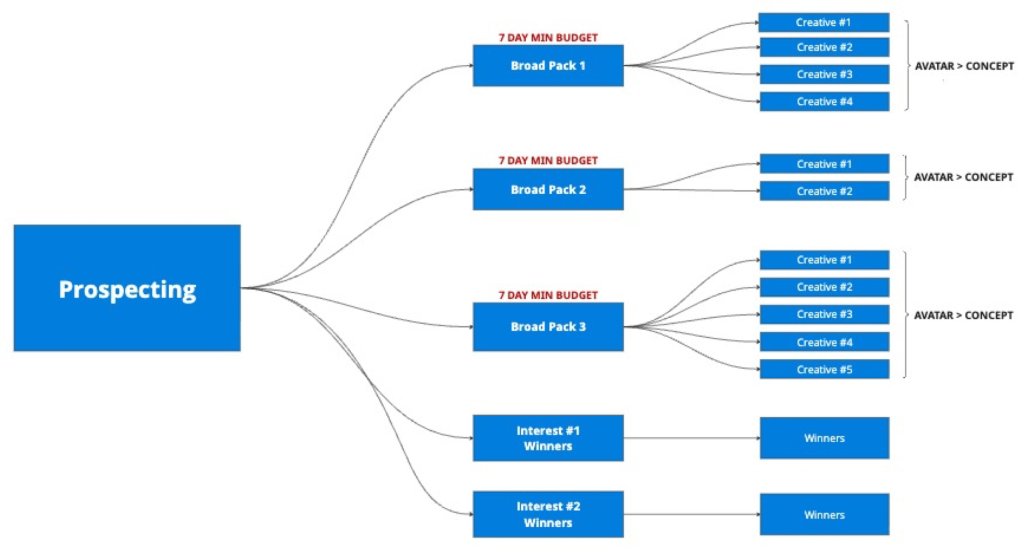
- The Prospecting Campaign (CBO): Operating on Campaign Budget Optimization (CBO), this single campaign houses multiple ad sets referred to as "packs." Each fresh round of creatives receives its own pack. The CBO framework empowers Meta’s algorithm to distribute budget dynamically across packs, automatically channeling funds toward whichever ads show immediate conversion potential.
- The Retention Campaign: Running concurrently alongside prospecting, this dedicated campaign targets existing customers. Separating retention spend from acquisition spend ensures complete financial clarity as budgets scale, giving executives precise visibility into acquisition versus retention costs.
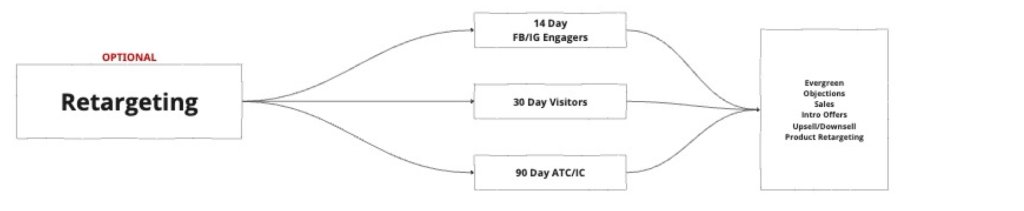
- Optional Retargeting and Scaling Campaigns: Brands can optionally deploy a retargeting campaign for high-intent window shoppers who haven’t converted, alongside a dedicated scaling campaign that forces spend exclusively against the account’s top three to five proven "hit" ads.
Advanced Control Mechanisms
By moving away from all-in-one setups—where the "pause button" is the only available lever—structured ad sets unlock powerful algorithmic parameters:
- Value Rules: Adjust how the algorithm values specific user segments based on real-time performance indicators.
- Ad Set Budget Minimums and Maximums: Impose spending caps on declining ads while enforcing minimum expenditure floors to guarantee that untested creative packs receive the impressions needed to prove their viability.
Stage 2: Creative Execution and Problem-Solution Alignment
Following Meta’s algorithmic shifts (such as the Andromeda update), micro-targeting parameters have largely taken a backseat to creative content. Today, the creative itself serves as the targeting mechanism. Generic, broad ad copy fails because it attempts to appeal to everyone; high-converting ads speak directly to a specific audience avatar’s unique pain point.
Designing Problem-Solution Ads
A winning creative identifies a precise customer problem, addresses it without ambiguity, and positions the brand’s product as the definitive solution.
- Example: A generic ad reading "High-quality back brace for back pain" forces a brand to compete in a saturated ocean of generic competitors. Conversely, an ad tailored specifically for construction workers suffering from chronic lumbar strain caused by lifting and bending—featuring talent that mirrors that demographic—captures a highly qualified, intent-driven audience.
Manufacturing "Hits" and Iterative Variation
Piliero defines a "hit" as any creative that surpasses target ROAS thresholds while capturing 10% or more of total account spend. Because natural hit rates vary, creative volume is essential.
- Competitive Intelligence: Leverage tools like the Facebook Ads Library and MagicBrief to audit competitor assets. Prioritize ads running for extended durations with high impression counts; longevity is a reliable indicator of sustained profitability.
- Semi-Professional UGC (User-Generated Content): Top-of-funnel prospecting performs best with video assets, specifically authentic UGC produced by micro-influencers (1,000 to 2,000 followers). By providing creators with key talking points while letting them deliver the script naturally in native reel formats, brands secure high-performing content for a fraction of traditional agency costs.
- Iterative Scaling: Never start completely from scratch when looking for new variations. If a simple static image with a headline wins, build minor iterations: alter the background, swap the talent’s outfit, adjust the headline, or introduce a different product variant. For video, swap the hook while preserving the body, or keep the hook and test multiple body angles.
Stage 3: Deep Dive Analysis and Behavioral Data Mining
Many media buyers maintain flat, identical daily budgets across every day of the week, inadvertently leaving substantial revenue on the table. Consumer behavior fluctuates based on temporal and demographic patterns.
Uncovering Temporal and Placement Patterns
Drawing from his tenure at BarkBox—where ad performance reliably spiked every Saturday and Sunday because consumers were home with their pets—Piliero emphasizes that every business possesses hidden conversion rhythms:
- Pet Brands: Typically surge on weekends.
- Gift-Oriented Products: Frequently peak on Mondays and Tuesdays as shoppers plan ahead.
To uncover these patterns, brands must pull 90 to 180 days of historical data, filtering out seasonal aberrations like Black Friday, Cyber Monday, or major promotional events to establish a true evergreen baseline.

Executing the Data Audit
Break baseline data down across multiple vectors:
- Day of the week
- Placement (Feed vs. Reels vs. Stories)
- Age and gender demographics
- Geographic regions
Establish a 20% to 30% performance variance threshold to separate meaningful statistical signals from random noise. Rather than eliminating low-performing days entirely—which can disrupt top-of-funnel impression momentum required for end-of-week conversions—advertisers should dynamically lower budgets on slower days and aggressively scale them up on peak days.
Stage 4: Scaling Mechanics and Strategic Execution
Scaling should only be pursued when foundational unit economics are secure. Attempting to scale an inherently broken funnel or a low-ROAS account only accelerates financial loss. Piliero outlines three distinct modalities of scaling:
1. Vertical Scaling
Increasing the budget on an existing, profitable campaign.
- Execution: Incrementally raise budgets by 10% to 30% every two to three days, allowing the algorithm to recalibrate without forcing the account back into a volatile learning phase. For low-ticket impulse buys (e.g., a $25 phone case), feedback loops occur rapidly, allowing for tighter adjustment windows.
2. Horizontal Scaling
Deploying entirely new, standalone campaigns alongside primary evergreen structures.
- Execution: Reserved almost exclusively for limited-time promotional events, product launches, or flash sales. These auxiliary campaigns run with isolated budgets for short windows (3 to 10 days) to prevent disruption to core prospecting assets.
3. The "Twin Engine" Loop
The most powerful growth mechanism, combining vertical and horizontal scaling simultaneously.
- The Loop Process: Identify a prospecting CBO ad that qualifies as a "hit" (exceeds ROAS targets and captures 10%+ spend), generate immediate creative iterations of that winning asset, and inject those variations directly back into the primary prospecting CBO. Simultaneously, scale the campaign budget vertically. Keeping iterations inside the primary campaign preserves algorithmic learning and prevents budget fragmentation.
The Supply-Constraint Exception
Not all businesses are built for aggressive customer acquisition. For supply-constrained brands—such as a specialty merchant unable to manufacture inventory fast enough to meet surging demand—the primary objective must invert entirely. For these operations, chasing raw customer volume creates catastrophic fulfillment bottlenecks. Instead, the strategic goal shifts from maximizing scale to maximizing ROAS on a tightly controlled volume of orders, utilizing deep-dive optimizations to protect margin without driving hyper-growth.
Supporting Context & Metrics
To contextualize the impact of the M4 framework, industry benchmarks and client outcomes illustrate its efficacy:

- Revenue Acceleration: Five distinct client accounts managed by Piliero’s firm arrived spending under $30,000 monthly with sub-$100,000 monthly revenues; following systematic implementation of the M4 Method, all five scaled into the $50 million-plus annual revenue bracket.
- Efficiency Lifts: Granular deep-dive analysis and day-parting adjustments regularly yield an approximate 20% improvement in ROAS or equivalent reductions in customer acquisition costs.
- The "King Goal" Philosophy: Borrowing from foundational eCommerce axioms, teams must establish a singular North Star metric (e.g., CAC or baseline ROAS). While secondary metrics (CPM, CTR, CPC) offer valuable diagnostic insights, operational decisions must never be compromised by chasing proxy metrics at the expense of the core financial king goal.
Official Statements & Expert Perspectives
"Obsessing over efficiency metrics like return on ad spend might feel impressive, but it doesn’t tell you what’s actually going into your pocket. The real goal is profit—more specifically, contribution margin."
— Sam Piliero, Growth Strategist & Co-Creator of the M4 Method"Many advertisers either over-engineer their accounts with dozens of campaigns pulling in different directions, or they hand everything to the algorithm and hope for the best. There is a deliberate sweet spot between those two extremes, and getting it right is what makes predictable scaling possible."
— Michael Stelzner, Founder of Social Media Examiner
Future Outlook & Strategic Recommendations
As advertising algorithms on Meta and competing platforms continue to evolve toward total automation, the role of the media buyer is shifting from tactical configuration to strategic oversight. Future success in eCommerce advertising will not belong to those who manipulate manual targeting levers, but to brands that master creative velocity, data-driven resource allocation, and structural discipline.
Key Actionable Takeaways for Marketers:
- Audit Your Profitability Drivers: Shift focus away from vanity ROAS targets and calculate true contribution margins (targeting a healthy 10% to 20% net profit on revenue).
- Consolidate and Structure: Implement a clean account architecture separating prospecting, retention, and scaling campaigns to maintain granular visibility over capital allocation.
- Scale Creative Production: Treat creative as your primary targeting tool. Invest heavily in problem-solution UGC and rapidly iterate upon proven winning formats.
- Leverage Temporal Insights: Analyze 90 to 180 days of non-holiday baseline data to uncover day-of-week and placement performance patterns, adjusting daily budgets dynamically rather than maintaining flat spend.
- Protect Unit Economics: Never force scale into a broken funnel or a supply-constrained operation; align your scaling strategy directly with your operational capacity.