
The Rise of Answer Engine Optimization: How E-Commerce Merchants Are Rewriting the Rules for AI Shopping Agents

Executive Overview
The landscape of digital commerce is undergoing a profound paradigm shift. For decades, online retail success was defined by traditional Search Engine Optimization (SEO)—a relentless pursuit of keyword rankings, backlink profiles, and visual page appeal designed to capture human eyeballs through Google, Bing, and social channels. Today, however, a new gatekeeper has arrived: the generative artificial intelligence shopping assistant.
As millions of consumers increasingly bypass traditional search engines to ask tools like ChatGPT, Perplexity, and Google Gemini complex, conversational shopping queries—such as "Find me a pre-seasoned 12-inch cast-iron skillet compatible with induction cooktops"—the mechanics of discovery are changing. AI agents do not appreciate poetic marketing prose, emotional brand storytelling, or aesthetic page designs. They crave structured data, quantifiable attributes, and unambiguous facts.
This shift has given rise to Answer Engine Optimization (AEO). Unlike legacy SEO, which prioritizes driving traffic via human search behaviors, AEO focuses on making product data instantly digestible, verifiable, and machine-readable. Brands that fail to adapt their digital storefronts to this new "confidence hierarchy" risk becoming invisible to conversational commerce tools, effectively locking them out of a rapidly growing segment of high-intent buyers.
This report investigates the core mechanics of AEO, examines the technical strategies store owners must implement—from category page optimization to the emerging use of llms.txt files—and outlines how merchants can measure their success in an era where AI dictates the digital shelf.
Detailed Chronology of the Shift to Agentic Commerce
To understand why AEO has become a critical focal point for e-commerce platforms like WooCommerce, one must trace the rapid evolution of conversational AI over the past few several years.
Phase 1: The Keyword Era and Early E-Commerce (2000s–2010s)
For years, online retail relied on keyword matching. Merchants stuffed product titles and descriptions with variations of search terms to satisfy primitive algorithms. While Google’s algorithms grew exponentially smarter at understanding context, the interface remained the same: a search query returned a page of blue links, leaving the consumer to click, browse, compare, and synthesize information independently.
Phase 2: The Conversational Leap (2022–2024)
The public debut of generative large language models (LLMs) fundamentally altered consumer expectations. Shoppers quickly realized they no longer needed to sift through dozens of tabs to find the right product. Instead, they could delegate the research phase entirely to an AI assistant. Consumers began asking hyper-specific, multi-layered questions.

However, early LLM shopping recommendations were frequently plagued by hallucinations, outdated pricing, or arbitrary selections because most e-commerce sites were not built to feed structured specifications to algorithms.
Phase 3: The Standardization of Agentic Commerce (2025–Present)
By 2025 and 2026, major e-commerce platforms and content management systems began moving aggressively to support "agentic commerce." Ecosystems such as WooCommerce introduced native integrations for structured data, rich snippets, and machine-readable directory structures. Major SEO plugins, including Yoast and Rank Math, rolled out automated generation for specialized files like llms.txt, bridging the gap between human-facing web design and machine-readable data architecture. Today, optimizing for AI is no longer an experimental fringe tactic; it is a fundamental operational requirement for competitive digital retailers.
Supporting Context & Metrics: The Anatomy of a Machine-Readable Product Description
The core challenge of AEO lies in how LLMs process information. When an AI model evaluates a web page, it evaluates text through a lens of verifiable data points rather than persuasive narrative.
The "Confidence Hierarchy" of Product Data
AI agents evaluate content based on clarity, structure, and verifiability. A product page with a rich emotional narrative but zero explicit specifications forces the AI to "guess" or pass over the product entirely in favor of a competitor whose page explicitly lists weight, dimensions, and material compatibility.
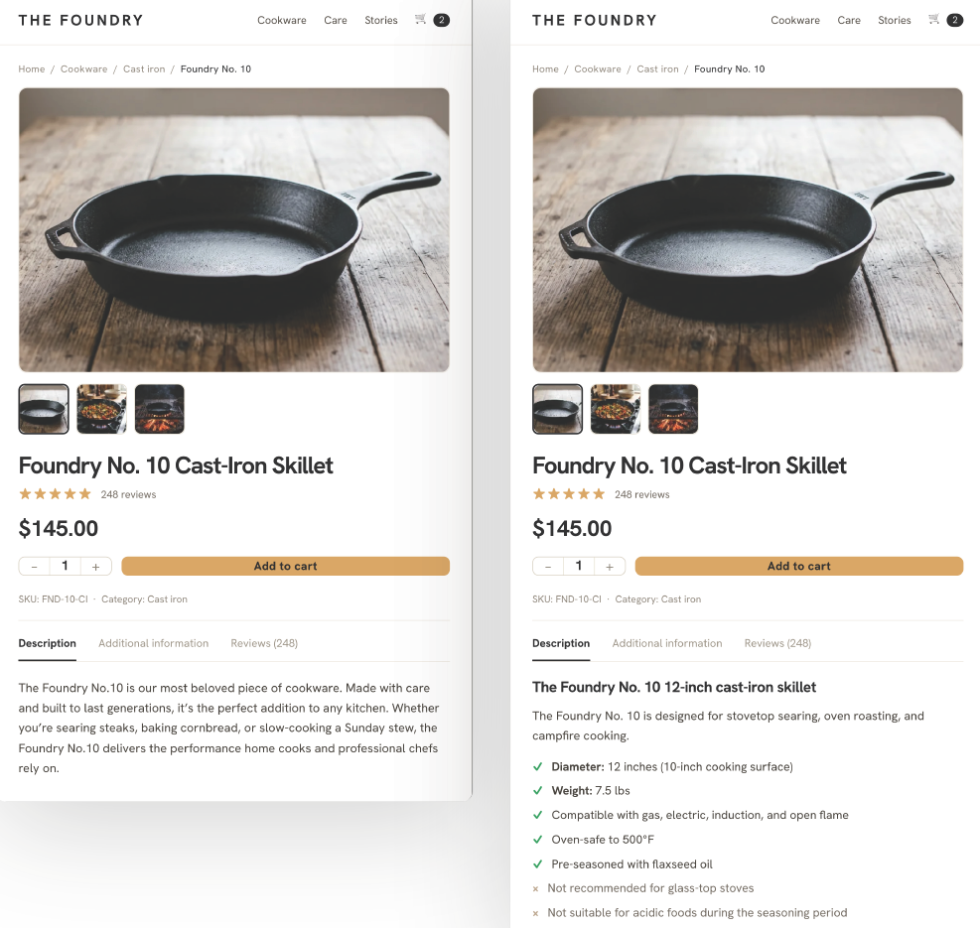
Consider the classic contrast between traditional copywriting and AEO-optimized copy using a popular kitchenware item, the cast-iron skillet:
- Traditional Marketing Description: "The Foundry No.10 is our most beloved piece of cookware. Made with care and built to last generations, it’s the perfect addition to any kitchen. Whether you’re searing steaks, baking cornbread, or slow-cooking a Sunday stew, the Foundry No.10 delivers the performance home cooks and professional chefs rely on."
- Matchable Attributes: 0. An AI looking for specific dimensions, material weights, or cooktop compatibilities finds no usable data points here.
- AEO-Optimized Description:
- Heading: The Foundry No. 10 12-inch cast-iron skillet
- Core Use: Designed for stovetop searing, oven roasting, and campfire cooking.
- Diameter: 12 inches (10-inch cooking surface)
- Weight: 7.5 lbs
- Compatibility: Gas, electric, induction, and open flame
- Thermal Limits: Oven-safe to 500°F
- Treatment: Pre-seasoned with flaxseed oil
- Limitations: Not recommended for glass-top stoves; not suitable for acidic foods during the seasoning period.
- Matchable Attributes: 8 distinct, verifiable data points.
If a consumer asks an AI assistant for a "pre-seasoned 12-inch cast-iron skillet compatible with induction," the second version instantly registers three precise matches. The first version fails entirely.
Optimizing Beyond the Product Page
AI agents do not look at single pages in isolation; they evaluate the architecture of an entire online store. Merchants must optimize several key digital touchpoints:
- Category Pages: Traditionally designed as simple grids of product thumbnails with minimal text, category pages must now include contextual summaries. Adding a concise introductory paragraph answering fundamental buyer questions—such as "What to look for in a cast-iron skillet"—gives AI models a high-level overview of the store’s inventory focus.
- Frequently Asked Questions (FAQ) Blocks: Complex compatibility or maintenance details that do not fit neatly into core specifications can be captured using structured FAQ blocks at the bottom of product pages.
- Policy Pages: Trust signals such as return policies, warranty details, and shipping timelines must be explicitly quantified. AI tools favor concrete numbers (e.g., "30-day return policy," "ships within 2 business days") over vague corporate promises.
- The
llms.txtFile: Emerging as a standard for machine-readable site navigation, anllms.txtfile placed in a website’s root directory provides a clean, Markdown-formatted summary of a store’s key categories, top products, and vital policy pages. While platforms like Anthropic and Perplexity actively parse these files, major plugins in the WordPress ecosystem now automate their generation.
Official Insights & Platform Perspectives
Industry leaders emphasize that optimizing for AI does not mean abandoning human customers; rather, it means creating a more transparent, frictionless digital experience for everyone.
"Your online store should make it simple for customers to find and buy the products they want," notes industry guidance from modern e-commerce platform architects. "As more people use AI to help them shop, it’s important to give AI shopping agents enough clear information so they can show your products to potential buyers. Getting your products recommended by AI isn’t about having a big brand or spending a lot on ads. AI assistants prefer stores that make things easy for them."
Product marketing experts echo this sentiment, pointing out that bridging the gap between raw data structures and human-centric design is the defining challenge for merchants in the current digital economy. By translating verbose marketing copy into structured, verifiable attributes, merchants empower autonomous agents to act as tireless, highly accurate sales representatives.
Future Outlook: Measuring Success in the Era of Agentic Commerce
As agentic commerce matures, tracking return on investment (ROI) requires moving beyond standard metrics. Because AI shopping assistants often operate via API calls or direct conversational interfaces without passing traditional tracking cookies, referral visibility can be nuanced.
Merchants must adopt a multi-pronged approach to evaluate their AEO performance:
- Monitoring AI Referral Traffic: E-commerce operators should regularly audit their web analytics platforms (such as Google Analytics 4) by filtering traffic sources for specific domains associated with conversational AI agents, including
chat.openai.com,perplexity.ai, andgemini.google.com. While initial visit volumes may start small, upward trends indicate growing AI brand trust. - Executing Manual Prompt Audits: Store owners must routinely test conversational platforms themselves. By entering target consumer queries into tools like ChatGPT or Perplexity, merchants can observe whether their products are recommended, analyze which competitors consistently appear, and reverse-engineer the reasons behind the AI’s selections.
- Continuous Schema Validation: Regular technical audits using tools such as Google’s Rich Results Test and Google Search Console ensure that structured product data (Schema.org markup) remains error-free, valid, and easily readable by automated web scrapers.
Strategic Next Steps for Merchants
To prepare for the future of retail, online store operators should audit their ten highest-traffic product pages. For each page, content teams should tally the number of matchable attributes—such as materials, dimensions, weight, use cases, target audiences, and compatibility limits.
If a page features fewer than five distinct, structured attributes, it is likely being bypassed by modern AI shopping assistants. By rewriting these descriptions into clear, bulleted, fact-dense specifications, merchants can future-proof their operations, ensuring their products remain front and center no matter how consumers choose to shop.