
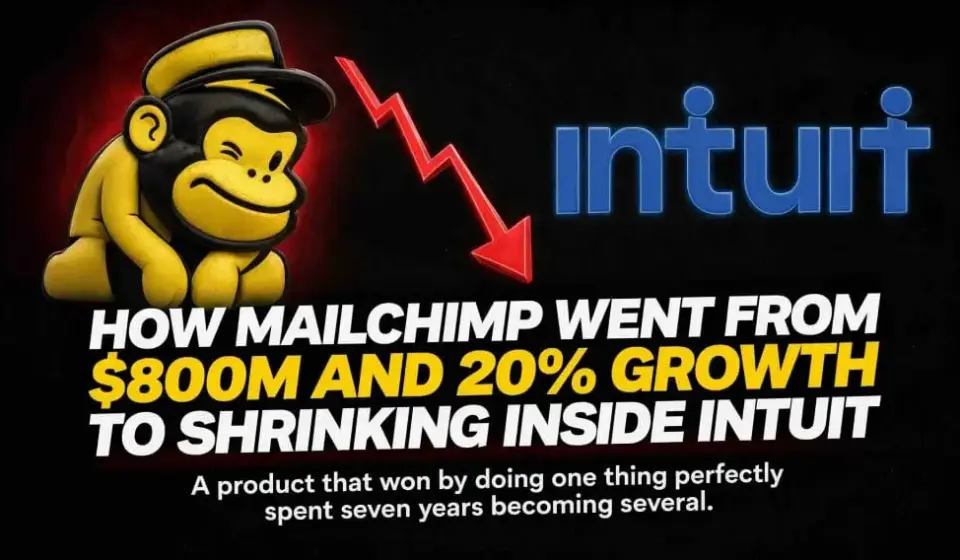

For nearly two decades, Mailchimp was the undisputed default answer to a ubiquitous question: "What do you use for email?"
Built on a foundation of radical simplicity, whimsical branding, and a pioneering freemium model, the company grew into a juggernaut by doing one thing exceptionally well: allowing small business owners to design, send, and track marketing emails in minutes without a technical degree.
Yet, on May 20, 2026, during Intuit’s Q3 FY26 earnings call, the underlying reality of its multi-billion-dollar acquisition was laid bare. Intuit published its corporate growth rate twice: once with Mailchimp included, and once with the asset entirely stripped out. Five years after acquiring the email marketing pioneer for $12 billion—partly funded by a $4.7 billion term loan—its parent company was actively distancing its core metrics from the very asset it had bet its small-business ecosystem on.
What happened to Mailchimp is not a story of sudden corporate collapse or overnight negligence. Instead, it is a masterclass in structural drift—a cautionary tale of what happens when a narrow, hyper-focused category leader spends seven years trying to morph into an all-in-one corporate suite, only to miss the dawn of the AI agent era entirely.
Executive Overview: The Seven-Year Drift
To understand Mailchimp’s current trajectory, one must look back at its valuation and financial journey. When Intuit acquired the company in 2021, Mailchimp was generating approximately $800 million in annual revenue and growing at roughly 20% per year. In the single quarter Intuit broke out the numbers (Q4 FY22), Mailchimp pulled in $265 million—pacing at an annualized rate of roughly $1.06 billion.
Fast forward to mid-2026, and the narrative has shifted dramatically. Growth has stagnated, free-tier benefits have been systematically dismantled to harvest short-term Average Revenue Per User (ARPU), engineering and deliverability teams have absorbed deep cuts, and corporate leadership has pivoted from compound growth to cash generation.
The decline can be traced through two fatal missteps:
- The Suite Strategy: Diluting a product that won by being narrow into an unwieldy, all-in-one marketing platform.
- The Agent Blind Spot: Failing to adapt to an era where the entry point for software has shifted from human marketers clicking through graphical user interfaces (GUIs) to developers and AI models provisioning infrastructure via APIs and Model Context Protocols (MCPs).
Detailed Chronology: From Category King to Corporate Harvest
1. The Era of Expansion (2019–2021)
Long before Intuit entered the picture, Mailchimp began its structural pivot. Around 2019, the company started adding non-email features: websites, landing pages, social ads, postcards, CRM tools, appointment schedulers, and SMS capabilities.
The thesis—marketed heavily in corporate pitch decks—was that small-to-medium businesses (SMBs) wanted an all-in-one hub. But seasoned industry operators, such as MailNinja founder Doug Dennison (historically ranked the world’s top Mailchimp partner out of 900+), watched as the platform’s core focus shifted. Large-organization agency work began to dry up as Mailchimp chased down-market scale while simultaneously trying to build mid-market features.
2. The Intuit Acquisition and the Four-Quarter Warning (2021–2026)
When Intuit bought Mailchimp for $12 billion, the corporate vision was to marry QuickBooks financial data with Mailchimp marketing reach to create a closed-loop revenue engine. However, a 12-person plumbing business or local bakery does not buy data-synergy narratives; they buy speed and simplicity. Every feature added to serve Intuit’s platform narrative made the core job of sending a simple email slightly harder.
Intuit’s own public disclosures mapped this friction over four consecutive quarters:
- September 2025 (Investor Day): A half-point drag on segment guidance.
- December 2025: The drag expanded to four points.
- May 2026: Guidance reflected three points of drag and an outright revenue decline.
Guidance language decayed in parallel. In August 2025, CFO Sandeep Aujla characterized Mailchimp as a "near-term drag" expected to recover by year-end. By February 2026, double-digit growth expectations were pushed out beyond fiscal 2026. By May 2026, growth language vanished entirely, replaced by discussions of operational profitability and cash flow. CEO Sasan Goodarzi’s internal memos confirmed the new reality: "reducing investments in areas including Mailchimp."
Supporting Context & Metrics: The Cost of Stagnation
Eleven Million Users, Zero Growth
According to January 2026 data from EmailToolTester tracking self-reported Email Service Provider (ESP) customer counts, competitors experienced double-digit growth trajectories over an 18-month span. Mailchimp, by contrast, remained flat.
While Mailchimp frequently touts a headline base of 11 million users, this metric relies heavily on a massive, unmonetized denominator of free-tier accounts. When a platform’s largest user count comes from non-paying users who never graduate to paid tiers, the headline number ceases to reflect underlying business health.
The Contrast: Klaviyo’s Masterclass in Specialization
To understand how Mailchimp’s market could still thrive under a different philosophy, one need only look at Klaviyo. In Q1 2026, Klaviyo reported:
- Revenue: $358 million, up 28% year-over-year.
- Customer Base: Over 196,000 customers.
- Net Revenue Retention (NRR): 110%, up two points—an extraordinary feat for a platform skewing heavily toward small businesses, which are traditionally structural churners.
While Klaviyo doubled down on deep, specialized B2C customer data and messaging for commerce brands, Mailchimp’s leadership admitted to Reuters that small businesses found its platform "a bit harder to use," directly harming retention and expansion.
The Freemium Clampdown
To squeeze financial value out of a slowing user base, Intuit began systematically dismantling Mailchimp’s growth engine: the free tier.
- Multi-step automations were stripped from the free plan by mid-2025.
- Contact limits began counting unsubscribed and non-subscribed records, causing lists to hit arbitrary ceilings faster.
- Exceeding limits now results in paused sending capabilities, including test emails.
- In April 2026, legacy accounts created before May 2019 absorbed an 11% to 13% price increase.
These measures successfully increase short-term ARPU by taxing the remaining paid cohort, but they do so by choking off the top of the funnel, effectively borrowing revenue from future years.
Official Statements and Operational Fallout
The shift from a growth mindset to a harvesting strategy inevitably impacted human capital. Within hours of Intuit’s strategic updates, affected Mailchimp employees took to public platforms to disclose layoffs across core operational units, including:
- Email and SMS delivery operations
- Software and infrastructure engineering
- Engineering management
In the email marketing industry, deliverability engineering is not overhead; it is the lifeblood of the platform. It dictates inbox placement speed, incident resolution, and direct technical diplomacy with major inbox providers like Google and Microsoft. Cutting deep into these teams risks degrading the core utility of the platform.
As industry analyst Evan Burke noted following the layoffs, losing core delivery engineering talent signals a pivot away from infrastructural excellence toward margin preservation.
Future Outlook: The Agent Era Blind Spot
As Mailchimp grapples with its legacy architecture, a structural shift is occurring across the broader software landscape. The buyer persona has evolved. Today, applications are increasingly born through AI-assisted development platforms like Replit, Lovable, and Vercel. When these platforms spin up new applications requiring email infrastructure, they natively provision developer-first tools like Resend or Twilio.
Mailchimp is absent from these foundational lists.
Furthermore, modern workflows are increasingly driven by autonomous AI agents rather than human users clicking through dashboards. While Mailchimp has rolled out features like a conversational analytics agent and integrations with ChatGPT and Claude, it remains largely un-operable for external developer agents:
- Lack of Core APIs: Mailchimp’s official Model Context Protocol (MCP) server covers only Transactional Messaging (formerly Mandrill). Its core marketing platform—audiences, campaigns, automations, and reports—lacks official MCP support.
- Authentication Shortcomings: Community-built wrappers rely on static account-level bearer keys or non-expiring OAuth tokens with zero granular scoping or revocation paths.
- API Limitations: Crucial features, such as modern multi-step automations, are entirely inaccessible programmatically through the Mailchimp API.
An AI agent cannot safely operate a platform that lacks robust, programmatic MCP support. In the agentic era, if a platform cannot be driven autonomously by an AI model, it risks being bypassed entirely.
Eight Essential Lessons for B2B Founders
- Focus is a Moat with Ongoing Maintenance Costs: Every feature added outside your core competency places a small tax on the primary job your product was hired to do.
- Ease of Use is a Retention Metric: Product complexity always manifests downstream in churn and weak expansion, long after roadmap decisions are made.
- Protect Your Funnel: Systematically choking off a freemium growth engine to artificially inflate near-term ARPU borrows revenue from tomorrow’s cohorts.
- Beware Vanishing Denominators: Large user counts comprised of unmonetized free users hide underlying stagnation. Report the customers you actually monetize.
- Watch the Earnings Disclosures: When an acquirer routinely publishes growth rates with an asset removed, that asset is on notice.
- Synergy Must Benefit the Buyer: Architectural integration in a corporate deck means nothing unless it delivers a tangible speed or efficiency gain for the end user.
- Switching Costs Are Collapsing: Modern AI and automated migration tools make switching email providers easier than ever. Incumbency alone no longer protects mediocre product experiences.
- Agent-Operability is the New Evaluation: If autonomous AI agents cannot discover, provision, and operate your product via official APIs and MCP servers, your software will be routed around.
Conclusion: The Lag Between Decision and Disclosure
The story of Mailchimp under Intuit is a stark reminder of how long the lag can run between a strategic misstep and its public reckoning. For roughly seven years, a category leader coasted on brand equity and pricing power while its product widened rather than deepened.
The financial engineering of harvesting a mature asset can sustain margins temporarily, but it cannot manufacture organic relevance in a shifting technological landscape. For B2B founders and product leaders watching from the sidelines, the lesson is clear: long-term survival requires protecting your core utility, honoring user simplicity, and ensuring your infrastructure is built for the agents of tomorrow, not just the human interfaces of yesterday.
What do you feel about this post?

Like

Love

Happy

Haha

Sad

Angry