
The Anatomy of Marketing Waste: Why "Cost Per Session" and Activity-Based Metrics Are Threatening Enterprise Growth

EXECUTIVE SUMMARY
For decades, corporate marketing departments have operated under a flawed imperative: drive traffic at all costs, celebrate high impression volumes, and optimize for shallow engagement metrics. However, as global markets face increasing macroeconomic pressures and the dawn of an AI-driven search ecosystem, this antiquated approach is no longer just ineffective—it is an existential threat to enterprise profitability.
In a recent strategic engagement for a multinational corporation operating across 75 countries, veteran marketing analytics authority Avinash Kaushik uncovered a startling reality: teams were treating "Cost Per Session" as a primary key performance indicator (KPI). This reliance on superficial activity metrics masks a grim underlying truth. When subjected to rigorous financial accountability—factoring in campaign costs and the Cost of Goods Sold (COGS)—many high-traffic, automated digital campaigns are actively destroying corporate profit.
This investigative report examines the critical shift from Activity to Outcomes, and ultimately to Accountability. By analyzing real-world performance models comparing automated paid media (such as Google Advantage+) against traditional channels like email, this article provides a blueprint for CMOs and CFOs seeking to align marketing budgets with true incremental business impact, survive the AI search disruption, and eliminate wasteful vanity metrics once and for all.
1. Detailed Chronology: The Discovery of a Flawed Paradigm
The realization of how deeply flawed modern digital marketing metrics have become began during a strategic consulting engagement. Tasked with architecting a next-generation marketing strategy for a global enterprise, the engagement involved deep-dive alignment meetings with various regional and functional sub-teams.
During an early exploratory workshop, a sub-team proudly presented their primary metric for campaign success: Cost Per Session (CPS).
Having spent decades working alongside the world’s largest corporations, authoring bestselling analytics texts translated into multiple languages, and helping invent foundational digital analytics tools, this was the first time the metric had been encountered in a professional career. The only traditional "CPS" familiar to seasoned veterans was Cost Per Sale—a metric tied directly to top-line commercial results.
The introduction of Cost Per Session as an end-goal revealed a dangerous philosophy within the organization: the primary objective of marketing was merely to shovel traffic onto a digital property as cheaply as possible, regardless of the quality, intent, or commercial outcome of that traffic.
This operational blind spot is symptomatic of a broader industry disease. For years, marketers have relied on superficial vanity metrics—such as Impressions and Views—that are so devoid of intrinsic value that they scarcely qualify as metrics at all; they are merely administrative "things." When an organization incentivizes its internal teams and external agency partners to buy traffic without regard for what happens after the click, it creates a systemic wealth transfer from the corporate treasury directly to ad platforms, while delivering zero sustainable value to the business.
2. Supporting Context & Metrics: Moving from Activity to Accountability
To protect the Chief Marketing Officer (CMO) from the scrutinizing eye of the Chief Financial Officer (CFO), marketing analytics must evolve past basic activity tracking. The objective is to build a strategy where all marketing execution withstands the strictest financial audits, proving incremental business impact that justifies expanding marketing budgets year over year.
The Four-Tiered Evaluation Framework
To accurately assess marketing performance, enterprises must transition through four distinct analytical views:
[ ACTIVITY VIEW ] ➔ [ OUTCOMES VIEW ] ➔ [ INPUTS VIEW ] ➔ [ ACCOUNTABILITY VIEW ]
 (Traffic/Clicks)     (Revenue/Orders)     (Ad Spend/COGS)    (POI / Profitability)
Tier 1: The Activity View (The Danger Zone)
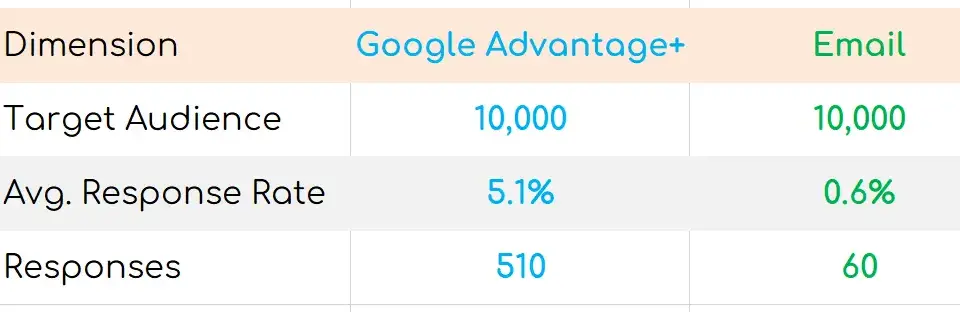
Most corporate reporting dashboards focus entirely on activity. Metrics like clicks, sessions, and response rates (e.g., Google Advantage+ outperforming email in pure traffic generation) are greeted with internal celebration. Budgets are subsequently funneled toward platforms simply because they generate massive volumes of top-of-funnel movement.
Tier 2: The Outcomes View
When pressured by a legacy-minded CMO or an engaged CFO, organizations typically graduate to measuring basic outcomes: Revenue and Conversion Rate. When applied to automated paid campaigns, the data often shows an increase in raw orders and gross revenue. However, stopping at revenue is a critical error.
For B2B companies, businesses with long sales cycles, or pharmaceutical firms where the macro-conversion is an offline prescription, tracking outcomes requires bridging digital micro-conversions with offline conversion rates and average outcome values. While these modeled numbers may carry a minor margin of error, they are infinitely superior to measuring pure activity.
Tier 3: The Inputs View
Marketing is not free. Every campaign requires capital allocation for ad spend, alongside the Cost of Goods Sold (COGS)—the direct cost of producing the products sold by the marketing campaigns. Collecting these baseline financial inputs is mandatory for true fiscal governance.
Tier 4: The Accountability View (ROAS vs. ROI vs. POAS vs. POI)
The ultimate test of marketing maturity is found when assessing full accountability. Many organizations rely on Return on Ad Spend (ROAS). However, ROAS is deeply misleading because it treats all gross revenue as a direct credit to marketing without subtracting the underlying cost of the ad campaign.
A comparative analysis of automated paid campaigns (such as Google Advantage+) versus direct channels (such as Email) reveals a startling inversion when financial reality is applied:
- ROAS View: Automated campaigns may show an acceptable ROAS (e.g., 2.4), while email shows a high ROAS (e.g., 9.6).
- ROI (Return on Investment) View: Subtracting campaign costs from claimed revenue drops the automated channel significantly.
- POAS (Profit on Ad Spend) & POI (Profit on Investment) Views: When true profitability—factoring in both ad spend and COGS—is calculated, the narrative changes entirely.
In a representative enterprise case study, while Google Advantage+ generated 173 orders compared to Email’s 14 orders, the financial return told a brutal story. For every $1 spent on automated paid campaigns, the enterprise received a negative profit return ($0.70 return, representing a net loss). Conversely, Email delivered a robust $5.70 in profit for every $1 spent.
When gross revenue is prioritized over bottom-line profit, an enterprise risks existing for the sole purpose of funding the sales commissions of advertising platforms.
3. Official Perspectives & Industry Guidance
Industry leaders and search engine operators are actively pushing back against the culture of vanity metrics. The imperative to abandon shallow engagement indicators is mirrored in technical guidelines issued by major platforms adjusting to artificial intelligence.
The Shift in Search and AI Discovery
As search engines evolve toward conversational AI experiences (such as AI Overviews and chat-based discovery), the nature of web traffic is fundamentally transforming. Official documentation released by Google regarding success in AI Search explicitly cautions enterprises against chasing hollow volume:
"Understand the full value of your visits. We’ve seen that when people click to a website from search results pages with AI Overviews, these clicks are higher quality, where users are more likely to spend more time on the site… you might not optimize for these if you focus too much on clicks instead of the overall value of your visits from Search. Consider looking at various indicators of conversion on your site, be it sales, signups, a more engaged audience, or information lookups about your business."
The directive from platform developers aligns directly with advanced analytics principles: Stop incentivizing Cost Per Session. Stop rewarding teams for generating "one-night stands" of low-intent traffic that bounce instantly upon arrival.
Sucking Less: The Intermediate Metric
If organizational inertia or legacy corporate cultures prevent an immediate transition to full Profit on Investment (POI) modeling, teams must at least refine their intermediate operational metrics.
Instead of measuring raw Cost Per Session, organizations should shift to Cost Per Non-Bounced Session.
- Example: If a campaign delivers 510 sessions at a spend of $7,200, the raw Cost Per Session is $14.
- However, if the bounce rate is 52% (meaning 265 visitors arrived, contributed nothing, and immediately departed), those sessions are entirely unproductive.
- Removing non-converting, high-bounce traffic recalculates the true financial burden to a Cost Per Non-Bounced Session of $27.
Confronting internal teams and external agency partners with a realistic $27 cost per engaged visit sparks the necessary friction to re-evaluate underperforming audience targeting and creative execution.
4. Future Outlook: Strategic Action Plan for the Enterprise
Eliminating unprofitable marketing spend requires decisive, courageous leadership. When data conclusively proves that a paid channel is systematically eroding corporate profit, half-measures are insufficient.
A Five-Step Remediation Framework for CMOs
- Immediate Spend Interruption: Cut automated, low-performing digital ad spend to zero immediately. Send an unequivocal message to internal teams and external agencies that being a drain on corporate profit is unacceptable. Prepare executive leadership for the inevitable short-term shock: traffic will drop, and raw top-line revenue will appear to contract. Remind stakeholders that underlying enterprise profitability is simultaneously recovering.
- The Probationary Challenge: Offer internal media teams, external agency partners, and platform representatives a defined window to restructure campaigns and demonstrate the ability to deliver green, positive Profit on Investment (POI).
- Strategic Realignment: Initiate a rigorous, three-part structural strategy:
- A. Intent Mapping: Re-examine the true consumer intent available on the ad platform.
- B. Tactical Innovation: Deploy a refreshed suite of creative assets, messaging frameworks, and tailored offers designed to match that intent.
- C. AI Integration: Leverage modern, automated machine-learning tools correctly—moving past lazy "set-it-and-forget-it" spending to actively turbocharge targeting and engagement.
- Iterative Scaling: Keep budgets paused until high, positive POI is definitively proven through rigorous testing.
- CFO Alignment: Permanently establish POI, POAS, and ROI as the foundational metrics for budget approval, aligning the marketing organization directly with the financial priorities of the Chief Financial Officer.
Conclusion
The era of celebrating top-funnel activity while ignoring bottom-line profitability is officially over. By prioritizing Outcomes over Activity, and ultimately Accountability over Outcomes, modern marketing professionals can build strategies that withstand macroeconomic scrutiny and AI-driven market disruptions.
The path forward demands difficult conversations, rigorous analytical discipline, and the complete eradication of vanity metrics like Cost Per Session. For those willing to embrace financial accountability, the reward is clear: an AI-disruption-proof career, a secure seat at the executive table, and marketing budgets that grow because they unequivocally drive real corporate profit. Carpe diem.
What do you feel about this post?

Like

Love

Happy

Haha

Sad

Angry