
The Startup Executive Litmus Test: How to Know If You’ve Hired a "Good Enough" VP Before It Costs You a Year

Executive Overview
For startup founders and early-stage CEOs, the transition from founder-led operations to executive delegation represents one of the most perilous milestones in a company’s lifecycle. Wait too long to hire a Vice President, and the business stalls out under the weight of unscalable processes and founder burnout. Underhire—opting for a junior placeholder or an unproven resume—and you fail to secure a true owner who can autonomously drive a department. Overhire, and you burn through precious venture capital on an enterprise-grade executive whose overhead suffocates a nimble organization.
Worst of all is getting it wrong. A mismatched Vice President can easily set a startup back an entire year, corrupt team culture, and shatter investor confidence. Yet, despite the catastrophic downside of executive misfires, many founders hesitate to pull the trigger when a hire is failing, opting instead to rationalize poor performance or grant endless extensions.
To cut through the fog of executive evaluation, SaaS industry veteran and SaaStr founder Jason Lemkin has introduced a definitive diagnostic framework. The 4-Part VP Litmus Test offers founders an unsparing, rapid-fire mechanism to evaluate whether they have hired a genuine executive leader or an imposter who merely "talks the talk." By measuring performance across talent acquisition, core metrics, operational offloading, and team buy-in within the first 30 to 60 days, founders can strip away corporate smoke and mirrors. This article explores the anatomy of this framework, examining how founders can apply these four rigorous criteria to protect their startups from the compounding damage of a bad executive hire.
Detailed Chronology: The Dangerous Lifecycle of a Bad Executive Hire
Understanding why rapid evaluation is mandatory requires examining how a hiring mistake compounds over a typical 12-month startup lifecycle. When a founder misjudges a Vice President, the timeline of failure rarely resolves itself through patience; instead, it follows a predictable, destructive trajectory.
Month 1: The Honeymoon and the "Ramping Up" Excuse
During the first thirty days, a struggling VP relies heavily on corporate jargon and the universal shield of "onboarding." They spend their time in introductory meetings, auditing existing processes, and absorbing company history. To an overwhelmed founder eager for relief, this period looks like diligence. However, true executive operators are actively diagnosing bottlenecks and delivering early wins. The imposter, by contrast, is merely buying time.
Months 2 to 3: The Justification of Mediocrity
By day sixty, the cracks begin to show. Key departmental metrics remain flat or decline, and team members start whispering about a lack of clear direction. When confronted, a failing VP will offer elaborate excuses: market conditions are too volatile, the pipeline left by the founders was tainted, or the tech stack is outdated. Founders who fail to apply strict objective standards often buy into these rationalizations, believing that giving the executive "another quarter" will turn the tide.
Months 4 to 6: Cultural Erosion and Founder Re-Entry
By the end of the second quarter, the damage reaches the operational layer. High performers on the team lose faith, questioning leadership’s judgment. The founder, sensing that the department is drifting, is forced to step back in to micro-manage the function—defeating the entire purpose of the hire. Instead of taking work off the founder’s plate, the bad VP has effectively doubled the founder’s workload by requiring constant oversight and damage control.
Months 7 to 12: The Lost Year
By the time the founder finally acknowledges reality and terminates the contract, six to twelve months have elapsed. In the hyper-competitive startup ecosystem, a lost year is an eternity. Competitors have captured market share, capital has been squandered, and employee morale has plummeted. The takeaway is absolute: if a VP is going to fail, the founder must know within 60 days and take immediate, decisive action.
Supporting Context & Metrics: The 4-Part VP Test
To prevent the aforementioned scenario, founders must measure their new executives against four non-negotiable standards. These criteria apply universally across functions—whether evaluating a VP of Sales (VPS), VP of Marketing (VPM), VP of Customer Success (VPCS), or VP of Engineering (VPE).
+-----------------------------------------------------------------+
|                   THE 4-PART VP LITMUS TEST                     |
+-----------------------------------------------------------------+
| 1. Talent Acquisition : Did they hire someone great in 60 days? |
| 2. Core Metrics       : Did their #1 key metric improve?        |
| 3. Operational Relief : Did they take work off your plate?      |
| 4. Team Belief        : Does the team genuinely believe in them?|
+-----------------------------------------------------------------+
Criterion #1: Did they hire someone great in the first 60 days?
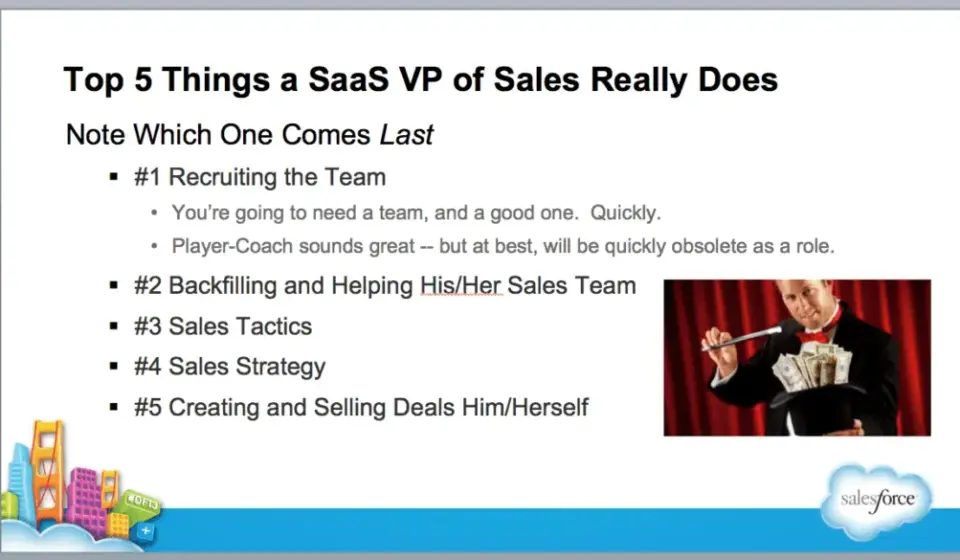
A foundational truth of executive leadership is that half of a real VP’s job is recruiting. In the early stages, this means sourcing and closing critical individual contributors; later, it scales to building entire organizations.
True VPs are perpetual talent magnets. They do not wait for a job requisition to be approved before scanning their network; the best operators always keep one or two exceptional candidates in their back pocket. If a new VP has not attracted, interviewed, and successfully closed at least one high-caliber hire within their first 30 to 60 days, they likely never will. A leader who cannot recruit cannot scale, and a non-recruiting VP is an immediate red flag that demands structural intervention.
Criterion #2: Did their #1 key metric improve?
Founders cannot expect overnight miracles from a new executive, but they can expect directional momentum. Every executive role has a single North Star metric:
- VP of Sales: Closed revenue, win rates, and deal velocity.
- VP of Marketing: Qualified leads, pipeline generation, and conversion rates.
- VP of Customer Success: Net Revenue Retention (NRR), Customer Satisfaction (CSAT), and logo churn reduction.
- VP of Engineering/Product: Deployment frequency, sprint velocity, and product stability.
A real VP makes tangible improvements to their primary metric within the first 60 days. Crucially, this rule holds true even during difficult economic climates or periods of company struggle. In boom times, impact can sometimes be masked by rising tides; in lean times, a great VP extracts maximum efficiency from existing resources.

Can a new VP of Sales turn 20% year-over-year growth into 300% overnight? Unlikely. But they can take a struggling pipeline and improve conversion rates by tightening discovery calls, restructuring discounting policies, and better aligning messaging with customer pain points. If a VP responds to missed metrics with excuses about market headwinds rather than tactical adjustments, they are not fit for purpose.
Criterion #3: Did they take part of the job off your plate?
When founders hire their first few VPs, those executives are stepping into functions previously managed directly by the founding team. While a founder may still maintain a consultative presence—such as closing marquee enterprise logos alongside a new VP of Sales—they should no longer bear the operational burden of running the department.
If, after 60 days, the founder is still managing day-to-day triage, drafting strategic plans, and firefighting operational crises, the hire has failed to deliver. A legitimate VP absorbs the weight of execution, allowing the founder to pivot toward high-level strategy, fundraising, and company-wide vision.
Criterion #4: Does the team believe?
Perhaps the most infallible diagnostic tool available to a founder is the internal sentiment of the existing team. Employees who have spent months or years in the trenches possess an acute radar for authentic competence.
When a true leader enters an organization, team confidence builds organically within the first 30 days. Employees notice sharper strategic direction, fairer processes, and decisive problem-solving. Conversely, when an imposter occupies the seat, the team senses it immediately through corporate doublespeak, paralyzed decision-making, and persistent ambiguity. If employee morale is flatlining and team trust is eroding rather than building, the verdict is in.
Expert Perspectives and Strategic Commentary
In his framework, Jason Lemkin emphasizes that acknowledging these truths requires immense psychological fortitude from founders. The greatest impediment to startup turnaround is emotional attachment to a hiring decision.
"You can hire a stretch candidate, someone who’s only done some of the job before, someone that has a lot to prove. That’s OK and often the right choice. But they have to get the core of the VP job done. If they haven’t, move on. The damage will only compound from there."
— Jason Lemkin, Founder of SaaStr
Founders frequently fall into the trap of partial compliance—rationalizing that if a new executive passes two or four criteria, they deserve an extended probationary period. Lemkin warns against this fallacy. Scoring a 50% or 75% on the VP test is functionally a failing grade when dealing with critical executive functions.
Furthermore, industry experts note that hiring for potential versus execution is a high-stakes gamble. While "stretch VPs"—directors stepping up into their first Vice President role—can inject ferocious hunger and energy into a company, they must still exhibit the fundamental operational reflexes outlined in the 4-part test. If they lack the raw capacity to recruit and improve core metrics, enthusiasm cannot substitute for competence.
Future Outlook: The Imperative of Decisive Leadership
As the macroeconomic environment continues to reward capital efficiency and operational rigor, the margin for error in executive hiring has narrowed to near zero. Startups can no longer afford the luxury of bloated management layers or multi-quarter grace periods for underperforming leaders.
Looking ahead, venture-backed companies will place an even higher premium on agile executive assessment. Founders who master the discipline of rapid evaluation—utilizing frameworks like the 4-Part VP Test—will successfully weed out professional interviewers and surround themselves with operators capable of scaling a business from seed stage to category dominance.
The message to founders is clear: trust the data, listen to your team, and measure performance strictly within the first 60 days. When an executive fails the test, decisively cutting ties is not an admission of failure—it is the ultimate act of protection for your company, your team, and your future.
What do you feel about this post?

Like

Love

Happy

Haha

Sad

Angry