

In the modern media landscape, sports remain the undisputed king of live television. Data from recent broadcast cycles indicates that nearly all of the top 50 most-watched telecasts in the United States are tethered directly to sports. The rare exceptions—such as marquee awards shows, special anniversary broadcasts, high-profile investigative news interviews, and select reality or game show television events—only serve to prove the rule. Even whimsical programming anomalies like an “NFL Weather Delay” routinely command massive audiences, proving that contemporary viewers will watch almost anything bearing a sporting banner.
Because sports represent the final, resilient bastion where audiences gather synchronously to watch live television, streaming giants and legacy networks alike are fiercely bidding for broadcast rights. Simultaneously, corporate marketers are rushing headlong into sports advertising. They pour billions into team sponsorships, jersey patches, equipment branding, stadium naming rights, and elaborate hospitality suites.
Yet, this gold rush inevitably triggers a reckoning. At some point in the budget cycle, a savvy senior executive inevitably poses the foundational question that sends shivers down the spine of marketing directors:
"Look, I’ve enjoyed the hospitality suite, I’ve loved shaking hands with legendary athletes, and my stakeholders think I’m a genius for getting them into exclusive clubhouses. But for $38 million in marketing expenditures, is this actually moving the needle for our core business?"
Consequences have arrived. It is time to dissect how modern enterprises can rigorously measure the true business impact of sports marketing, moving past vanity metrics and into the realm of undeniable financial accountability.
Detailed Chronology: The Evolution of Sports Marketing Accountability
To understand how we arrived at the current era of sophisticated media analytics, one must trace the historical trajectory of corporate sports sponsorships—a journey defined by a gradual shift from blind faith to empirical science.
Phase One: The Era of Pure Hospitality (Pre-2000s)
Historically, sports marketing was treated as an executive perk rather than a performance-driven channel. Budgets were allocated based on personal relationships, corporate entertainment needs, and intuitive "gut feelings." Success was measured by the quality of the food in the luxury suite, the prestige of the athletes available for handshakes, and the prominence of a CEO’s box seats at major golf tournaments. During this era, financial accountability was virtually nonexistent.
Phase Two: The Rise of "Big Numbers" and Vanity Metrics (2000s–2010s)
As digital media matured, corporate boards began demanding proof of performance. In response, sports marketing agencies introduced initial quantitative metrics—most notably Impressions, Social Media Engagement rates, and Earned Media Value (EMV). While these metrics provided an illusion of accountability, they remained fundamentally disconnected from real business outcomes. Brands celebrated billions of impressions without knowing whether those eyeballs translated into brand preference, customer acquisition, or long-term revenue growth.
Phase Three: The Quest for Brand and Causal Impact (Present Day)
Today, sophisticated marketing analytics leaders are dismantling traditional sponsorship models. Armed with advanced econometric modeling, robust test-vs-control methodologies, and multi-touch attribution frameworks, companies are refusing to sponsor in the dark. The focus has shifted from measuring noise (how many times a logo appeared on screen) to measuring signal (how a sports campaign fundamentally alters consumer perception, consideration, and incremental revenue).
Supporting Context & Metrics: The Five-Level Playbook for Impact Intelligence
All fundamental laws of marketing apply directly to sports sponsorship. If a paid media creative and narrative gets lost in the blink of an eye on digital platforms, a corporate logo plastered across a race car or stadium sideline will suffer an identical fate. Because the primary consumer objective is watching the game, passive sports sponsorships often demand more attention-grabbing reinforcement than traditional media, not less.
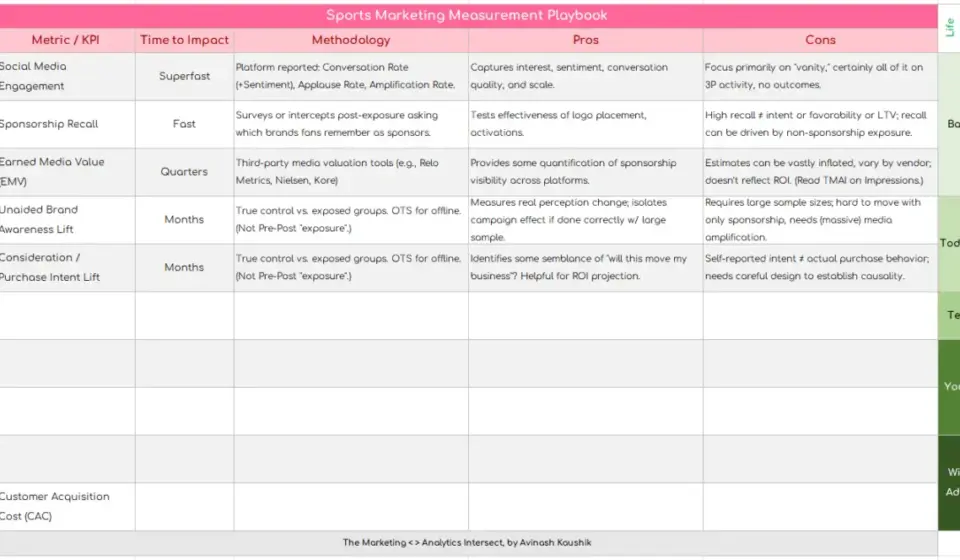
To bring order to this chaos, analytics frameworks categorize sports marketing measurement into five distinct levels of sophistication, rated via an Impact Intelligence Score (IIS) scaling from 1 to 10. Let us examine these levels through the lens of a hypothetical B2B enterprise, CloudPixel, sponsoring a professional soccer team.
Level 5: The Opening Gambit — Vanity (IIS: 1/10)
Every brand starts at Level 5; unfortunately, far too many remain trapped there. This is the domain of massive numbers that look impressive in slide decks but measure activity rather than outcomes.
- L5.1 Social Media Engagement: Tracking conversation rates, applause rates, and amplification metrics across social channels. While easy to measure and often free, this data merely reflects the baseline noise of audience interaction.
- L5.2 Sponsorship Recall: Post-exposure surveys querying fans on which brands they remember as sponsors. These surveys often rely on flawed, aided approaches ("Are you aware that CloudPixel is a sponsor?") rather than rigorous unaided recall.
- L5.3 Earned Media Value (EMV) / Ad Value Equivalency (AVE): The ultimate agency favorite and analytical illusion. Software counts every second a logo appears on screen and multiplies it by standard ad rates. EMV assumes all exposure is positive, ignores audience relevance, and is widely discredited by major marketing associations.
Verdict: Level 5 measures inputs and noise, providing zero financial linkage or causal proof. Brands should utilize these metrics only in the opening weeks of a campaign before moving upward.
Level 4: The Quest for Brand Impact (IIS: 4/10)
Level 4 introduces the first true test-versus-control measurements of human impact. Here, marketing leaders ask: Did the sponsorship fundamentally shift what target audiences think and feel about CloudPixel?
- L4.1 Unaided Brand Awareness (UBA) Lift: A challenging, long-term revenue driver. An effective, sustained sports marketing program should be able to measurably lift UBA over time. Short-term sports deals are little more than financial waste due to the natural lag of brand perception.
- L4.2 Consideration and Purchase Intent Lift: This is where Chief Financial Officers sit up and take notice. Utilizing traditional brand tracking surveys, analysts compare exposed cohorts (fans who saw the sponsored broadcast, highlights, or amplified paid ads) against matched control groups. Propensity score matching ensures true comparability while accounting for external variables like competitor activity.
Verdict: While self-reported intent does not always equate to immediate purchase behavior, Level 4 introduces serious scientific rigor into measuring perception shifts explicitly caused by sports marketing.
Levels 3, 2, and 1: Moving Toward Financial Nirvanas
Beyond Level 4 lie the ultimate tiers of advanced measurement:
- Level 3 ("The Heart & Mind Influence"): Uncovers insights into compounding brand advantage and long-term customer equity.
- Level 2 ("The First Digital Trace"): Connects brand exposure directly to digital behavioral pathways and intermediate conversion events.
- Level 1 ("Show Me The MONEY!"): The gold standard of marketing analytics, utilizing Marketing Mix Modeling (MMM) and causal experimentation to prove ultimate business incrementality and return on investment.
Official Perspectives and Industry Insights
As the sports marketing ecosystem expands into streaming and digital-first formats, industry leaders are increasingly vocal about the need for standardized, rigorous evaluation metrics.
"For too long, corporate sponsorships have operated outside the rigorous financial governance applied to digital advertising or search marketing," notes a leading marketing analytics strategist. "When you are writing checks worth tens of millions of dollars, ‘hospitality and brand love’ are no longer acceptable justifications. CMOs must demand causal proof that their sports investments drive incremental business value."
Furthermore, industry analysts emphasize that creative execution dictates the success of sports sponsorships just as it does in conventional media. Creative storytelling accounts for 60% to 70% of brand marketing success. Therefore, successful sports marketing is not merely about buying logo placement; it is about leveraging the emotional equity of the sport and the athlete to elevate the brand’s narrative—and backing that creative execution with sufficient paid media amplification to prove profitability via econometric modeling.
Future Outlook: The Next Era of Sports Media and Analytics
Looking ahead, the intersection of sports, entertainment, and data analytics will redefine how corporate sponsorships are bought, sold, and evaluated.
- The Death of Passive Sponsorships: As economic scrutiny tightens, CFOs will refuse to fund passive logo placements that lack clear tracking mechanisms. Agencies and teams that fail to provide advanced analytics and lift studies will lose out to data-fluent competitors.
- Streaming Integration and Programmatic Sports: With live sports migrating heavily to streaming platforms (such as Amazon Prime, Apple TV+, and Netflix), sports advertising is becoming increasingly digitized. This transition will allow for dynamic ad insertion, real-time attribution tracking, and more granular audience segmentation.
- Holistic Econometric Modeling: The future belongs to brands that integrate sports marketing directly into comprehensive Marketing Mix Models (MMM). By treating sports sponsorships not as standalone vanity projects, but as integrated channels capable of generating both upper-funnel brand equity and lower-funnel sales lift, modern enterprises can finally turn the lights on in a historically opaque marketplace.
Sports marketing can be immensely transformative—as demonstrated by decades-long partnerships like Rolex and tennis. But to unlock that potential safely, organizations must stop sponsoring in the dark, abandon outdated vanity metrics, and embrace the rigorous, multi-level playbook of modern impact intelligence.