
The Curiosity Deficit in Modern Marketing: Why Advanced Analytics and AI Fail Without the "Why"

Executive Overview
In an era dominated by enterprise marketing technology (MarTech) stacks, predictive algorithms, and automated analytics dashboards, modern marketing organizations possess unprecedented access to real-time performance data. Yet, despite multi-million-dollar investments in attribution software and artificial intelligence, marketing teams increasingly fall into a structural routine: campaigns are deployed, performance metrics are recorded, celebrations or brief post-mortems occur, and the organization moves on to the next initiative.
This cycle reveals a pervasive operational blind spot across the digital marketing ecosystem: the absent investigation of causality.
While advanced dashboards excel at detailing what occurred—such as a sudden 18% collapse in conversion rates or an unexpected 40% surge in campaign yield—they are fundamentally incapable of answering why those fluctuations happened.
The gap between passive performance reporting and sustainable optimization cannot be bridged by technology alone. It requires curiosity—the deliberate, methodical inquiry into consumer behavior, market dynamics, and operational assumptions.
Without an institutional commitment to questioning underlying drivers, enterprise marketing risks transforming best practices into rigid dogma and reducing data analytics to empty scorekeeping.
Detailed Chronology: The Evolution of Campaign Analytics and the Emergence of the Inquiry Gap
To understand how marketing arrived at this analytical paradox, one must examine the operational shifts over the past three decades as technology shifted the discipline from creative intuition to automated execution.
+-----------------------------------------------------------------------------------+
|                        EVOLUTION OF CAMPAIGN ANALYTICS                            |
+-----------------------------------------------------------------------------------+
|  1990s - Early 2000s: The Empirical Era                                           |
|  • Limited metrics (clicks, impressions, basic web traffic).                      |
|  • High manual investigation required to correlate spend with actual revenue.     |
+-----------------------------------------------------------------------------------+
                                         |
                                         v
+-----------------------------------------------------------------------------------+
|  2010s: The Automation & MarTech Boom                                             |
|  • Rapid expansion of multi-touch attribution, CRMs, and real-time dashboards.    |
|  • Metric saturation: Teams flooded with open rates, CTRs, and CAC data.          |
|  • Unintended consequence: Reporting replaced inquiry; speed eclipsed analysis.   |
+-----------------------------------------------------------------------------------+
                                         |
                                         v
+-----------------------------------------------------------------------------------+
|  Present Day: The AI & Generative Execution Era                                   |
|  • Algorithmic content generation and dynamic campaign execution.                 |
|  • Automated anomaly detection surfaces patterns instantly.                       |
|  • The Curiosity Deficit: "What happened" is automated; "Why" remains overlooked. |
+-----------------------------------------------------------------------------------+
Phase 1: The Empirical Era (1990s – Early 2000s)
In the early days of digital marketing, measurement was primitive and manual. Marketers tracked direct response mechanics, basic click-through rates, and rudimentary web traffic. Because data was scarce, teams were forced to ask deep, qualitative questions about copy resonance, offer alignment, and audience selection to justify spend.
Phase 2: The MarTech Infrastructure Boom (2010s)
The middle decade saw a explosion in enterprise software solutions. The proliferation of automated customer relationship management (CRM) systems, automated email platforms, search engine optimization (SEO) tools, and multi-touch attribution models transformed marketing into a data-dense discipline.
However, this influx of data created an unintended consequence: reporting began to replace analysis. Because dashboards could update instantly, teams prioritized velocity and execution over reflective evaluation. Numbers were systematically funneled into weekly decks, but the underlying consumer motivations remained unexamined.
Phase 3: The Algorithmic and Generative Era (Present Day)
Today, generative AI and machine learning tools can automate copy generation, creative variations, audience segmentation, and spend allocation. Platforms can instantly flag performance anomalies.
Yet, this automated efficiency has exacerbated the "curiosity deficit." As execution becomes friction-free, teams spend less time evaluating the human psychology behind campaign outcomes. The industry has mastered campaign velocity, but often at the expense of continuous learning.
Supporting Context & Metrics: Transforming Raw Data into Strategic Insight
Data points in isolation are merely operational artifacts. An enterprise dashboard indicating that a landing page conversion rate dropped by 18% provides diagnostic data, but it does not yield business intelligence.

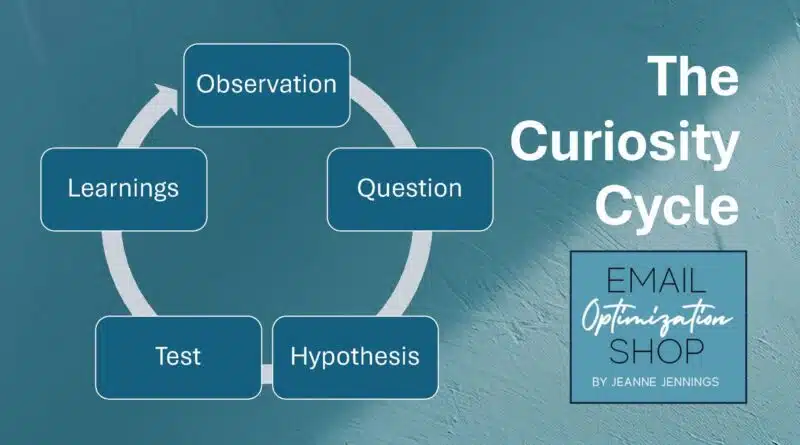
Transforming data into actionable strategic insight requires applying a structured methodology centered on rigorous, continuous questioning.
       [ Observation ]  --->  A decline or spike in core KPI occurs
              |
              v
        [ Question ]    --->  "Why did this shift occur within this specific cohort?"
              |
              v
       [ Hypothesis ]   --->  "Traffic quality shifted due to a channel targeting bug."
              |
              v
          [ Test ]      --->  Isolate variables and run a controlled experiment
              |
              v
        [ Learning ]    --->  Validate or invalidate the underlying assumption
              |
              v
      [ Next Question ] --->  "How do we scale this finding across other segments?"
Deconstructing the Insight Loop
1. Observation
A tangible variance in performance is identified via standard analytics tools (e.g., an 18% drop in landing page conversion or a 40% performance overperformance in paid social).
2. Diagnostic Inquiry (The "Why?")
Rather than treating the variance as a definitive conclusion, the curious marketer interrogates the data across multiple vectors:
- Did the performance variance occur globally, or was it isolated to a specific traffic source, demographic segment, or device type?
- Was there a concurrent change in ad copy, landing page load speed, user experience, or promotional offer?
- Did external market dynamics shift (e.g., competitor pricing changes, seasonality, macro-economic factors)?
3. Hypothesis Formulation
Formulating a testable explanation based on diagnostic inquiry (e.g., "The 18% drop was driven by a mismatch between new top-of-funnel ad creative and existing landing page messaging for mobile users").
4. Controlled Testing
Executing targeted A/B or multivariate experiments designed explicitly to prove or disprove the hypothesis, rather than merely searching for an operational win.
5. Institutional Learning
Synthesizing results to update baseline audience understanding. A rejected hypothesis is treated not as a tactical failure, but as valuable empirical data that eliminates incorrect assumptions.
6. Subsequent Iteration
Using the newly gained baseline knowledge to frame the next commercial question, establishing a permanent loop of continuous optimization.
Dissecting High-Performing Anomalies
A common breakdown in modern marketing operations is the tendency to investigate only underperforming campaigns. When a project fails to meet benchmarks, teams naturally initiate post-mortems to assign accountability or fix technical flaws.
Conversely, when a campaign exceeds performance forecasts—for example, beating baseline key performance indicators (KPIs) by 40%—the standard response is celebration followed by immediate deployment of the next campaign.
+------------------------------------------------------------------------------------+
|                         THE ASYMMETRY OF INVESTIGATION                             |
+------------------------------------------------------------------------------------+
| TRADITIONAL APPROACH:                                                              |
| Underperformance (-18%) ----> Deep Post-Mortem & Blame Assessment                   |
| Overperformance (+40%)  ----> Celebration & Immediate Move to Next Project        |
| Result: Zero repeatable knowledge gained from positive outliers.                   |
+------------------------------------------------------------------------------------+
| CURIOUS OPTIMIZATION APPROACH:                                                     |
| Underperformance (-18%) ----> Isolate variables, hypothesize, re-test.             |
| Overperformance (+40%)  ----> Question success: Was it creative, audience, market? |
| Result: Codified mechanics for scalable, systematic replication.                   |
+------------------------------------------------------------------------------------+
Failing to scrutinize positive anomalies leaves an organization vulnerable to strategic errors:
- Inability to Replicate: If a team does not understand why a campaign succeeded, they cannot reliably reproduce that success in future iterations.
- False Attribution: A campaign may have overperformed due to external market conditions (e.g., a competitor’s inventory shortage) rather than superior creative execution. Mistaking external luck for strategic brilliance leads to misallocated budget in subsequent quarters.
- Missed Expansion Opportunities: The underlying driver of an overperforming campaign may reveal an entirely unserved consumer segment or an unaddressed pain point that could inform broader business strategy.
Challenging Industry "Best Practices"
The lack of critical inquiry also causes an over-reliance on industry best practices. Marketing literature is saturated with absolute recommendations:
- "Keep lead generation forms as short as possible."
- "Place primary Calls-to-Action (CTAs) strictly above the digital fold."
- "Limit landing pages to a single conversion goal."
While best practices serve as useful baseline starting points, accepting them as universal truths can degrade long-term performance. What optimizes conversion for a low-cost direct-to-consumer product may completely undermine lead qualification for a complex enterprise software-as-a-service (SaaS) contract.
Curiosity mandates that teams challenge conventional wisdom through direct empirical testing against their own specific user bases.
Official Statements & Expert Analysis
Industry leaders increasingly argue that technical capabilities are baseline requirements, whereas cognitive and investigative frameworks represent the real battleground for sustainable differentiation.
"Execution gets the campaign out the door; curiosity makes the next campaign better. As the tools we use become more sophisticated, curiosity is becoming more important, not less."
— Senior MarTech Strategist Analysis
Furthermore, experts emphasize that fostering an investigative mindset requires a fundamental cultural shift in how marketing leadership treats negative experimental outcomes.
"A hypothesis isn’t something to defend; it’s something to investigate. If the test disproves it, that doesn’t mean the test failed. It means you learned something. Curiosity shifts the goal from proving you’re right to finding out what’s true."
— Marketing Optimization Research
Note on AI Integration and Analytical Disclosure
As generative tools become deeply embedded in workflow architectures, transparency regarding how insights are generated is critical. Automated systems can analyze large data sets, surface macro trends, and assist in draft generation, but human intuition remains essential for critical framing.
+------------------------------------------------------------------------------------+
|                       THE HUMAN-AI ANALYTICAL MATRIX                               |
+------------------------------------------------------------------------------------+
|  AI & AUTOMATED SYSTEMS (The "What")     |  HUMAN CURIOSITY & STRATEGY (The "Why")   |
+------------------------------------------+-----------------------------------------+
|  • Rapid pattern identification          |  • Contextual & psychological reasoning |
|  • Real-time metric aggregation          |  • Nuanced hypothesis generation        |
|  • Dynamic creative distribution         |  • Strategic decision-making            |
|  • Automated anomaly detection           |  • Ethical and disclosures oversight    |
+------------------------------------------+-----------------------------------------+
When artificial intelligence is utilized as a collaborative thought partner—whether to organize outlines, pressure-test analytical frameworks, or identify variance patterns—marketing executives must ensure that the underlying strategic premises, audience interpretations, and final editorial assertions remain firmly guided by experienced human judgement.
Future Outlook & Actionable Roadmap: Institutionalizing Curiosity in the AI Era
As artificial intelligence democratizes baseline content creation, dynamic creative optimization, and media buying, technical tools will cease to provide a structural competitive advantage. When every enterprise enterprise operates comparable AI technologies, competitive advantage reverts back to the quality of inputs, strategic questions, and experimental frameworks.
Organizations that institutionalize curiosity will systematically outpace competitors who rely solely on automated execution.
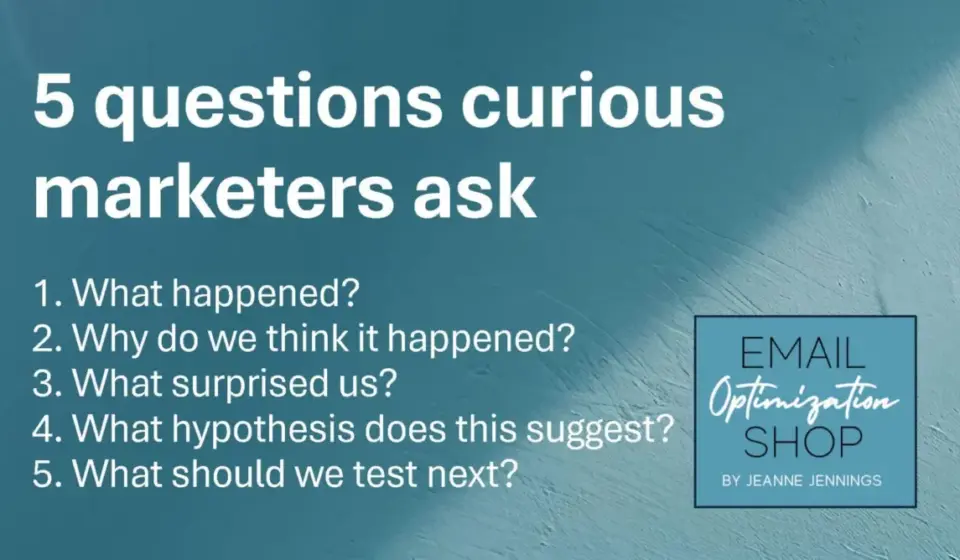
The Five-Question Post-Campaign Review Framework
To move from theoretical advocacy to operational execution, marketing leadership should embed a mandatory Five-Question Post-Campaign Framework into every campaign recap, testing protocol, and performance review:
+------------------------------------------------------------------------------------+
|                THE 5-QUESTION POST-CAMPAIGN INQUIRY FRAMEWORK                      |
+------------------------------------------------------------------------------------+
| 1. WHAT SPECIFIC VARIANCE OCCURRED?                                                |
|    Isolate exact performance metrics that deviated significantly from baselines.    |
+------------------------------------------------------------------------------------+
| 2. WHAT ALTERNATIVE EXPLANATIONS COULD ACCOUNT FOR THIS RESULT?                    |
|    Look beyond primary metrics to evaluate market, technical, or seasonal drivers. |
+------------------------------------------------------------------------------------+
| 3. WHAT ASSUMPTION ABOUT CONSUMER BEHAVIOR WAS INVALIDATED OR CONFIRMED?           |
|    Translate metric performance into psychological insights about the target market. |
+------------------------------------------------------------------------------------+
| 4. WHAT SPECIFIC HYPOTHESIS SHOULD BE TESTED NEXT BASED ON THIS LEARNING?          |
|    Formulate actionable, isolated test parameters derived directly from results.   |
+------------------------------------------------------------------------------------+
| 5. HOW DOES THIS FINDING ALTER OUR BROADER MARKETING STRATEGY?                     |
|    Scale validated learnings across adjacent channels, messaging, and products.    |
+------------------------------------------------------------------------------------+
Step 1: Isolate Specific Variances
- Objective: Move beyond generic summaries (e.g., "The campaign went well") to isolate precise statistical anomalies, sub-segment behaviors, or metric divergence.
- Tactical Action: Identify the exact variables that deviated from historical benchmarks by a predefined threshold (e.g., ±15%).
Step 2: Uncover Alternative Explanations
- Objective: Mitigate confirmation bias by brainstorming non-obvious factors that might explain the result.
- Tactical Action: Require the team to formulate at least three distinct hypotheses for why the outcome occurred, accounting for external variables, technical friction, and audience composition shifts.
Step 3: Extract Behavioral Insights
- Objective: Translate operational performance data into meaningful understanding of consumer psychology.
- Tactical Action: Document explicitly what the data reveals about customer pain points, value perceptions, or friction points.
Step 4: Define the Next Immediate Test
- Objective: Prevent analytical dead-ends by ensuring that every campaign recap directly triggers a follow-up experiment.
- Tactical Action: Draft a test brief that isolates a single variable derived from the most compelling hypothesis generated in Step 2.
Step 5: Update Foundational Baselines
- Objective: Ensure learnings are not trapped within individual channel teams, but are distributed across the entire commercial organization.
- Tactical Action: Update organizational buyer personas, core messaging guides, and strategic playbooks based on validated experimental findings.
Conclusion
The future of marketing success does not belong to the teams with the most expensive software stacks or the fastest content deployment schedules. It belongs to teams that use their data as a starting point for deeper investigation.
Technical proficiency enables execution; systematic curiosity drives optimization. By refusing to settle for surface-level metrics and consistently asking why, modern marketing organizations can turn routine data reporting into a continuous engine of strategic growth.
What do you feel about this post?

Like

Love

Happy

Haha

Sad

Angry