

Executive Overview
In the modern corporate landscape, "ownership" has become a ubiquitous corporate buzzword. Organizations across industries routinely urge employees to take proactive charge of their work, solve complex problems autonomously, and treat the company’s mission as their own. For passionate design professionals, this call to action strikes a resonant chord. A deep sense of creative investment often serves as the primary engine driving high motivation, meticulous attention to detail, and enduring job satisfaction.
However, organizational leadership rarely addresses the profound nuances—and hidden perils—of psychological ownership. While feeling connected to one’s output can elevate performance, an unchecked or misdirected sense of ownership can easily morph into a destructive trap. When designers bind their self-worth and identity to elements outside their control—such as final production code, organizational priorities, or absolute authorship over a shared concept—the psychological toll is severe.
This misplaced ownership fuels territorial defensiveness, resistance to constructive feedback, poor cross-functional collaboration, and, ultimately, professional burnout. Rather than amplifying a designer’s impact, it becomes a liability. This report explores the psychological mechanics of ownership in design, examines how it misfires in common workplace scenarios, and outlines actionable strategies for redirecting this powerful psychological impulse toward sustainable, rewarding targets.
Detailed Chronology: The Lifecycle of Psychological Ownership
To understand how ownership goes awry, we must first trace its psychological evolution within a designer’s career trajectory. The phenomenon does not emerge in a vacuum; rather, it follows a distinct developmental arc shaped by education, team dynamics, and day-to-day project execution.
Phase 1: Academic Conditioning and the Myth of Total Control
The journey often begins in design schools and bootcamps, where curricula frequently promote idealized, frictionless workflows. Students are traditionally taught to manage every facet of a project from conception to visual polish, operating in relative isolation. In these academic environments, a student can maintain absolute authorship over an artifact without consequence, corporate politics, or technical constraints. This early conditioning plants the seed of psychological ownership, framing it as an individualistic pursuit of creative purity.
Phase 2: Workplace Collision with Reality
Upon entering the corporate world, designers encounter a muddy ecosystem characterized by tight deadlines, competing business objectives, technical constraints, and organizational hierarchies. According to foundational research by organizational psychologists Linn Van Dyne and Jon Pierce, psychological ownership naturally develops from three primary sources:
- Intimate familiarity: Spending extended time deeply engaging with the details of a problem and its solution.
- Personal investment: Exercising individual judgment, taste, and effort to shape the output.
- Control and self-efficacy: Having the autonomy to mold the work directly.
Because typical design tasks naturally supply all three conditions, designers readily form powerful psychological attachments to their deliverables, prototypes, and roles.
Phase 3: The Misfire and Cognitive Friction
As projects progress, these natural attachments frequently misfire. When a developer modifies a design during a sprint, or when stakeholders push back on a user flow during a review, the designer experiences cognitive dissonance. Because their psychological ownership has incorrectly attached to the artifact itself (the prototype or the exclusive authorship) rather than the shared objective (delivering value to the user and the business), routine feedback is unconsciously processed as a personal attack.
Phase 4: Burnout or Strategic Realignment
Left unexamined, this cycle of perceived threat, defensive posturing, and inevitable compromise leads to disillusionment. Designers begin to view their colleagues as adversaries rather than partners, culminating in cynicism, diminished performance, and high attrition rates. However, by recognizing this trajectory, professionals can consciously interrupt the cycle, shifting away from misplaced control and toward a healthier, more collaborative model of ownership.
Supporting Context & Metrics: The Dual Nature of Psychological Ownership
Psychological ownership is a double-edged sword. Empirical research in organizational behavior and industrial-organizational psychology underscores both its profound benefits and its systemic hazards.
The Bright Side: Amplified Stewardship and Motivation
When directed appropriately, psychological ownership acts as a catalyst for organizational citizenship behavior (OCB). Studies published in the Journal of Organizational Behavior and the Journal of Applied Psychology indicate that employees who experience healthy psychological ownership exhibit:
- Enhanced Stewardship: A natural inclination to protect and nurture the product or service, treating its success as a personal milestone.
- Proactive Problem-Solving: A willingness to go above and beyond the formal job description to resolve user pain points.
- Sustained Engagement: Higher levels of intrinsic motivation, leading to greater resilience when tackling ambiguous design problems.
The Dark Side: Territoriality and the Common-Knowledge Effect
Conversely, when psychological ownership misfires, it triggers defensive psychological mechanisms. Research by Markus Baer and Graham Brown reveals that strong, unyielding ownership of a creative idea makes individuals significantly less receptive to alternative viewpoints. Designers fall prey to the common-knowledge effect, withholding critical information or dismissing collaborative input because they view it as a dilution of their exclusive authorship.
Furthermore, this dynamic exacerbates team friction. When a designer views a prototype as an extension of their own identity, constructive design critiques are no longer evaluated on their merits. Instead, they are interpreted as a challenge to the designer’s competence, turning collaborative review sessions into adversarial debates.
Official Insights and Workplace Scenarios
To translate abstract psychological theory into practical application, we must examine how misplaced ownership manifests in four common workplace scenarios—and how to successfully redirect it.
Scenario 1: The Trap of Exclusive Authorship vs. Collaborative Ideation
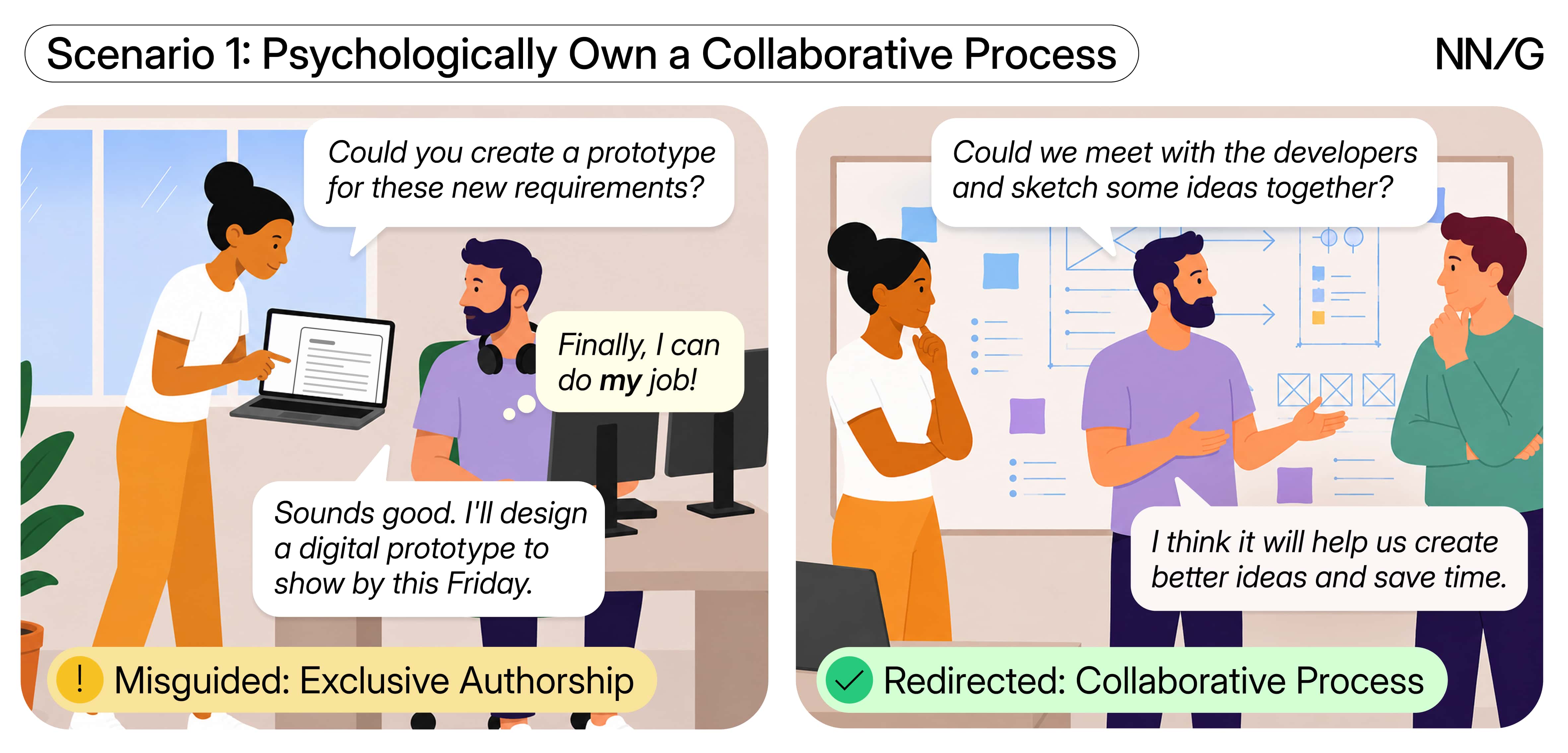
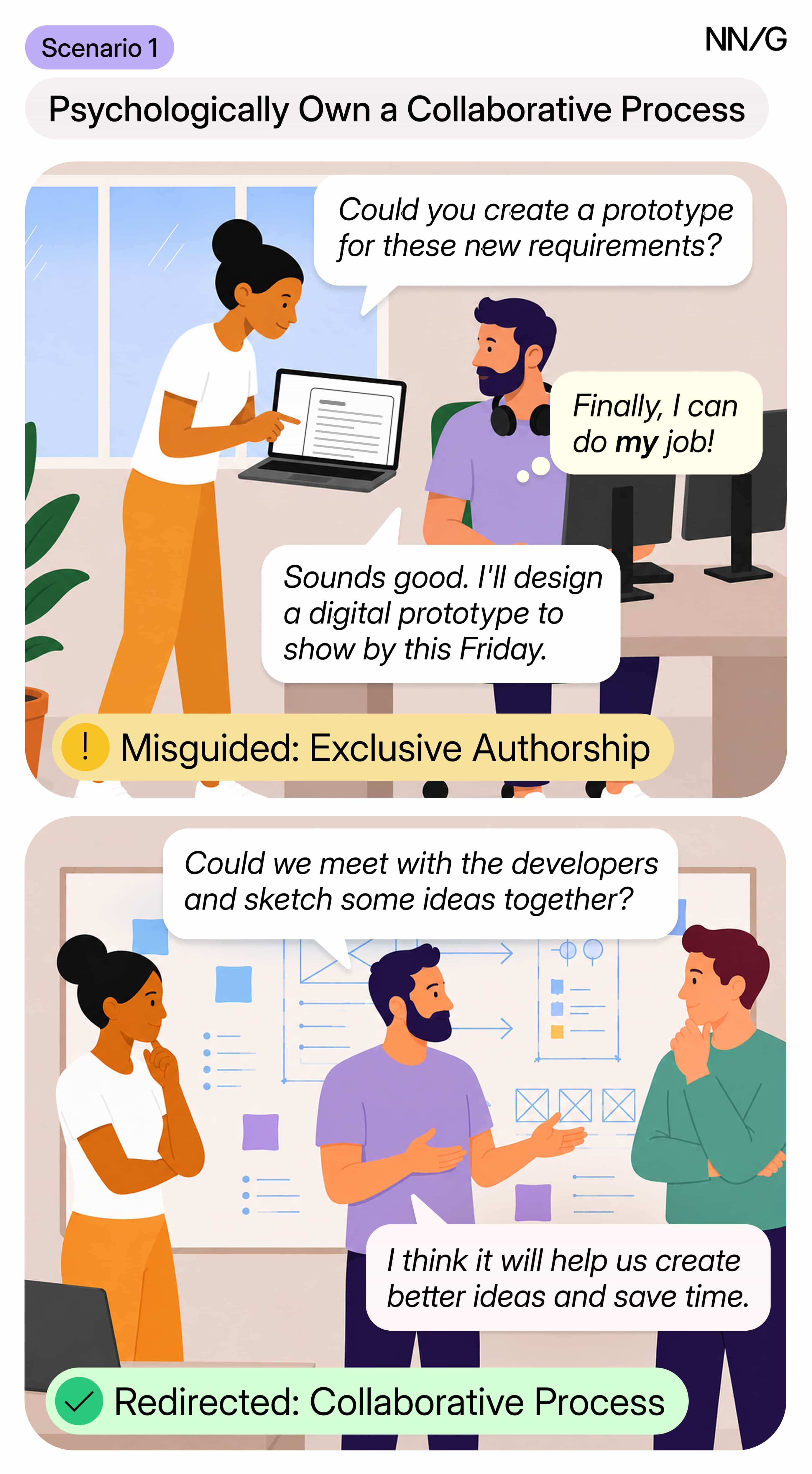
- The Problem: Experiencing a quiet sense of relief when teammates leave you alone to design in a silo. While solo focus has its place for low-risk, tactical tasks, treating your initial concept as an untouchable work of art leads to insular thinking. Research shows that early solo concepts are typically laden with unverified assumptions.
- The Redirect: Own a collaborative design process rather than exclusive authorship. Host cross-functional sketching sessions with developers and product managers before your concept hardens. Serve as a facilitator rather than a lone creator, actively searching for the positive elements in others’ ideas to weave into the final solution.
Scenario 2: "My" Prototype vs. Collective Team Goals
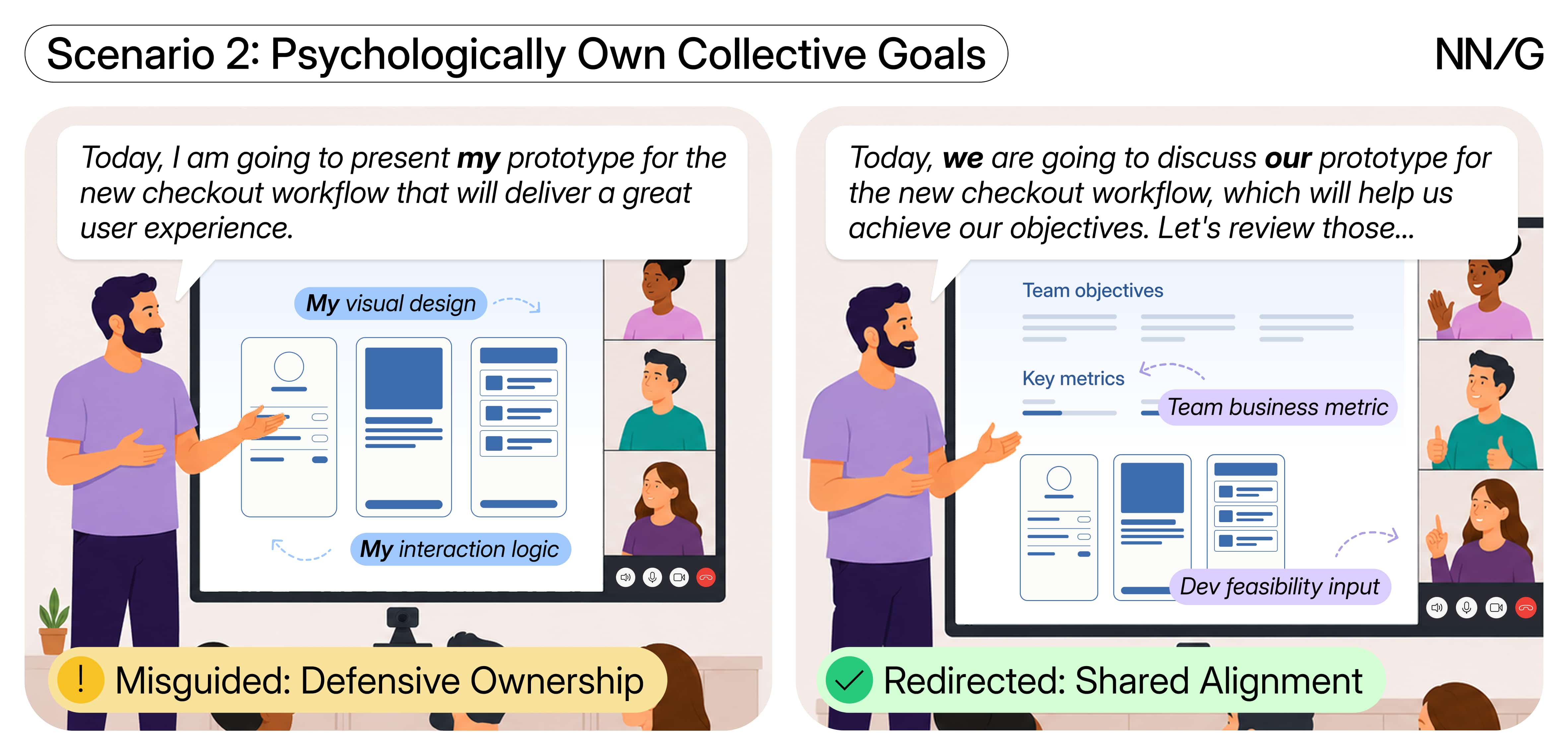
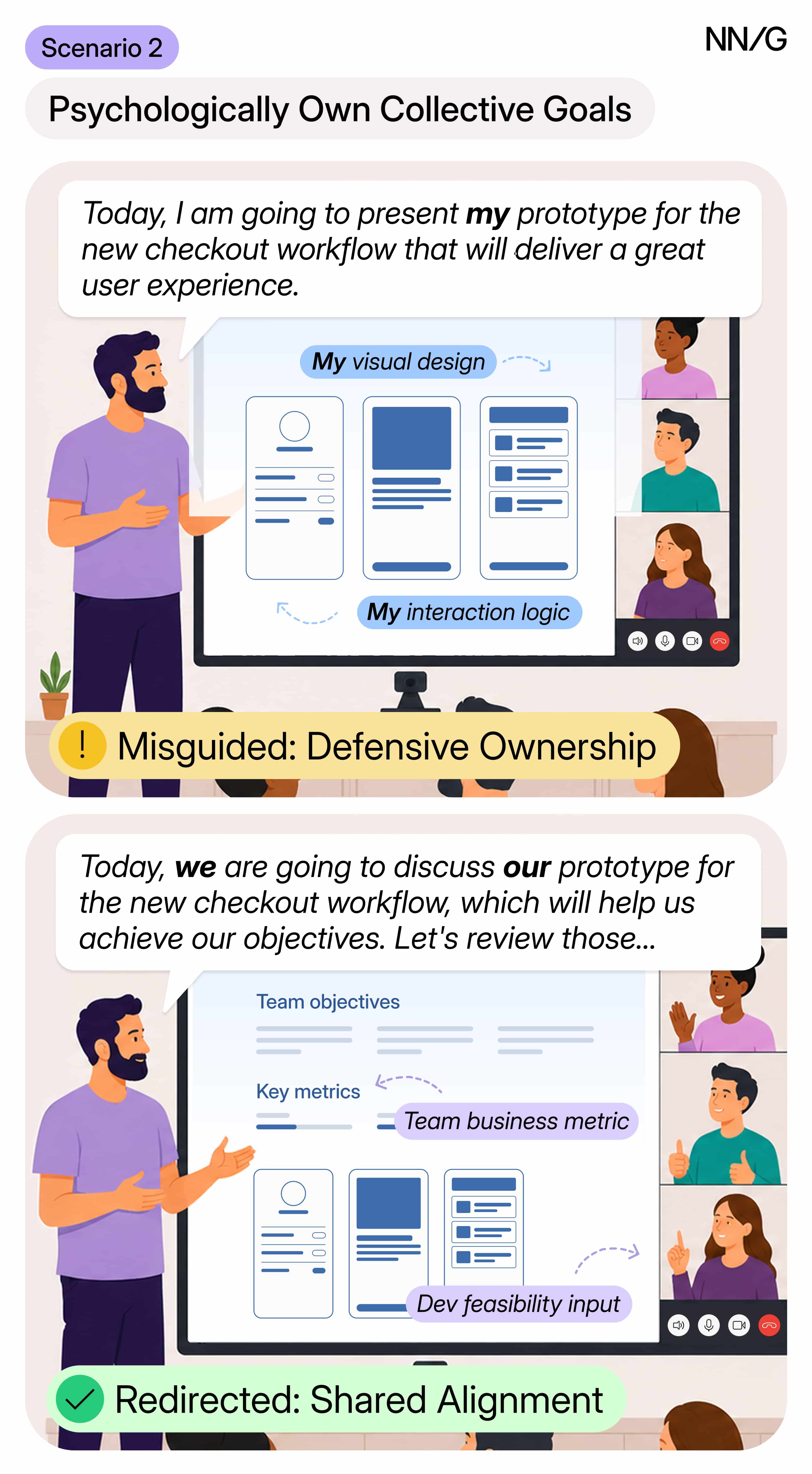
- The Problem: Presenting a prototype as an extension of yourself during reviews, framing it as something to defend against criticism rather than a joint hypothesis to test.
- The Redirect: Own collective team goals. In creative team studies led by Steven Gray, originators who actively solicited peer input experienced significantly less friction. During reviews, deliberately use first-person-plural pronouns ("we," "our") and frame the prototype as a shared artifact addressing UX, technical, and business constraints simultaneously.
Scenario 3: Feedback as an Attack vs. Shared User Evidence
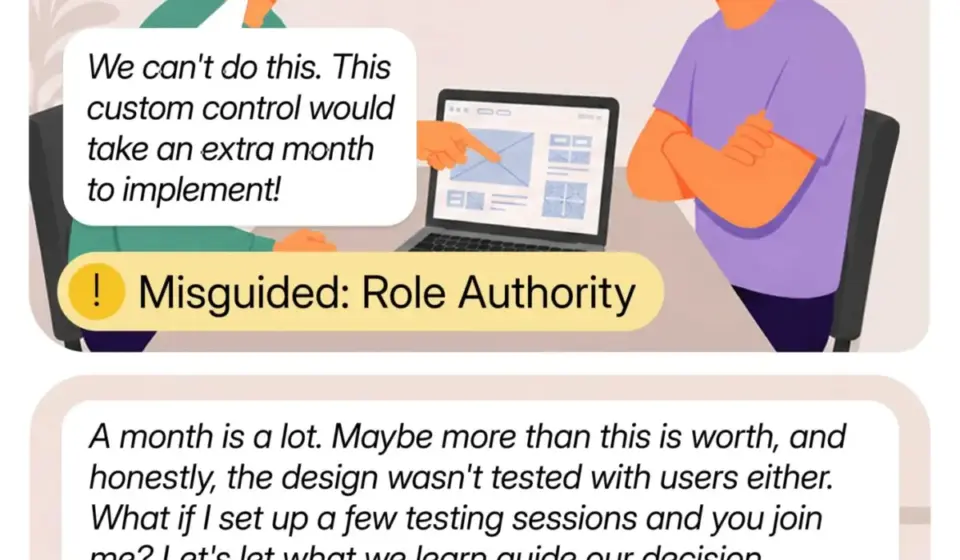
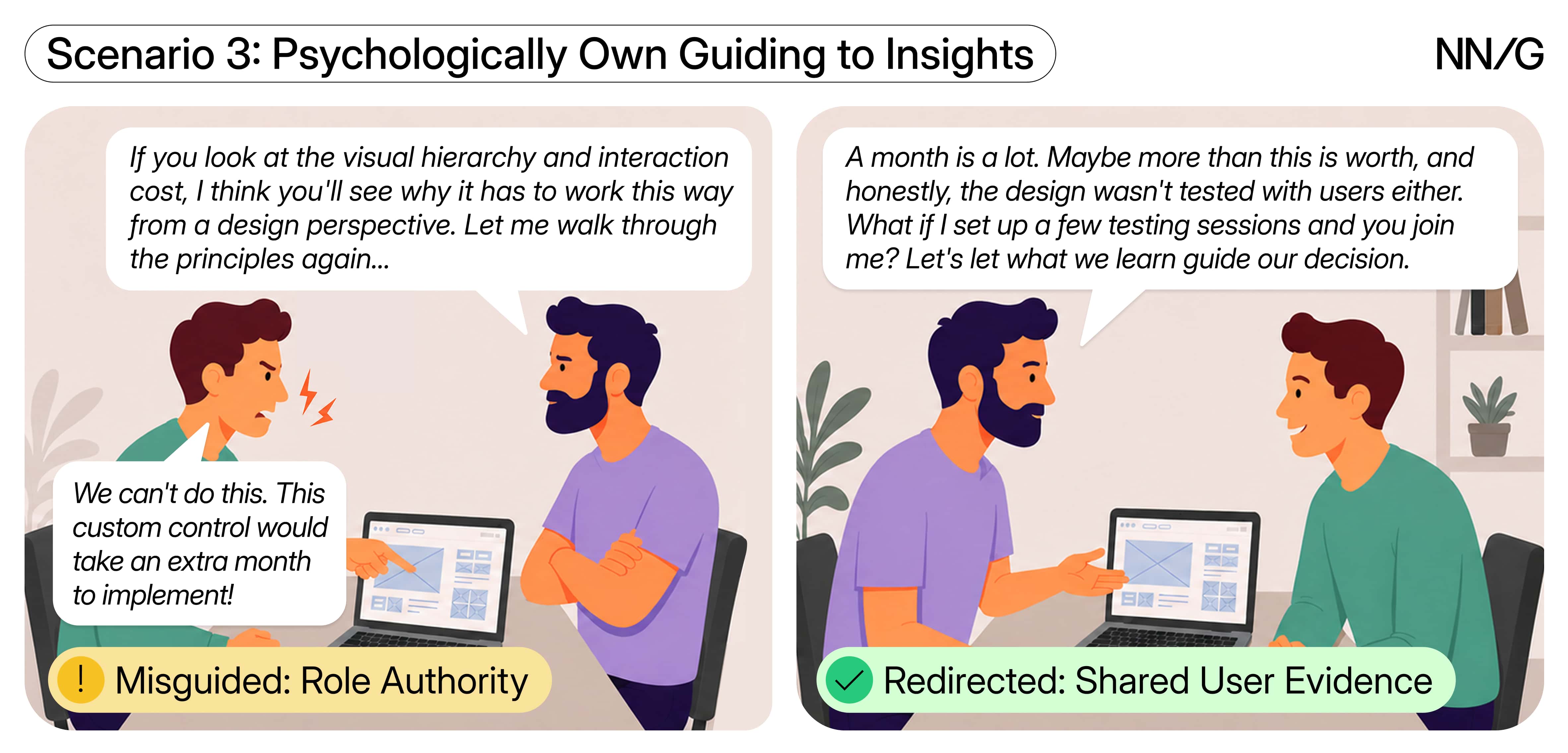
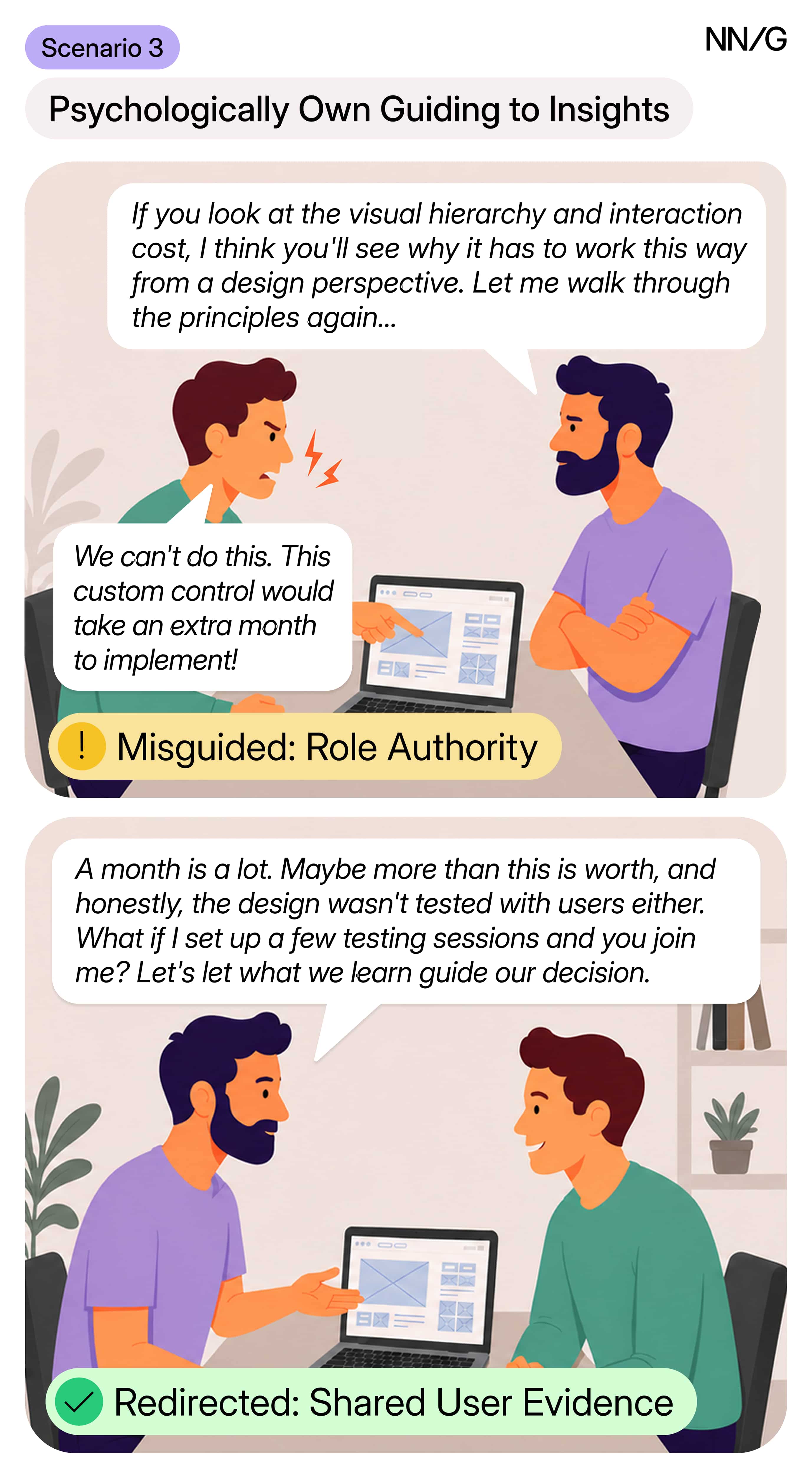
- The Problem: Escalating design disagreements into arguments by relying solely on your role authority and personal expertise to defend your choices.
- The Redirect: Own guiding others to experience user insights. When skepticism arises, stop trying to win the argument through sheer force of will. Instead, involve your colleagues directly in discovery research or comparative usability testing. Let real user data settle the debate, transforming a personal disagreement into a shared educational moment.
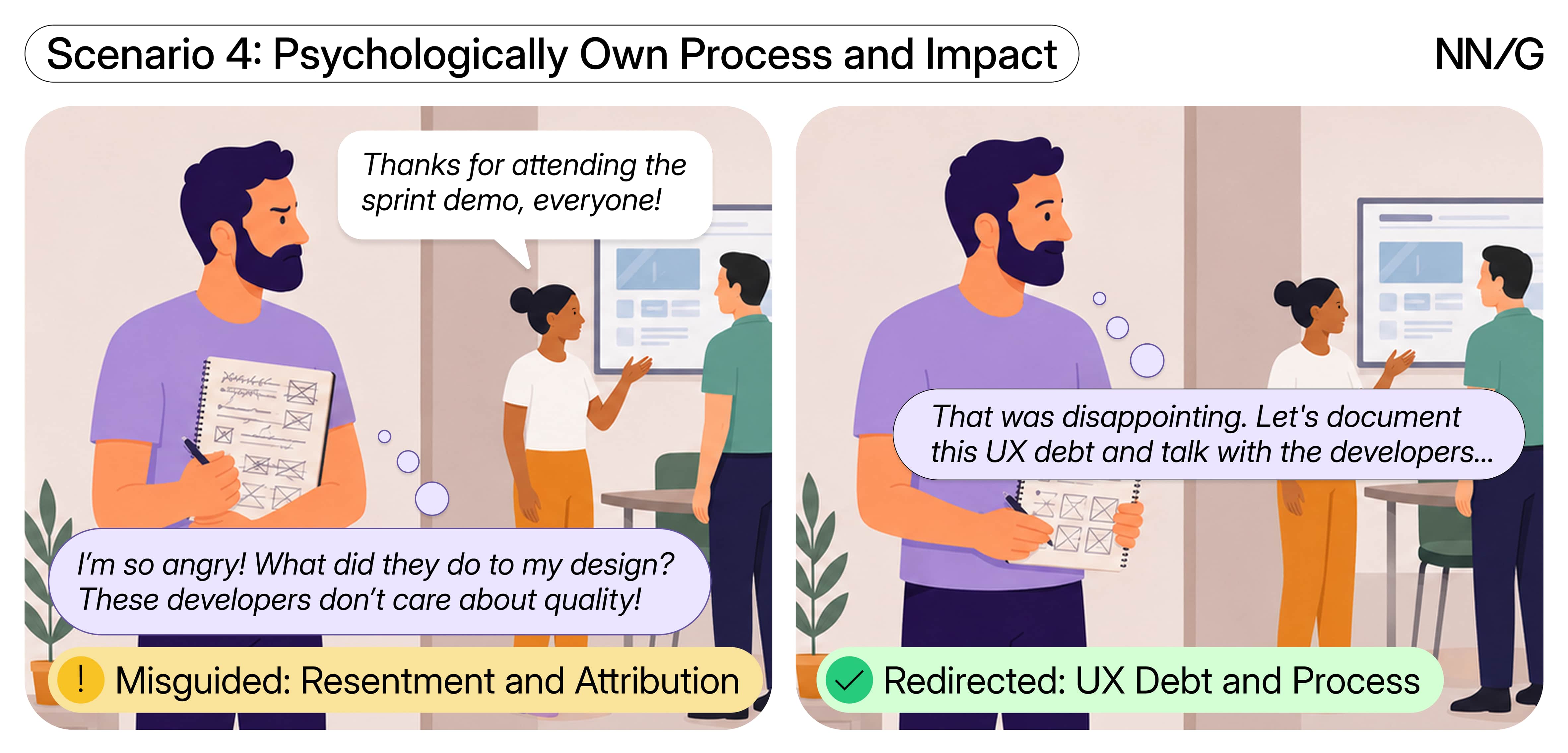
Scenario 4: The Divergent Build vs. UX Debt and Process
- The Problem: Fuming when a shipped feature diverges from your original designs, viewing developers’ compromises as a personal insult or a lack of care for quality.
- The Redirect: Own monitoring impact and improving your process. Acknowledge your disappointment, but resist the fundamental attribution error—the cognitive bias of assuming others’ choices stem solely from poor character rather than systemic constraints like deadlines or technical debt. Document the gaps as official UX debt, follow up with engineers to understand the constraints they faced, and focus your energy on what you can actually control.
Future Outlook: Defining What is Genuinely Yours to Own
If designers must loosen their grip on shared artifacts, shipped features, and organizational decisions, what remains within their legitimate sphere of control? A great deal, provided they look inward rather than outward.
What You Can (and Should) Fully Own:
- Your Professional Judgment: The analytical frameworks and frameworks you use to evaluate problems.
- Your Actions and Initiative: How proactively you seek out data, conduct research, and advocate for accessibility.
- Your Career Growth: The continuous acquisition of new skills, methods, and domains of knowledge.
- Your Core Values: Your commitment to ethical design, user advocacy, and inclusive practices.
- Your Interpersonal Boundaries: Managing your energy, establishing healthy work-life integration, and maintaining psychological safety.
By taking absolute personal responsibility for these internal pillars while holding external outputs loosely, designers can defuse the risk of burnout.
A Call to Action for Design Leaders
Organizational leaders must also evolve. Mindlessly echoing corporate slogans that demand "total ownership" from junior staff—particularly in environments with low UX maturity—is a recipe for disaster. The most passionate designers are precisely the ones most vulnerable to attaching ownership to the wrong targets. Leaders must actively coach their teams on these psychological distinctions, fostering a culture where accountability is balanced with psychological safety, collaborative problem-solving, and shared responsibility.
Ultimately, psychological ownership cannot be switched off; it is an intrinsic part of creative passion. But by consciously choosing what that instinct holds onto, designers can transform a potential source of exhaustion into a sustainable engine for long-term professional growth and meaningful impact.