

Executive Overview
The foundational economic engine of the multi-billion-dollar B2B software industry is broken. For over two decades, the per-seat pricing model served as the gold standard for enterprise software monetization. It acted as a reliable, predictable proxy for headcount, which in turn tracked corporate growth and organizational output. If a company hired more employees, it bought more licenses; software vendors watched their revenues scale effortlessly alongside their customers’ headcount.
Today, that nexus has shattered. Following recent commentary by ZoomInfo CEO Henry Schuck—who polled top-tier consultants and hundreds of core enterprise customers only to conclude that "nobody knows" where B2B pricing is heading next—industry leaders are waking up to an uncomfortable reality: sitting still is no longer a viable strategy; it is a slow death spiral.
The traditional seat-based model is collapsing under the weight of three compounding pressures: four relentless years of SaaS inflation that have exhausted corporate budgets, a massive strategic shift by Chief Information Officers (CIOs) who are actively cutting traditional software licenses to fund AI tokens, and the fundamental decoupling of software licensing units from actual enterprise value creation.
As artificial intelligence agents and automation begin to handle workloads once reserved for large teams, companies are achieving exponentially greater output with fewer human logins. Consequently, the seat model has become counterproductive—punishing customers for efficiency and failing to capture the true value of modern software. To survive this paradigm shift, the enterprise software ecosystem is undergoing a chaotic, high-stakes migration toward three emerging economic frameworks: consumption pricing, outcome-based pricing, and resolution-based pricing.
Detailed Chronology of the Pricing Shift
The unraveling of the B2B SaaS pricing model did not happen overnight; it is the culmination of macroeconomic trends, aggressive vendor pricing strategies, and the sudden, disruptive arrival of enterprise-grade artificial intelligence.
Phase 1: The SaaS Inflation Peak (2022–2025)
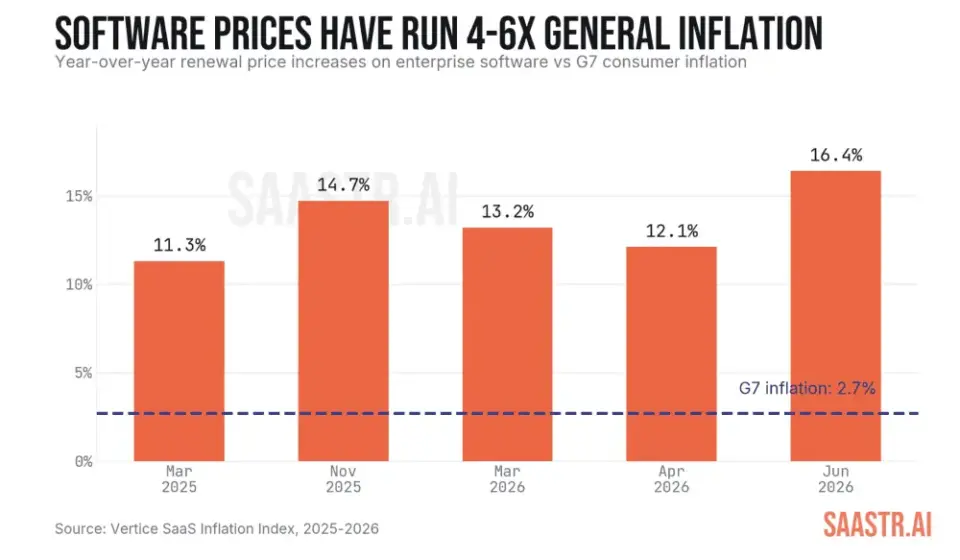
For four straight years, software vendors leaned heavily on per-seat pricing to expand margins and meet ambitious growth targets, completely outstripping broader macroeconomic indicators. According to the Vertice SaaS Inflation Index, which tracks tens of billions of dollars in enterprise technology spend, SaaS inflation persistently outpaced general G7 economic inflation (averaging around 2.7%) by margins of 12% to 16.4%.
By the end of 2025, the average software cost per corporate employee skyrocketed to approximately $9,100, up sharply from $7,900 in 2023. Zylo’s 2026 SaaS Management Index—compiled from more than 40 million licenses and $75 billion in tracked enterprise spending—revealed the breaking point: the average enterprise spent $55.7 million annually on SaaS, representing another 8% increase in total spend, even though their overall application portfolio remained entirely flat at 305 applications.
Enterprise software budgets were not growing because companies were buying more tools; they were growing because vendors were aggressively inflating prices on existing contracts.
Phase 2: The CIO Budget Reallocation (Late 2025–Early 2026)
By late 2025 and moving into 2026, the cumulative financial strain triggered a fierce backlash. CIOs hit a definitive wall. Faced with continuous 12%+ annual price hikes, renewal discussions transformed from routine administrative exercises into bitter cost-cutting negotiations.
Simultaneously, the widespread enterprise deployment of generative AI and autonomous agents introduced a fierce new competitor for corporate IT budgets: the token bill. Industry research from Redpoint, Goldman Sachs, and Creative Strategies painted a clear picture of shifting capital. Data indicated that roughly two-thirds of AI inference and token costs were not being funded by net-new budget additions; instead, they were being forcibly reallocated from existing technology budgets.
Crucially, enterprises began putting these cost-cutting strategies into writing. Publicly, major professional services firms like Publicis Sapient announced sweeping plans to slash traditional SaaS licenses—including core enterprise staples like Adobe—by roughly half to redirect capital toward AI-native tooling. When Fortune 500 buyers publicly normalize cutting legacy software to fund tokens, enterprise procurement teams across the Global 2000 quickly follow suit.
Phase 3: The Decoupling of Headcount and Value (Mid-2026)
By mid-2026, the foundational premise of seat pricing—that more people equal more value—became completely obsolete. Generative AI agents began doing the heavy lifting of Level 1 customer support, data processing, and administrative workflows.
When a corporate support team handles triple the customer volume using the exact same 40 human agents, seat-based pricing bills the enterprise the same amount for tripling its output. Conversely, when headcount drops from 40 to 25 because autonomous AI agents successfully handle the workload, seat-based vendors inadvertently punish themselves by shrinking their own invoices.

This mismatch explains a striking market dynamic observed throughout 2026: while total enterprise software spending continues to grow robustly, traditional categories strictly tied to per-seat models (CRM, sales automation, marketing tech, and collaboration tools) are stalling in single-digit growth, while the broader tech market surges ahead by over 15%. The market demand for digital transformation hasn’t slowed down; the billing unit simply broke.
Supporting Context & Metrics
To fully grasp the structural transformation sweeping the enterprise software landscape, one must analyze the empirical data governing corporate IT spend, software inflation, and the financial performance of companies that have successfully modernized their business models.
Key Metrics at a Glance
- 16.4%: The peak SaaS inflation rate recorded by Vertice in mid-2026, towering far above the G7 general inflation rate of roughly 2.7%.
- $9,100: The average annual software cost per corporate employee by the end of 2025, up from $7,900 in 2023.
- $55.7 Million: The average annual enterprise spend on SaaS according to Zylo’s 2026 index, representing an 8% year-over-year increase despite application counts remaining completely flat.
- 79% & 78%: The proportion of IT leaders who experienced unexpected price increases at renewal, or unexpected charges tied directly to AI features and consumption-based metrics, respectively.
- 72 Cents vs. 28 Cents: According to Creative Strategies’ index data, out of every incremental dollar spent on AI initiatives, only 28 cents represents net-new IT budget. The remaining 72 cents is cannibalized directly from pre-existing software stack allocations.
The Rise of Alternative Pricing Frameworks
Faced with the terminal decline of the legacy seat model, three distinct pricing structures have emerged to fill the vacuum. They vary wildly in operational difficulty, predictability, and alignment with modern AI capabilities:
- Consumption Pricing: Customers pay strictly for what they use—credits, API calls, tokens, records processed, or compute runs. Pioneered by infrastructure and data giants like Snowflake, Databricks, MongoDB, and Twilio, this model maps tightly to resource utilization. However, without proper guardrails, it frequently triggers severe bill shock and financial forecasting nightmares for corporate CFOs.
- Outcome-Based Pricing: Customers pay exclusively when a defined, measurable business result occurs—such as a closed-won deal, a verified cost reduction, or a completed mortgage application. While difficult to implement in complex go-to-market categories plagued by long attribution cycles, it converts a speculative software expense into an undeniable, quantifiable business case.
- Resolution-Based Pricing: A simplified, highly practical variant of outcome pricing, resolution billing focuses on discrete, countable operational events. A support ticket was fully resolved by an AI agent, or it wasn’t; a data record was accurately retrieved, or it came back null. With fixed per-resolution rates ranging generally from $0.50 to $1.50 across market leaders, this model eliminates ambiguity and aligns buyer and vendor incentives seamlessly.
Official Statements and Industry Insights
The discourse surrounding the B2B pricing crisis has drawn sharp commentary from industry titans, highlighting the widening chasm between agile new market entrants and legacy software incumbents.
Henry Schuck, CEO of ZoomInfo:
"Nobody knows [where B2B pricing is going]. Not the experts, not the customers, and the answer keeps changing week to week. But sitting still is not a strategy, it’s a slow death spiral today."
Jason Lemkin, SaaS investor and founder of Saastr:
Highlighting the unprecedented, record-breaking hyper-growth of modern outcome- and resolution-driven companies like Palantir and Sierra against legacy SaaS stagnation, Lemkin noted:
"Almost everyone’s growth rate decays at scale. Not Palantir. It just pulled off a quarter (and a year) like we’ve never seen: revenue grew 93% year-over-year to $1.935 billion… twelfth consecutive quarter of accelerating growth, and 47% GAAP operating margins."
The Procurement Perspective:
Enterprise procurement teams and CIOs have made their shifting expectations clear through various industry surveys (including Redpoint’s comprehensive 2026 studies). With 46% of CIOs explicitly anticipating that usage- or outcome-based pricing will become the dominant enterprise standard, and 29% actively expecting seat-based pricing to decline outright, institutional buyers are no longer willing to underwrite the traditional headcount-based licensing tax.
Future Outlook: Surviving the Post-Seat Era
As the enterprise software industry charges deeper into the second half of the decade, the strategic imperative for software executives is clear. The companies dominating the next era of enterprise technology—such as Palantir, Sierra, and modern AI-first platforms—succeeded not merely by building superior algorithms, but by aligning their billing architecture directly with the value they deliver from day one.
For legacy incumbents weighed down by entrenched pricing models, the road ahead is grueling. Abandoning per-seat pricing requires simultaneous, high-risk overhauls across four load-bearing organizational pillars:
- Rewiring Compensation Plans: Sales and customer success teams accustomed to selling and defending multi-year seat licenses must be retrained and re-incentivized around usage, resolution metrics, or consumption thresholds.
- Transforming Revenue Recognition: Financial reporting and forecasting models must pivot away from predictable, ratable annual recurring revenue (ARR) toward fluctuating, consumption- or outcome-driven cash flows.
- Overhauling Product Delivery: Software architectures must be refactored to incorporate real-time metering, transparent usage dashboards, and strict budget guardrails that prevent accidental enterprise bill shock.
- Shifting Implementation Risk: Companies must move away from pushing the burden of deployment onto the customer’s IT team, adopting forward-deployed engineering motions that prove tangible value prior to contract execution.
Strategic Recommendations for Incumbents
To navigate this tumultuous transition without losing market share to agile new entrants, software leadership teams must act decisively:
- Audit Your Value Metric: Determine whether your software’s core utility is best measured by compute consumption, operational resolutions, or verified business outcomes.
- Launch Controlled Experiments: Do not attempt a wholesale, overnight migration of your entire customer base. Spin up isolated business units or new product SKUs to test consumption and resolution pricing in targeted market segments.
- Build Guardrails into Consumption Models: If you adopt usage- or token-based pricing, you must provide customers with robust controls—including automated spend caps, real-time alerts, and intelligent usage throttling—to completely eliminate consumer bill shock.
- Embrace Transparency: Make pricing clarity a competitive advantage. When buyers can easily map every dollar spent to a countable resolution or a verified business result, the exhausting enterprise pricing negotiation evaporates entirely.
Per-seat pricing was a brilliantly effective proxy for corporate value during an era when human headcount dictated operational output. That proxy has permanently broken. Software now executes tasks that once required entire departments, and the enterprises extracting the highest value from technology are rapidly shrinking their human footprints. Vendors that fail to adapt their pricing models to reflect this new economic reality will find themselves subsidizing the very AI token bills threatening to replace them. The future belongs to those brave enough to modernize their monetization strategies before the market forces their hand.
What do you feel about this post?

Like

Love

Happy

Haha

Sad

Angry