Beyond the Generic Bot: How to Train Artificial Intelligence to Think, Reason, and Scale Like You

Executive Overview
In the rapidly evolving landscape of modern enterprise, a pervasive narrative has taken root among knowledge workers: artificial intelligence is coming for your job. The conventional wisdom warns that LLMs (Large Language Models) and generative AI systems will soon commoditize professional expertise, rendering unique human insights interchangeable with algorithmic output.
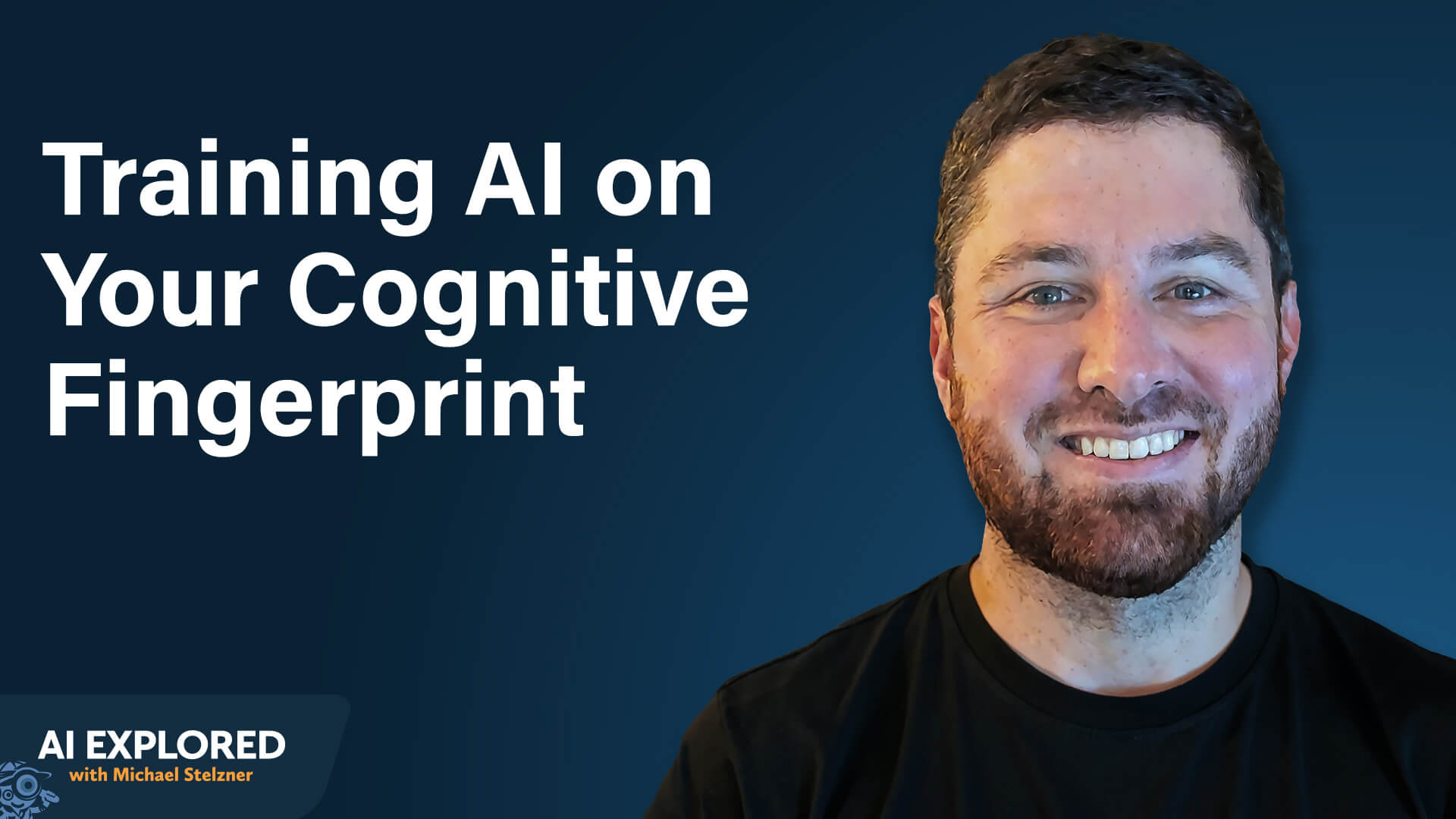
However, a counter-movement is emerging among forward-thinking strategists, marketers, and consultants. Spearheaded by experts like Max Bernstein—in collaboration with industry analysts such as Michael Stelzner—this approach argues that the key to surviving and thriving in an AI-dominated economy is not to work harder at writing generic prompts, but rather to teach AI how you actually think.
Most attempts at personalizing AI fail because they rely on surface-level interactions: filling out static questionnaires, tweaking style preferences, or prompting an AI to interview you about your job. These methods capture only what an expert can consciously articulate in a formal setting. Yet, according to foundational principles of cognitive science, true expertise operates largely below the surface in the realm of tacit knowledge—the things experts know instinctively but cannot easily describe on demand.
To bridge this gap, Bernstein has introduced a robust, step-by-step framework known as the Cognitive Fingerprint Interview. By processing unscripted meeting transcripts, coaching sessions, and problem-solving dialogues through a specialized four-layer knowledge matrix, professionals can extract their unique decision DNA. The result is a portable, 20-to-30-page context document that enables any AI platform to reason, write, and execute tasks precisely like its human creator. This comprehensive report explores the philosophy, mechanics, and transformative business applications of building your own cognitive fingerprint.
Detailed Chronology: The Evolution of AI Personalization
The quest to make artificial intelligence sound human has undergone a radical transformation over the past several years, moving from simple stylistic tweaks to deep psychological and cognitive mirroring.
Phase 1: The Era of Surface-Level Prompting
When generative AI first entered the mainstream professional consciousness, personalization was largely confined to "persona prompts." Users would type commands such as: "Act as an expert copywriter with ten years of experience in B2B SaaS marketing." While these prompts altered the superficial tone of the output, they produced generalized, robotic responses that lacked genuine industry depth or individual nuance. The AI sounded professional, but it sounded like every professional.
Phase 2: The Interview Loop Limitation
Recognizing the limitations of static prompts, innovators began utilizing AI-driven questionnaires. Users instructed the AI to interview them—asking questions about their communication style, professional philosophy, and preferred workflows—and then fed those answers back into the system as system instructions.
While this method offered a slight improvement, Bernstein and other cognitive analysts identified a fatal flaw: it is fundamentally limited by human self-awareness. When professionals sit down to describe their own methodology, they default to what cognitive scientists call declarative knowledge. They list their job titles, standard procedures, and high-level summaries, completely missing the nuanced, instinctual decision-making that actually drives their success.
Phase 3: The Tacit Knowledge Revolution and the Cognitive Fingerprint
To solve the problem of missing expertise, industry pioneers turned to cognitive science—specifically drawing upon the decades-old theories of philosopher Michael Polanyi, who famously noted that "we can know more than we can tell."
Rather than forcing humans to artificially manufacture a description of themselves, Bernstein realized that the raw material for authentic AI personalization already exists in our daily digital footprints. By capturing unscripted, real-world conversations—such as client calls, team brainstorms, and coaching sessions—and analyzing them through a structured four-layer framework, AI could finally be trained to replicate true human cognition. This methodology gave birth to the "Cognitive Fingerprint," shifting AI utilization from generic automation to exact cognitive replication.
Supporting Context & Metrics: The Four Layers of Expert Knowledge
At the heart of the cognitive fingerprint methodology is a rigorous framework that categorizes human expertise into four distinct strata of depth. Extracting all four layers is what separates a superficial AI customization from a genuine cognitive mirror.
[Level 4: Metacognitive Knowledge] -> Mental Models & Thinking About Thinking
[Level 3: Conditional Knowledge]   -> Decision DNA (If-Then Logic)
[Level 2: Procedural Knowledge]    -> Step-by-Step Execution (SOPs)
[Level 1: Declarative Knowledge]   -> Surface Facts & Job Descriptions
1. Declarative Knowledge (The Surface Layer)
Declarative knowledge represents the most basic level of expertise. It is the information you would naturally put on a LinkedIn profile, a corporate bio, or an introductory pitch deck. It covers what you do and the high-level facts of your profession. While necessary, it is entirely insufficient for deep AI training because it lacks context, personality, and operational mechanics. Most casual AI personalization attempts begin and end here.
2. Procedural Knowledge (The Execution Layer)
Moving one layer deeper, procedural knowledge encompasses how you execute your work. It includes the step-by-step sequences, methodologies, and standard operating procedures (SOPs) you follow to achieve a specific outcome. Where declarative knowledge names the destination, procedural knowledge maps out the exact route taken to get there. Extracting this layer from transcripts is often used to automate repeatable business workflows.
3. Conditional Knowledge (Decision DNA)
Conditional knowledge introduces true personalization into the AI training pipeline. This layer governs the "if-then" logic behind your actions: the specific conditions, triggers, and situational variables that dictate when and why you deploy certain strategies.

For instance, when a particular type of client presents a unique challenge, a specific advisory pattern instinctively kicks in. These dynamic shifts feel entirely automatic to the practitioner, but they represent accumulated professional judgment that no generic algorithm can guess. Bernstein refers to this collection of conditional rules as your decision DNA.
4. Metacognitive Knowledge (The Deepest Layer)
The deepest and most valuable stratum of the cognitive fingerprint is metacognitive knowledge—how you think about thinking. This includes your core mental models, cognitive biases, frameworks for evaluating uncertainty, and the underlying philosophy that guides your worldview.
Crucially, metacognitive knowledge is almost impossible to self-diagnose accurately. When professionals are asked to describe their own mental models in a survey, their self-assessed descriptions rarely match what an objective analysis of their actual conversational transcripts reveals. This discrepancy underscores why passive self-reporting fails and why processing unscripted conversational data through AI is mandatory for true cognitive replication.
Official Strategies: How to Build and Deploy Your Cognitive Fingerprint
Transitioning from theory to execution requires a deliberate, multi-step process involving data collection, specialized transcription tools, and advanced prompting techniques.
Step 1: Collect Unscripted Transcripts
Questionnaires and prepared speeches will not yield a true cognitive fingerprint. The raw material must come from unscripted, real-world interactions where your expertise operates without active curation. High-yield sources include:
- Client Coaching and Advisory Sessions: The natural back-and-forth draws out tacit knowledge and problem-solving instincts.
- Sales and Discovery Calls: Captures how you read a room, handle objections, and adapt your messaging in real time.
- Team Brainstorms and Strategy Meetings: Reveals how you generate, evaluate, and synthesize novel ideas.
- Solo Voice Memos: Capturing raw thoughts while driving, walking, or processing tasks between meetings.
Experts recommend compiling a minimum of 3 to 5 transcripts from genuinely diverse contexts. Furthermore, adding a brief context note at the top of each file (e.g., "Client Coaching Session" or "Internal Product Strategy") helps the AI understand your operational mode during pattern extraction.
Step 2: Leverage Modern Transcription Tech
The tooling ecosystem for capturing clean conversational data has evolved far beyond basic meeting bots:

- For Virtual Meetings: Tools like Google Meet, Zoom, and Fathom offer automated transcription. However, advanced tools like Granola operate as background audio processes with customizable output templates that integrate seamlessly into Notion and other team workspaces.
- For In-Person Interactions: Wearable hardware such as Plaud clips directly to clothing or attaches to mobile devices to record live dialogue.
- For Solo Brainstorming: Voice-to-text engines like Wispr Flow allow users to speak context and ideas directly into an AI session, producing richer, more natural prompts than typed text.
Step 3: Prompt AI to Build the Fingerprint
Once your labeled transcripts are uploaded into an advanced project environment (such as a ChatGPT project, Claude project, or Gemini Gem), deploy a structured extraction prompt. Instruct the AI to analyze the text simultaneously across all four knowledge layers—identifying declarative statements, procedural sequences, conditional decision logic, and metacognitive mental models, while proactively flagging potential blind spots or unstated assumptions.
As subsequent transcripts are uploaded, the AI builds incrementally upon previously discovered patterns. The cumulative output is a comprehensive, 20-to-30-page cognitive fingerprint document.
Step 4: Operationalize Your Portable Context Layer
The ultimate advantage of the cognitive fingerprint is its portability. Because the AI landscape shifts rapidly—with new models launching and user preferences evolving—having a static context document ensures your unique voice travels seamlessly across platforms. Whenever a new tool drops, you simply load your fingerprint file into the project container, instantly equipping the model with your exact mental models and decision logic.
Future Outlook: The Strategic Implications of Scaled Expertise
The implications of the cognitive fingerprint methodology extend far beyond day-to-day productivity gains. As businesses and knowledge workers adopt this framework, several profound shifts are taking shape across the professional landscape:
- The Rise of Explicit Intellectual Property: For consultants, coaches, and agency owners, the hardest part of building courses, frameworks, or proprietary methodologies has always been translating intuitive expertise into structured assets. By making tacit knowledge explicit, the cognitive fingerprint document serves as the foundational blueprint for creating high-value intellectual property.
- Team-Level Cognitive Mapping: When multiple members within an organization develop individual cognitive fingerprint files, leadership gains unprecedented visibility into team dynamics. Organizations can map out who excels at analytical reasoning, who leverages narrative framing best, and who generates optimal ideas in unstructured environments. This clarity revolutionizes project assignment, internal pitching, and cross-functional collaboration.
- Redefining Professional Value: In an era where generative AI can effortlessly manufacture mediocre content, human value will no longer be measured by the volume of output produced, but by the uniqueness of the cognitive models behind it. By training AI to think like you, you do not replace your expertise—you scale it, ensuring that your distinct professional voice remains irreplaceable in an automated world.