

Executive Overview
In the rapidly evolving landscape of software development and product design, an artificial intelligence revolution is fundamentally altering what it means to build. With AI increasingly capable of handling complex coding, data processing, and asset generation—tasks that historically defined the core value proposition of engineers and designers—professionals across tech sectors face mounting pressure to pivot. The mandate has shifted from how to build to what to build.
This paradigm shift has brought a historically elusive concept to the forefront of industry discourse: product sense.
Widely regarded as the secret weapon of elite product managers, designers, and founders, product sense is frequently invoked yet rarely defined with operational precision. Traditional definitions lean heavily on abstract notions of user empathy and creative ideation. While vital, these definitions leave product builders stranded in ambiguity, offering little guidance on how to measure, cultivate, or deploy this critical skill.
This article dismantles conventional wisdom surrounding product sense. By synthesizing cognitive psychology, decision-making research from experts like Daniel Kahneman and Gary Klein, and modern product development realities, we propose a rigorous, actionable framework. True product sense is not a mystical, innate gift. Rather, it is a cognitive pattern-matching engine forged by closing the experimentation loop—and crucially, knowing when those patterns no longer apply.
Detailed Chronology: The Evolution of Product Decision-Making
To understand the modern crisis of product sense, one must trace how decision-making authority has migrated through the technology sector over the past two decades.
Phase 1: The Execution-Heavy Era (Pre-2015)
In the early days of scalable software and mobile apps, the primary bottleneck was engineering feasibility. Product teams were heavily focused on execution. Designers crafted interfaces, and engineers wrote robust code to bring wireframes to life. Product management existed largely to bridge business goals with engineering constraints. Decisions regarding what to build were often dictated by top-down executive vision or rudimentary market research, while "product sense" was treated as an unquantifiable trait possessed only by seasoned entrepreneurs.
Phase 2: The Data-Driven Boom (2015–2022)
As analytics platforms, A/B testing frameworks, and continuous deployment pipelines matured, the tech industry swung hard toward empirical optimization. Every feature release, button color, and layout change was subjected to rigorous quantitative testing. While this era produced massive efficiencies, it inadvertently fostered a generation of product builders who optimized locally while losing sight of macro-level product vision. Product sense was often sidelined in favor of incremental metric-chasing.
Phase 3: The Generative AI Disruption (2023–Present)
The sudden democratization of generative AI has compressed execution timelines to near-zero. Tasks that once required weeks of frontend development or intensive UX research can now be prototyped in minutes. Consequently, execution has been commoditized.
This compression has left designers, engineers, and product managers exposed. Without the shield of complex implementation challenges, professionals are forced to answer the ultimate question: Is this the right thing to build? The term "product sense" has surged in popularity to describe this capability, yet the industry remains unequipped to teach it systematically.
Supporting Context & Metrics: The Anatomy of Product Sense
Deconstructing Existing Definitions
The most widely cited benchmark for product sense belongs to Jules Walter, who wrote in Lenny’s Newsletter in 2022:
"Product sense is the skill of consistently being able to craft products (or make changes to existing products) that have the intended impact on their users. Product sense relies on (1) empathy to discover meaningful user needs and (2) creativity to come up with solutions that effectively address those needs."
While eloquent, Walter’s definition—alongside similar frameworks from industry leaders like Jackie Bavaro, Julie Zhuo, and Marty Cagan—suffers from an operational blind spot. It treats empathy and creativity as static inputs. Much of the prevailing advice encourages aspiring product builders to consume scattered inputs: reading newsletters, tearing down competitor apps, studying design systems, and analyzing case studies.
However, accumulating these inputs does not automatically generate reliable intuition. Gathering data points without context is like studying chess game transcripts without ever playing a match; you understand the theory, but you freeze when confronted with a novel board state.
A New Definition of Product Sense
To move beyond vague abstractions, we must define product sense through the lens of cognitive psychology:
Product sense is the ability to recognize when current problems match past successes or failures and reliably estimate how similar solutions will affect desired outcomes.
This definition shifts product sense from an artistic disposition to a structured pattern-matching mechanism. It mirrors how experts across high-stakes fields—such as fire chiefs, neonatal intensive care (NICU) nurses, and chess grandmasters—make split-second, high-accuracy decisions in low-information environments.
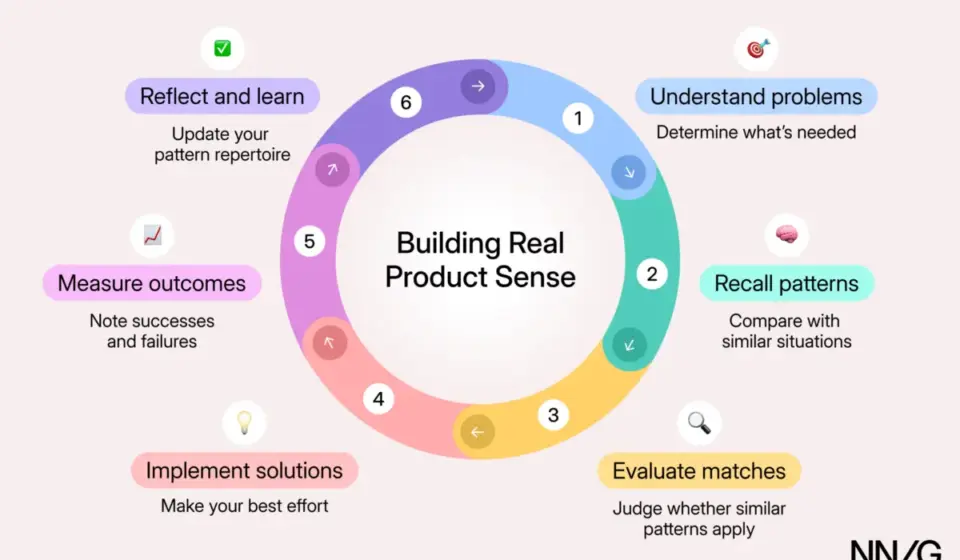
These experts do not rely on raw gut feeling. They rely on a deep mental repertoire built by completing the full experimentation loop:
- Understanding the initial problem.
- Recalling relevant past patterns.
- Evaluating potential matches.
- Implementing solutions.
- Rigorously measuring outcomes.
- Reflecting on and internalizing the results.
Official Perspectives: The Three Categories of Decision Environments
A critical component of product sense is knowing when your experience applies and, equally importantly, when it does not. Drawing on the foundational work of psychologists Daniel Kahneman, Gary Klein, and Robin Hogarth, we can categorize decision-making environments into three distinct tiers.
+-------------------------------------------------------------------------+
|                  THE THREE DECISION ENVIRONMENTS                        |
+-------------------------------------------------------------------------+
| 1. High-Validity Situations                                             |
|    - Mirrors past learning environments.                                |
|    - Clear, familiar cues allow for reliable pattern-matching.          |
+-------------------------------------------------------------------------+
| 2. Low-Validity Situations                                              |
|    - Novel environments with thin cues and long feedback loops.         |
|    - High uncertainty; trusting intuition alone is dangerous.           |
+-------------------------------------------------------------------------+
| 3. Wicked Situations (Most Dangerous)                                   |
|    - Superficial similarities mask underlying differences.              |
|    - Triggers false confidence, reinforcing incorrect patterns.         |
+-------------------------------------------------------------------------+
1. High-Validity Situations
In high-validity environments, the current problem mirrors the contexts in which an expert learned their patterns. Familiar cues are abundant, making pattern matching straightforward and reliable.
- Example: A senior UX designer who has optimized dozens of standard mobile e-commerce checkout flows encounters a minor drop-off issue in a new retail app. Because the user psychology and friction points remain consistent, the designer can diagnose and fix the issue rapidly without exhaustive new user research.
2. Low-Validity Situations
Low-validity situations diverge significantly from past experience, or they lack immediate, clear feedback loops regarding the impact of an action.
- Example: Building a zero-to-one AI agent with an extended feedback loop. Even seasoned product leaders have limited historical precedent here. Relying purely on "product sense" in these environments is a high-stakes gamble; rigorous assumption-testing and continuous discovery are mandatory.
3. Wicked Situations
Coined by organizational theorist Robin Hogarth, "wicked situations" represent the greatest hazard for product builders. Unlike low-validity environments—where uncertainty is transparently obvious—wicked situations feel identical to high-validity ones. They present familiar surface-level cues, but their underlying dynamics are fundamentally different.
- Example: A product team successfully scales a feature in Product A and attempts to replicate it verbatim in Product B for a different demographic. Because the team assumes a direct pattern match, they skip user testing. The feature bombs. The team’s intuition was tricked by superficial similarities, leading them to reinforce a flawed mental model while inflating their misplaced confidence.
True product sense requires the metacognitive awareness to distinguish between these environments, ensuring builders never blindly apply past playbooks to novel landscapes.
Future Outlook: Surviving and Thriving in the Age of AI
As artificial intelligence absorbs the mechanical aspects of software creation, the industry faces a profound vocational hazard: the outsourcing of learning.
When AI writes code, generates user flows, and synthesizes customer feedback in seconds, human product builders are increasingly relegated to managing outputs rather than owning outcomes. This creates a dangerous illusion of experience. A product manager or engineer who orchestrates dozens of AI-generated feature launches per month—without ever sticking around to analyze long-term retention metrics, customer support tickets, or unintended side effects—is accumulating administrative hours, not product sense. They resemble the firefighter who arrives for the first half of a shift to handle initial calls, but leaves before seeing whether the building structurally collapses.
To remain indispensable in the coming decade, product professionals must actively resist the temptation to decouple themselves from the full product-building lifecycle.
Actionable Strategies for Cultivating Product Sense
- Own the Full Loop: Refuse to hand off features immediately after deployment. Mandate that you or your team review quantitative retention curves and qualitative user feedback 30, 60, and 90 days post-launch.
- Audit Your Mental Models: When a feature succeeds or fails, write down why you thought it would perform that way. Compare your hypothesis against reality to calibrate your pattern-matching engine.
- Interrogate Analogies: Whenever you hear the phrase, "This worked wonderfully at our last company," pause. Treat that statement as a red flag and force the team to articulate why the current context matches the historical precedent.
- Embrace Intentional Friction: Use AI to accelerate execution, but deliberately slow down during problem definition and outcome measurement. Protect the cognitive spaces where deep learning occurs.
Conclusion
Buzzwords will continue to cycle through the tech ecosystem, but the core competency of building valuable things for humans will endure. Product sense is not a mystical trait reserved for visionary founders; it is a disciplined, experience-honed mastery of pattern recognition and context evaluation.
Artificial intelligence will undoubtedly rewrite how we build software, but it cannot synthesize lived accountability. By staying in the ring, owning your strategic decisions, and unflinchingly facing their empirical results, you ensure that your intuition remains the most valuable asset in the room.