
Cutting Through the Hype: How the PROVE Framework Empowers Tech Workers to Evaluate AI Objectively

Executive Overview
In the modern digital workplace, tech professionals are caught in a relentless crossfire. On one side, executive leadership issues sweeping mandates to accelerate delivery, aggressively integrate newly procured artificial intelligence suites, and keep pace with a dizzying weekly cadence of model updates. On the other side, these same workers are expected to maintain meticulous quality standards, cut operational overhead, and absorb new software proficiencies entirely on the fly—without sacrificing an hour of their core project timelines.
This pervasive anxiety-driven corporate environment has birthed a culture of superficial evaluation. Under immense pressure to demonstrate compliance or capture fleeting productivity gains, workers typically default to two detrimental extremes: either they engage in endless, unstructured tinkering with every shiny new tool that hits the market, or they reject AI altogether out of deep-seated skepticism and fatigue. Both approaches miss the fundamental target. They fail to answer the core metric that matters: Compared to your existing human workflow, does this specific tool produce an outcome genuinely worth adopting?
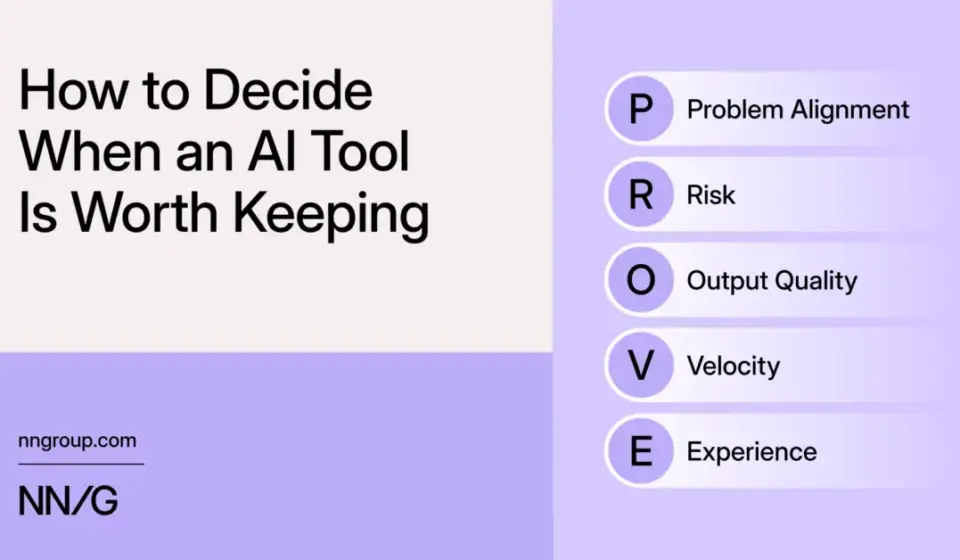
To counter this systemic issue, the Nielsen Norman Group (NN/g) has developed PROVE, a streamlined, rigorous evaluation framework tailored for individual contributors and product teams. Standing for Problem Alignment, Risk, Output Quality, Velocity, and Experience, PROVE offers a disciplined methodology to test a single tool against a single task. By the end of the evaluation, the user is left with an empirically grounded, defensible decision that can be transparently communicated to managers, clients, or skeptical teammates.
Rather than serving as a blanket corporate mandate or an enterprise-wide procurement tool, PROVE acts as a personal operational shield. It cuts through the deafening noise of corporate AI hype, replacing emotional pressure with empirical evidence.
Detailed Chronology: The Anatomy of a Practical AI Evaluation
To understand how the PROVE framework operates in the wild, it is helpful to examine a real-world application. Consider the routine workflow of curating and drafting a weekly research digest for an internal product team’s Slack channel. This task requires skimming two to four industry articles, synthesizing their core themes, and writing a brief, engaging commentary with direct links.
An evaluation using the PROVE methodology unfolds across five distinct, sequential checkpoints.
Phase 1: Problem Alignment
The initial temptation with any novel technology is to open a browser tab, log in, and start randomly prompting the model. While recreational exploration can be entertaining, it yields zero actionable data regarding workplace utility. Before spending a dime, altering a pipeline, or encouraging peers to adopt a system, the evaluator must explicitly define the target task.
- The Core Question: What specific friction point or bottleneck does this tool alleviate?
- The Application: In evaluating Google’s Gemini Notebooks (formerly NotebookLM) for the weekly Slack digest, the task passed alignment immediately. The work is recurring—making any efficiency gains compound over time. The stakes are internal and conversational, meaning it does not demand exhaustive publication-quality prose. Furthermore, Gemini Notebooks’ core mechanic—uploading reference documents and prompting the model to synthesize across them—maps directly onto the preparation phase of the digest. Because access was already provisioned through the corporate Google Workspace, zero bureaucratic friction or procurement delays stood in the way.
Phase 2: Risk Assessment
Before uploading a single byte of data into an AI sandbox, professionals must evaluate data governance and security parameters. In a climate of intense corporate pressure to "use AI," employees frequently resort to "shadow AI"—spinning up unauthorized personal accounts or pasting proprietary code and sensitive data into consumer-grade tools. Research by UpGuard indicates that approximately 80% of employees admit to using unapproved AI services. However, widespread adoption does not equate to safety.
- The Core Question: Is the tool approved, and does its privacy policy safeguard the specific data classification being introduced?
- The Application: Because the inputs for the research digest consisted exclusively of published, publicly available web articles, no proprietary intellectual property, unreleased product strategies, or confidential user data were at risk. Furthermore, a review of Gemini Notebooks’ enterprise documentation verified that Workspace user uploads and queries are shielded from human review and are never utilized for model training. Had the workflow involved confidential user research transcripts or unreleased code, this phase would have immediately terminated the evaluation.
Phase 3: Output Quality Benchmarking
Once safety and utility are established, the AI’s output must be directly benchmarked against authentic historical work. Quality is not a monolithic standard; an internal brainstorming outline requires a vastly different threshold of excellence than an executive-facing client proposal.
- The Core Question: Is the AI-generated version better than, as good as, or sufficiently adequate compared to your existing human baseline?
- The Application: The evaluator uploaded three distinct sources—a classic 1983 white paper on the ironies of automation, an industry podcast transcript, and a recent essay on AI coding agents—into Gemini Notebooks, prompting it to generate a team Slack digest. The resulting output was factually pristine: every assertion traced accurately back to the correct source without any algorithmic hallucinations. However, structurally, it read like an academic report, complete with rigid numbered lists and formal Summary/Significance metadata tags. In contrast, the human-authored baseline read like a conversational colleague sharing insights. While the content was captured flawlessly, the distinct human voice was missing.
Phase 4: Velocity Measurement
A common illusion in generative AI tooling is the intoxicating speed of generation time. A model may spit out a thousand words in three seconds, creating an illusion of hyper-efficiency. However, if those three seconds of generation require thirty minutes of painstaking error correction, reformatting, and context-switching, the net velocity of the workflow has deteriorated.
- The Core Question: What is the total end-to-end time consumed with the tool versus without it (including setup, prompting, validation, editing, and deployment)?
- The Application: Drafting the weekly digest entirely by hand traditionally required roughly 25 minutes. Utilizing Gemini Notebooks for the initial pass—followed by necessary voice editing—reduced total end-to-end processing time to approximately 10 minutes. Even accounting for a minor initial learning curve, the velocity metric yielded a clear net positive.
Phase 5: Experience and Recurring Friction
A tool can boast pristine output quality and impressive net velocity while still failing miserably in daily, long-term practice due to user-experience friction. Small administrative burdens—such as forcing users to shuttle files across disjointed browser tabs, manage awkward file conversions, or endure repetitive configuration setups—compound severely over time.
- The Core Question: Does the tool integrate smoothly into daily habits, or does it introduce persistent administrative overhead?
- The Application: While initial setup friction was negligible, Gemini Notebooks introduced a frustrating architectural penalty: workflow fragmentation. Writing the digest manually historically required a clean three-step sequence: select articles, draft directly in Slack, and publish. Introducing Gemini Notebooks inflated the process into a cumbersome six-step handoff: select articles, download or copy source text, upload to the notebook, generate synthesis, copy-paste the output back into the local editor, and finally format and post to Slack. The tool sat awkwardly between source selection and final publishing, demanding two extra administrative handoffs every week. Consequently, this dimension received the lowest score in the evaluation.
Supporting Context & Metrics: Decoding the Results
To translate subjective impressions into concrete data, the PROVE framework utilizes a straightforward five-point rating scale across its core performance vectors, where a score of 3 represents parity with the evaluator’s legacy workflow.
When mapping out the Gemini Notebooks evaluation, the final scoring profile emerged as follows:
- Problem Alignment: High (Directly maps to a weekly recurring bottleneck)
- Risk: Clear (Public data inputs; secure enterprise privacy terms)
- Output Quality: Above Par (Factually accurate, though deficient in conversational voice)
- Velocity: High (Total drafting time compressed from 25 minutes down to 10)
- Experience: Low-to-Moderate (Introduced workflow fragmentation and extra handoffs)
The Four Pillars of Defensible Decision-Making
Scores alone merely highlight behavioral patterns; they do not replace critical thinking. To finalize an evaluation—whether for personal workflow adoption or presentation to skeptical organizational stakeholders—an evaluator must be able to articulate a concise narrative addressing four key questions:
- What specific task was evaluated? (Drafting a weekly research digest for a team Slack channel.)
- How did the AI tool compare to the existing baseline? (It produced accurate, complete drafts and cut total time from 25 minutes to 10, though it required deliberate voice editing.)
- What is the immediate next step? (Commit to a one-month trial period to confirm sustained time savings.)
- What are the acknowledged caveats? (The output retains a clinical, report-like tone rather than a natural human cadence, necessitating manual rewriting.)
This structured communication prevents common organizational overreaches. It ensures that a single test on a single workflow is correctly framed as an operational screen rather than an absolute verdict, neutralizing the temptation to mandate enterprise-wide tool adoption based on isolated demo successes.
Official Statements and Industry Perspectives
The introduction of frameworks like PROVE arrives at a critical juncture for enterprise technology management. Industry analysts and workplace psychologists have increasingly warned against the psychological toll of "AI fatigue" and mandatory tool proliferation.
In recent advisory seminars, workplace productivity researchers have emphasized that organizational pressure is fundamentally distinct from empirical evidence. As methodology experts at the Nielsen Norman Group articulate:
"Pressure to adopt AI isn’t evidence that a tool actually helps. When leadership demands that teams move faster and leverage newly purchased software suites without carving out dedicated learning time, evaluation inevitably collapses into reactive chaos. We must decouple corporate anxiety from technical validation. A framework like PROVE empowers workers to look management in the eye and say: ‘This specific tool did not improve this specific workflow enough to justify its operational cost, risk, or friction.’"
Furthermore, cybersecurity researchers studying the proliferation of shadow AI echo these warnings from a data governance perspective. Data compiled by UpGuard underscores that unauthorized tool utilization is driven almost entirely by the friction of official procurement cycles clashing with the desperate need for personal productivity gains. By institutionalizing lightweight evaluation frameworks, organizations can bridge the gap between employee agility and enterprise compliance, fostering an environment where security policies and productivity enhancement operate in tandem rather than in opposition.
Future Outlook: Building a Trustworthy AI Stack
The ultimate objective of deploying evaluation frameworks like PROVE is not to build an impenetrable shield against technological progress, nor is it to blindly chase every algorithmic breakthrough released into the wild. Rather, the goal is to cultivate a lean, highly trusted stack of digital instruments that demonstrably elevate human capability.
Treating the outcome of a PROVE evaluation as a provisional decision is paramount. Software ecosystems evolve at a breakneck pace; foundation models update, enterprise security postures shift, and individual competencies mature. A workflow that fails an evaluation today due to poor user experience or rigid output formatting may successfully pass a re-evaluation six months later following a major software update. Consequently, teams should establish a cadence of revisiting shelved tools after significant product iterations.
Looking ahead, the maturity of the tech industry will be measured not by how many AI licenses an organization purchases, but by its ability to separate genuine operational enhancement from empty technological theater. By replacing vague executive edicts ("use more AI") with rigorous, evidence-based inquiries ("which workflows have we tested, and where did the data show improvement?"), professionals can reclaim agency over their daily work.
Ultimately, the goal is to clear away the suffocating pile of impressive yet counterproductive AI novelties, leaving behind a streamlined, dependable suite of tools that genuinely make work better, faster, and more human.