
Google Play Overhauls Its Ecosystem: A Comprehensive Analysis of New Billing Flexibility, Restructured Fees, and Developer Programs

By Global Tech & Business Desk
Published: March 2026
Executive Overview
In what marks one of the most substantial structural shifts in the history of mobile app marketplaces, Google has formally unveiled a sweeping overhaul of its Google Play business model. Announced by Paul Feng, Vice President of Google Play Engineering, Product, and UX, the initiative introduces unprecedented billing flexibility, a complete decoupling of service fees from transaction processing fees, and revamped incentive structures aimed at rewarding developers who build exceptional user experiences.
The announcement follows a series of regulatory pressures, developer feedback loops, and an overarching corporate mandate to foster a more open, competitive Android ecosystem. For years, major app store operators have faced intense scrutiny regarding mandatory in-app payment systems and commission rates. Google’s latest pivot directly addresses these criticisms by allowing developers in key territories—including the United Kingdom, the European Economic Area (EEA), and the United States—to integrate alternative billing options, direct users to external web links, and benefit from lower, segmented cost frameworks.
Crucially, these changes are not merely cosmetic. They represent a fundamental redesign of how digital commerce is conducted on Android. By separating the baseline service fee from the payment processing fee, Google is attempting to carve out a middle ground that satisfies regulatory demands for open market access while retaining its value proposition as a secure, scalable distribution platform.
This comprehensive report explores the anatomy of Google Play’s new business model, detailing the mechanics of alternative billing, the fine print of the restructured fee schedules, the upgraded criteria for the "Games Level Up" and "Apps Experience" programs, and the staggered global rollout timeline that developers must navigate in the months ahead.

Detailed Chronology & Policy Evolution
The journey toward this modernized framework has been gradual, shaped by a complex interplay of antitrust litigation, regional legislation—such as the European Union’s Digital Markets Act (DMA)—and continuous dialogue with the global developer community.
The Path to Openness
Earlier in the year, Google signaled a major philosophical shift when it teased a "new era for choice and openness" on Android. Historically, developers distributing apps through Google Play were strictly required to use Google Play’s proprietary billing system for digital goods and services. While this system streamlined tax compliance, multi-market currency conversions, and fraud detection across more than 195 markets and 300 local payment methods, it left little room for commercial maneuverability or fee negotiation.
The introduction of the new billing choice programs represents the maturation of pilot initiatives previously tested in select regions. Now, Google is scaling these options into a standardized global framework.
Key Milestones and Implementation Phases
The rollout of these sweeping changes is structured across a careful timeline, designed to give developers adequate breathing room to adapt their backend systems, user experience flows, and financial models.
- Initial Phase (United States, EEA, and UK): Beginning June 30, 2026, developers operating in these major economic zones will experience the first wave of restructured service and billing fees. This phase serves as the proving ground for the decoupled fee architecture.
- Program Adaptation Window: Throughout the summer of 2026, developers are encouraged to review updated guidelines for user choice screens, alternative payment integrations, and web-link redirection policies.
- Ecosystem Programs Launch: Set for September 30, 2026, the official availability of the newly minted "Games Level Up" and "Apps Experience" program rate cards will open doors for high-performing developers to secure even lower commission tiers.
- Global Staggered Rollout: Because these adjustments require deep technical infrastructure integration and close alignment with localized financial regulations, the remaining global markets will follow a staggered release schedule over the subsequent quarters.
Core Pillars of the New Framework
To fully understand the impact of Google’s announcement, developers and industry analysts must examine the three foundational pillars upon which the new policy is built: Billing Flexibility, Separated Fees, and Ecosystem Incentive Programs.

1. Advanced Billing Flexibility and Choice Screens
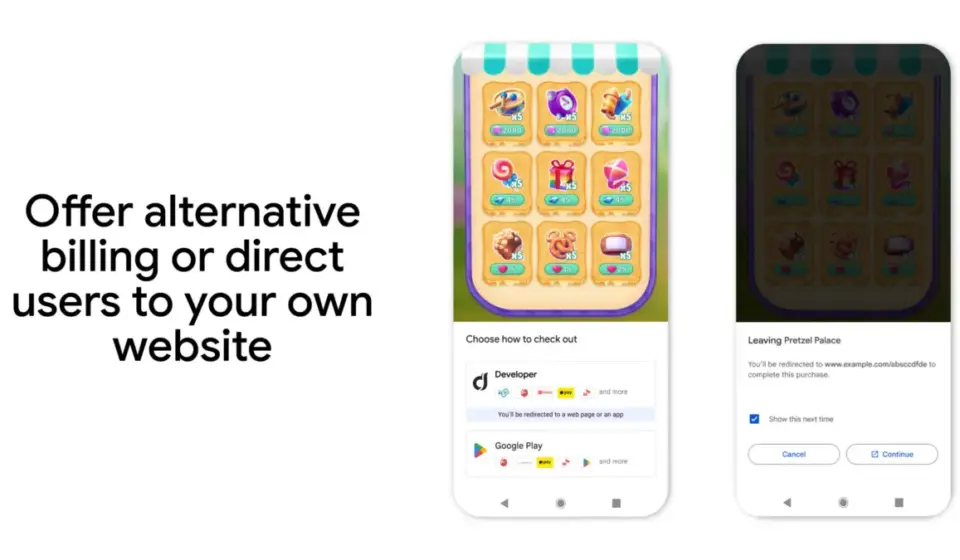
Under the expanded billing choice programs, developers are no longer locked into a single payment gateway. While Google Play’s native billing system remains a robust, out-of-the-box solution for handling compliance, fraud mitigation, and local payment preferences worldwide, developers now possess the autonomy to:
- Offer Alternative Billing Systems: Integrate third-party payment processors directly within their apps alongside Google Play’s default checkout.
- Redirect Users Externally: Guide users seamlessly to the developer’s proprietary website to complete transactions.
- Design Custom Choice Screens: Rather than relying solely on Google’s default UI prompt, developers can design their own choice screens, provided they strictly adhere to Google’s updated UX guidelines. This ensures that users retain clarity regarding data privacy, security, and refund processes while maintaining brand consistency for the developer.
2. Separated Fees: Service vs. Billing
Perhaps the most financially significant aspect of the update is the decoupling of the service fee from the billing fee. Previously lumped together as a single commission percentage, these costs are now itemized to reflect the true cost of platform maintenance versus payment processing.
- The Baseline Service Fee: Regardless of whether a developer utilizes Google Play’s billing system, an alternative payment gateway, or an external web link, a baseline service fee applies. This fee is pegged at an attractive 10% on the first $1 million (USD) in annual earnings for all developers. Furthermore, this favorable 10% rate extends to all auto-renewing subscriptions, providing long-term relief for subscription-based business models.
- The Transaction/Billing Fee: For transactions processed directly through Google Play’s robust billing infrastructure, an additional billing fee applies. In the US, UK, and EEA, this billing fee is set at a flat 5%. Conversely, for transactions processed via alternative billing systems or external web links, this billing fee is entirely waived.
This structural separation grants developers a clear mathematical formula to calculate whether the convenience of Google’s payment rails outweighs the cost, factoring in third-party payment processing fees incurred elsewhere.
3. Incentivizing Excellence: Games Level Up & Apps Experience Programs
Google is doubling down on its commitment to high-quality software craftsmanship. Recognizing that apps and games offering superior technical performance, user interface design, and deep engagement enrich the entire Android ecosystem, Google has overhauled two flagship developer initiatives:
- Games Level Up: A revamped program tailored specifically for game studios that meet stringent performance, optimization, and player experience benchmarks.
- Apps Experience Program: A brand-new framework designed to reward non-game applications that push the boundaries of utility, design, and accessibility on Android.
Qualifying developers who meet the rigorous criteria set forth on the respective program portals will unlock access to an exclusive program rate card. These specialized rate cards offer substantially reduced fee tiers, providing a powerful financial incentive for studios and enterprise developers to invest heavily in the quality and polish of their Android releases ahead of the September 30, 2026 deadline.

Supporting Context & Strategic Metrics
The timing and structure of Google’s policy pivot cannot be viewed in a vacuum. Over the past half-decade, the digital marketplace ecosystem has undergone profound legal, economic, and cultural transformations.
Economic Pressures and Developer Margins
For smaller independent studios and mid-sized tech companies, operating margins on mobile platforms have historically been squeezed by standard 15% to 30% commission rates. By lowering the entry-level service fee to 10% for the first million dollars earned—and extending that 10% rate to subscriptions regardless of billing mechanism—Google is directly addressing the profitability of early-stage startups and indie developers.
Subscription models, in particular, stand to gain immensely. In the modern app economy, recurring revenue is the lifeblood of software-as-a-service (SaaS) and digital media apps. Applying a predictable 10% service fee to subscriptions lowers the barrier for developers attempting to scale recurring revenue streams without sacrificing vital capital needed for user acquisition and product iteration.
Regulatory Alignment
Regulators across the globe—most notably the European Commission under the Digital Markets Act—have continually pushed gatekeeper platforms to open their ecosystems to inter-operable payment systems and fair commercial conditions. Google’s global expansion of alternative billing choice programs into the UK, EEA, and the United States demonstrates a proactive regulatory compliance strategy. By establishing transparent, standardized rules for alternative billing and web redirects, Google is preempting potential antitrust penalties while crafting an environment where developers can choose their preferred commercial path.
Official Perspectives and Guidance
In his policy briefing, Paul Feng emphasized that these updates stem from a dual commitment: protecting the end-user experience while empowering developers with the adaptability required to thrive in a competitive digital economy.

"At Google Play, we are committed to delivering the best possible experience to users, while ensuring developers have the tools and adaptability to succeed," Feng noted. "Evolving our business model requires technical infrastructure and alignment with local regulations, so these updates will roll out on a staggered timeline to ensure a smooth transition for everyone involved."
Actionable Steps for Developers
Google has urged developers not to wait until the final hours of the rollout schedule. To prepare effectively, development and finance teams should take the following actions:
- Audit Current Monetization Pipelines: Evaluate existing payment flows to determine whether migrating certain transaction types to alternative billing or external web links makes financial sense when weighed against the 5% billing fee and third-party processor costs.
- Review UX Guidelines: Familiarize internal design teams with Google’s updated choice screen specifications to ensure any custom payment routing UI remains fully compliant with platform policies.
- Target Ecosystem Programs: Review the technical and operational benchmarks required for the Games Level Up and Apps Experience programs. Optimizing app performance to meet these criteria before September 30, 2026, can yield significant long-term commission savings.
- Consult Official Documentation: Utilize the Google Play Console, developer blogs, and Help Center articles (such as Help Center Article #17161464 and #16954621) for precise regional rate card breakdowns and implementation guides.
Future Outlook: The Next Generation of Android Experiences
As the mobile app industry looks toward the latter half of the decade, Google Play’s evolving business model signals a mature, pragmatic approach to ecosystem management. The days of monolithic, one-size-fits-all app store policies are rapidly giving way to modular, flexible frameworks that balance security with commercial freedom.
By decoupling service and billing fees, embracing alternative commerce paths, and financially rewarding high-quality engineering through the Games Level Up and Apps Experience initiatives, Google is laying the groundwork for a more dynamic Android marketplace. For developers, these changes unlock new strategic levers to optimize revenue, foster deeper customer relationships, and scale businesses globally.
As the staggered rollout progresses through regional milestones in 2026 and beyond, the success of this new era will ultimately be measured by how seamlessly developers adapt these tools to deliver richer, more innovative experiences to billions of Android users worldwide.