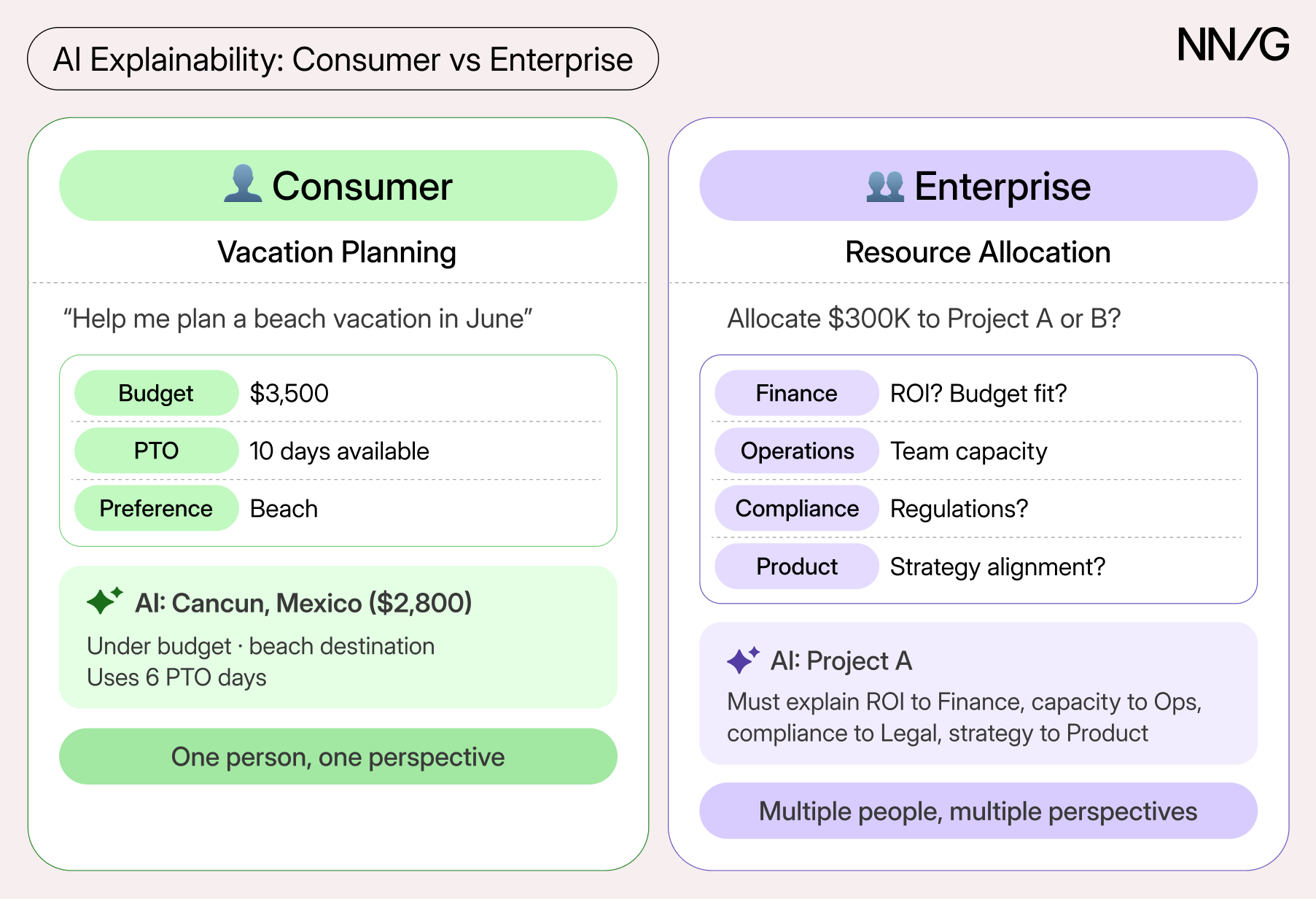
As organizations globally race to integrate artificial intelligence into their core operations, a persistent barrier continues to stall meaningful employee adoption: the "black box" nature of enterprise AI. While consumer-facing applications can afford to deliver mysterious, probabilistic recommendations—such as a curated playlist or a suggested vacation itinerary—enterprise deployments carry vastly different stakes. When organizations deploy AI tools that directly influence livelihoods, manage proprietary data, and dictate compliance metrics, the cost of opaque system behavior is catastrophic. Misconfigured AI agents or unexplainable model decisions can trigger cascading corporate liabilities, regulatory penalties, and a complete breakdown of internal trust.
Yet, solving this transparency crisis requires moving past the superficial notion that AI explainability is a universal feature. According to new insights from user experience research and enterprise software development frameworks, different enterprise roles need entirely different types of explanations to understand AI outputs.
Whether it is a governance lead evaluating system-wide compliance, a developer debugging an autonomous help-desk agent, or a domain expert validating business outputs, stakeholders approach AI with distinct goals, operational contexts, and levels of technical expertise. Consequently, treating enterprise AI explainability as a monolithic, one-size-fits-all solution is a recipe for organizational friction. To foster genuine trust and drive long-term adoption, platform vendors and internal development teams must intentionally design context-specific explanation layers tailored to the specific jobs-to-be-done across the enterprise hierarchy.
Detailed Chronology: The Evolution of Enterprise AI Transparency
The trajectory of artificial intelligence in the workplace has evolved rapidly over the past decade, shifting from isolated experimental models to deeply integrated, autonomous enterprise agents. Understanding how the industry arrived at the current imperative for role-based explainability requires tracing this operational evolution.
Phase 1: The Era of Black-Box Machine Learning (Pre-2018)
In the early days of corporate machine learning adoption, predictive models were treated as statistical oracles. Data science teams deployed complex neural networks and random forest models to forecast churn, predict supply chain bottlenecks, or screen resumes. Little to no emphasis was placed on how these models reached their conclusions. The prevailing philosophy among developers was that predictive accuracy superseded interpretability. However, as these systems began impacting hiring, credit scoring, and internal operations, organizations hit a brick wall: employees refused to use tools they could not understand, and legal teams flagged severe compliance vulnerabilities.
Phase 2: The Rise of General Consumer Explainability (2018–2022)
Recognizing the trust deficit, academic institutions and technology giants began developing foundational explainability frameworks. Notable among these was IBM’s landmark 2019 taxonomy of AI explainability techniques, which sought to classify how models reveal their reasoning. Simultaneously, user experience (UX) researchers began studying how consumers interacted with transparent AI features. However, nearly all design guidance during this period centered squarely on consumer use cases—helping individuals understand why a streaming service recommended a movie or how a digital assistant planned a trip. Enterprise systems, which require multi-stakeholder accountability and stringent risk management, remained poorly served by these consumer-grade solutions.
Phase 3: The Generative AI Boom and the Agentic Shift (2023–Present)
The widespread commercialization of Large Language Models (LLMs) and autonomous agentic workflows fundamentally altered the enterprise landscape. AI systems transitioned from passive prediction engines to active participants capable of taking actions, writing code, and resolving customer support tickets independently. With this autonomy came unprecedented organizational risk. A misdirected automated workflow could accidentally leak sensitive customer data or execute unauthorized financial transactions.
Industry leaders realized that AI governance could no longer be bolted on as an afterthought. Explainability transformed from a niche technical metric into a critical enterprise design discipline, necessitating structured methodologies—such as the Jobs-to-Be-Done (JTBD) framework—to map out precisely who needs to understand AI behavior, when they need it, and to what end.
Supporting Context & Metrics: The Three Pillars of Enterprise AI Users
To operationalize explainability effectively, organizations must recognize that enterprise AI ecosystems do not operate in a vacuum. They are architected, governed, and utilized by a diverse triad of professional roles. While traditional software engineering treats system users uniformly, enterprise AI requires segmenting internal stakeholders based on their functional responsibilities.
Who they are: Enterprise AI experts, Centers of Excellence (CoEs) leads, compliance officers, and solution architects.
Their Job-to-Be-Done: Define organizational best practices, evaluate AI tools against stringent security and regulatory standards, and advise executive leadership on responsible deployment strategies.
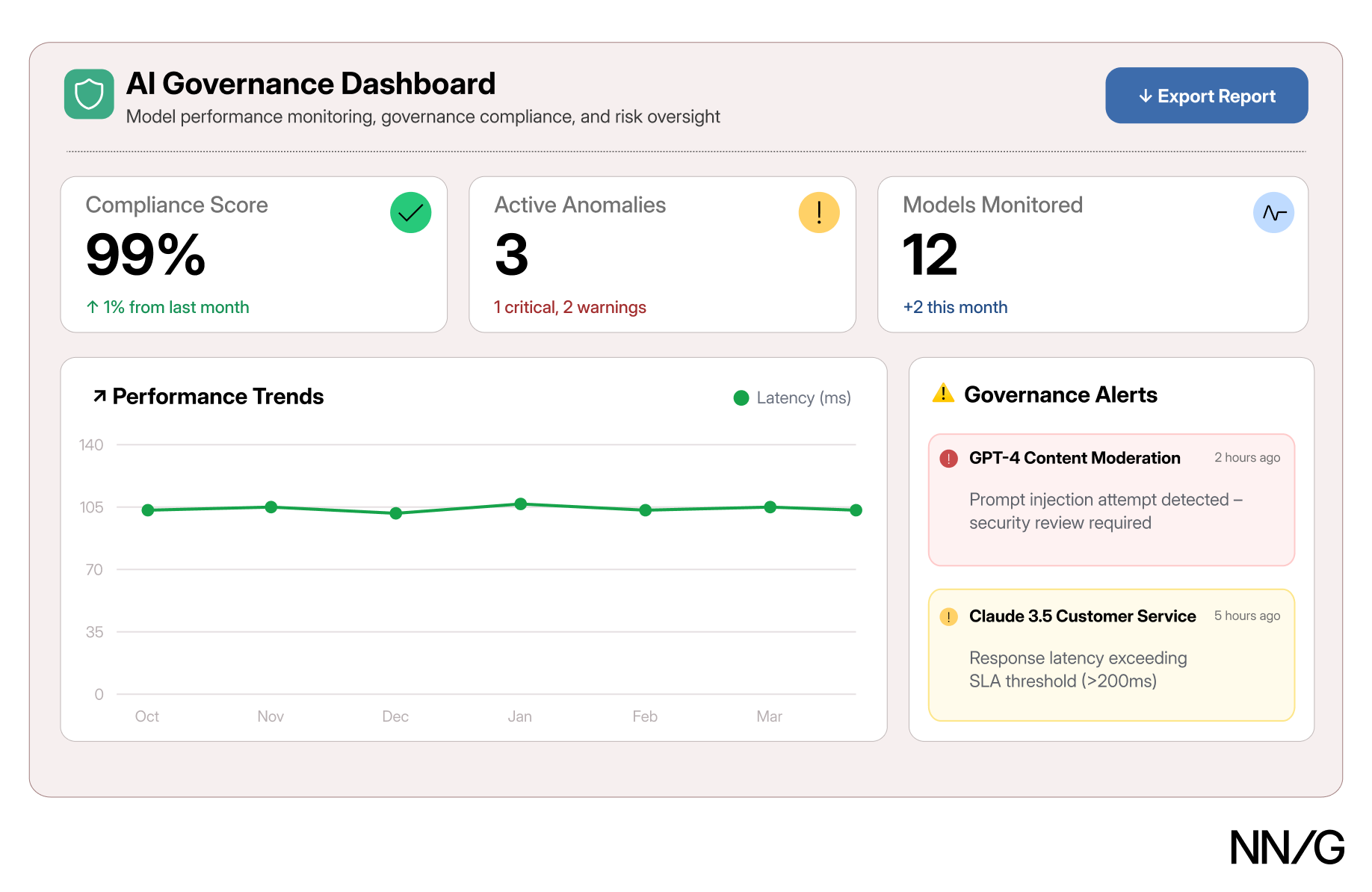
Explainability Requirements: Operating primarily at the system and process level, governance leads require global, model-based, and static explanations. They do not need to inspect individual predictions. Instead, they require high-level audit summaries, system-wide trend lines, compliance scores, and behavioral pattern analysis across multiple deployments to ensure that risk tolerances are strictly maintained at scale.
2. Builders (Developers, Platform Admins, and Configurers)
Who they are: Software engineers, platform administrators, prompt engineers, and operations managers who handle the hands-on configuration of AI tools.
Their Job-to-Be-Done: Translate abstract business requirements into fully functional, reliable AI solutions through continuous configuration, prompt tuning, and maintenance.
Explainability Requirements: Builders operate at the input-output level and require local, data-based, and interactive explanations. Because many builders bring deterministic expectations from traditional software development, they need visibility into probabilistic system behaviors to use AI as a debugging tool. Interactive interfaces that allow them to test "what-if" scenarios are vital for helping them build functional intuition and rapidly adjust confidence thresholds.
3. Domain Experts (Process Owners and Business Analysts)
Who they are: Service-desk leads, financial analysts, subject-matter experts, and process owners who intimately understand the daily workflow context into which AI must fit.
Their Job-to-Be-Done: Identify high-value AI opportunities, evaluate pre-deployment outputs, and continuously improve system performance by contributing specialized domain knowledge over time.
Explainability Requirements: Domain experts do not care about model internals, token limits, or latency benchmarks. They need local, data-based explanations coupled with embedded feedback mechanisms. When reviewing an AI-generated output, they need to see policy anchors, comparable historical precedents, and plain-language reasoning that they can readily verify, act upon, and explain to their teams.
Practical Application: The Help-Desk AI Scenario
To make these role-specific distinctions concrete, consider a midsize software company purchasing an enterprise AI Agent solution to automate its internal help-desk operations. Before the autonomous agent goes live, three distinct stakeholders must interact with it, each requiring a fundamentally different explanation style to move forward with confidence.
The Governance Perspective
Before deployment, the platform-governance lead must evaluate whether the agent is organizationally and regulatory compliant. She does not review individual chat logs. Instead, she relies on a pre-deployment audit dashboard displaying topic coverage metrics, out-of-scope handling rates, escalation logic boundaries, and aggregate confidence scores. This global explanation assures her that the agent operates within the company’s acceptable risk threshold before it ever touches an employee’s browser.
The Builder’s Perspective
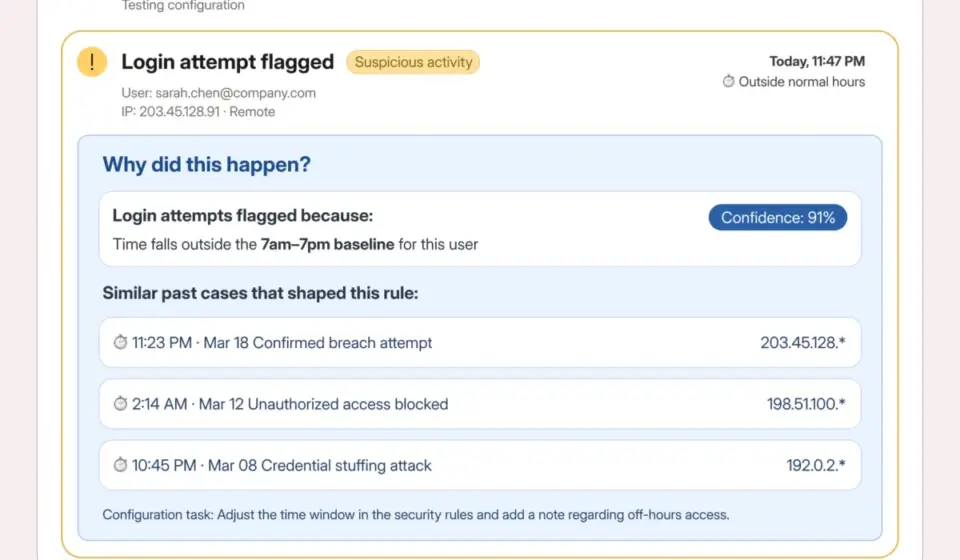
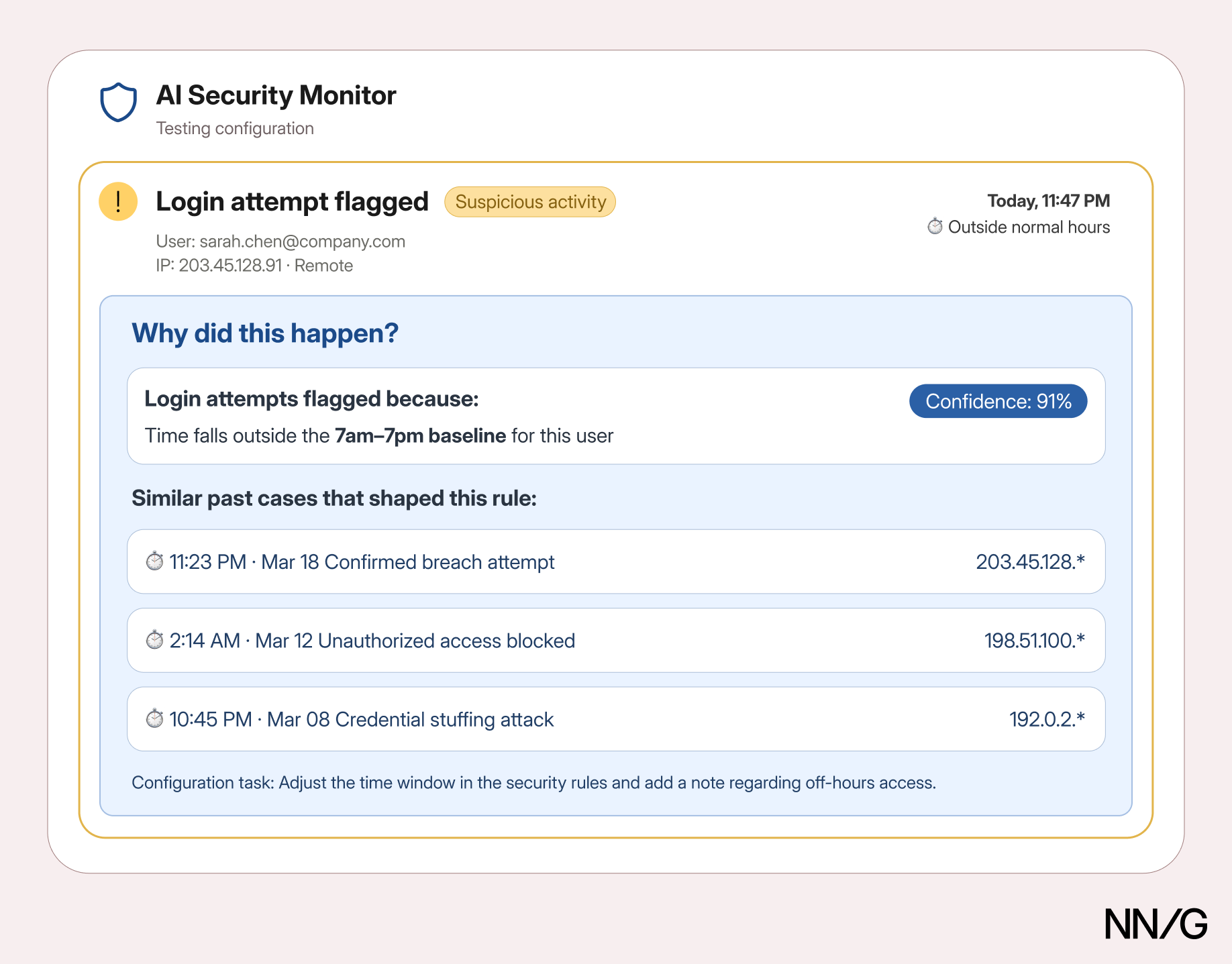
During configuration, a developer notices that password-reset requests are disproportionately rerouted to human agents, bypassing self-service protocols. Using an interactive local explanation, she isolates a specific test ticket and discovers that the user’s account was flagged for an multi-factor authentication review, which triggered an out-of-scope escalation (confidence score: 84%). Armed with this granular, data-based insight, she adjusts the system prompt’s scope definition with absolute precision.
The Domain Expert’s Perspective
An experienced IT support specialist with eight years of service-desk tenure reviews a batch of test responses. She spots an answer directing a user to a legacy, deprecated password-reset page. Rather than viewing a complex neural activation map, she receives a clear contextual summary: “This response was based on 14 similar past tickets directing users to the legacy portal prior to the recent systems migration; the updated policy document was added three weeks ago.” Using an embedded feedback widget ("Outdated policy"), she flags the issue instantly, closing the loop and improving the AI’s future accuracy without writing a single line of technical bug reports.
Official Statements and Industry Insights
Industry leaders and researchers emphasize that transparency is no longer optional for enterprise software procurement.
"AI explainability is the degree to which an AI system’s decisions are understandable to humans. It helps users see how and why an outcome was reached." — UX Research & Enterprise Standards Framework
According to recent management research highlighted in publications like the Harvard Business Review, overcoming organizational barriers to AI adoption depends heavily on psychological safety and institutional trust. When employees feel that AI systems operate as opaque, unaccountable entities, resistance mounts, leading to shadow IT workarounds and complete system abandonment.
Furthermore, human factors research underscores the direct link between interface design and cognitive workload. As noted by cognitive ergonomics researchers (Alami et al., 2025), mismatched explanation levels severely degrade multitasking performance and diminish user reliance on AI tools. When systems provide the right type of explanation to the right user at the exact moment of decision-making, cognitive friction drops significantly, empowering employees to become active, collaborative supervisors of technology rather than passive recipients of mysterious automated edicts.
Future Outlook: Designing for Real Enterprise Impact
As artificial intelligence matures and enterprise platforms become increasingly accessible, the rigid boundaries separating technical builders from business domain experts will continue to blur. However, the fundamental demand for contextual, role-calibrated explainability will only intensify.
Organizations that treat explainability merely as a compliance checklist item or an engineering afterthought will continue to struggle with low employee adoption, unpredictable system failures, and severe governance vulnerabilities. Conversely, enterprises that embrace explainability as a core design discipline—integrating global dashboards for executives, interactive debugging tools for developers, and plain-language, feedback-enabled interfaces for domain experts—will unlock the true transformative potential of artificial intelligence.
Ultimately, trust and explainability are entirely inseparable. By engineering systems that honor the unique contexts, goals, and jobs-to-be-done of every professional role within the corporate hierarchy, design practitioners can transform opaque algorithms into trusted, transparent collaborators that genuinely elevate human potential in the modern workplace.
Disclaimer: The views and opinions expressed in this article are solely those of the authors and do not necessarily reflect the official policy or position of ServiceNow or any other organization.
References
Alami, J., El Iskandarani, M., & Riggs, S. L. (2025). The Effect of Workload and Task Priority on Multitasking Performance and Reliance on Level 1 Explainable AI (XAI) Use. Human Factors: The Journal of the Human Factors and Ergonomics Society, 67(9). https://doi.org/10.1177/00187208251323478
Arya, V., Bellamy, R. K. E., Chen, P.-Y., Dhurandhar, A., Hind, M., Hoffman, S. C., Houde, S., Liao, Q. V., Luss, R., Mojsilović, A., Mourad, S., Pedemonte, P., Raghavendra, R., Richards, J., Sattigeri, P., Shanmugam, K., Singh, M., Varshney, K. R., Wei, D., & Zhang, Y. (2019). One Explanation Does Not Fit All: A Toolkit and Taxonomy of AI Explainability Techniques. arXiv preprint arXiv:1909.03012. https://doi.org/10.48550/arXiv.1909.03012