
Executive Overview
In the rapidly evolving landscape of artificial intelligence integration, product teams, engineering leads, and enterprise decision-makers face a quiet, persistent illusion. A developer prompts an AI customer-service model with a nuanced query—such as "Can I return an opened product after 30 days?"—and watches as the system generates a flawless, policy-compliant response. Thrilled by the coherence and speed, the team checks the box, declares the feature production-ready, and moves on.
This scenario plays out across boardrooms and code repositories daily. Yet, it represents a foundational misunderstanding of how generative artificial intelligence operates.
Unlike traditional, deterministic software where a feature that functions correctly once will do so reliably ad infinitum, AI language models are inherently nondeterministic. They operate via probabilities, selecting subsequent tokens from statistical distributions. Submitting the exact same input to the exact same model multiple times can yield entirely different outcomes: one run may explain the policy accurately, another may omit a vital exception, and a third may boldly promise an unauthorized refund.
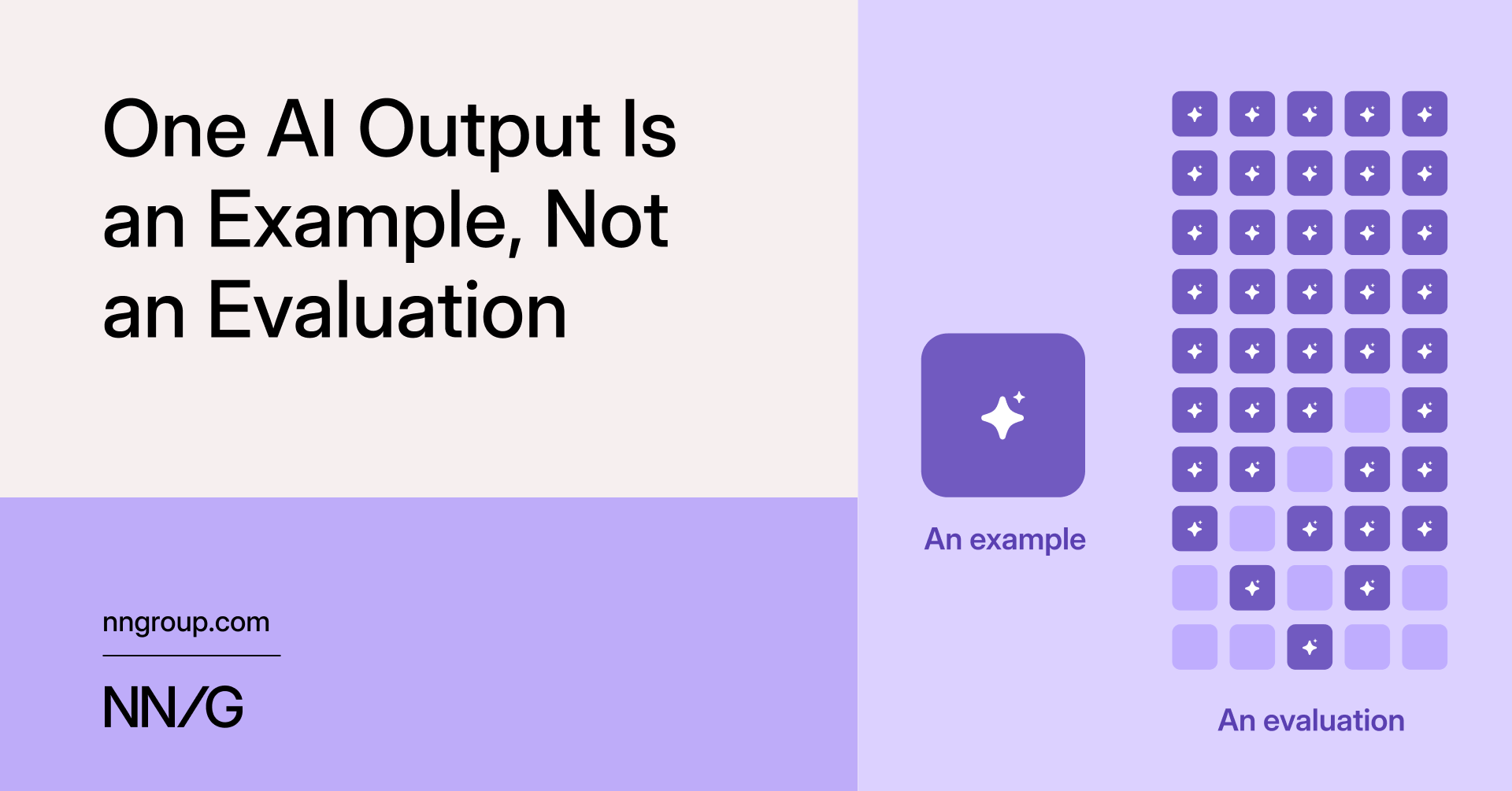
Taking a single output as proof of system capability is not an evaluation; it is an anecdote.
True AI assessment requires a methodological shift away from anecdotal inspection and toward the rigorous standards of quantitative UX research and experimental design. To understand how an AI system performs, organizations must evaluate it using a structured triad: multiple representative test inputs, repeated runs for each input, and comprehensive metrics that incorporate averages and confidence intervals. This article explores why single-output testing fails, how to structure reliable evaluations, how to dissect performance variability, and why adopting statistical rigor is non-negotiable for enterprise deployment.
Detailed Chronology: The Evolution of Software Testing vs. AI Evaluation
To understand why modern product teams continuously misjudge AI performance, one must examine the historical divergence between deterministic software engineering and probabilistic machine learning.
The Era of Deterministic Certainty (1970s–2020)
For decades, software engineering was built upon a bedrock of deterministic logic. If a developer wrote a function to calculate sales tax, inputting a $100 subtotal with a 5% tax rate would yield $5.00 every single time. Software testing methodologies—such as unit testing, integration testing, and regression testing—were designed around this predictability. A test case either passed or failed. Once a suite of deterministic tests passed, engineers could deploy updates with absolute mathematical confidence that the underlying logic would execute identically in production.
This philosophy deeply conditioned product culture. Teams learned to trust spot-checks. If a feature worked in a staging environment during a manual smoke test, the assumption of reliability was safe.
The Generative AI Paradigm Shift (2020–Present)
The rise of large language models (LLMs) shattered this paradigm. Modern AI systems do not execute static code paths; they generate text dynamically by calculating probabilities across vast token spaces.
As generative AI transitioned from academic curiosities to commercial enterprise tools, product teams carried their old habits forward. They treated LLM prompts like API endpoints, testing them with a single "Hello, World!" style query. If the model gave a smart answer, it was deemed functional.
However, AI researchers and quantitative UX specialists quickly noticed systemic anomalies. Models that aced initial demos began hallucinating facts, dropping edge-case exceptions, or failing under slightly different phrasings in live production. The industry realized that a single output demonstrates only that a system can perform a task, not how often or how reliably it will do so.
Today, leading AI safety labs and technical researchers—such as those at Anthropic, Hugging Face, and various academic institutions—are pushing the industry to adopt formal experimental designs. Metrics like pass@k in coding benchmarks and confidence-interval reporting in human evaluation arenas (such as Chatbot Arena) mark the beginning of a new era: one where AI evaluation is treated less like software unit testing and more like a clinical drug trial or a large-scale quantitative user study.
Supporting Context & Metrics: Unpacking AI Variability
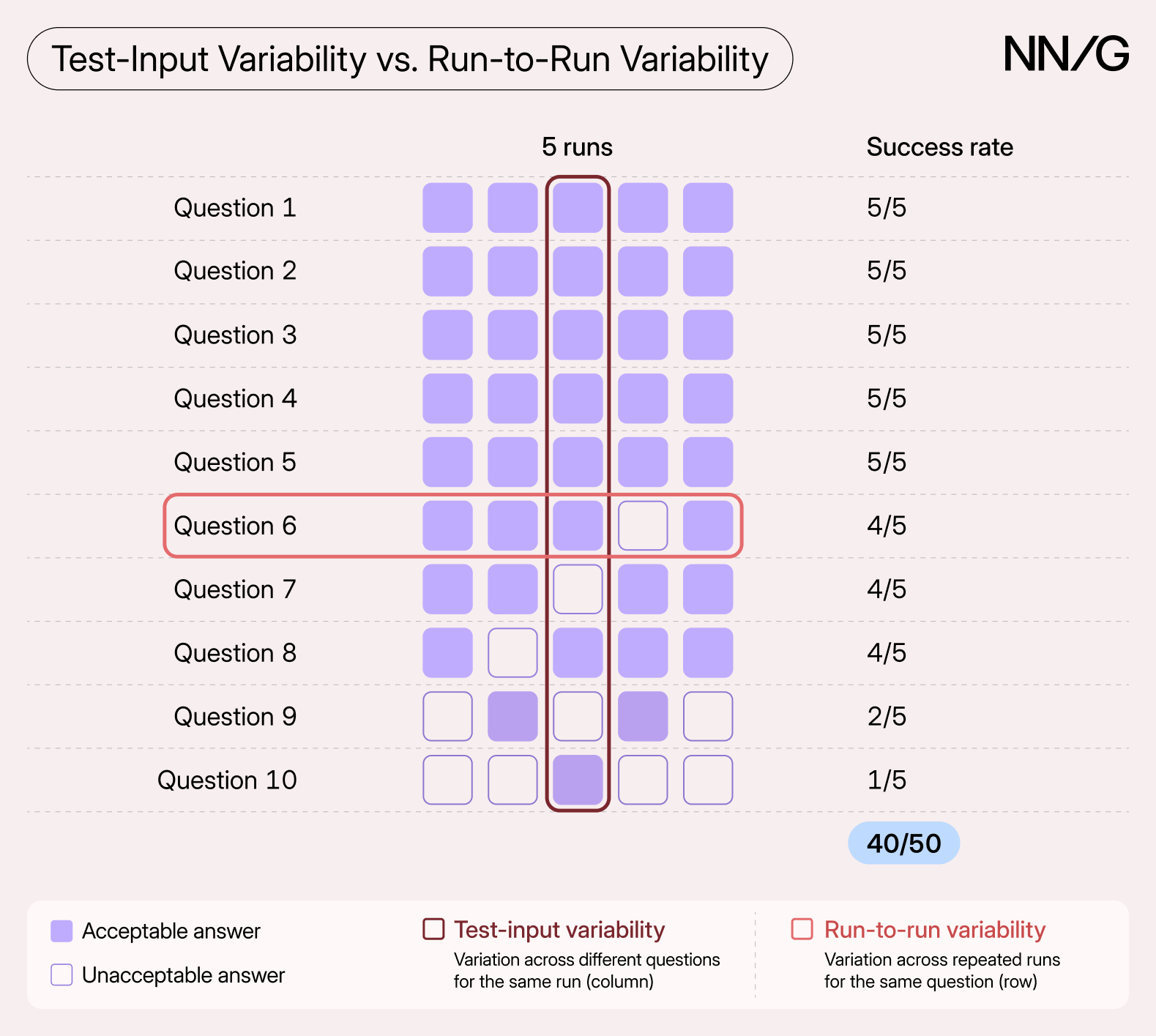
Evaluating an AI system requires accounting for two distinct types of data variability: test-input variability and run-to-run variability. Conflating these two sources of error leads to flawed architectural decisions.
1. Test-Input Variability
Test-input variability represents the variation in output quality that occurs when a system is subjected to different types of inputs.
For instance, an AI customer-service agent might excel at handling straightforward, uniform queries like "Where is my order?" but collapse when confronted with complex, conditional scenarios involving tiered subscription upgrades, regional warranty exclusions, or damaged goods.
If an evaluation relies solely on a batch of easy, softball questions, it will drastically overestimate the system’s real-world readiness. Conversely, curating a test set that mirrors actual user behavior—encompassing edge cases, typos, emotional language, and ambiguous policies—reveals the true boundaries of the model’s competence.
2. Run-to-Run Variability
Run-to-run variability occurs when a system produces different-quality outputs for the exact same input submitted across multiple trials.
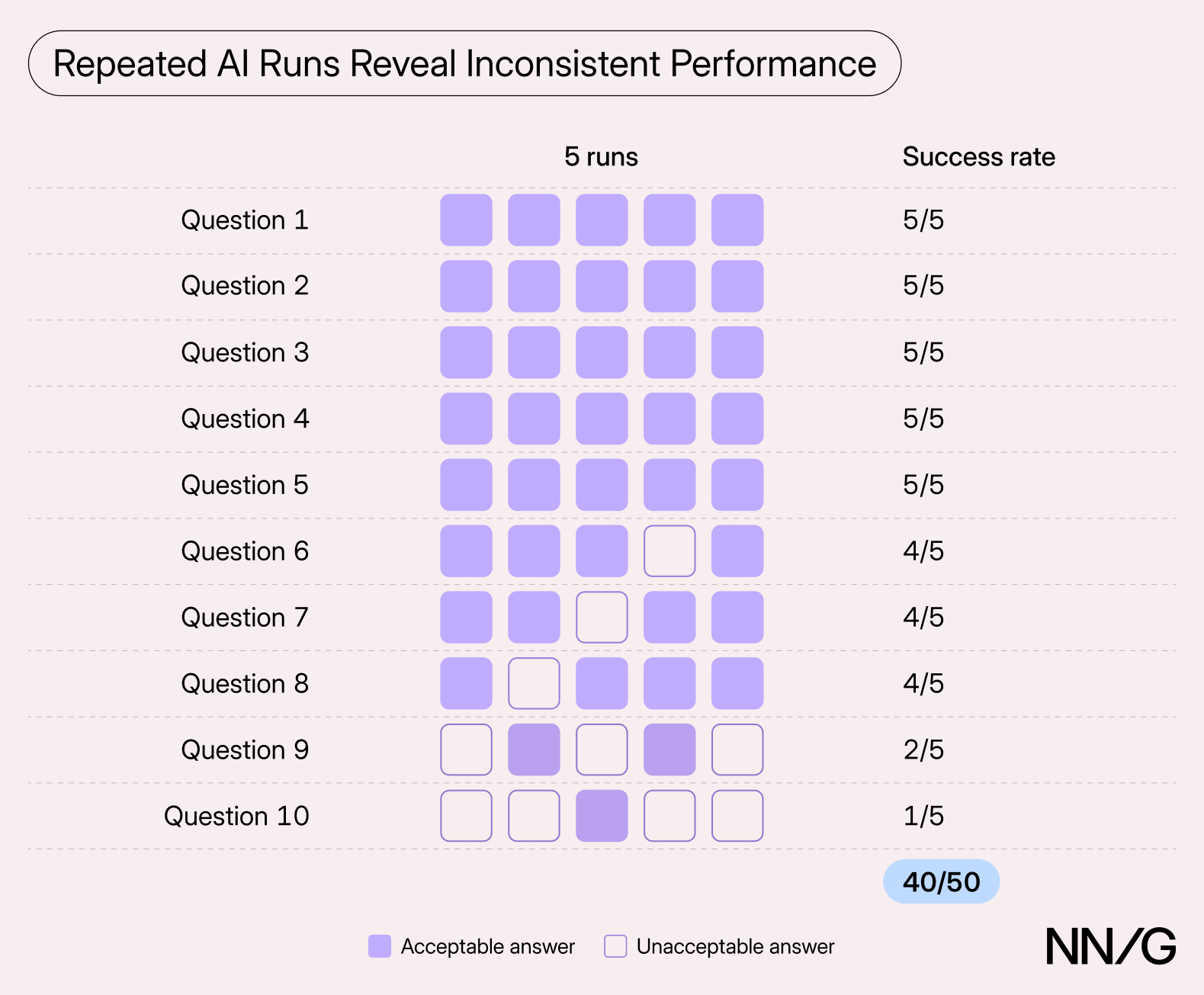
Because language models select tokens probabilistically, a prompt executed five times may succeed four times and fail once. Without repeated runs, an evaluator cannot distinguish between a robust capability and a lucky roll of the dice. A system that passes a single-shot test may simply have hit a statistical jackpot during that specific execution.
The Anatomy of an Evaluation Model
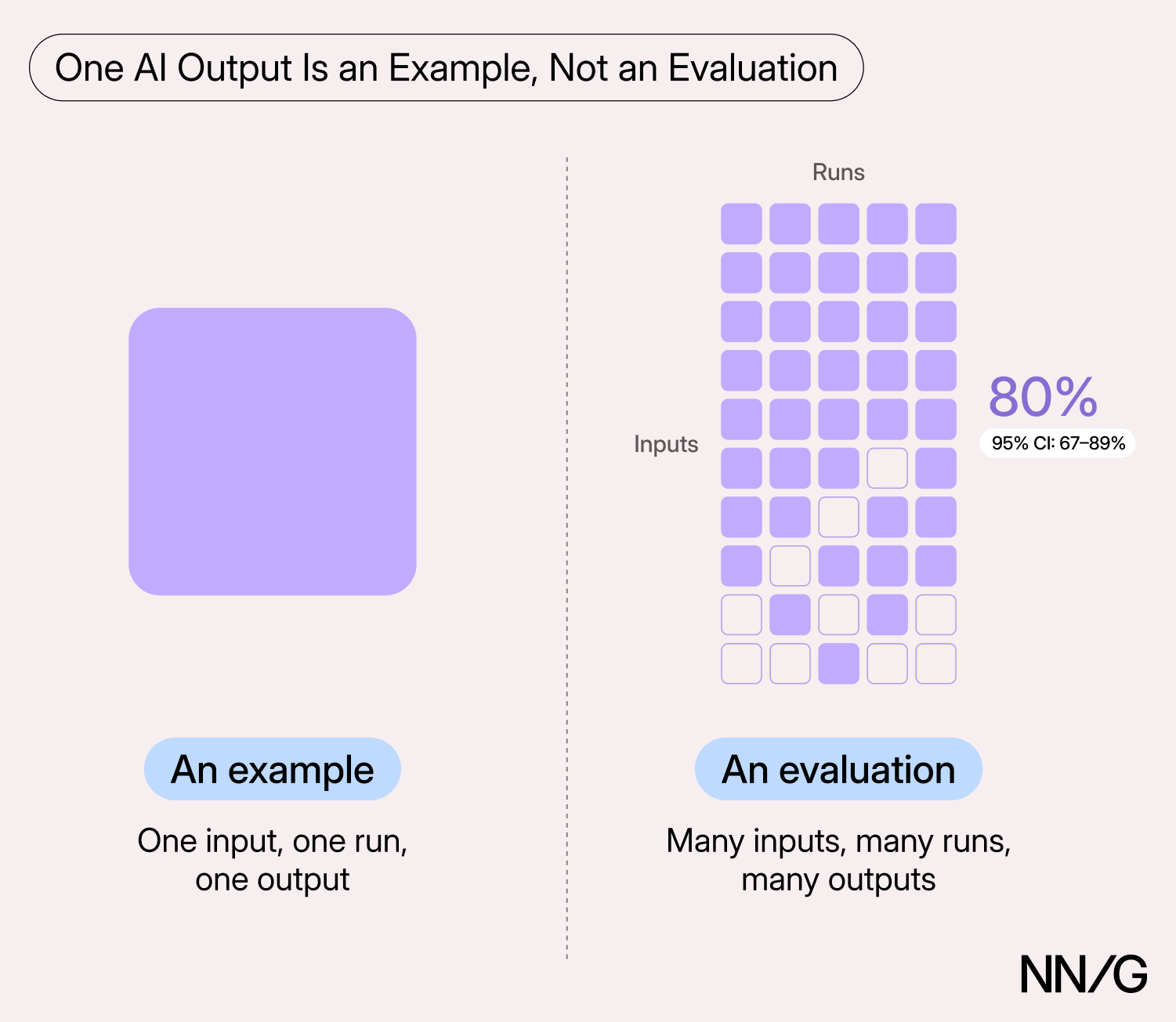
To visualize how these principles intersect, consider a structured evaluation framework:
- The Inputs: Select 10 representative customer-service queries spanning returns, cancellations, warranties, and damaged shipments.
- The Runs: Submit each query to the system 5 times, resulting in a total of 50 independent outputs.
- The Criteria: Establish a binary or rubric-based definition of an "acceptable" answer (e.g., accurately states the 30-day window, notes the opened-product exception, and provides the correct return portal link).
- The Summary: Calculate success rates per question and across the entire system, while establishing confidence intervals to quantify uncertainty.
+-----------------------------------------------------------------------------+
|                          AI EVALUATION FRAMEWORK                            |
|                                                                             |
|  [Representative Inputs] (10 Questions)                                     |
|         │                                                                   |
|         ├──> Run 1 ──┐                                                      |
|         ├──> Run 2   │                                                      |
|         ├──> Run 3   ├──> [50 Total Outputs] ──> [Success Rate & C.I.]      |
|         ├──> Run 4   │                                                      |
|         └──> Run 5 ──┘                                                      |
+-----------------------------------------------------------------------------+
The Trap of Identical Success Rates
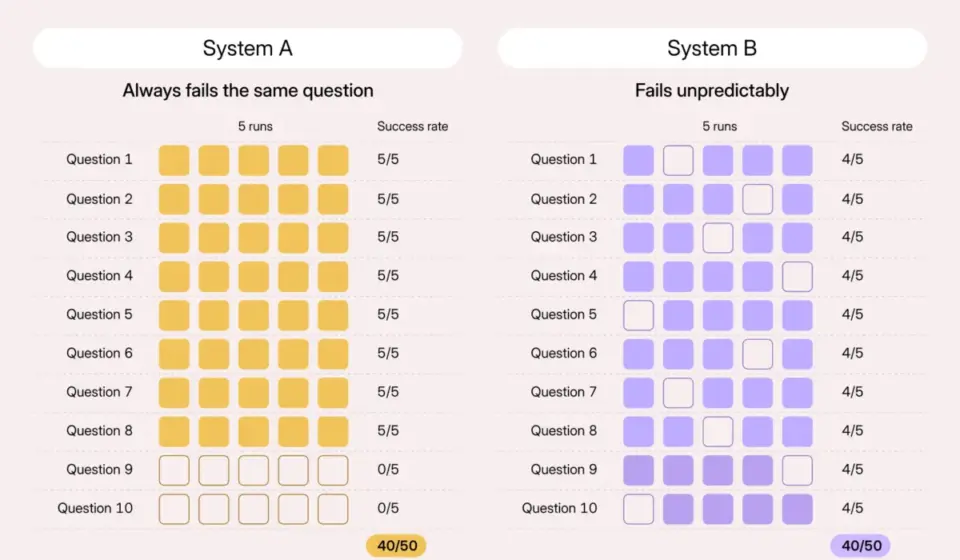
A common pitfall in naive AI evaluation is relying solely on aggregate success rates. Imagine two different customer-service AI systems evaluated on our 10-question, 5-run framework. Both achieve an identical overall success rate of 80% (40 out of 50 runs).
However, their underlying failure modes are radically different:
- System A (Consistently Predictable): Answers 8 questions perfectly on every single run (5/5), but completely fails on the remaining 2 questions across all runs (0/5).
- System B (Unpredictably Erratic): Answers every single question correctly in 4 out of 5 runs, but experiences sporadic, random failures across all 10 questions.
While both systems share an 80% score, their deployment strategies must diverge completely. System A can be safely deployed if administrators route those specific 2 failing question categories to human agents. System B, however, is a liability; because its failures are unpredictable, any customer interaction risks generating an unvetted error. Aggregate scores alone conceal these critical structural defects.
Official Perspectives & Expert Insights
As the machine learning community grapples with the limitations of anecdotal benchmarking, leading researchers and institutions are formalizing new standards for evaluation.
In recent literature and technical frameworks, experts emphasize that probabilistic systems demand statistical thinking. In a seminal 2024 paper from Anthropic titled Adding Error Bars to Evals: A Statistical Approach to Language Model Evaluations, researcher Evan Miller argues that language model evaluations must be treated as formal scientific experiments. Miller points out that point estimates (such as a flat 85% accuracy score) are practically meaningless without standard errors, paired comparisons, and methodologies that account for dependent test items.
Similarly, academic research presented at computational linguistics conferences (such as Song et al., 2025, The Good, the Bad, and the Greedy: Evaluation of LLMs Should Not Ignore Non-Determinism) underscores that ignoring model non-determinism during evaluation introduces severe blind spots. The authors demonstrate that ranking models or validating prompts based on single-generation outputs introduces massive variance, often leading teams to select suboptimal prompts or inferior model checkpoints simply due to sampling noise.
Industry standard-bearers, including the Nielsen Norman Group, echo these concerns from a user-experience perspective. In usability engineering, nobody evaluates an ecommerce checkout flow by asking a single user to buy one item and declaring the interface universally usable based on their success. UX research relies on sample sizes, task success rates, time-on-task averages, and confidence intervals. AI evaluation must embrace this exact epistemological humility.
Future Outlook: The Maturation of Enterprise AI Governance
Looking ahead, the methodology of AI evaluation is transitioning from an ad-hoc engineering chore into a core pillar of enterprise risk management and quality assurance (QA).
The Shift Toward Automated, Continuous Evaluation
As models update automatically via API providers and internal fine-tuning pipelines, static benchmark datasets will no longer suffice. Future engineering workflows will integrate Continuous Evaluation (CE) pipelines. Every time a prompt is modified, a retrieval-augmented generation (RAG) knowledge base is updated, or a base model is swapped, automated evaluation harnesses will execute thousands of randomized test runs against representative input distributions.
Regulatory Pressures and Auditability
Regulatory frameworks—such as the European Union Artificial Intelligence Act and emerging enterprise compliance standards—will increasingly demand verifiable proof of system reliability, bias mitigation, and failure rate disclosure. Organizations that rely on anecdotal "it works on my machine" testing will find themselves exposed to severe compliance risks, brand damage, and liability.
To prepare for this future, engineering and product leaders must institutionalize three core tenets:
- Ban the Single-Output Demo: Never approve a production release based on a single successful prompt response.
- Embrace Statistical Tooling: Adopt metrics like confidence intervals, pass-at-$k$ distributions, and systematic regression suites that capture both test-input and run-to-run variability.
- Document the Context: Treat AI evaluations like laboratory experiments. Record exact model versions, temperature settings, prompt templates, system instructions, and execution dates.
Conclusion
The allure of generative AI lies in its breathtaking fluency and human-like eloquence. But this same linguistic prowess often masks deep underlying statistical volatility. By abandoning the comforting illusion of deterministic software testing and embracing the rigorous principles of quantitative research, organizations can finally bridge the gap between impressive prototype demos and reliable, production-grade enterprise systems. A single good output is merely an introduction; a comprehensive, multi-run evaluation is the proof.
What do you feel about this post?

Like

Love

Happy

Haha

Sad

Angry