
The Artificial Intelligence Inflection Point: How Small Businesses Are Quietly Redefining the Marketing Landscape

Executive Overview
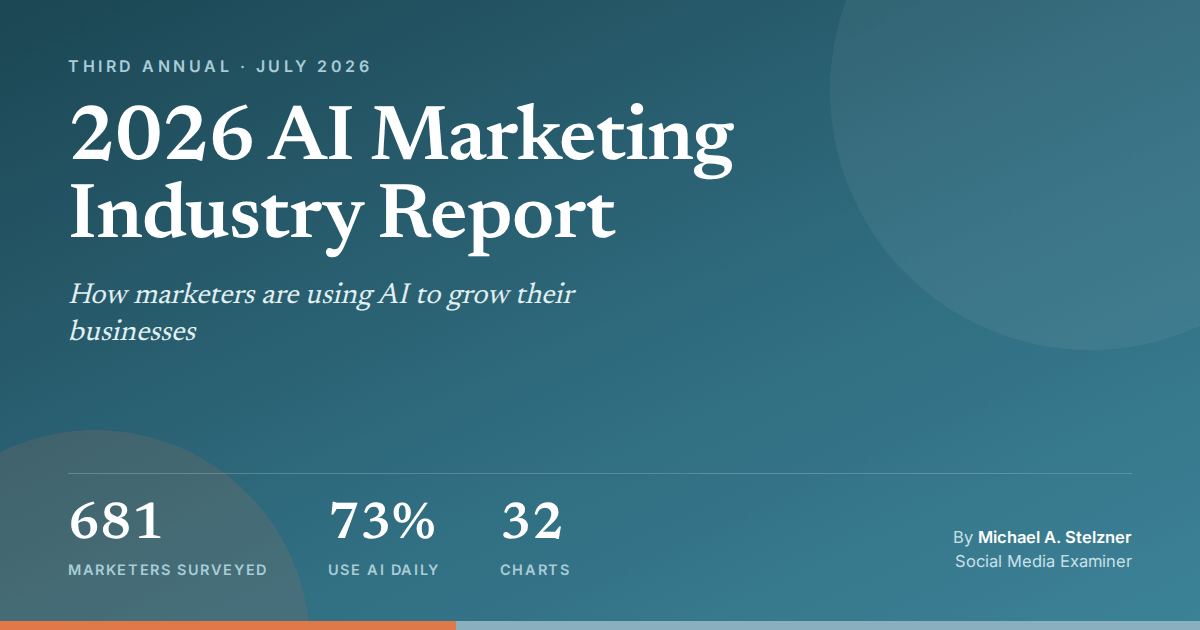
The narrative surrounding artificial intelligence in business has shifted dramatically over the past 24 months. What began as a volatile landscape dominated by speculative headlines, technological hype, and corporate apprehension has matured into an entrenched operational reality. According to comprehensive data from the 2026 AI Marketing Industry Report released by Social Media Examiner, generative and autonomous artificial intelligence tools are no longer experimental novelties reserved for enterprise-level budgets. Instead, they have become foundational infrastructure for lean organizations.
Most notably, the empirical data reveals that this transformation is being spearheaded not by monolithic corporations with dedicated tech departments, but by micro-businesses and small teams. With 60% of survey respondents operating in environments consisting of ten or fewer employees, the findings paint an intimate portrait of how nimble organizations leverage technology to punch above their weight.
Daily utilization rates have more than doubled since 2024, self-directed experimentation has replaced corporate training programs, and a profound measurement gap has emerged between perceived productivity and quantifiable Return on Investment (ROI). Furthermore, as the industry stands on the precipice of a new wave dominated by autonomous AI agents and video generation tools, small business operators find themselves uniquely positioned to capitalize on massive strategic gaps. This report explores the five eye-opening findings defining this modern commercial epoch, providing a rigorous breakdown of where the market stands, where it is heading, and what these shifts mean for entrepreneurs navigating the digital age.
Detailed Chronology: The Rapid Acceleration of AI Adoption
To understand the current state of artificial intelligence in marketing, one must trace the rapid velocity of its integration over the last three years. The evolution from a peripheral utility to a core operational engine happened not over decades, but in a matter of months.
The 2024 Baseline: Curiosity and Caution
When the modern generative AI boom first captured the public consciousness, organizations approached the technology with a mixture of awe and hesitation. Industry surveys from 2024 indicated that roughly one-third (37%) of marketers integrated AI tools into their daily workflows. A significant minority—approximately 23%—rarely or never touched the technology, citing concerns over content quality, data privacy, brand voice preservation, and a simple lack of familiarity. During this period, AI was predominantly viewed as an assistant for drafting rough outlines or brainstorming low-stakes blog posts. Budgets were largely nonexistent for software subscriptions, with practitioners relying entirely on free introductory tiers of nascent large language models.
The 2025 Transition: Mainstream Normalization
By the following year, the friction of initial adoption began to dissolve. As interfaces became more intuitive and tool capabilities expanded beyond simple text generation into image synthesis and data analysis, weekly usage surged. Businesses recognized that failing to incorporate automated efficiency meant falling behind competitors who could produce output at a fraction of the time. The transition shifted from "should we use AI?" to "how can we use AI safely and effectively?" Training, however, remained informal; institutional onboarding programs failed to materialize at scale, leaving employees to bridge the knowledge gap through self-directed exploration during evening and weekend hours.
The 2026 Reality: The New Industrial Baseline
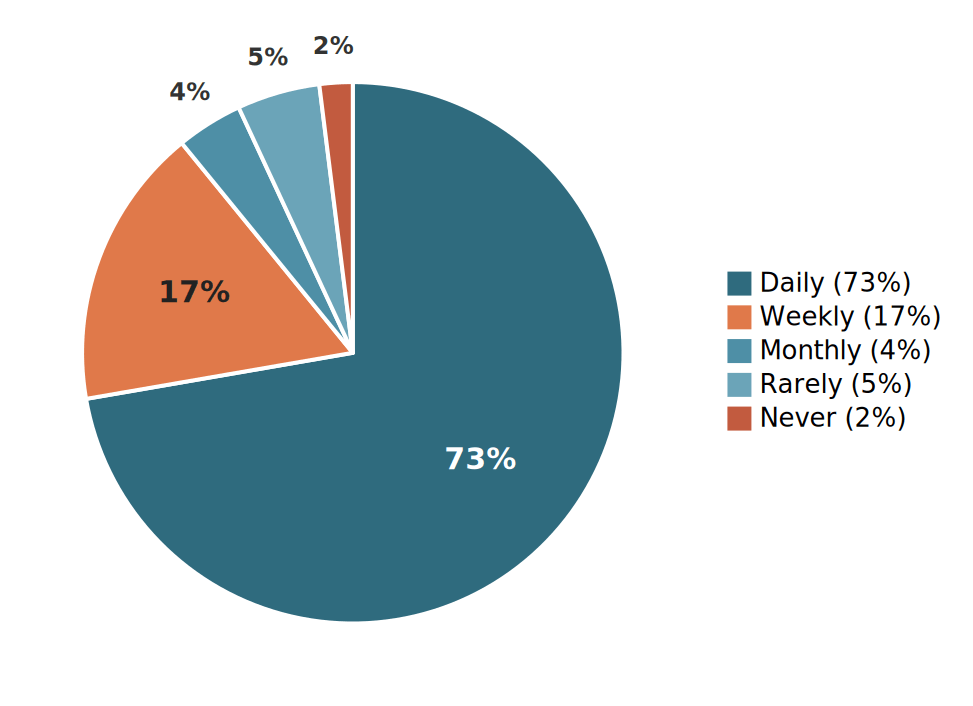
Fast forward to the present day, and the data confirms a wholesale structural transformation. Daily AI usage among marketing professionals has skyrocketed to 73%, while 90% of respondents utilize these systems at least on a weekly basis. The segment of the workforce that actively avoids or ignores AI has shrunk to a negligible 7%.
Crucially, this momentum shows no signs of plateauing. 84% of surveyed professionals report that their overall usage has increased over the past twelve months, and 78% anticipate continued growth in their consumption of AI services. The window for early-adopter advantage is rapidly narrowing; what was once a differentiator has officially become table stakes for modern commercial survival.
Supporting Context & Metrics: Five Eye-Opening Findings
A granular examination of the 2026 AI Marketing Industry Report yields critical insights that challenge conventional assumptions about enterprise technology deployment, skill acquisition, and performance metrics.
Finding #1: AI Isn’t a "Nice-to-Have" Anymore—It Is the New Normal
The most striking macro-statistic from the research is the normalization of daily interaction with intelligent software. Moving from 37% daily usage in 2024 to 73% today represents one of the fastest technology adoption curves in commercial history—rivaling the historical adoption rates of email or the mobile web.
This is not merely incremental change; it is a fundamental rewiring of how creative and analytical labor is executed. Because 90% of marketers engage with AI on at least a weekly basis, the market has reached a critical mass. Organizations operating without an integrated AI strategy are no longer merely traditional; they are operating at an insurmountable structural disadvantage regarding speed, iteration volume, and cost efficiency.
Finding #2: The Demise of Big Budgets and Corporate Training
Conventional wisdom suggests that mastering advanced technologies requires substantial capital expenditure, formal vendor onboarding, and dedicated corporate training departments. The data shatters this illusion entirely.
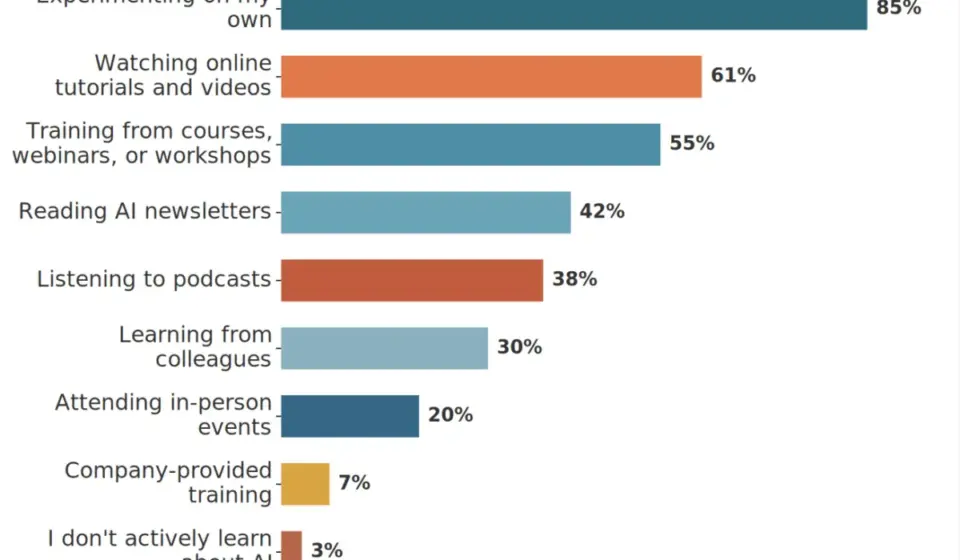
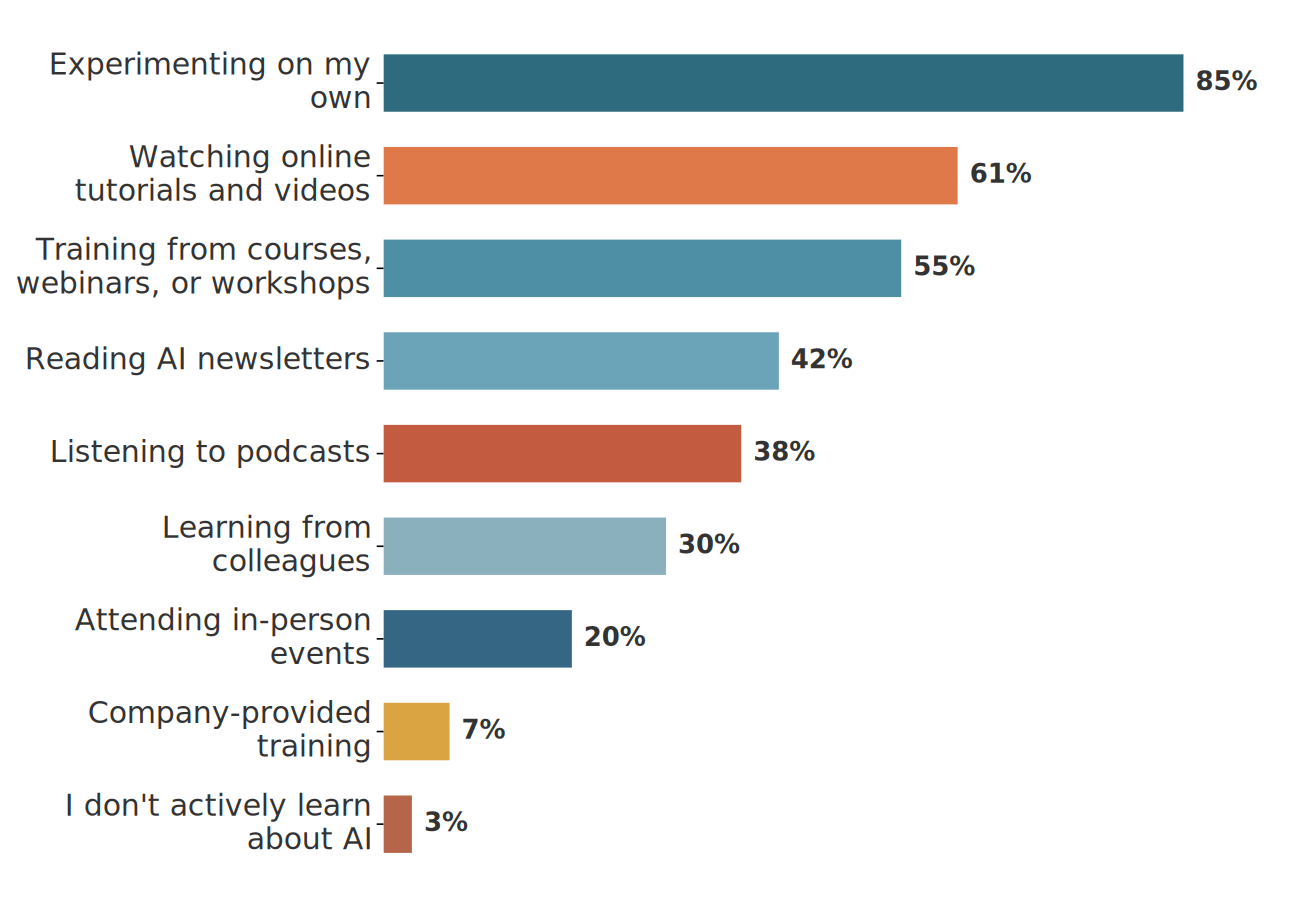
When asked how they acquired their proficiency, 85% of marketers reported learning through self-directed experimentation. Conversely, a mere 7% received formal, company-provided training. The burden of technological literacy has fallen squarely on the shoulders of individual practitioners.
This DIY ethos extends directly to financial investment. Over half (53%) of marketers are spending their own personal funds to access premium AI capabilities, and 85% pay for tools in some capacity. The era of relying exclusively on restricted free tiers is fading as professionals recognize that premium capabilities yield disproportionate returns. When identifying who drives AI adoption within their organizations, 55% of respondents answered simply: "Me." For small business owners, this decentralized, resourceful approach is second nature, meaning independent operators are inherently structured to thrive in this environment better than rigid corporate hierarchies.
Finding #3: The Great Measurement Gap (High Value, Zero Proof)
Despite the overwhelming enthusiasm for artificial intelligence, the industry suffers from a severe analytical blind spot regarding tangible proof of value.
- 86% of marketers strongly agree that AI saves them valuable time.
- 86% agree that the technology substantially boosts their overall productivity.
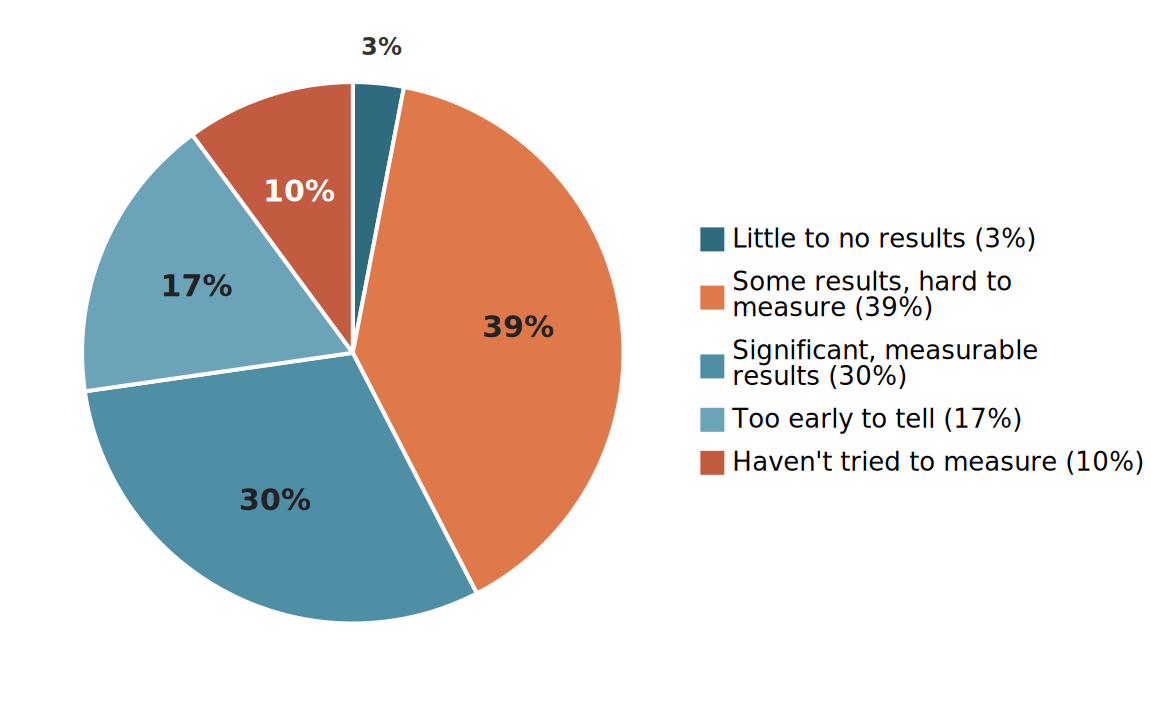
However, when asked to provide rigorous, measurable financial proof of these gains, the numbers plummet. Only 30% of respondents could point to significant, quantifiable metrics tied to their AI investments. An additional 39% admitted they observe positive results but lack the tracking mechanisms to quantify them, while 10% have made no attempt to measure impact whatsoever.
+-------------------------------------------------------+
|              THE AI MEASUREMENT PARADOX               |
+-------------------------------------------------------+
| 86% | Report significant time savings                 |
| 86% | Report noticeable productivity boosts           |
| 30% | Can point to quantifiable, measurable results   |
+-------------------------------------------------------+
This disconnect highlights a major strategic opportunity. Organizations that implement robust tracking frameworks—monitoring metrics such as content production velocity, customer acquisition cost reductions, and direct hours saved per week—will immediately separate themselves from the 70% of competitors operating in the dark.
Finding #4: AI Video Is the Ultimate Untapped Frontier
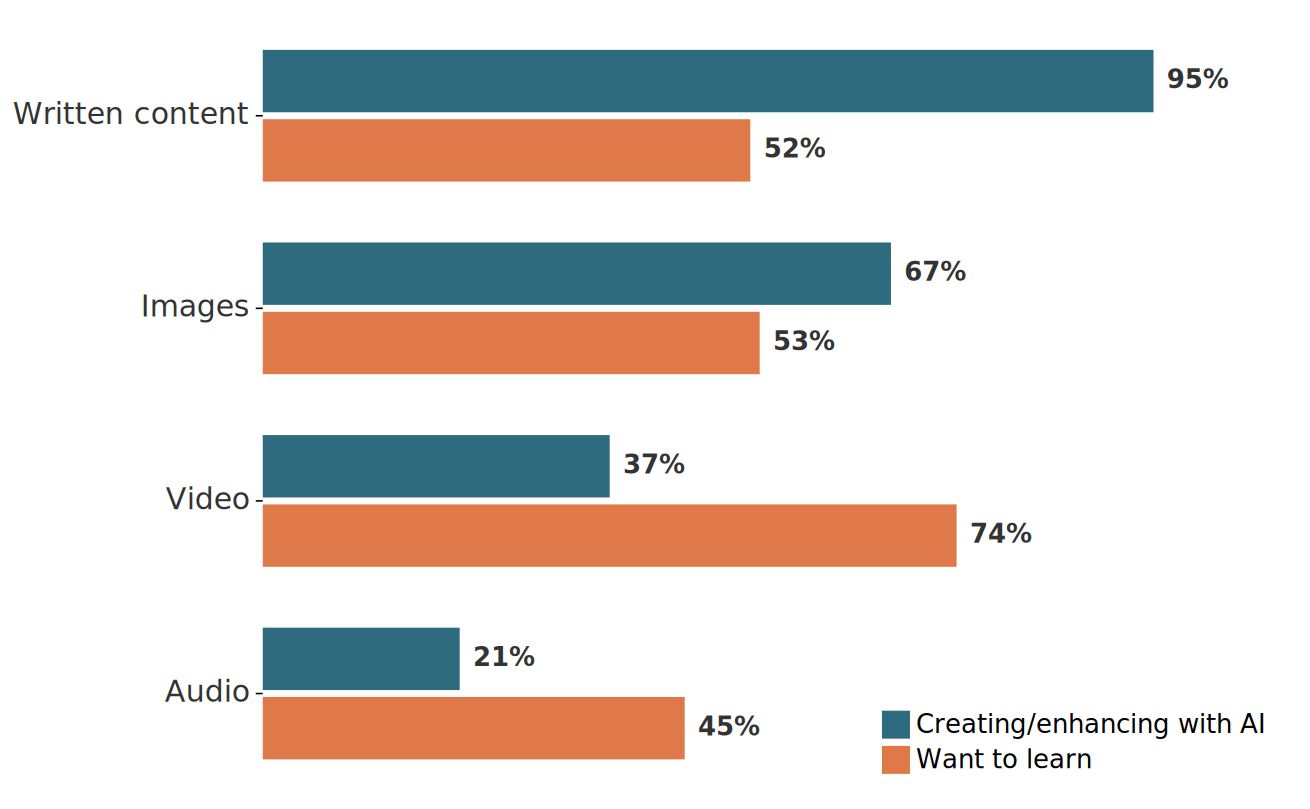
While textual generation has achieved near-universal saturation (95% utilization), the multimedia landscape tells a vastly different story.
- AI Video Adoption: Only 37% of marketers currently utilize artificial intelligence for video production.
- Market Demand: 74% of respondents stated that learning to create video content with AI is their top educational priority.
This creates a massive 37-point gap between desire and execution—the largest discrepancy measured across any content format in the survey. While AI image generation has experienced explosive growth (surging from 39% to 67% adoption since 2024), video remains the final operational frontier. Businesses that conquer basic AI video workflows today will capture disproportionate audience engagement in a digital ecosystem starved for dynamic visual media.
Finding #5: Autonomous AI Agents Are the Next Paradigm Shift
Introduced as a formal survey category in 2026, autonomous AI agents—systems capable of executing multi-step workflows without constant human prompting—represent the next major evolutionary phase.
Currently, 11% of marketers use agents regularly, and 24% are actively experimenting with them. However, 44% intend to adopt them in the near future, bringing total current and planned utilization to an astonishing 79%. Furthermore, understanding how to deploy AI agents is the single most requested educational topic among professionals. For lean small business teams, autonomous agents promise the operational leverage historically achieved only by hiring additional administrative, analytical, or customer support staff.
Official Perspectives and Industry Commentary
In releasing the findings of the 2026 AI Marketing Industry Report, Michael Stelzner, founder of Social Media Examiner, emphasized the pragmatic reality facing modern entrepreneurs.
"Two years ago, about a third of marketers used AI every day. Today, nearly three out of four do. That’s not a trend. That’s a transformation," Stelzner noted. "We surveyed marketers to find out how they’re actually using AI. Not the hype. Not the headlines. The real story. And since 60% of our respondents come from businesses with 10 or fewer people, this isn’t enterprise research. This is your world."
Stelzner underscored that the data is fundamentally encouraging for small business owners who may feel overwhelmed by the constant introduction of new technologies. Because the vanguard of AI adoption has been driven by individual hustle, resourcefulness, and self-taught experimentation rather than massive corporate budgets, independent operators already possess the cultural agility required to succeed.
"The marketers who are furthest ahead didn’t get there through corporate training programs or massive budgets," Stelzner added. "They got there the same way you would—by rolling up their sleeves and figuring it out. In the AI era, it turns out everyone else is catching up to the way you already work."
Future Outlook: Navigating the Next Era of Intelligent Operations
As the business community looks toward the remainder of the decade, the trajectory of artificial intelligence points toward deeper integration, multimodal workflows, and autonomous execution. The transition from simple chat interfaces to complex agentic systems will redefine the boundaries of what a small team can accomplish.
Strategic Imperatives for Small Businesses
- Bridge the Measurement Gap: Move beyond subjective feelings of productivity. Implement basic tracking systems to measure the exact hours saved per week, cost reductions per content asset, and conversion rate impacts. Quantifying success allows for smarter software subscription decisions.
- Close the Video Gap: Capitalize on the 37-point adoption deficit in AI video. Utilizing user-friendly text-to-video and avatar-based platforms can instantly elevate a small business’s marketing collateral above competitors relying solely on static text and images.
- Prepare for Agentic Workflows: Begin exploring how autonomous agents can handle repetitive, multi-step administrative burdens—such as sorting inbound customer inquiries, analyzing performance analytics dashboards, and managing automated email nurturing sequences.
- Embrace Self-Directed Mastery: Abandon waiting for institutional training. The competitive edge belongs to those who dedicate a small portion of each week to hands-on testing, prompt engineering refinement, and exploring emerging software tools.
Ultimately, the data from the 2026 AI Marketing Industry Report delivers an empowering message. The artificial intelligence revolution is no longer an exclusive playground for tech giants and venture-backed conglomerates. It is a decentralized, democratized utility that rewards curiosity, resourcefulness, and practical execution—qualities that define the very core of the small business spirit.