
The Anatomy of a Deceleration: How BigCommerce (Commerce.com) Went From Market Darling to a Cautionary Tale of B2B SaaS

Executive Overview
In the high-stakes arena of enterprise software, few cautionary tales are as stark or instructive as the trajectory of BigCommerce—recently rebranded as Commerce.com under the ticker CMRC.
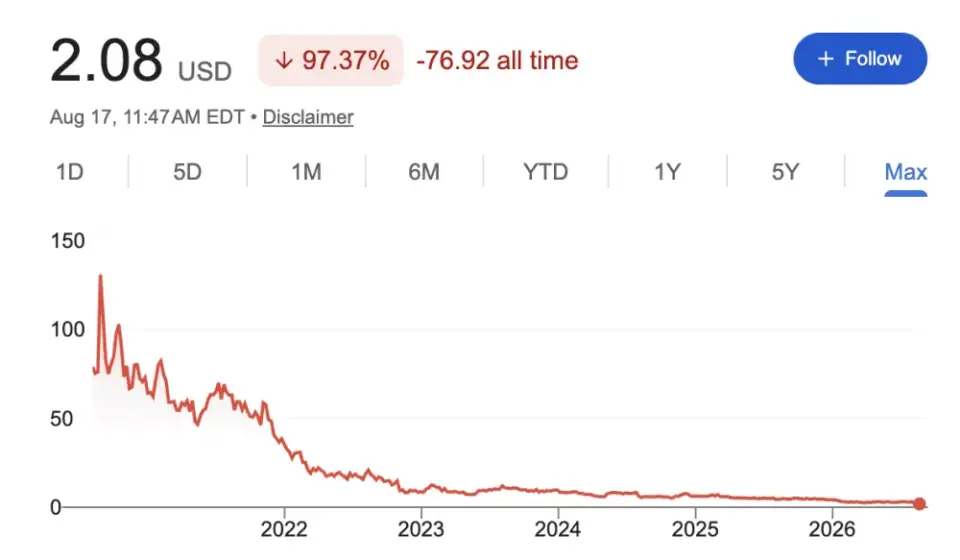
Six years ago, the narrative surrounding the company was brimming with potential. Fresh off a blockbuster 2020 initial public offering that yielded one of the largest first-day pops of the year, BigCommerce stood tall as the credible, independent runner-up to the undisputed juggernaut of the e-commerce software landscape: Shopify. Valued at roughly $4.8 billion on its opening day—after famously spurning a $1.5 billion acquisition offer from Intuit—the company commanded respect as the sole pure-play, public alternative for investors seeking exposure to the booming digital storefront market.
Today, the landscape is unrecognizably altered. Trading at a modest $200 million market capitalization—valuing the business at less than 1x its Annual Recurring Revenue (ARR)—Commerce.com finds itself fending off a hostile takeover bid from a significantly smaller rival. More damningly, the company recently issued a full-year 2026 revenue guidance whose midpoint sits below its total revenue for 2025.
While the ultimate victory of Shopify was widely anticipated by industry watchers as early as 2020, the exact mechanics of BigCommerce’s decline offer a masterclass in the realities of compounding business models. This deep dive examines the anatomy of that decay, dissecting the structural decisions, growth deceleration patterns, and strategic missteps that transformed a multi-billion-dollar market leader into a humbling case study on the limits of second-place survival in B2B software.
Detailed Chronology: From IPO Euphoria to Hostile Bids
The 2020 Watershed Moment
To understand the present reality, one must return to the hyper-inflated market environment of July 2020. Amid a global pandemic that supercharged e-commerce adoption, BigCommerce stepped into the public markets. Meritech’s IPO breakdown at the time characterized the company as "a very distant #2"—yet in the bullish market sentiment of the era, even that status was viewed as a badge of honor.
Unlike competitors embedded within larger tech conglomerates—such as Magento inside Adobe, Commerce Cloud inside Salesforce, or WooCommerce inside Automattic—BigCommerce stood alone as a pure-play public equity. When its stock price priced at $24 and closed its first trading session at $72.27, it signaled an unquenchable market appetite for alternative e-commerce infrastructure.
The Slow, Unnoticed Erosion
Unlike catastrophic corporate failures defined by sudden fraud, massive data breaches, or botched platform migrations, BigCommerce’s decline was remarkably uneventful on a quarter-to-quarter basis. There was no single "black swan" event. Instead, the decay was orchestrated entirely by a gradual, persistent deceleration in growth rates.
From 2020 through 2022, the revenue gap between Shopify and BigCommerce hovered relatively steady at around a multiple of 20x. For a brief window, it appeared the market was vast enough to comfortably accommodate two distinct winners. However, as the macroeconomic climate shifted post-2022, the divergence accelerated. BigCommerce’s year-over-year revenue growth rates slipped from 27% down to 11%, then to 7%, and finally flatlined near 3%. Meanwhile, Shopify—operating at a scale twenty times larger—maintained robust growth velocities between 26% and 30%.
The Turnaround Toolkit and the Rebrand
Faced with contracting top-line momentum, management deployed the standard playbook for a stalling growth asset:
- Executive Leadership Refresh: Bringing in fresh leadership to re-evaluate product-market fit.
- Corporate Rebranding: Transitioning the corporate identity from BigCommerce to Commerce.com to signal a modernized, forward-looking strategic posture.
- Operational Realignment: Implementing aggressive workforce reductions driven by artificial intelligence and automation efficiencies.
- Margin Discipline: Achieving two consecutive quarters of positive GAAP net income, highlighted by strong non-GAAP operating income figures that outpaced initial internal guidance.
Despite these rigorous cost-cutting measures and margin expansions, the equity markets remained unforgiving. The Q2 financial print triggered a downward revision of full-year revenue guidance by $18 million at the midpoint. Wall Street analyst price targets contracted, and speculative pressures culminated in a hostile takeover attempt by Rezolve AI—a fraction of Commerce.com’s size—whose executive team publicly labeled the company’s historic growth trajectory as untenable.
Supporting Context & Metrics: The Anatomy of a Growth Divergence
1. The Revenue Gap Widens Without a Single Disaster
The divergence between Shopify and BigCommerce is a testament to the compounding nature of revenue growth. While BigCommerce’s growth rate tapered off into the low single digits, Shopify expanded at scale. By mid-2026, Shopify was posting quarterly revenue growth acceleration, adding roughly $900 million in incremental quarterly revenue—an amount equivalent to roughly 2.7 times Commerce.com’s entire annual revenue—every single three-month period.
This statistical chasm illustrates a fundamental truth of B2B enterprise software: Growth rate at scale is the single most predictive metric of long-term corporate health.
2. The Business Model Fault Line: Software vs. Transaction
The structural divergence between the two competitors boils down to a foundational monetization philosophy: BigCommerce sold software; Shopify sold the transaction.

A breakdown of Commerce.com’s financials reveals that subscription solutions traditionally accounted for roughly 75% of its quarterly revenue mix ($63.1 million out of $84.5 million). Under this legacy SaaS subscription model, a merchant pays a fixed monthly fee whether their gross merchandise volume (GMV) is $1 million or $50 million.
Shopify, conversely, aligned its revenue engine directly with merchant success. As merchant merchandise flows grew across Shopify’s ecosystem, the platform captured a proportional slice of the economic activity via payments, financial services, and embedded financial infrastructure. Over a six-year horizon, the compounding effect of transaction-based monetization versus flat-fee subscriptions resulted in a 40x divergence in revenue and a nearly 1,000x gap in market capitalization.
Recognizing this fatal flaw, Commerce.com’s executive team belatedly shifted focus toward closing the delta between GMV growth and revenue monetization. The rollout of integrated payment solutions—such as BigCommerce Payments in partnership with PayPal—yielded early transaction volumes exceeding internal plans by over 30%. While strategically sound, this structural pivot arrived roughly six years after Shopify had cemented transaction monetization as the centerpiece of its modern platform economy.
3. The Niche Trap: Enterprise B2B and Analyst Accolades
Conventional startup wisdom dictates that when a company cannot out-scale the market leader, it must carve out a defensible, specialized niche. BigCommerce followed this playbook to the letter. It pivoted decisively toward enterprise-grade B2B merchants, engineered a highly open and flexible API-driven architecture, and routinely dominated technical feature comparisons.
For instance, the company swept numerous accolades, including top rankings across multiple categories in the Paradigm B2B Combines for four consecutive years.
However, the financial reality of this niche strategy exposed a harsh paradox: Rising revenue per account combined with a shrinking total account count is merely price capture on a deteriorating customer base. Winning analyst scorecards while the primary market leader expands its footprint in that exact same segment four times faster is not a sustainable moat. It is simply a slower, more polished descent into irrelevance.
Official Statements & Industry Perspectives
The structural realities facing Commerce.com have sparked intense debate across the venture capital and investment communities. Industry analysts point out that while cost discipline and operational restructuring are vital for survival, they cannot substitute for organic top-line expansion.
During recent earnings calls, executive leadership has sought to reassure stakeholders regarding the traction of their newly minted monetization initiatives. The company’s Chief Financial Officer emphasized that accelerating the attach rates of payments, cross-selling, and financial services remains the paramount corporate objective. "We are successfully narrowing the historical gap between our gross merchandise volume expansion and our direct top-line capture," executive commentary noted, pointing to early outperformance in proprietary payment adoption volumes.
Conversely, external market critics have been unsparing. The hostile acquisition overtures and public commentary from smaller market players underscore a brutal verdict from the peanut gallery: profitability and cost-cutting measures are merely stopgaps designed to buy time. As market commentators have frequently observed, profitability does not fix a growth problem; it merely buys you time to look for one—and the public markets price those two outcomes with ruthless divergence.
Future Outlook and Strategic Takeaways
The collapse of BigCommerce’s valuation serves as a foundational case study for founders, operators, and institutional investors navigating the B2B SaaS ecosystem. It definitively proves that holding the undisputed "number two" spot in a software category is not an inherent defensive moat unless that runner-up matches or exceeds the growth velocity of the category leader.
For organizations operating outside the top tier of their respective markets, five critical lessons emerge from this corporate trajectory:
- Business Model Alignment Trumps Feature Parity: Having superior enterprise features or winning independent analyst accolades will not save a company if its fundamental economic capture model fails to scale alongside customer success.
- Deceleration is a Silent Killer: Companies rarely implode overnight due to acute disasters; more frequently, they are hollowed out by years of gradual, unaddressed growth deceleration.
- Monetize the Outcome, Not Just the Seat: Software pricing models must capture the expanding utility and economic upside experienced by the end user. Flat-rate subscription models struggle to compete against transaction-aligned ecosystems.
- Cost Optimization Has a Hard Ceiling: While AI-driven automation, headcount realignments, and positive GAAP net income are admirable operational achievements, they cannot artificially manufacture top-line growth or command venture-scale valuation multiples.
- The Market is Unforgiving of Stagnation: In modern enterprise software, capital flows overwhelmingly to category creators and compounding growth leaders. Distant runners-up risk being relegated to sub-scale valuations, making them vulnerable to hostile takeovers or structural irrelevance.
Ultimately, the market for digital commerce infrastructure proved vast enough to support multiple technological frameworks, but it was fundamentally intolerant of two competing business models operating under divergent economic realities. For Commerce.com, the road ahead will test whether aggressive cost discipline and late-stage payment integration can salvage a viable enterprise, or if it will ultimately stand forever as a monument to the perils of second-place stagnation.
What do you feel about this post?

Like

Love

Happy

Haha

Sad

Angry