
Cutting Through the Noise: How the PROVE Framework Brings Rigor to Enterprise AI Adoption

Executive Overview
In the modern knowledge economy, tech workers, product managers, and creative professionals find themselves trapped in an uncomfortable paradox. Leadership demands that organizations move faster, embrace generative artificial intelligence, utilize corporate-procured software licenses, and keep pace with a relentless weekly release cycle. Simultaneously, professionals are expected to accomplish this while trimming operational budgets and mastering complex new interfaces without sacrificing billable hours or missing core project deadlines.
Under this crushing institutional pressure, traditional tool evaluation collapses. Employees typically default to one of two unhealthy extremes: either they succumb to novelty bias—treating every flashy software demo as a revolutionary breakthrough—or they experience total adoption paralysis, retreating to legacy habits out of sheer overwhelm. Neither approach answers the fundamental question that matters to a working professional: Compared with the way I already execute this task, does this specific AI tool produce an outcome genuinely worth adopting?
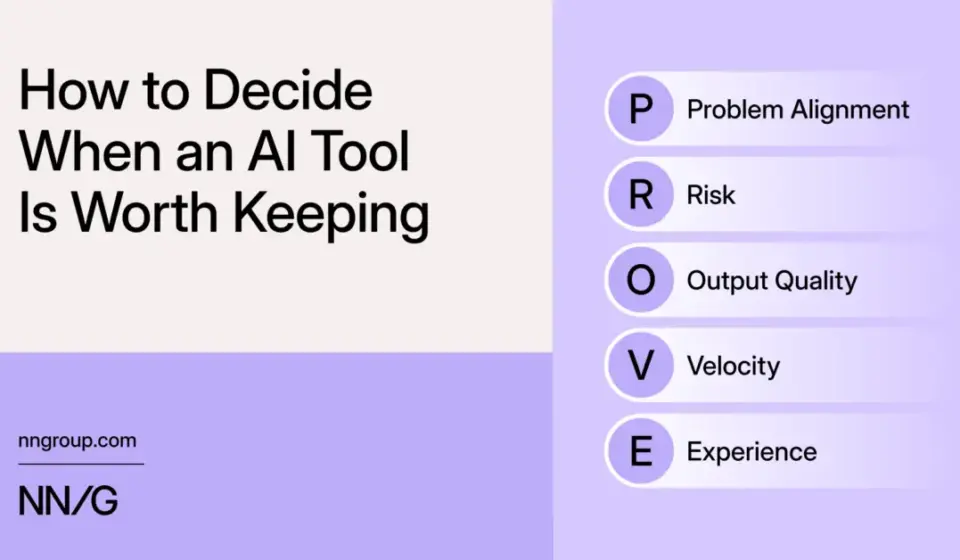
To counter this epidemic of unverified adoption and alleviate workplace anxiety, the Nielsen Norman Group (NN/g) has developed a lightweight, highly pragmatic evaluation methodology known as the PROVE framework. Standing for Problem Alignment, Risk, Output Quality, Velocity, and Experience, this structured approach shifts the evaluation paradigm away from vague corporate mandates and toward concrete, empirical testing. PROVE is not designed to dictate organization-wide software procurement strategies, nor is it meant to calculate long-term monetary amortization across massive enterprise deployments. Instead, it serves as a razor-sharp, individual screening mechanism. It tests one specific tool against one discrete task, generating a provisional, defensible decision that an employee can comfortably explain to a manager, a skeptical teammate, a client—or themselves.
Detailed Chronology: Testing Google’s Gemini Notebooks in a Real-World Workflow
To understand how the PROVE framework operates in practice, it is necessary to examine it applied to a real, recurring professional bottleneck. Consider the weekly operational routine of a content curator: synthesizing multiple complex sources into an accessible, high-signal team update.
Every week, a typical knowledge worker must curate two to four industry articles worth sharing with colleagues, digesting their core arguments into a brief, readable update for an internal Slack channel. Ideally, this process yields a concise paragraph of insightful commentary paired with direct links. To test whether generative AI could genuinely streamline this chore without degrading the human touch, an evaluation was conducted using Google’s Gemini Notebooks (formerly known as NotebookLM).
The evaluation followed the sequential pillars of the PROVE framework, moving systematically from initial task alignment to final workflow integration.
Phase 1: Problem Alignment and Task Matching
The first rule of evaluating any software tool is resisting the temptation to open a browser tab and blindly poke around. While unstructured exploration can be entertaining, it provides zero actionable data regarding workplace utility. Before spending a single dollar, altering a pipeline, or encouraging peers to migrate, a professional must explicitly define the task.
In this instance, the weekly Slack digest passed the problem alignment check with flying colors. It is a recurring task that consumes meaningful time; therefore, any fractional improvement compounds significantly over a fiscal quarter. Furthermore, the audience is an internal team channel, meaning the output does not require rigid, publication-grade prose. Most importantly, Gemini Notebooks’ core technical mechanic—allowing a user to upload disparate source texts and prompt the system to synthesize across them—mapped perfectly onto an existing workflow where the human had already selected the source material and merely needed help drafting the connective tissue. Because the tool was already accessible via the organization’s existing Google Workspace, no complex procurement request was required.
Phase 2: Risk Assessment and the Shadow AI Trap
Before spending hours testing capabilities, an evaluator must verify that the tool is appropriate for the data intended for input. Crucial security questions must be asked: Is the software approved by corporate IT? What data classifications are permissible? Does the privacy policy permit model training on user inputs? Are you inadvertently handling personally identifiable information (PII), confidential research data, unreleased corporate strategies, or proprietary source code?
Under intense pressure to hit productivity targets, employees frequently resort to creating personal consumer accounts or subscribing to unapproved cloud services. This phenomenon—widely categorized as shadow AI—is staggering in its prevalence. Research from UpGuard indicates that approximately 80% of corporate employees admit to utilizing AI tools that their employers have never formally vetted or approved.
However, "widespread" does not equate to "safe." Feeding sensitive enterprise data into an unapproved third-party tool creates catastrophic compliance and security risks that can instantly wipe out any theoretical time savings. In the Gemini Notebooks evaluation, the input data consisted exclusively of published, publicly available web articles—no client lists, participant data, or internal strategies. Furthermore, a review of Google Workspace privacy documentation confirmed that user uploads and queries are shielded from human review and are never used to train foundational models. Low-sensitivity inputs combined with acceptable terms of service meant the tool safely passed the risk gate.
Phase 3: Output Quality Benchmarking
Once safety is guaranteed, an AI tool’s output must be rigorously benchmarked against actual, historical human work. Evaluators must pull a real example of their own past output and ask a direct question: Is the machine-generated version better than, as good as, or merely "good enough" compared to what is natively produced?
In the test run, three distinct sources were uploaded to a Gemini Notebook: a 1983 academic white paper on the ironies of automation, a recent industry podcast transcript, and a technical blog post detailing AI coding agents. The prompt directed the system to draft a Slack-ready digest.
The resulting output was factually accurate and structurally complete. Every claim traced back cleanly to the correct source, and there were zero hallucinations or invented findings. Yet, a critical qualitative gap emerged: the AI wrote like a formal academic report, complete with rigid numbered items and clinical Summary/Significance labels. Conversely, the human counterpart’s natural voice sounded like a colleague casually talking to peers. The tool captured the raw data perfectly, but it missed the cultural cadence of the team channel. Output quality was deemed functional, but imperfect.
Phase 4: Velocity and Total Time Auditing
A common trap in productivity software evaluation is measuring only generation speed. A flashy interface might generate a block of text in three seconds, but if that text requires thirty minutes of aggressive copy-editing, error-correction, reformatting, and context-switching, the net velocity is negative.
To accurately gauge velocity, an evaluator must measure the total time consumed across the entire lifecycle of the task: initial setup, prompt engineering, output review, error remediation, reformatting, and manual migration between systems. Conversely, a tool that takes longer to operate upfront can still be valuable if it produces an insight or synthesis that a human could not have generated alone.
In this trial, drafting the digest manually from scratch consistently required roughly 25 minutes. Generating and refining the Gemini Notebooks version—including necessary voice edits and reformatting—took a little over 10 minutes. A portion of that time represented a standard learning curve, implying that subsequent iterations would be even faster.
Phase 5: Experience and Recurring Friction Analysis
Even if an AI tool delivers high-quality output swiftly, it can still fail in daily practice if it introduces toxic workflow friction. Tools that require repetitive setup, force constant context-switching across multiple browser tabs and file formats, or obscure their reasoning make results difficult to trust.
PROVE emphasizes the separation of one-time friction from recurring friction. It is entirely reasonable for novel software to require a setup investment and a learning curve. However, it is entirely unacceptable for a tool to impose an awkward, error-prone workflow indefinitely.
For Gemini Notebooks, initial setup friction was exceptionally low, and the learning curve was easily surmounted. However, the recurring friction manifested as workflow fragmentation. Manually writing the update involved a clean three-step process:
- Read and select articles.
- Draft commentary directly in Slack.
- Post to the team.
With Gemini Notebooks integrated, the workflow expanded into a cumbersome six-step chain:
- Select and read articles.
- Open a separate Gemini Notebook tab.
- Upload source URLs/files.
- Prompt the model to synthesize.
- Copy-edit the formal output into a conversational tone.
- Transfer the text to Slack and format manually.
While the tool sat between the curation and posting steps, it added two extra manual handoffs every single week. While tolerable, this fragmentation earned the tool its lowest score in the evaluation matrix.
Supporting Context & Metrics: The PROVE Evaluation Scorecard
To translate qualitative impressions into actionable intelligence, the PROVE framework utilizes a straightforward five-point rating scale across its core operational dimensions, where a score of 3 denotes performance "about the same as my current manual approach."
Below is the structured scorecard resulting from the Gemini Notebooks evaluation:
| PROVE Dimension | Metric Evaluated | Score (1–5) | Operational Notes |
|---|---|---|---|
| Problem Alignment | Does the tool match a recurring, high-friction task? | 4 / 5 | Maps directly onto weekly synthesis needs; high compounding value. |
| Risk Assessment | Are inputs safe, compliant, and policy-approved? | 5 / 5 | Public web sources only; Workspace privacy terms protect data. |
| Output Quality | How does output compare to native human work? | 3 / 5 | Factually accurate and complete, but reads like a formal report rather than human chat. |
| Velocity | Does total task time decrease significantly? | 4 / 5 | Cuts total task time from 25 minutes down to roughly 10 minutes. |
| Experience | Is daily friction acceptable over the long term? | 2 / 5 | Introduces workflow fragmentation and extra handoffs between systems. |
Synthesizing the Decision
Scores alone, however, must never replace professional judgment. A tool with mediocre output quality but an exceptional velocity boost might still warrant a limited trial, whereas a tool with high overall scores might represent a terrible cultural fit for a high-stakes client deliverable.
A defensible PROVE evaluation should enable any professional to answer four core questions when presenting their findings to leadership or teammates:
- What specific task was tested? (Drafting a weekly research digest for a team Slack channel).
- How did it compare to the baseline? (Produced accurate drafts and cut time from 25 to 10 minutes, though voice editing is required).
- What is the immediate next step? (Initiate a one-month trial period).
- What are the primary caveats? (The tool writes in a clinical report style, requiring ongoing human stylistic intervention).
Official Statements and Industry Insights
The introduction of frameworks like PROVE addresses a growing chorus of concern from workplace psychologists, organizational leaders, and human-computer interaction (HCI) researchers. As enterprise software budgets shift aggressively toward generative AI licenses, organizational friction has reached an all-time high.
Dr. Jakob Nielsen, principal and co-founder of the Nielsen Norman Group, has repeatedly emphasized the danger of ungrounded technology adoption in enterprise environments. In recent organizational briefings, industry experts have underscored a vital truth: pressure is not evidence.
"When leadership issues a blanket mandate to ‘use more AI,’ they are confusing executive enthusiasm with empirical utility," notes a leading enterprise UX researcher. "If an employee is challenged on why they aren’t utilizing a newly procured suite of generative tools, they shouldn’t have to mumble apologies about resistance to change. They need hard, defensible evidence: ‘We tested this specific tool against this exact workflow, and the cognitive overhead, security risk, and workflow fragmentation outweighed the time savings.’ Frameworks like PROVE give professionals the vocabulary to replace emotional workplace debates with objective operational science."
Furthermore, enterprise security bodies have echoed warnings regarding the shadow AI epidemic. UpGuard’s extensive threat research highlights that unauthorized software deployment remains one of the most critical vulnerabilities facing modern corporations, proving that convenience frequently supersedes compliance unless structured evaluation guardrails are put in place.
Future Outlook: Provisional Decisions and Continuous Evolution
The ultimate objective of adopting an evaluation framework like PROVE is not to build an impenetrable shield that protects legacy workflows from necessary modernization. Skepticism must never become a knee-jerk reflex designed to preserve obsolete habits.
In the case of the Gemini Notebooks evaluation, the process ended in a resounding "yes"—and the collected evidence made that decision remarkably easy to defend. When a software tool produces work that is "good enough" for the task at hand, saves measurable blocks of time, and operates safely within corporate compliance guardrails, it deserves a permanent home in the modern professional’s toolkit, regardless of initial personal resistance.
However, professionals must treat the outcome of any PROVE evaluation as a provisional decision, not a permanent verdict. The technology landscape shifts at a dizzying pace: foundational models update, user interfaces are redesigned, corporate security policies evolve, and personal skill sets mature.
Industry analysts recommend revisiting software tool evaluations after a structured period of real-world use—typically 30 to 60 days—especially when major version updates roll out. Ultimately, the future of work belongs to professionals who curate a lean, highly trusted stack of software tools that demonstrably improve their daily output. By rejecting ungrounded hype and embracing systematic evaluation frameworks like PROVE, organizations can eliminate the growing pile of impressive-looking AI novelties, replacing corporate anxiety with clarity, confidence, and verifiable productivity.
What do you feel about this post?

Like

Love

Happy

Haha

Sad

Angry