
The Evolution of Growth: Why Iterative Testing is Replacing the "Home Run" Marketing Strategy

By Josh Gallant | Updated August 1, 2025
Executive Overview
For decades, the standard marketing playbook has suffered from a high-stakes, all-or-nothing addiction. Campaign managers and digital agencies alike have routinely pinned their hopes—and considerable portions of their quarterly budgets—on massive, over-engineered launches. They spend months agonizing over every pixel, drafting sweeping redesigns, and crossing their fingers for a miraculous "home run."
The harsh reality? Striking out is far more common than hitting the fences. When these massive swings fail, they do not just miss; they drain budgets, demoralize creative teams, and leave organizations scrambling to recover lost momentum.
Enter iterative testing: a systematic, compounding philosophy of experimentation borrowed from software development and tailored for modern digital marketing. Rather than betting the house on a single, monolithic redesign, iterative testing relies on continuous, small-scale, data-backed adjustments. Each experiment builds organically on the insights of the last, forming an agile feedback loop that adapts to shifting user behaviors, cuts wasteful ad spend, and systematically accelerates conversion rate optimization (CRO).
This comprehensive guide explores the mechanics of iterative testing, how it transforms marketing performance, a step-by-step roadmap for implementation, and the vital best practices required to build an enduring culture of continuous experimentation.
Detailed Chronology & Industry Evolution: From Guesswork to Continuous Feedback
Marketing has undergone a seismic shift over the past twenty years. In the early days of digital advertising, strategy was dictated by high-level intuition, subjective executive preferences, and lengthy quarterly review cycles. If a landing page underperformed, marketers often had to wait months—and endure countless internal debates—before greenlighting a brand-new iteration.
Phase 1: The Static Era and the "Big Bang" Redesign
Historically, website updates resembled construction projects. Organizations would endure a blackout period, pour resources into a complete digital overhaul, and launch a static asset designed to remain untouched for years. Feedback loops were agonizingly slow, relying on lagging indicators like quarterly revenue dips rather than real-time user behavior.
Phase 2: The Advent of Basic A/B Testing
The introduction of early A/B testing tools allowed marketers to move past pure guesswork. Teams could finally pit two distinct variations of a webpage against one another to see which secured a higher conversion rate. However, early testing was often treated as a binary, one-off event. Marketers would run a test, celebrate a win or mourn a loss, implement the winning variant, and immediately revert to static operations until the next major campaign cycle.

Phase 3: The Modern Paradigm of Iterative Agility
Today, high-performing growth teams recognize that consumer habits change too rapidly for static pages or isolated A/B tests. The modern digital landscape requires a paradigm where optimization is not a project, but a perpetual process. Iterative testing bridges this gap by shrinking feedback loops from quarters to days. By testing discrete, bite-sized hypotheses continuously, organizations can compound small wins into massive long-term growth.
Supporting Context & Core Metrics: The Data Behind the Method
To understand why iterative testing outperforms traditional campaign planning, one must examine the empirical data driving modern consumer interactions. Modern benchmarks reveal distinct patterns in user psychology, complexity, and device fragmentation that traditional, single-shot campaigns routinely miss.
1. The Clarity Paradox: Simplicity Wins
Many marketing teams assume that B2B audiences or high-intent buyers require sophisticated, jargon-heavy copy to feel validated. Data consistently proves the opposite.
According to data from the Unbounce Conversion Benchmark Report, landing pages written at a 5th-to-7th-grade reading level convert at an impressive 11.1%—more than double the rate of professional, highly complex writing. Furthermore, research highlights a stark -24.3% negative correlation between high word complexity and conversion rates.
Iterative testing allows marketers to test this principle in real-time. Rather than overhauling an entire site based on broad benchmarks, a team can iteratively strip jargon from a single value proposition, measure the response of their specific audience, and scale the clarity across broader digital assets.
2. The Mobile Disconnect
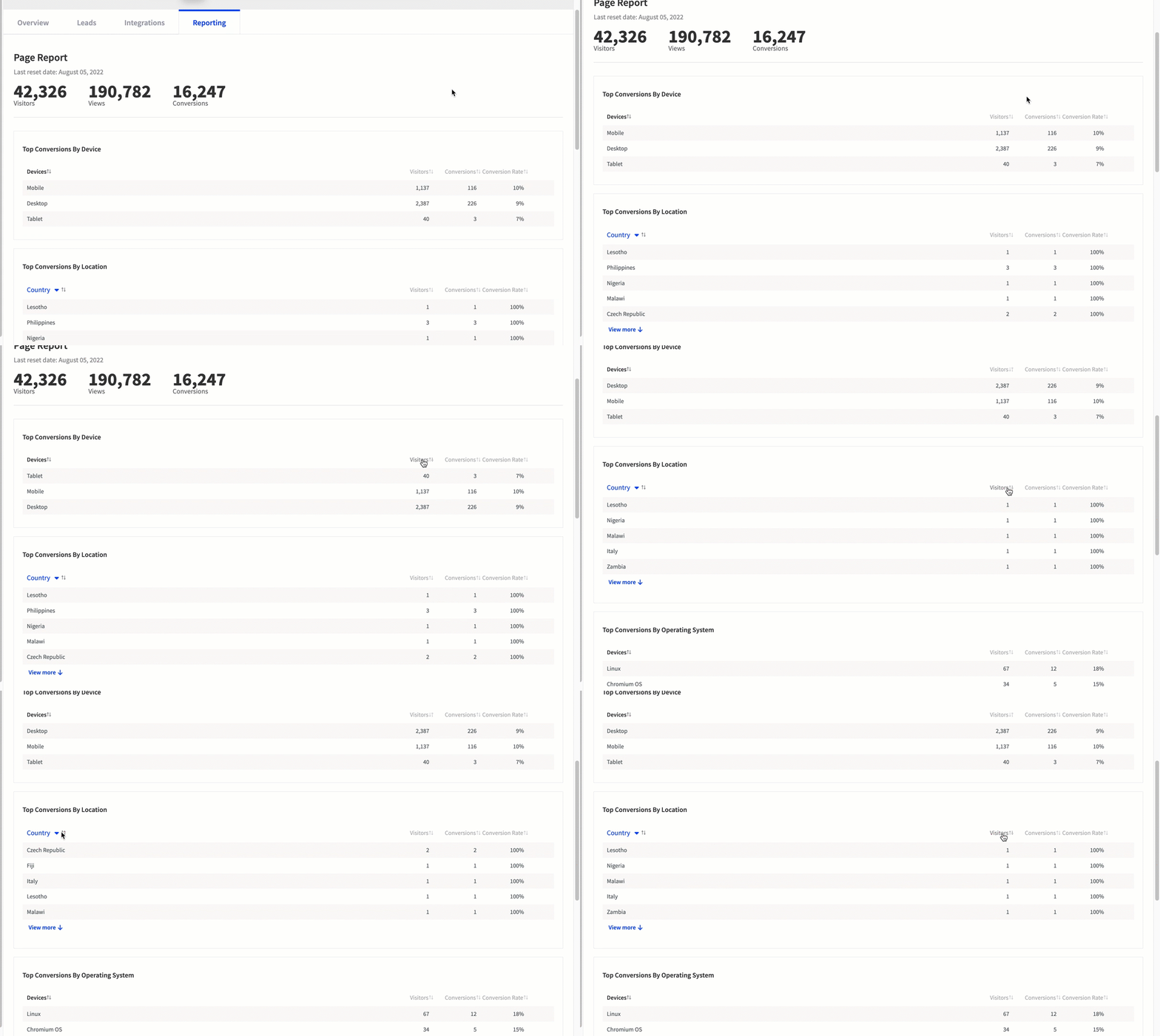
Consumer browsing habits have fundamentally decoupled from conversion realities. Industry data indicates that 83% of all landing page visits now occur on mobile devices. Yet, desktop sessions continue to convert at an average rate roughly 8% higher than mobile counterparts.
A traditional marketing team might look at this statistic and implement a sweeping, resource-heavy mobile redesign. An iterative testing team, however, treats this as a hypothesis backlog:
- Are mobile users bouncing due to slow load times?
- Is the checkout friction higher on smaller screens?
- Does the core messaging lose its punch when viewed vertically?
Through rapid, iterative cycles, marketers can test targeted mobile-specific adjustments—such as simplified form fields or sticky call-to-action (CTA) buttons—recovering lost revenue without undertaking a risky, full-scale site migration.

The Iterative Testing Process: A Step-by-Step Blueprint for Marketers
Transitioning from chaotic, ad-hoc experimentation to a disciplined iterative framework requires a structured methodology. Below is a practical, six-step framework designed to maximize learning velocity and conversion impact.
[1. Focused Hypothesis] ➔ [2. Prioritize (Impact/Effort)] ➔ [3. Minimal Variation]
                                                                    │
[6. Scale & Iterate]    ◄─ [5. Extract Insights]     ◄─ [4. Collect Data]
Step 1: Define a Focused Hypothesis
The single biggest pitfall in digital experimentation is trying to test everything at once. Changing the headline, hero image, color scheme, and form length simultaneously yields zero actionable insights if conversions spike or plummet.
Iterative testing demands laser-focused hypotheses tied directly to user observation. Instead of vague goals, construct precise statements such as:
- “If we replace our corporate hero image with a product-in-action screenshot, mobile users will feel a stronger connection to the software, increasing trial sign-ups by 5%.”
- “If we shorten our multi-step lead capture form down to two fields, friction will decrease, lifting overall conversion volume.”
Step 2: Prioritize Based on Impact and Effort
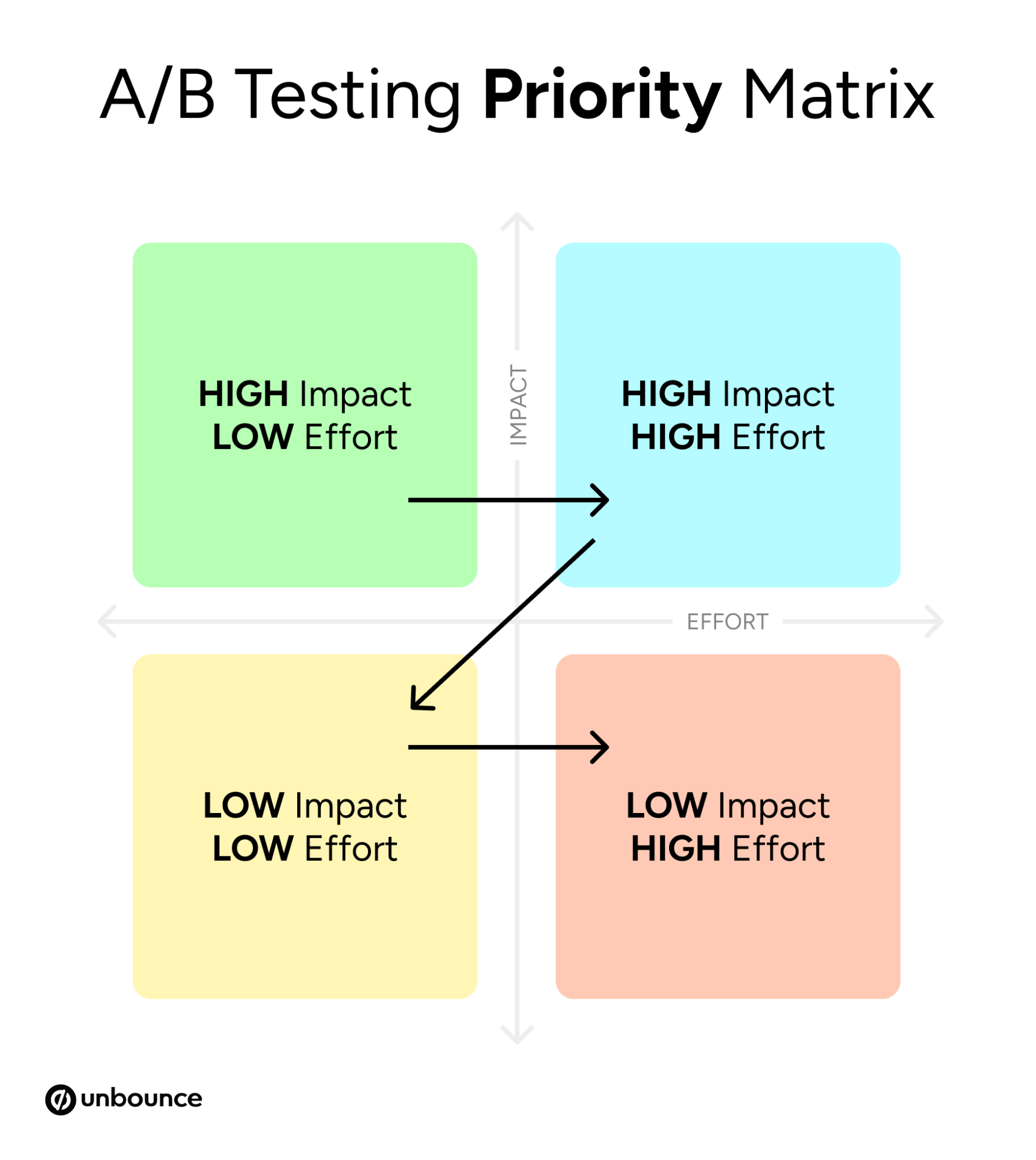
Not all tests are created equal. Marketers must evaluate potential experiments using a simple 2×2 prioritization matrix balancing Expected Impact against Implementation Effort.
- Quick Wins (High Impact, Low Effort): Copy adjustments, headline shifts, and button color changes. These should be deployed immediately to build internal momentum.
- Strategic Projects (High Impact, High Effort): Full UX overhauls or new video assets. These require careful resource allocation.
- Fill-ins (Low Impact, Low Effort): Minor formatting tweaks. Execute only when bandwidth permits.
- Time Sinks (Low Impact, High Effort): Complex changes with minimal projected return; avoid entirely.
Step 3: Build a Minimal, Testable Variation
Keep your test variants clean and isolated. Avoid the temptation to over-engineer variations. Utilizing a dedicated A/B testing and optimization platform (such as Unbounce) allows marketers to duplicate control pages and execute targeted changes rapidly without tying up developer resources.
Step 4: Launch and Collect Meaningful Data
Patience is the marketer’s greatest virtue during an active test. Pulling the plug early due to impatience or vanity metrics invites statistical noise rather than genuine insight. Ensure your traffic volume reaches statistical significance—meaning your sample size is large enough to confirm that results reflect true user preference rather than random chance. Advanced tools with intelligent traffic routing can accelerate this phase by optimizing variant distribution based on real-time performance.
Step 5: Analyze Results and Extract Actionable Insights
Data without interpretation is just numbers. When analyzing a test, look beyond the surface-level winner. Ask yourself:
- Why did Variant B outperform the control?
- Did the winning element appeal to a specific traffic source or demographic?
- What does this tell us about our audience’s deeper psychological motivations?
Transforming a raw metric into a broad, strategic insight ensures that a win on a single landing page can inform email campaigns, ad copy, and sales enablement collateral.
Step 6: Iterate, Expand, and Scale Successful Learnings
When a test concludes successfully, you have three primary paths:
- Iterate Further: Push the winning concept deeper (e.g., if simplifying copy worked, test even more concise phrasing).
- Expand Horizontally: Apply the insight to adjacent campaigns, channels, or landing pages.
- Scale Broadly: Codify the finding into brand guidelines or global site architecture.
Remember: Even a "failed" test (a rejected hypothesis) is a victory. Discovering what does not resonate with your audience provides critical guardrails for future planning.
Best Practices for Effective Iterative Testing
To sustain a long-term culture of experimentation, marketing organizations should adhere to several core best practices:
- Prioritize Speed over Perfection: Shipping ten simple tests in the timeframe it takes to plan one massive redesign yields exponentially more market intelligence. Momentum fuels internal buy-in.
- Avoid Metric Bloat: Do not drown your team in secondary data spreadsheets. Focus on core metrics—Conversion Rate, Cost Per Acquisition (CPA), Bounce Rate, and Average Order Value (AOV)—while treating everything else as supporting context.
- Break Down Silos: Tap into insights from customer support, sales, and product development. Your support reps know the exact friction points customers face; leverage that frontline feedback to build sharper test backlogs.
Future Outlook: The Next Frontier of Marketing Optimization
As artificial intelligence, machine learning, and predictive analytics continue to mature, the landscape of iterative testing is poised for profound acceleration. We are rapidly moving toward an era of hyper-personalized, real-time iteration, where digital assets automatically adapt dynamic messaging, design layouts, and offers on the fly based on individual user intent signals.
However, the core philosophy will remain unchanged. Technology will simply amplify the speed at which marketers can form hypotheses, test assumptions, and learn from their audiences.
Organizations that cling to the outdated "home run" mindset will continue to gamble their budgets on unpredictable, high-risk launches. Meanwhile, those that embrace iterative testing will build resilient, highly responsive marketing engines capable of compounding small wins into dominant, long-term market leadership.
What do you feel about this post?

Like

Love

Happy

Haha

Sad

Angry