

The Great Platform Migration: Analyzing BigCommerce’s Pricing Overhaul and the Open-Source Alternative

By Renzo Bojanovich
Product Marketing Manager, Woo
Executive Overview
In the fast-evolving landscape of digital commerce, platform stability and predictable cost models are the bedrock of sustainable business growth. However, recent strategic maneuvers by major Software-as-a-Service (SaaS) providers are forcing merchants to re-evaluate where they build their digital storefronts. On June 1, BigCommerce initiated a sweeping restructuring of its subscription tiers, lowering Gross Merchandise Value (GMV) thresholds, renaming core plans, and introducing punitive transaction fees of up to 2% for merchants utilizing non-approved payment gateways.
While BigCommerce provided a standard 60-day window for merchants to adapt to these changes, the ripple effects across the e-commerce ecosystem have been profound. For many growing brands, these updates represent more than a mere pricing adjustment—they signal a fundamental shift in how SaaS platforms monetize success.
This report provides an authoritative analysis of BigCommerce’s recent policy changes, examines the hidden costs of closed-ecosystem platforms, and outlines a transparent framework for merchants considering a migration to open-source alternatives like WooCommerce. By breaking down the Total Cost of Ownership (TCO), infrastructure control, and integration flexibility, this article offers digital business leaders the insights necessary to navigate their next strategic move.
Detailed Chronology: The Anatomy of BigCommerce’s Overhaul
To understand the current anxiety within the merchant community, it is essential to trace the exact timeline and mechanics of BigCommerce’s recent updates.
The June 1 Transition
Announced with limited lead time, BigCommerce rolled out a comprehensive plan restructuring across its entire global user base. Every existing plan was renamed, key performance thresholds were recalibrated downward, and new financial penalties were introduced for merchants operating outside the platform’s preferred vendor ecosystem.
Lowered GMV Thresholds and the Overage Model
The most immediate impact of the June 1 update hit small-to-midsize businesses (SMBs) through lowered revenue ceilings. The traditional entry-level plan, formerly known as Standard, was rebranded to "Core." Crucially, its trailing twelve-month (TTM) GMV threshold was slashed from $50,000 to $30,000. For small and emerging stores, crossing this threshold now triggers an involuntary and premature migration into higher-priced tiers.
Larger merchants face an equally aggressive recalibration. Under the new guidelines, once a store’s GMV surpasses $100,000, it is automatically transitioned to the Growth plan, which relies on a continuous overage model. BigCommerce codified this shift by implementing a continuous 0.9% rate on GMV exceeding $33,333 per month, effectively replacing the Pro plan’s predictable, fixed per-block charges with a variable tax on revenue.

The Introduction of Non-Standard Transaction Fees
Historically, BigCommerce carved out a competitive advantage against market rivals like Shopify by heavily promoting a "zero transaction fees" policy. That marketing pillar has crumbled.
Under the new terms, BigCommerce levies up to a 2% penalty fee on orders processed through payment gateways that fall outside its proprietary "Embedded Payment Providers" list. This directly penalizes regional merchants, specialty retailers, and B2B wholesalers who rely on niche or localized payment processors to serve their unique customer bases. Furthermore, these transaction fees apply to offline and manual payment methods, creating a substantial financial burden for high-volume B2B operations where profit margins are already tightly managed.
Supporting Context & Metrics: Taxing Business Success
The core philosophical conflict between SaaS platforms like BigCommerce and open-source ecosystems like WooCommerce boils down to a single economic principle: how growth is treated.
The Cost of Scaling on Closed SaaS
BigCommerce’s pricing architecture is structurally tied to merchant revenue. Consequently, as a business scales, its expenses climb exponentially—not merely due to increased product sales, but because the platform’s subscription tiers, overage charges, and payment penalties scale in tandem.
- Feature Gates: Essential operational tools are increasingly locked behind higher paywalls. For instance, stored payment methods are excluded from the entry-level Core plan, while advanced product filtering requires an immediate upgrade to Scale or Pro tiers.
- Catalog Limitations: Growing merchants frequently bump against structural platform limits, such as BigCommerce’s notorious 600-variant cap per product, forcing complex inventory workarounds or expensive architectural compromises.
- The Revenue Tax: Ultimately, BigCommerce’s business model monetizes merchant success. When a store generates record sales during peak seasons, its platform overhead increases correspondingly, penalizing the business for its own growth.
The Total Cost of Ownership (TCO) on WooCommerce
In contrast, open-source platforms like WooCommerce operate on a fundamentally different economic model. Because the core software is free and open source, there are no revenue thresholds, no arbitrary plan bumps, and no mandatory subscription upgrades tied to TTM GMV.
However, running a professional WooCommerce store is not without cost. Merchants must budget for foundational elements such as:
- Hosting Infrastructure: Premium, high-performance managed WordPress hosting tailored to traffic volume.
- Payment Processing: Standard gateway fees without platform-imposed surcharges or "preferred vendor" monopolies.
- Extensions and Plugins: Specialized tools for subscriptions, advanced taxes, or multi-currency support.
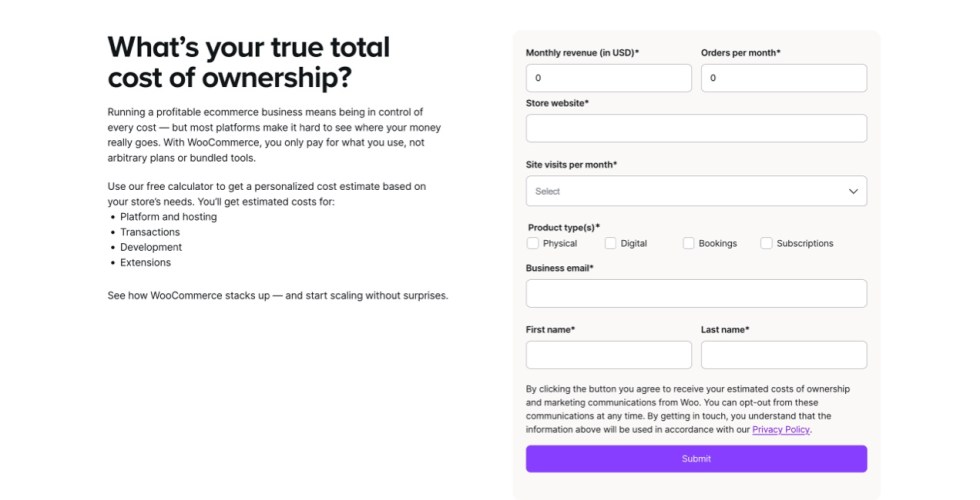
Crucially, every dollar spent on a WooCommerce store is directed toward tools that directly enhance business capabilities rather than paying a platform tax for the privilege of growing. By utilizing the official TCO Calculator, merchants can accurately forecast expenses across hosting, transactions, and extensions based on their actual operational metrics.
Official Perspectives: Control Versus Convenience
When evaluating a platform migration, merchants must weigh the convenience of managed infrastructure against the long-term strategic advantages of absolute digital sovereignty.

The Illusion of Managed Convenience
BigCommerce handles server provisioning, security patches, and cloud infrastructure via its proprietary SaaS environment. For early-stage startups, this "hands-off" approach removes technical friction. However, as businesses mature, this lack of control becomes a operational bottleneck.
During high-traffic events like Black Friday and Cyber Monday, performance bottlenecks can cripple sales. On a closed SaaS platform, merchants have zero direct control over server resource allocation, caching layers, or database optimization. If the platform’s shared infrastructure buckles under peak load, every minute of downtime translates directly to unrecoverable lost revenue.
Architectural Freedom and Data Ownership
WooCommerce places the merchant in total command of their digital environment. Operating within the WordPress ecosystem means retaining absolute ownership of:
- The underlying database and raw files.
- Customer records, order history, and product catalogs.
- Hosting provider selection and server configuration.
When site performance is the priority, a merchant can migrate seamlessly to enterprise-grade, high-traffic hosting providers. Furthermore, direct database access enables instantaneous synchronization with complex Enterprise Resource Planning (ERP), Customer Relationship Management (CRM), and warehouse management systems without being forced through rigid, pre-approved middleware.
The Subscription Dilemma: An Illustrative Case Study
The limitations of closed ecosystems are starkly evident in feature availability. For example, BigCommerce lacks robust, native subscription billing capabilities. Merchants are forced to rely on third-party SaaS extensions to manage recurring revenue.
Because BigCommerce does not control these third-party vendors, sudden policy updates, price hikes, or sudden service deprecations by the external provider can leave merchants stranded with zero viable alternatives.
Conversely, the WooCommerce ecosystem offers solutions like WooCommerce Subscriptions for a predictable annual fee, completely devoid of hidden per-transaction platform commissions, and operating entirely on infrastructure controlled by the business owner.
Strategic Migration Roadmap: Moving to WooCommerce
Migrating an enterprise or scaling store from BigCommerce to WooCommerce requires a methodical approach, separating raw data transfer from broader design and architectural decisions.
1. Data Extraction and Mapping
Migrating core assets—products, customer profiles, order histories, and categories—is a straightforward technical process. Merchants can utilize CSV exports, direct API connections, or specialized migration tools such as Cart2Cart. Prior to execution, teams should audit critical metadata, including:
- Stock Keeping Units (SKUs) and complex product variations.
- Customer identification numbers and past order statuses.
- Active coupon codes and custom database attributes.
2. Design and Workflow Rebuilds
A migration presents a natural inflection point to audit existing workflows. Because visual themes do not transfer directly between distinct software architectures, merchants must select a fresh, modern WordPress theme and replace outdated plugins with optimized WooCommerce extensions.
3. SEO Preservation and URL Redirection
Preserving search engine rankings is paramount. Merchants must retain existing URLs wherever possible. For any changed slugs, comprehensive 301 redirects must be implemented prior to launch. Thoroughly auditing category pages, internal linking structures, and metadata ensures that organic traffic channels remain entirely undisturbed.
Future Outlook: Regaining Strategic Autonomy
The recent changes enacted by BigCommerce serve as a timely wake-up call for digital commerce leaders. When an e-commerce platform dictates how much growth should cost, controls your payment gateway choices, and penalizes your revenue milestones, the platform has ceased to be a partner and has become an operational landlord.
To determine if a migration is necessary, merchants should conduct a rigorous financial audit:
- Calculate the total expenditures paid to BigCommerce over the trailing 12 months—including subscription fees, overage charges, and newly implemented payment penalties—expressed as a percentage of total GMV.
- Run identical business metrics through the WooCommerce TCO calculator.
- Categorize every cost item: Which expenses did you consciously choose, and which were imposed upon you?
The costs chosen for you represent the hidden tax of building on rented land. By transitioning to an open-source framework like WooCommerce, merchants reclaim full sovereignty over their infrastructure, data, and financial future—ensuring that business growth fuels enterprise value, rather than platform overhead.
Are you feeling constrained by your current e-commerce architecture? Take the first step toward absolute control and plan your transition today.