Decoding the 2026 Affiliate Playbook: Push, Pop, or Direct Click—Which Format Actually Delivers ROI?

Executive Overview
In the rapidly evolving landscape of digital marketing and performance-based advertising, media buyers and affiliates continually grapple with a foundational dilemma: choosing the optimal ad format for their campaigns. While the industry frequently searches for a silver-bullet format capable of universally driving high-yield conversions across all verticals, reality dictates a more nuanced approach. Rates, operational budgets, creative agility, and geographical targets all play pivotal roles in determining success.
To provide clarity for the 2026 fiscal cycle, the traffic-generation experts at RollerAds have broken down the core mechanics, distinct use cases, and performance benchmarks of the three pillars of modern affiliate traffic: Push notifications, Pop (OnClick) traffic, and Direct Click traffic.
Far from being interchangeable, each format utilizes a distinct psychological trigger, technical delivery mechanism, and bidding structure. This comprehensive report explores the operational dynamics of each traffic type, evaluates real-world monetization potential, and outlines crucial GEO benchmarks to help advertisers maximize their return on ad spend (ROAS).
Detailed Chronology and Mechanics: How the Top Three Formats Operate
Understanding the technical pathways of ad delivery is essential for designing high-conversion funnels. Each format—Push, Pop, and Direct Click—engages users at different points in their browsing journeys, requiring tailored strategies for campaign structuring and optimization.
1. Push Traffic: Native Integration and Opt-In Engagement
Push traffic relies on notification-style ads delivered directly to a user’s desktop or mobile device. Unlike aggressive display units, push notifications mimic native device alerts, allowing them to blend seamlessly into the user’s daily digital experience.
The lifecycle of a Push traffic campaign follows a strict sequence:
- The Opt-In Phase: Before any promotional content reaches a device, the user must grant explicit consent. This is typically achieved through a browser prompt reading "Allow to receive notifications." Users who accept are immediately added to a proprietary subscriber database.
- Campaign Deployment: The advertiser constructs a targeted marketing campaign within an ad network, incorporating concise text and a compact visual creative.
- Distribution: Upon launch, the network dispatches the notification to active subscribers based on targeting parameters such as GEO, device type, and carrier.
- Conversion and Monetization: When a subscriber interacts with the notification, they are redirected to a designated landing page, product catalog, or app store listing. Completing the desired micro- or macro-conversion generates revenue.
Common bidding models for Push traffic include Cost Per Click (CPC), SmartCPC, and CPA Goal. Because they rely on explicit user permission, push subscribers generally exhibit higher initial engagement, making this format a favorite for both scaling and initial offer testing.
2. Pop Traffic (OnClick): Maximizing Visibility and Retargeting Efficiency
Pop traffic—commonly referred to as OnClick traffic—generates conversions by redirecting users to full-page advertisements that open in a new browser window or tab. Depending on the technical configuration, these ads can appear either in front of the active browsing tab (pop-ups) or behind it (popunders).
The operational workflow for Pop traffic is streamlined:
- Campaign Creation: Advertisers configure their offers within the network. Notably, traditional Pop traffic campaigns require zero ad creatives beyond the destination landing page or pre-lander.
- The Trigger Mechanism: A user navigates to a publisher website embedded with a tracking script. Clicking anywhere on the page—or interacting with specific elements like exit buttons or timer triggers—activates the ad redirection.
- Strategic Deployment: Pop-ups are traditionally deployed when the primary objective is capturing immediate, undivided attention. Popunders, by contrast, offer a less intrusive user experience by loading silently behind the active window. This allows users to review the offer later without disrupting their primary browsing session, making popunders exceptionally powerful for retargeting and re-engaging previous visitors.
Pop traffic primarily utilizes CPM, Smart CPM, and CPA Goal bidding models. Because they eliminate the need for banner design and creative optimization, Pop campaigns offer one of the lowest barriers to entry in the affiliate space.

3. Direct Click Traffic: High-Intent Redirections
Direct Click traffic bridges the gap between accidental traffic and high-intent user journeys. While it operates similarly to a pop-up or redirection tab, its traffic channels are fundamentally different and significantly more qualified.
Direct Click traffic is primarily sourced from three major pillars:
- Parked Domain Traffic: The largest driver of Direct Click volume, generated when users mistype a search query or visit an expired domain and are dynamically redirected to relevant offers.
- Survey Exit Traffic: High-volume user flows captured upon the completion of online questionnaires and feedback forms.
- High-Engagement Clicks: Action-driven clicks originating from interactive webpage elements, such as "Play," "Download," or "Continue" buttons.
The mechanics of Direct Click function through high-intent conversion paths:
- Redirection: When a user triggers the traffic source (e.g., landing on a parked domain after a mistyped URL), they are instantly routed to an ad matching their implied search intent rather than facing a dead-end error page.
- Monetization: Because the user was actively searching for information, software, or media, they arrive at the destination page with pre-conditioned intent, leading to elevated conversion rates.
Direct Click campaigns rely primarily on CPC and SmartCPC bidding models and, much like Pop campaigns, require no complex ad creatives—only a high-converting landing page.
Supporting Context and Metrics: 2026 Traffic Benchmarks
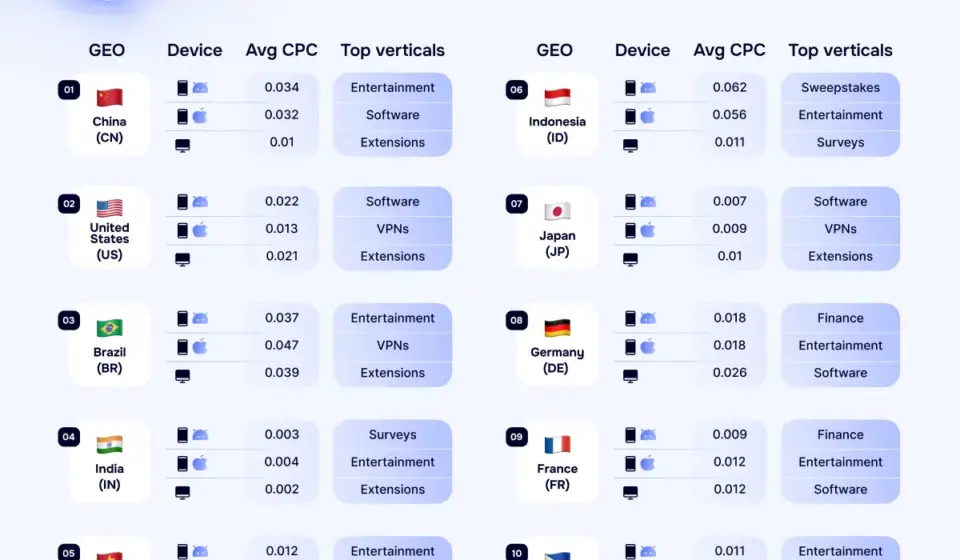
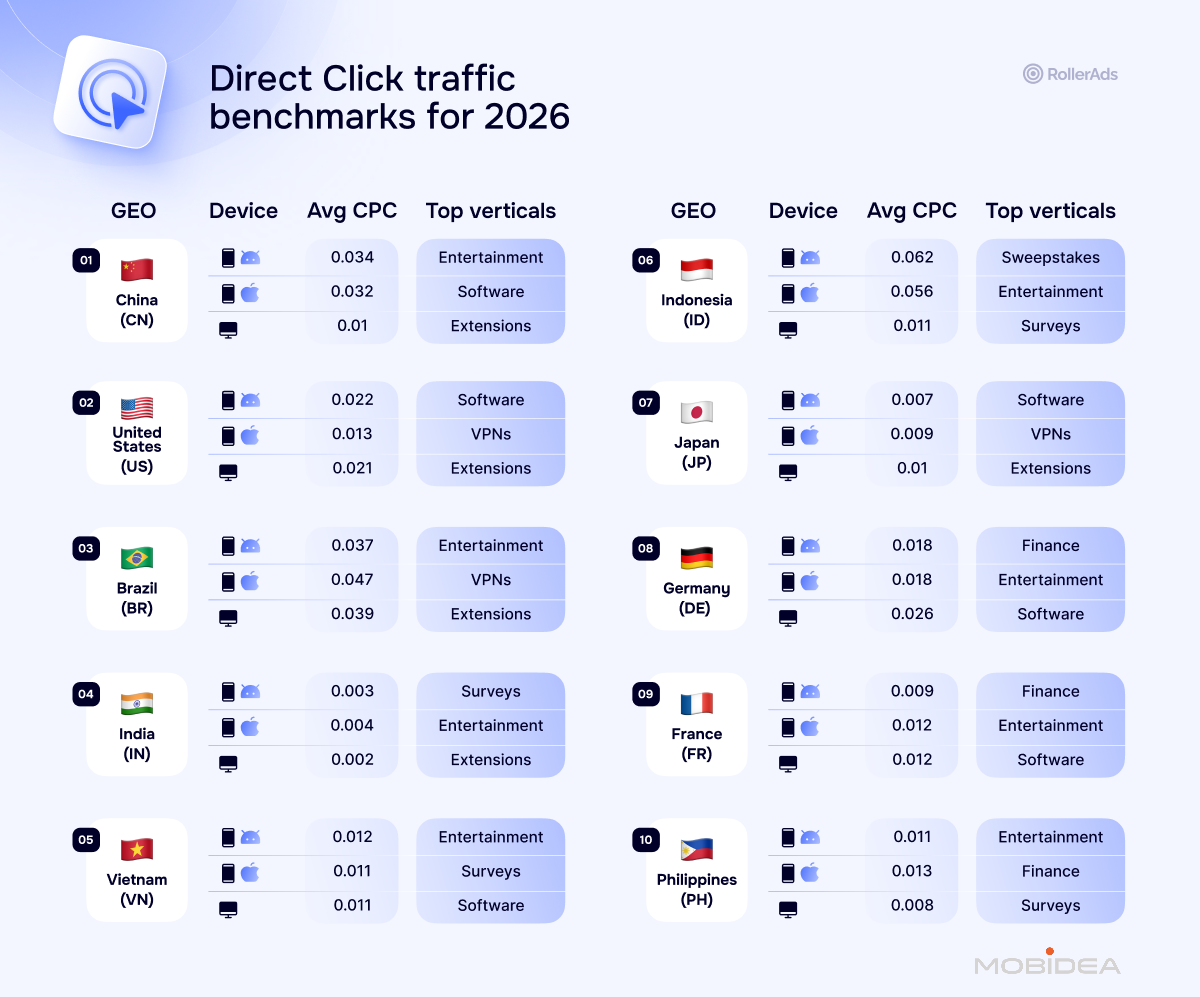
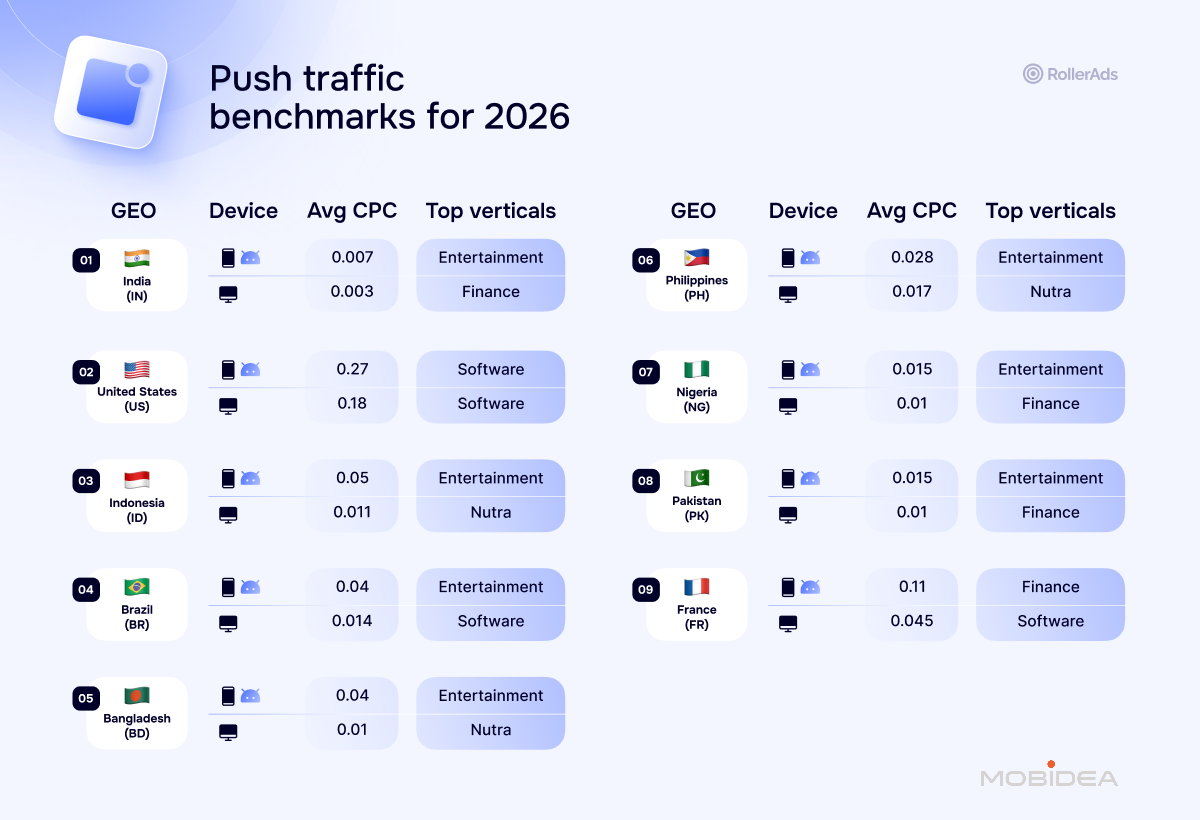
Selecting an ad format without referencing current market data is a recipe for wasted ad spend. RollerAds’ internal data analytics team has compiled comprehensive performance benchmarks for 2026, mapping out recommended pricing ranges, viable verticals, and geographical sweet spots for Push, Pop, and Direct Click traffic.
Strategic Vertical Alignment
- Push Notifications: Highly effective for sweepstakes, mobile apps, finance, e-commerce, and lead generation. The native delivery style excels at driving impulse actions and capturing user attention for time-sensitive promotions.
- Pop (OnClick) Traffic: Dominates high-volume verticals such as iGaming, dating, utilities, streaming, and mainstream lead gen. Its ability to scale rapidly makes it the go-to format for broad-audience offers.
- Direct Click: Excels in verticals requiring high user intent, including software installs, VPN services, utilities, lead gen, and specific e-commerce niches where search-driven behavior correlates with immediate conversion.
2026 Traffic Benchmarks and Infographics Data
To assist media buyers in mapping out profitable campaigns for the 2026 fiscal year, industry insights emphasize the importance of adjusting bids relative to GEO tiers:
- Tier 1 GEOs (US, UK, CA, AU): Command higher CPC/CPM rates due to intense market competition, but yield significantly higher payouts per conversion. SmartCPC and Smart CPM automated bidding models are recommended here to prevent overpaying for saturated inventory.
- Tier 2 and Tier 3 GEOs (LATAM, SEA, Eastern Europe): Offer massive traffic volumes at significantly lower entry costs. These regions are ideal for initial offer testing, allowing affiliates to validate pre-landers and conversion funnels on modest budgets before scaling into Tier 1 markets.
(Note: Advertisers should consult the official RollerAds 2026 Traffic Benchmark Infographics for real-time, granular CPC and CPM ranges categorized by specific country codes and vertical constraints.)
Official Industry Perspectives and Expert Recommendations
Industry leaders emphasize that mastering modern affiliate marketing requires a departure from rigid, one-size-fits-all strategies. According to RollerAds’ internal compliance and media buying experts, the key to long-term profitability lies in rigorous testing methodologies and format diversification.
"There is no universal ad format that fits every marketing campaign like a glove," notes the RollerAds strategy team. "While Push offers unmatched user engagement through native placement, Pop traffic delivers unmatched volume and scale with minimal creative overhead. Meanwhile, Direct Click captures intent at the exact moment of search error or exit. The secret to modern profitability is not finding the ‘best’ format, but matching the right format to your budget, technical skill, and vertical."
Experts strongly advocate for A/B testing parallel campaigns when media buyers find themselves undecided between formats. By launching identical offers across two distinct traffic channels—such as testing a sweepstakes offer on Push versus Pop—advertisers can empirically determine which ecosystem yields a superior ROI before committing substantial capital to scaling.
Future Outlook: The Evolution of Affiliate Ad Formats
Looking ahead through 2026 and beyond, the performance marketing sector is poised for continued technological refinement. As ad-blockers become more sophisticated and consumer tolerance for intrusive advertising diminishes, traffic networks are placing a greater emphasis on user-intent alignment and algorithmic bidding efficiency.
- The Rise of Smart Bidding: Automated optimization tools like SmartCPC and CPA Goal will increasingly take over manual bid adjustments. Machine learning algorithms within networks like RollerAds will dynamically adjust bids in real time based on historical conversion data, ensuring advertisers only pay for high-probability impressions.
- Shift Toward High-Intent Traffic Channels: With traditional display banners facing diminishing returns, formats that capture genuine user intent—such as Direct Click and permission-based Push notifications—will capture an increasing share of performance marketing budgets.
- Creative Agility and Localization: As markets mature, the ability to rapidly swap landing page angles, localized ad copy, and pre-lander designs will separate profitable affiliates from those operating at a loss.
Final Thoughts
Navigating the 2026 affiliate marketing ecosystem requires a disciplined, data-driven approach. By understanding the underlying mechanics of Push, Pop, and Direct Click traffic, aligning campaigns with appropriate verticals, and leveraging up-to-date GEO benchmarks, media buyers can transform raw traffic into sustainable revenue streams.
For advertisers ready to test new channels or scale existing funnels, joining established networks like RollerAds provides access to top-performing ad formats, real-time optimization tools, and responsive technical support designed to navigate the complexities of modern digital advertising.