The Declarative Revolution: Celebrating Five Years of Jetpack Compose and the Death of the findViewById Era

By Rebecca Franks, Nick Butcher, and Loryn Hairston (Android Developer Relations & Product Management)
Published by Android Developers | Special 5th Anniversary Retrospective & Industry Analysis
Executive Overview
Five years ago, on July 28, 2021, the Android ecosystem crossed a profound technical Rubicon with the official stable release of Jetpack Compose 1.0. What began as a bold, experimental effort to reimagine how native mobile interfaces are constructed has grown into an absolute tectonic shift for software engineering. Today, more than 68% of the top 1,000 applications in the Google Play Store rely on Jetpack Compose in production.
The milestone is more than just a chronological marker; it signals the definitive closing of an era. At Google I/O earlier this year, Google announced a sweeping architectural pivot: the Android UI ecosystem is officially Compose-first. With legacy Android Views entering formal maintenance mode and Material Design shifting its entire framework roadmap to prioritize declarative UI, the time-honored findViewById method call—a cornerstone of Android development since its inception—has finally been relegated to the history books.
From humble beginnings involving parallel internal prototypes and early community experiments like the Android Dev Challenge, Compose has matured into a multi-platform, multi-form-factor powerhouse. It now drives interfaces across mobile devices, foldables, Wear OS smartwatches, Android TV, glanceable home-screen widgets, and even advanced spatial computing interfaces via Jetpack Compose Glimmer.

As the framework reaches version 1.11—with version 1.12 looming on the horizon—this retrospective examines the tumultuous origins, rapid evolution, staggering industry adoption, and future trajectory of the technology that forever transformed Android development.
Detailed Chronology: From Parallel Prototypes to a Declarative Standard
To understand the ubiquity of Jetpack Compose today, one must look back at its unorthodox origins. The story of Compose did not begin as a single top-down mandate; rather, it was born out of two parallel engineering tracks inside Google that eventually collided to create something entirely revolutionary.
The Two Parallel Tracks
In the mid-2010s, the traditional Android Views toolkit team was actively investigating ways to unbundle the monolithic UI framework from the core Android SDK. The objective was straightforward: transform the UI toolkit into an independent library to accelerate development velocity, simplify distribution, and allow developers to adopt updates without waiting for overarching platform releases.
Simultaneously, a separate, skunkworks-style engineering group was exploring a radical, novel hypothesis. They wanted to build declarative layouts entirely from scratch by embedding XML-style structures directly inside Kotlin. Early internal prototypes looked vastly different from the modern APIs developers use today, relying on experimental syntax trees to inject layout parameters directly into compiler passes.

Recognizing the synergy between unbundling the UI layer and adopting a modern, compiler-backed declarative model, the two groups merged. The result was a synthesis of a custom Kotlin compiler plugin, a reactive runtime engine, and an intuitive UI vocabulary.
Pre-Alpha, the Community, and the Android Dev Challenge
Before reaching stable status in 2021, Compose underwent a rigorous, highly transparent pre-alpha incubation phase. Unlike previous Android toolkits developed entirely behind closed doors, the Compose team invited the community to stress-test APIs, file issues, and shape the framework’s ergonomic design.
A defining cultural milestone of this era was the Android Dev Challenge. Google challenged the global developer community to build four distinct functional tasks using pre-release Compose APIs. The initiative flooded developer feeds with custom puppy adoption apps, animated clocks, and dynamic weather interfaces. More importantly, it generated a torrent of real-world feedback that directly influenced the architectural decisions finalized in version 1.0.
@Composable
fun Newsfeed(stories: List<Story>)
    LazyColumn
        items(stories)  story ->
            Card
                val author = story.author
                Image(painterResource(author.profilePhoto),
                    contentDescription = author.name)
                Text(author.name)
                Text(story.content)
                if (story.hasCommentsEnabled())
                    for(comment in story.comments)
                        Text(comment.mainContent)
From Material 2 to Material 3 Expressive
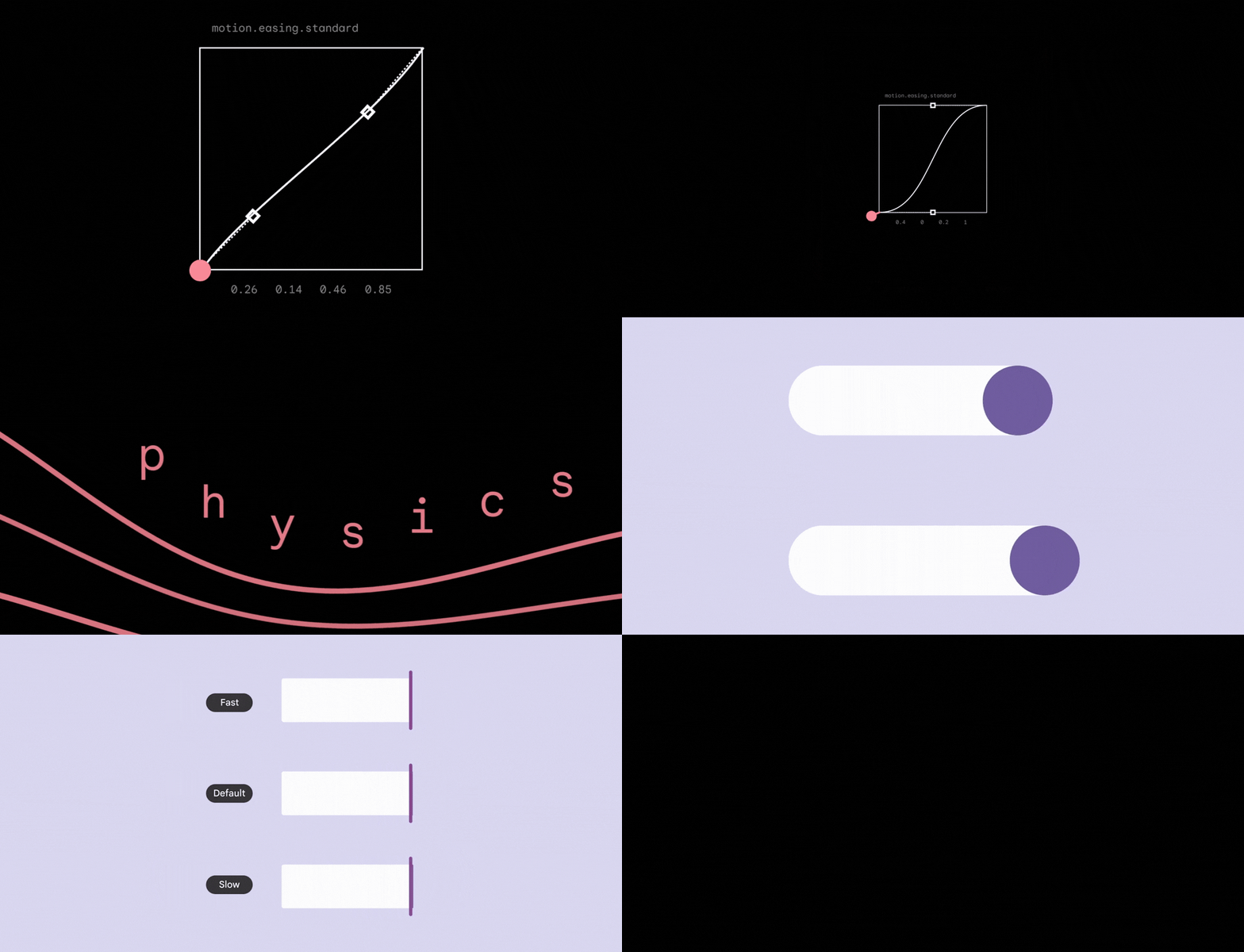
As the API surface stabilized, the design systems supporting it evolved in tandem. Version 1.0 launched with a robust set of Material 2 components, establishing the baseline for design consistency. Over the subsequent half-decade, Compose expanded rapidly to support modern design systems, culminating in recent integrations with Material 3 Expressive. These updates allow developers to build fluid, high-end, responsive interfaces that reflect the latest philosophies in visual hierarchy and motion design.

Supporting Context & Metrics: Conquering Ecosystems and Multi-Platform Horizons
The quantitative success of Jetpack Compose is staggering. Surpassing 68% adoption among the top 1,000 production apps on Google Play is proof that developers quickly recognized the productivity gains of declarative UI over imperative view manipulation.
Expanding Beyond Mobile: Form Factors Galore
While Compose started as a mobile-first paradigm, its underlying runtime architecture proved abstract enough to scale across an extraordinary array of hardware form factors:
- Wear OS: Bringing reactive, lightweight UI patterns to battery-constrained smartwatches.
- Android TV: Powering ten-foot navigation experiences with specialized focus and spatial awareness APIs.
- Glance for Widgets: Revolutionizing home-screen app widgets by allowing developers to write widget layouts using familiar composable functions.
- Jetpack Compose Glimmer: Pushing the envelope into spatial computing and display glasses, proving the adaptability of the declarative model to augmented and virtual reality environments.
The Multiplatform Explosion
Google’s internal efforts were powerfully augmented by strategic industry partnerships—most notably with JetBrains. Through Compose Multiplatform, JetBrains extended the reach of Compose far beyond Android. Today, developers can leverage their knowledge of composable functions to target desktop environments (macOS, Windows, Linux), Apple’s iOS ecosystem, and modern web browsers. This cross-platform synergy has turned Compose into a truly universal paradigm for client-side software engineering.
Official Statements: Perspectives from the Engineering Leadership
To mark the five-year milestone, the Android Developers Backstage podcast released a special retrospective episode featuring a powerhouse panel of Android engineering leaders: Clara Bayarri (Engineering Lead for Jetpack), Romain Guy (former Jetpack lead), Chet Haase (former Jetpack lead), and Tor Norbye (Senior Engineering Director).

Reflecting on the early days of development, the panel discussed the immense technical hurdles of convincing an entire industry to abandon decades of imperative programming habits. Transitioning from imperative view hierarchies—where developers manually managed state mutations and UI updates via commands like setText() or setVisibility()—to a reactive model where UI is a function of state required a complete cognitive rewiring.
"When we officially announced 1.0, we promised a simpler, faster, and more intuitive way to build native interfaces on Android," noted the team during the retrospective. "Looking back, it’s safe to say that Compose didn’t just deliver on that promise—it completely redefined how developers think about user interaction."
Furthermore, the recent announcements at Google I/O cement this philosophy as mandatory policy for the platform’s future. By declaring Android Compose-first, Google has drawn a hard line in the sand: all future UI innovation will happen exclusively within the Compose ecosystem.
Future Outlook: Version 1.11, Adaptive Layouts, and the Next Five Years
As Jetpack Compose enters its sixth year, version 1.11 is live in production, with version 1.12 right around the corner. The focus of the toolkit has shifted from basic layout primitives (Box, Row, Column) to advanced, highly adaptive layout engines designed for the era of foldables, tablets, and variable screen geometries.

Next-Generation Adaptive APIs
Recent updates have introduced sophisticated layout paradigms designed to handle multi-window environments and fluid screen real estate effortlessly:
FlexBoxandGrid: Advanced layout primitives that allow dynamic reorganization of elements based on available constraints.MediaQuery: Native reactive querying of viewport characteristics directly within composable scopes.Styles: Streamlined management of design tokens and typography hierarchies.
Community-Driven Innovation
Much of the cutting-edge momentum behind Compose continues to come from open-source contributors and Google Developer Experts (GDEs) who build robust toolchains on top of the framework:
- JetBrains: Driving web, desktop, and iOS compatibility via Compose Multiplatform.
- Sinasamaki: Crafting delightful micro-interactions, such as custom ribbon modifiers and glitch animation effects.
- Saket Narayan: Innovating testing and interaction tools like Telephoto (for pan/zoom gesture management and large image sub-sampling) and Touch Robot (for orchestrating and testing complex touch animations).
- Jake Wharton & Chris Banes: Pushing the boundaries of what is possible with libraries like Molecule (state flows via Compose runtime), Mosaic (terminal-based Compose UI), and Haze (advanced background blurring).
Conclusion: Cheers to the Next Five Years
Jetpack Compose has evolved from an ambitious research project into the undisputed standard for client-side Android development. The transition has not been trivial, requiring dedication from Google’s internal toolkit teams and a resilient, passionate global community of developers who filed bug reports, built third-party libraries, and shared their knowledge.
As the industry celebrates with global birthday parties and a special live stream on the Android Developers YouTube channel, one thing is certain: the imperative, findViewById era is officially behind us. Armed with powerful adaptive APIs, multiplatform reach, and a thriving ecosystem, Jetpack Compose is poised to define the next generation of user interfaces across every screen imaginable.
.gif)
Here’s to the next five years—and happy composing!
What do you feel about this post?

Like

Love

Happy

Haha

Sad

Angry