For the past two years, enterprise technology and marketing teams have been consumed by a singular imperative: traceability. Organizations have invested heavily in building observability pipelines, guardrail software, policy engines, and human-in-the-loop checkpoints. They have version-controlled their Large Language Models (LLMs), logged vector-database retrievals, and tracked tool calls down to the exact millisecond.
Yet, a troubling reality is emerging across corporate boardrooms: a perfect audit trail does not prevent a disaster; it merely documents it in exquisite detail.
Consider the modern marketing stack—one of the most heavily automated environments in the corporate ecosystem. An autonomous personalization engine evaluates customer cohorts and dispatches a promotional email offering a 20% discount to high-value accounts. Minutes later, enterprise leadership discovers that the offer violated margin mandates, eroded pricing integrity, and triggered thousands of redemptions before the campaign could be killed.
The organization’s logging infrastructure performed flawlessly. The system recorded the prompt input, the model version, the retrieved contextual data, the policy check, the synthetic approval state, and the final transactional trigger. The enterprise possesses a complete "Decision Receipt."
However, this brings leadership to a critical juncture: What happens in the ten minutes after the evidence arrives and confirms that the AI did precisely the wrong thing?
+-------------------------------------------------------------------------+
|                         THE DECISION RECEIPT                            |
+-------------------------------------------------------------------------+
|  [Input Context]  ->  [Model Version] -> [Policy Check] -> [Tool Call]   |
|         |                     |                 |              |        |
|  Logged 10:00:01     Logged 10:00:02   Logged 10:00:02  Executed 10:00:03|
+-------------------------------------------------------------------------+
                                    |
                                    v
          +---------------------------------------------------+
          | RESULT: Perfect Record of an Incorrect Outcome    |
          | "Forensics verify the action was fully documented |
          |  but fundamentally flawed."                       |
          +---------------------------------------------------+
As artificial intelligence shifts from internal administrative assistance to autonomous customer-facing execution, the primary vulnerability in enterprise deployment is no longer a lack of visibility. The challenge lies in the operational gap between retrieval (proving what happened) and remediation (identifying which structural layer failed and ensuring the system learns without repeating the error).
This investigation examines why current AI risk frameworks fall short when evidence arrives, dissects the root causes of automated campaign failures, and outlines the structural shifts required to move from passive technical forensics to active enterprise decision governance.
Detailed Chronology: Anatomy of an AI Marketing Failure
Marketing is frequently the first department to encounter the limits of AI governance because it operates with unprecedented velocity, high volumes of automation, and direct public exposure. Unlike internal financial models or HR tools—whose errors can be audited and corrected quietly behind corporate firewalls—a flawed marketing execution manifests instantly in customer inboxes, social media feeds, and news cycles.
For chief marketing officers (CMOs) and technology executives, accountability now frequently arrives in the form of a viral screenshot.
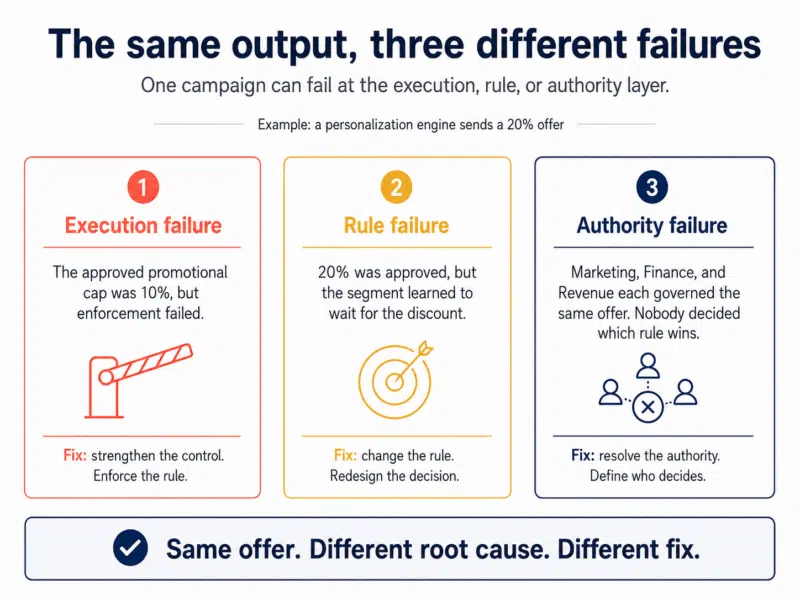
To understand why traditional logging fails to prevent these incidents, we must trace how a single automated campaign can produce identical telemetry outputs while masking fundamentally different systemic failures.
                  +-----------------------------------+
                  |   UNIFIED EXTERNAL FAILURE MODE   |
                  |  20% Discount Sent to Segment X   |
                  +-----------------------------------+
                                    |
         +--------------------------+--------------------------+
         |                          |                          |
         v                          v                          v
+------------------+       +------------------+       +------------------+
|   SCENARIO 1     |       |   SCENARIO 2     |       |   SCENARIO 3     |
| Implementation   |       | Strategic Policy |       | Conflict of      |
| Bug              |       | Failure          |       | Authority        |
+------------------+       +------------------+       +------------------+
| Failed gate/stale|       | Rule was correct |       | Marketing vs.    |
| permissions in   |       | as built, but    |       | Finance rules    |
| execution layer. |       | damaged margins. |       | collided.        |
+------------------+       +------------------+       +------------------+
Scenario 1: The Implementation Bug (Enforcement Layer Failure)
In this instance, executive management had established a strict promotional ceiling of 10% for the targeted customer cohort. The governance framework correctly identified the ceiling, and the decision architecture logged the appropriate restriction.
However, during execution, a stale parameter within the campaign deployment platform, an unpropagated API permission, or a bypassed runtime gate permitted the system to issue a 20% offer.
The Forensic Signature: The Decision Receipt captures a clear break between policy intent and tool output.
The Root Cause: A software engineering bug within the enforcement layer. This represents the classic failure mode that modern DevOps and IT control environments are designed to isolate and patch.
Scenario 2: The Flawed Business Logic (Policy Layer Failure)
In the second case, the 20% discount was authorized, coded, and executed strictly according to design. The model executed the rule perfectly.
However, three quarters post-deployment, longitudinal financial analysis reveals that the campaign inadvertently trained high-margin enterprise accounts to suppress purchases until automated discounts were triggered. Consequently, overall full-price conversion rates collapsed.
The Forensic Signature: The Decision Receipt shows that every validation gate was satisfied and that the system followed its operational parameters without deviation.
The Root Cause: The business strategy itself was flawed. The failure was not technical; it was an error in decision architecture, where a short-term conversion metric was optimized at the expense of long-term economic margin.
The third scenario represents the most complex challenge in enterprise AI operations. Here, three legitimate corporate mandates governed the interaction simultaneously:
Marketing Rules: Mandated that the high-value segment receive aggressive promotional incentives to drive retention.
Finance Rules: Dictated that no offer could reduce gross contribution margins below a strict 35% floor.
All three rules were active within the corporate environment, yet no executive authority had established which rule superseded the others during a conflict.
When the autonomous engine evaluated the campaign, it encountered this unresolved ambiguity. Lacking explicit instructions on rule priority, the software applied a platform default or executed code written by a software developer attempting to meet a sprint deadline.
The Forensic Signature: The Decision Receipt confirms that a recognized business rule was followed. It fails to show, however, that the rule lacked authoritative standing to override competing corporate mandates.
The Root Cause: An unmade organizational decision that was passed down to the software layer by default.
Supporting Context & Metrics: The Taxonomy of Decision Architecture
The scenarios detailed above illustrate a central truth in AI risk management: Proof of execution is not proof of correctness.
As enterprises transition from empirical testing of GenAI toward broad-scale deployment, governance models must differentiate between reconstruction and retrieval.
Reconstruction forces an enterprise to manually compile telemetry data, server logs, and engineer recollections after an incident occurs to understand why an action was taken. This reactive approach is slow and resource-intensive.
Retrieval relies on pre-assembled, immutable Decision Receipts captured at runtime. It allows organizations to instantly pull the full context of an action—including model versions, policy rules, and environmental states—enabling rapid root-cause analysis.
Standardizing AI Control Frameworks
To contextualize these requirements, leading technology organizations are mapping their operational stacks to the NIST AI Risk Management Framework (AI RMF 1.0) and emerging decision-governance methodologies such as the Brand Experience AI Operating System (BXAI-OS).
The NIST framework establishes four core functions for AI governance: Govern, Map, Measure, and Manage. However, enterprise implementations often collapse when moving from Measuring an incident to Managing its systemic remediation.
Governing Layer
Operational Function
Primary Failure Mode
Systemic Remediation Mechanism
Enforcement Layer
Real-time policy checks, API gates, tool-call permissions.
Engineering teams are equipped to build systems around resolved, explicit specifications. When handed clear rules, software operations can reliably construct matching enforcement mechanisms.
The systemic breakdown occurs when enterprise leadership provides software teams with an unresolved judgment disguised as a functional requirement.
+----------------------------------------------------------------------+
|                    THE UNRESOLVED JUDGMENT CASCADE                   |
+----------------------------------------------------------------------+
|  Executive Level: Policy collision left unresolved (e.g., Marketing  |
|  wants conversion; Finance guards contribution margins).            |
|                                  |                                   |
|                                  v                                   |
|  Engineering Level: Developer encounters ambiguity during sprint;     |
|  implements default or arbitrary logic fallback.                     |
|                                  |                                   |
|                                  v                                   |
|  Runtime Execution: System executes fallback logic perfectly.        |
|                                  |                                   |
|                                  v                                   |
|  Post-Incident: Receipt proves system worked as coded; strategy fails|
|  because authority was never formally assigned.                     |
+----------------------------------------------------------------------+
Consider an AI content engine that drafts an outbound email promising "24/7 dedicated account support" because historical campaign data indicates that the phrase increases open and click-through rates. The model possesses no awareness that the customer support division reduced weekend operations three months prior.
In this case:
No runtime gate failed.
No system prompt was bypassed.
No security boundary was breached.
The model optimized performance against the parameter it was assigned. The true failure point was institutional: the enterprise had never codified a policy establishing which business units possess authority to commit operational resources in public-facing communications.
When autonomous systems operate across fragmented enterprise databases, these unmade decisions compound rapidly, leading to conflicting customer-facing actions executed at scale.
Official Statements & Industry Perspectives
The challenge of moving from AI logging to operational governance has drawn intense scrutiny from technology strategists, risk officers, and corporate governance specialists.
A recent working paper on enterprise Decision Architecture published on SSRN highlights the critical structural distinction between basic system telemetry and actionable decision auditing:
"The enterprise belief that logging AI inputs and outputs constitutes governance is a dangerous operational misconception. A log records that a system acted; a governance architecture proves the lineage of authority that enabled the action. When an autonomous system makes a costly mistake, an audit log merely provides front-row seats to the failure. True risk management requires an explicit, machine-readable mapping of which human role holds the authority to resolve policy ambiguities before code deployment."
Similarly, technical experts evaluating alignment with the NIST AI Risk Management Framework emphasize that observability tools often lack clear remediation mechanisms:
"Under NIST AI RMF 1.0, traceability is categorized under the ‘Measure’ pillar. Yet, measuring an error has zero risk-reduction value if the system lacks a deterministic feedback loop to the ‘Manage’ pillar. If your diagnostic receipt cannot automatically inform the underlying policy engine where the breakdown occurred—whether in logic, enforcement, or human authority—the system is not self-healing. It is simply an automated record keeper."
From an operational standpoint, enterprise chief risk officers (CROs) are increasingly advocating for explicit boundary lines surrounding autonomous execution:
"Marketers and operational leads must recognize that software developers cannot be expected to settle inter-departmental policy conflicts in code comments. If Finance and Marketing have not explicitly agreed on discount precedence, that logic gap represents a corporate governance failure, not a software bug. AI systems expose these institutional gaps at scale."
Future Outlook: The Closed-Loop Governance Cycle
To prevent recurring AI failures, enterprises must shift their operational focus from basic forensic auditing to establishing a continuous Correction Loop.
                       +-----------------------+
                       |   DECISION PRODUCED   |
                       | (Receipt Generated)   |
                       +-----------------------+
                                   |
                                   v
                       +-----------------------+
                       |   ACTION CHALLENGED   |
                       |  (Outcomes Assessed)  |
                       +-----------------------+
                                   |
                                   v
                       +-----------------------+
                       |   LAYER DIAGNOSED     |
                       | (Code, Policy, Auth?) |
                       +-----------------------+
                                   |
                                   v
                       +-----------------------+
                       | AUTHORITATIVE FIX MADE |
                       | (Human with Standing) |
                       +-----------------------+
                                   |
                                   v
                       +-----------------------+
                       | CONTROL RE-ENFORCED   |
                       |  (System Updated)     |
                       +-----------------------+
                                   |
                                   +-------------------+
                                                       |
                                                       v
                                           [Next Decision Verified]
Under a modern Decision Architecture framework, every validated error must trigger a systematic five-step remediation process:
Receipt Retrieval: Rapidly pull the decision-time evidence to establish environmental states, parameters, and model versions.
Layer Diagnosis: Determine whether the root cause originated in the enforcement layer (software bug), the policy layer (flawed operational strategy), or the authority layer (unresolved policy collision).
Authoritative Human Resolution: Mandate that a human stakeholder with appropriate corporate authority—rather than an engineering lead guessing intent—resolve the policy ambiguity.
Policy & Control Re-enforcement: Update the upstream governance framework and push the modified rule set down to the runtime enforcement layer.
Systemic Verification: Validate that subsequent operations under identical parameters generate a updated Decision Receipt confirming that the fix holds.
The Four Tests of Enterprise AI Readiness
As corporate boards increase scrutiny on autonomous systems, executive teams must evaluate their AI infrastructure against four core benchmarks:
+------------------------------------------------------------------------+
|                 THE FOUR TESTS OF ENTERPRISE AI READINESS              |
+------------------------------------------------------------------------+
| 1. THE SCREENSHOT TEST | Could leadership publicly defend the output   |
|                        | if published by a third party today?         |
+------------------------------------------------------------------------+
| 2. THE BOARD TEST      | Can executive leadership clearly articulate  |
|                        | the systemic logic behind the decision?       |
+------------------------------------------------------------------------+
| 3. THE AUDIT TEST      | Can the organization instantly retrieve the   |
|                        | decision state rather than reconstruct it?    |
+------------------------------------------------------------------------+
| 4. THE CORRECTION TEST | Can the system prove that a resolved failure  |
|                        | permanently modified future executions?       |
+------------------------------------------------------------------------+
Organizations that satisfy the first three tests but fail the fourth possess strong forensic logging capabilities, yet lack an active learning framework. Without a closed correction loop, enterprises risk repeatedly generating detailed records of identical operational mistakes.
Conclusion
A Decision Receipt should not serve merely as a defensive shield during a post-incident review. When embedded within a mature decision architecture, every resolved failure establishes enterprise precedent. Every clarified rule strengthens subsequent autonomous actions.
Proof of execution clarifies what occurred. True governance is achieved when an organization can systematically adjust its operational policies and verify that the correction permanently takes hold across the enterprise.