Anatomy of a Tech Reset: Bending Spoons Acquires Airtable in a $2.25 Billion All-Cash Deal

Executive Overview
In a landmark transaction that underscores the profound valuation correction sweeping through the enterprise software sector, Milan-based serial acquirer Bending Spoons has agreed to acquire Airtable in an all-cash deal. The transaction values Airtable at an enterprise value of $1.285 billion. Factoring in Airtable’s robust net cash position, the total equity value rises to approximately $2.25 billion. Subject to customary regulatory approvals, the deal is expected to close by the end of the year.
For a company that once stood as the crown jewel of the "no-code" software movement—commanding a staggering $11.7 billion valuation at the peak of the 2021 venture capital frenzy—this acquisition marks a sobering reality check. Airtable enters the deal on solid financial footing: it boasts roughly $480 million in Annual Recurring Revenue (ARR) as of June 2026, growing at a steady 20% year-over-year. With gross margins hovering around 90% and a transition to cash-flow positivity in late 2024 that yields over $100 million annually, the company services more than 500,000 organizations, including an impressive 80% of the Fortune 100.
Yet, the headline acquisition multiple—2.7x ARR—serves as a cautionary bellwether for the broader B2B SaaS ecosystem. This deep-dive analysis examines how a category-defining pioneer of the last decade arrived at this junction, the mechanics of the liquidation preference stack, the strategic carve-outs that accompanied the deal, and what this transaction signals for the future of venture-backed technology companies.
Detailed Chronology: From the "Lego of Software" to the Market Reset
1. The Ascent (2012–2021)
Founded in 2012 by Howie Liu, Andrew Ofstad, and Emmett Nicholas, Airtable set out to solve a ubiquitous enterprise problem: bridging the gap between rigid relational databases and flexible spreadsheets. Billed as the "Lego of software," the platform enabled non-technical operators to build custom workflow applications using a bottoms-up adoption model that eventually metastasized into massive enterprise-wide deployments.
The zenith of this trajectory arrived in December 2021, when Airtable closed a massive $735 million funding round at an $11.7 billion post-money valuation, pricing shares at $187.28 against an ARR base of approximately $156 million. It was a 75x forward multiple that priced in endless, hyper-accelerated compounding.
2. The Macro Turn and Operational Retrenchment (2022–2024)
As monetary policy tightened and public market valuation multiples compressed, the venture capital cycle abruptly reversed. Airtable faced severe headwinds as enterprise software budgets contracted. The company executed two major rounds of layoffs—totaling 491 employees—and weathered a wave of online scrutiny in 2023.
Rather than burning through its capital reserves, management executed a tactical pivot. Airtable cut operational expenses, engineered a successful shift to cash-flow positivity by late 2024, preserved roughly half of the capital it had historically raised on its balance sheet, and maintained enterprise net retention rates even as top-line growth decelerated.
3. The AI Pivot and the Growth Plateau (2025–2026)
Unlike many of its peers that merely issued superficial press releases regarding artificial intelligence, Airtable undertook a substantive architectural refound. Led by founder-CEO Howie Liu—who actively returned to writing code—the company rebuilt its core infrastructure around AI capabilities.
The operational overhaul successfully stabilized the business, driving top-line growth to 20% year-over-year. However, in the post-2023 software market, 20% growth on a $480 million revenue base fails to command hyper-growth multiples. Airtable was systematically repriced by the market as a durable, cash-generating asset rather than a venture-backed compounder.
Supporting Context & Metrics: The Deal Mechanics and Cap Table Realities
The Valuation and the Secondary Market Reality
Over the three years preceding the acquisition, secondary market desks steadily wrote down Airtable’s private valuation. While secondary trades in January pointed to steep markdowns, the clearing price agreed upon with Bending Spoons landed roughly 44% below those levels—and about 25% below where secondary desks had marked the stock just weeks prior. At 2.7x ARR, Bending Spoons is paying a price that reflects current market realities for moderate-growth B2B assets.

The Preference Stack: Who Makes What?
Airtable raised approximately $1.4 billion across seven financing rounds. To understand why a $2.25 billion equity valuation resulted in starkly divergent outcomes for investors, founders, and employees, one must examine the liquidation preference stack (assuming standard 1x non-participating preferred shares):
- Preferred Holders: Approximately $1.29 billion is distributed off the top to preferred stockholders, who owned roughly 25% of the total shares. This protective stack ensures that crossover and late-stage institutional investors recover capital at or near par value, avoiding a catastrophic total loss.
- Common Stockholders: Approximately $900 million to $1 billion remains for common shareholders, spread across the remaining 75% of shares. This translates to an estimated payout of $18 to $25 per share—a far cry from the $187.28 per share implied by the 2021 Series F round.
- Founders: Founder-CEO Howie Liu’s equity stake—estimated by Forbes at roughly 10% during the 2018 Series C, subsequently diluted through subsequent financing rounds and option pool refreshes—likely nets between $90M and $130M at the final common share payout. Co-founders Andrew Ofstad and Emmett Nicholas face comparable, life-changing yet heavily adjusted outcomes.
- Employees: Employees holding options struck near the $11.7 billion peak receive zero value, as their strike prices sit far above the $18–$25 common payout. Conversely, employees who successfully liquidated portions of their holdings in secondary markets over the prior 12 months fared significantly better than those who held out for an eventual IPO.
The Hyperagent Carve-Out
A critical nuance uncovered in SEC filings prior to the deal’s closing was a pre-signing corporate reorganization. Assets and liabilities associated with Hyperagent Inc.—an autonomous AI agent platform announced by Airtable in February 2026—were carved out and transferred into a separate entity.
Because Bending Spoons cited the same ~$480M ARR baseline after the carve-out, Hyperagent contributed virtually nothing to Airtable’s near-term revenue. While the long-term value of Hyperagent remains speculative and dependent on future execution, the reorganisation ensures that the upside potential of this autonomous agent bet remains with existing shareholders rather than transferring entirely to the acquirer.
Official Statements and Industry Perspective
Neither Bending Spoons nor Airtable leadership has signaled a departure from Bending Spoons’ well-documented playbook of operational optimization. Known for acquiring marquee digital brands with stalled growth—such as Evernote, WeTransfer, Meetup, StreamYard, and Vimeo—Bending Spoons implements a disciplined framework: modernizing underlying technology stacks, streamlining headcount, optimizing pricing architectures, and driving extreme operating leverage.
Industry analysts have noted that Bending Spoons’ technological efficiency is striking; CEO Luca Ferrari has publicly reported that approximately 90% of the firm’s code is now generated by AI, driving revenue per employee to $2.57 million by 2025.
Alex Konrad of Forbes highlighted the strategic importance of the Hyperagent carve-out on social channels, noting:
"Everyone is an M&A expert today. But if your hot take on Bending Spoons acquiring Airtable doesn’t factor in that it spun out the AI unit, Hyperagent, it’s missing key pieces of the puzzle. Could be where execs and top engineers go, and changes the math on their exit value."
Future Outlook: Implications for the B2B SaaS Ecosystem
The acquisition of Airtable serves as a definitive case study for the venture-backed technology sector, yielding six primary takeaways for founders, investors, and operators:
- Growth is the Ultimate Multiplier: A business with 90% gross margins, 500,000 corporate customers, and dominant Fortune 100 penetration will still be valued as a cash-flow asset (around 2.7x ARR) if top-line growth decelerates below 25%.
- The Liquidation Preference is a Double-Edged Sword: While preference stacks protected late-stage institutional investors from total capital impairment, they simultaneously wiped out common-stock option value for rank-and-file employees.
- AI Integration is Defensive, Not Generative: Airtable’s comprehensive technical pivot to AI successfully stabilized operations and defended its market position, but it did not re-accelerate growth to levels that command premium valuation multiples.
- The M&A Buyer Universe is Thin: For large B2B assets generating between $300M and $800M in ARR with moderate growth, the pool of viable acquirers is restricted to a handful of serial tech consolidators and mega-fund private equity firms. When strategic alternatives fail, harvest-mode operations or distressed exits become the default outcomes.
- Secondary Liquidity Matters: Employees who leveraged secondary markets to monetize equity prior to a terminal market correction consistently outperformed those who adhered to traditional, long-term IPO holding strategies.
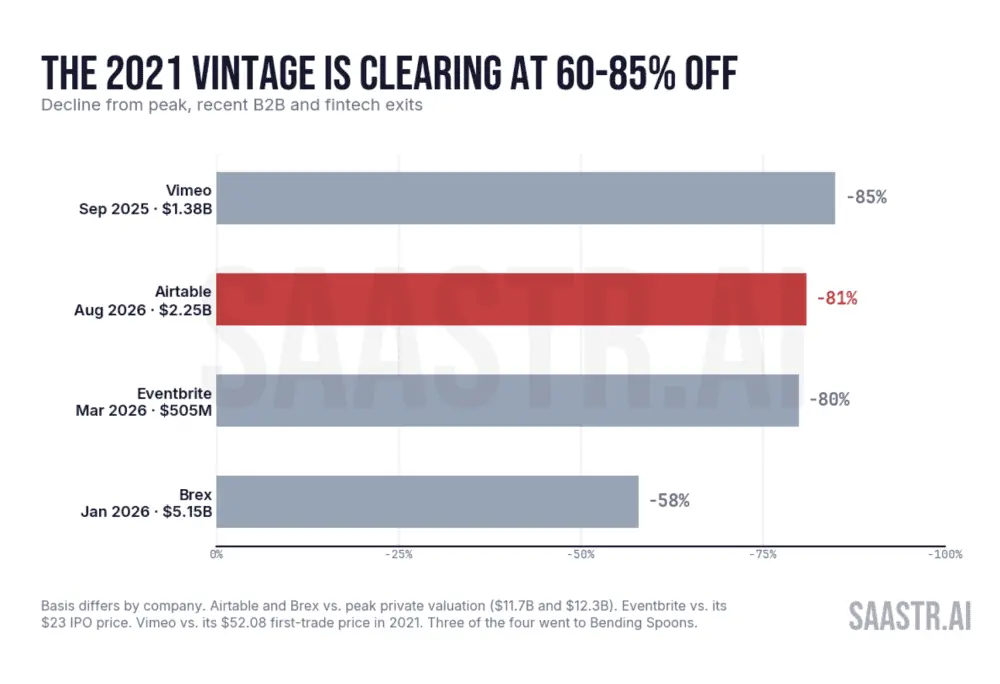
- The 2021 Vintage Reckoning Continues: Airtable represents one of the structurally sounder companies born of the 2021 funding boom. The fact that its ultimate exit returned a modest multiple on total capital raised illustrates the arduous path ahead for peers carrying heavier debt loads or lower operational margins.
As the transaction heads toward its anticipated closing later this year, the tech industry will be watching closely to see how Bending Spoons integrates Airtable’s iconic platform into its expanding portfolio—and whether the spun-out Hyperagent ecosystem can carve out a lucrative niche in the burgeoning autonomous AI agent economy.