

The modern media landscape is a fragmented wasteland. As audiences steadily abandon linear broadcasting for on-demand streaming, ad-free subscription tiers, and micro-moment social platforms, traditional advertisers face an existential crisis. Yet, amidst this sweeping migration, one monolithic titan remains defiantly intact: live sports.
The numbers are staggering. In recent television cycles, nearly all of the top 50 most-watched telecasts in the United States were tied directly to sports. The rare exceptions—such as premier award shows, anniversary specials, and prestige interview broadcasts—merely prove the rule. We live in an era where consumers will eagerly tune into an event explicitly titled "NFL Weather Delay," confirming a fundamental truth of contemporary media consumption: humanity will watch virtually anything as long as it has a sport attached to it.
Because live sports represent the absolute last bastion of mass, synchronous viewing, streaming giants are emptying their corporate treasuries to secure broadcasting rights, and global brands are rushing headlong into sports sponsorships. Marketers are plastering logos on jerseys, equipment, vehicles, sideboards, interview back panels, and stadium naming rights.
Inevitably, however, a moment of corporate reckoning arrives. At some point in the fiscal year, a sharp senior executive leans back in their chair, looks at their marketing leadership, and asks the ultimate question:
"Look, I’ve enjoyed the hospitality suite, I’ve loved shaking hands with legendary athletes, and my mother-in-law thinks I’m a genius for getting her into the clubhouse at Augusta National. But for our $38 million marketing investment, is this actually doing anything for the business?"
Silence falls across the boardroom. The honeymoon phase is over, and the cold reality of accountability has arrived.
For decades, sports marketing has operated in a gray zone of glamorous vanity metrics, justified by executive perks rather than rigorous econometric evidence. Today, we dismantle that opaque veil. By examining how fundamental marketing laws apply to athletic sponsorships and introducing a sophisticated, five-tiered measurement framework, we will answer the defining question of modern commercial enterprise: How do you truly measure the business impact of sports marketing?
Detailed Chronology: From Boardroom Indulgence to Econometric Accountability
To understand how sports marketing arrived at its current crossroads, we must trace its evolution from a gut-check branding exercise into a mathematically modeled science.
Phase One: The Golden Age of Blind Faith (Pre-2010s)
Historically, corporate investments in sports were treated as discretionary line items driven by executive preference rather than strategic planning. If a CEO loved Formula 1 or golf, the company sponsored a car or a tournament. Measurement was virtually non-existent; success was defined by whether the CEO’s friends could secure box seats for the finals. Marketing teams relied on superficial "eyeball" estimates—multiplying total broadcast viewers by the square footage of a logo on a screen—to justify millions of dollars in expenditure.
Phase Two: The Digital Mirage and Vanity Metrics (2010s–2020)
As digital channels matured, sports marketing attempted to modernize by adopting early social media metrics. Brands began tracking retweets, likes, and Earned Media Value (EMV)—a notorious metric that calculates how much a logo’s screen time would have cost if purchased as traditional ad spots. While these metrics provided impressive-looking charts for quarterly review decks, they remained fundamentally disconnected from actual revenue generation. They measured activity rather than outcomes, leaving brands blind to whether their multi-million dollar sponsorships were driving real consumer preference or just generating expensive noise.
Phase Three: The Era of Econometric Rigor and Causality (Present Day)
Today, forward-thinking organizations are no longer willing to accept "brand awareness" as a sufficient return on investment. With economic headwinds forcing tighter scrutiny on every corporate dollar, marketing analytics has intersected with sports sponsorship. Modern brands are deploying sophisticated econometric models—such as Marketing Mix Modeling (MMM) and rigorous Test-vs-Control brand lift studies—to strip away the smoke and mirrors. They are demanding proof of incrementality, bridging the gap between a televised athletic achievement and a measurable lift in enterprise value.
Supporting Context & Metrics: The Hard Laws of Sports Marketing
Before applying advanced measurement frameworks to sports marketing, practitioners must first accept a foundational premise: all standard laws of marketing apply doubly to sports.
Many organizations fall into the trap of believing that sports sponsorships operate under a different set of physical and psychological rules. They do not. If your creative execution fails in a standard marketing campaign, it will fail exponentially faster within a sports context.
1. The Creative Execution Trap
In the age of TikTok and micro-attention spans, if your creative message gets lost in 1.2 seconds, your corporate logo stamped onto a racing car, a soccer jersey, or an interview backdrop will suffer the exact same fate. In fact, because the audience is actively focusing on the game itself, your logo faces even stiffer competition for cognitive real estate.
The Uniform Test: Consider the Seattle Seahawks, a storied NFL franchise. Do you know which corporate logo has adorned their official uniforms for decades? It is arguably the most recognizable slam-dunk branding exercise in professional sports, yet casual observers routinely fail to identify it without prompting. Visibility does not automatically equal cognitive processing.
2. The Danger of Spike and Silence
If "spike and silence" is the kiss of death for standard digital campaigns, it is catastrophic for sports marketing. Relying on an athlete or a sporting event to automatically transfer a halo effect to your brand takes sustained, repetitive reinforcement. The sport itself is a massive distraction; therefore, transferring brand affinity requires five times the structural reinforcement of normal campaigns.
3. The Frequency Imperative
If a frequency of three exposures per user per week is the operational sweet spot for traditional media, assuming an "organic placement" in a sports broadcast will carry your brand is a recipe for failure. You still require that baseline frequency of three disciplined exposures per user over targeted weeks. This frequency must be artificially manufactured through paid media amplification—where the athlete and the sport actively dominate your creative assets—rather than hoping consumers will absorb your message via osmosis.
4. The Influencer Fallacy
Just as an occasional social media post by a massive global influencer is often a colossal waste of corporate capital due to dismal organic reach algorithms, the same rule applies to sports stars. Having a tennis champion casually carry your branded water bottle onto the court or drop a single sponsored post on Instagram yields minimal return unless backed by a rigorous paid media strategy.
5. The Limited Scale of Boutique Hospitality
If launching small, boutique pop-up events yields negligible business impact beyond the immediate attendees, your luxury hospitality tent at the Kentucky Derby or corporate suite at a Major League Baseball stadium will achieve the exact same limited scale. While these perks will undoubtedly make attending clients and internal executives happy—potentially securing a few contract renewals—they do not scale to drive enterprise-wide growth.
The Dirty Little Secret of Sports Marketing
Despite these pitfalls, sports marketing possesses one massive structural advantage: creative excellence. Because the vast majority of brands struggle endlessly with compelling storytelling and creative execution—and because creative accounts for 60% to 70% of all brand marketing success—it can be profoundly profitable to outsource your storytelling to a sport. By attaching your brand to the deep emotional resonance of an athletic discipline, you inherit its core values.
Make this decision consciously. Understand its implications. Then, secure a dedicated media budget to back up that creative with paid amplification, allowing advanced analytics models to prove your incremental profitability.
Official Playbook: The Five Levels of Sports Marketing Measurement
To eliminate guesswork, modern analytics professionals utilize a five-tier framework known as the Impact Intelligence Score (IIS), scaled from 1 to 10. To illustrate how this functions in the real world, let us examine a fictional B2B technology company, CloudPixel, sponsoring a professional soccer team, the San Jose Earthquakes.
Level 5: The Opening Gambit (Vanity Metrics)
- Speed of Impact: Superfast (Real-time data)
- Impact Intelligence Score: 1/10
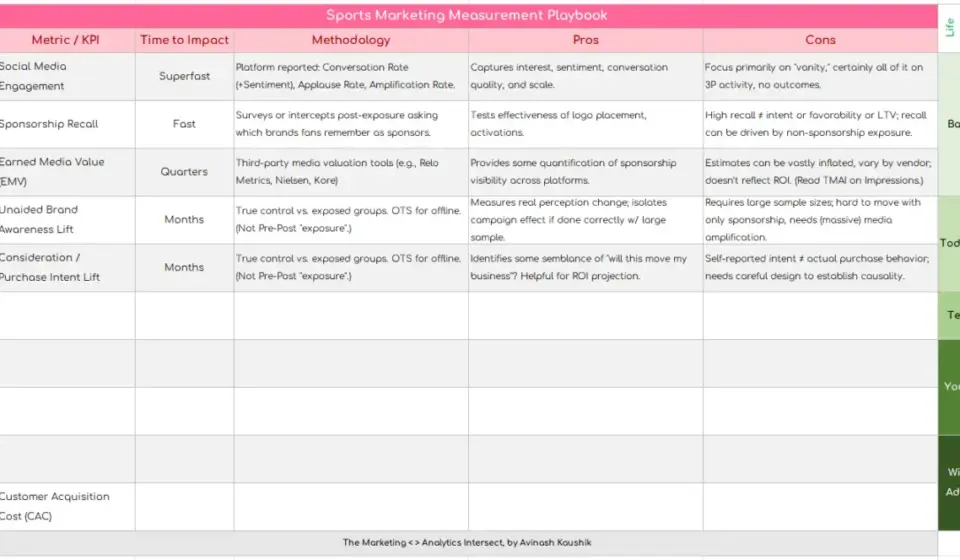
Every brand begins its sports marketing journey here, and tragically, far too many stay here permanently. Level 5 is the realm of big numbers designed to look impressive in executive slide decks ("450 Million Total Impressions!"). At this stage, you are measuring mechanical activity, not human outcomes.
- L5.1: Social Media Engagement: Tracking conversation rates, applause rates, and amplification rates across corporate and team social channels. While easy and inexpensive to pull, this data only measures digital noise.
- L5.2: Sponsorship Recall: Post-exposure surveys asking fans whether they remember CloudPixel as a sponsor. To maintain data integrity, teams must utilize unaided recall measures rather than leading questions ("Are you aware that CloudPixel is a sponsor?").
- L5.3: Earned Media Value (EMV): The ultimate agency illusion. Software calculates every second your logo appears on screen, multiplies it by commercial ad rates, and declares that you have saved millions. EMV assumes all exposure is positive, ignores audience relevance, and is widely discredited by major marketing associations.
Strategic Verdict: Measure this during the first few weeks of a campaign to ensure basic visibility, but transition immediately to Level 4 by week five.
Level 4: The Quest for Brand Impact
- Speed of Impact: Months
- Impact Intelligence Score: 4/10
This level represents the first true step toward understanding human cognitive shifts via rigorous Test vs. Control methodologies. For the Chief Marketing Officer, the central question is clear: Did this sponsorship fundamentally shift what people think and feel about CloudPixel?
- L4.1: Unaided Brand Awareness (UBA) Lift: UBA is notoriously difficult to move, serving as a long-term revenue driver. A successful sports marketing program must demonstrate the ability to shift UBA over time. (Never execute short-term sports deals; the lag time guarantees failure).
- L4.2: Consideration & Purchase Intent Lift: This is where CFOs pay attention. Metrics measure whether consumers place CloudPixel in their top three considerations or as their #1 choice for upcoming software purchases.
Methodology: Utilizing traditional brand trackers, panels, and propensity score matching, researchers compare an "exposed" group (fans who demonstrably engaged with sponsored broadcasts, highlights, or paid amplification) against a statistically matched "control" group. External variables—such as product launches or competitor campaigns—are rigorously controlled.
Levels 3, 2, and 1: The Ascent to Financial Nirvâna
While Level 4 establishes cognitive shifts, proving true profitability to the Board of Directors requires ascending the final three tiers of the analytical hierarchy:
- Level 3 ("The Heart & Mind Influence"): Measures compounding brand advantages, customer loyalty metrics, and long-term equity accumulation.
- Level 2 ("The First Digital Trace"): Connects brand exposure directly to digital behavioral footprints, tracking how sports audiences migrate to owned digital properties, search queries, and CRM sign-ups.
- Level 1 ("Show Me The Money!"): The gold standard of marketing analytics. Utilizing advanced econometric modeling and incrementality testing, Level 1 definitively proves that every dollar spent on sports marketing generated a measurable, profitable return that would not have occurred organically.
Future Outlook: Turning On the Lights
Sports marketing can be immensely transformative—consider the enduring synergy between Rolex and professional tennis, or Omega and the Olympic Games. However, transforming a multi-million-dollar sponsorship from an executive vanity project into a predictable growth engine requires a radical shift in mindset.
Organizations must stop executing sports marketing in the dark. By moving beyond Level 5 vanity metrics and investing in Level 4 brand lift studies and higher-order econometric attribution, modern enterprises can finally illuminate their sponsorship strategies.
The era of blind faith is over. The era of accountable, data-driven sports marketing has arrived. It is time to turn on the lights.