Decoding the Traffic Trifecta: Push, Pop, and Direct Click Advertising Benchmarks for 2026

Executive Overview
In the fast-paced ecosystem of digital affiliate marketing, media buyers and advertisers perennially chase a singular, elusive holy grail: the universal ad format. Yet, as the industry matures into 2026, it remains an immutable truth that no single ad type fits every campaign like a glove. Success hinges on an intricate calculus balancing bidding rates, operational budgets, creative angles, and geographical nuances.
To demystify this landscape, the optimization experts at RollerAds have broken down the industry’s three most prominent traffic pillars: Push Notifications, Pop (OnClick) traffic, and Direct Click. This comprehensive analysis explores the operational mechanics, ideal use cases, and critical performance benchmarks for each format. Far from a simple theoretical comparison, this report synthesizes strategic frameworks, bidding models, and real-world performance metrics to help advertisers navigate the complexities of modern performance marketing and maximize their return on ad spend (ROAS).
Detailed Chronology & Operational Mechanics
Understanding how traffic is generated, distributed, and monetized is foundational to engineering a profitable campaign. Each of the three primary formats operates on distinct user journeys and technical triggers.
1. Push Traffic: The Power of Native Opt-In Notifications
Push traffic directs users to landing pages via notification-style alerts that mimic native device messaging. Because they integrate directly into the operating system’s user interface, Push ads blend seamlessly with personal alerts, yielding high baseline engagement.
The lifecycle of a Push traffic campaign follows a strict four-step progression:
- The Opt-In: Before any ad can be displayed, the user must provide explicit, conscious consent, typically through a browser prompt reading "Allow to receive notifications." Consenting users are instantly enrolled in a subscriber database.
- Campaign Creation: The advertiser develops the marketing campaign, defining target parameters, GEOs, and creative assets (typically a compact icon and brief promotional text).
- Distribution: Upon campaign launch, the ad network pushes the notification instantly to the devices of active subscribers in the targeted database.
- Conversion and Monetization: If the subscriber interacts with the notification, they are redirected to a designated landing page, product catalog, or app store listing, where they complete a revenue-generating target action.
Common bidding models for Push traffic include CPC (Cost-Per-Click), SmartCPC, and CPA Goal, making it a versatile tool for both initial testing phases and aggressive scaling.
2. Pop Traffic (OnClick): Maximum Visibility and Seamless Implementation
Pop traffic—commonly referred to as OnClick traffic—is generated when users are redirected to advertisements that open automatically in a new browser window or tab. Depending on the configuration, these windows can manifest as pop-ups (appearing directly in front of the active tab) or popunders (opening quietly behind the active tab).
The mechanics of Pop traffic are straightforward:

- Campaign Creation: The advertiser configures the campaign parameters. Notably, Pop campaigns require zero traditional creative assets, bypassing the need for banner design or copywriting (though a high-converting landing page is still mandatory).
- The Trigger: A user visits a host website embedded with an ad script. When the user interacts with the page—typically via a standard click anywhere on the screen, a timed delay, or an exit-intent trigger—the ad window launches.
- Conversion and Monetization: Pop-ups are ideally deployed when the primary objective is capturing immediate, undivided attention. Popunders, conversely, offer a less intrusive experience, allowing users to consume the ad content after finishing their primary browsing session. This makes popunders exceptionally potent for retargeting campaigns. Bidding models typically revolve around CPM (Cost-Per-Mille), SmartCPM, and CPA Goal.
3. Direct Click Traffic: High-Intent Redirections
Direct Click shares structural similarities with Pop ads by utilizing browser windows or tabs, but its underlying traffic channels are fundamentally different. Direct Click is sourced primarily from three high-engagement channels: survey exit traffic, parked domains (which represent the single largest volume driver), and high-intent action clicks (such as "Play," "Download," or "Continue" buttons).
The Direct Click workflow operates as follows:
- Campaign Creation: The advertiser establishes a targeted Direct Click campaign within the ad network.
- Redirection: The user performs an everyday web action that triggers an offer. A classic example occurs when a user mistypes a URL, landing on an expired or parked domain. Rather than encountering a dead-end "404 Not Found" page, the user is seamlessly redirected to a relevant, high-converting offer matched to their implicit search intent.
- Conversion and Monetization: Because these users arrive via typo-squatting, search intent, or active engagement loops, their commercial intent is exceptionally high. This results in maximum conversion efficiency. Bidding models are primarily centered around CPC and SmartCPC.
Supporting Context & Metrics: 2026 Benchmarks
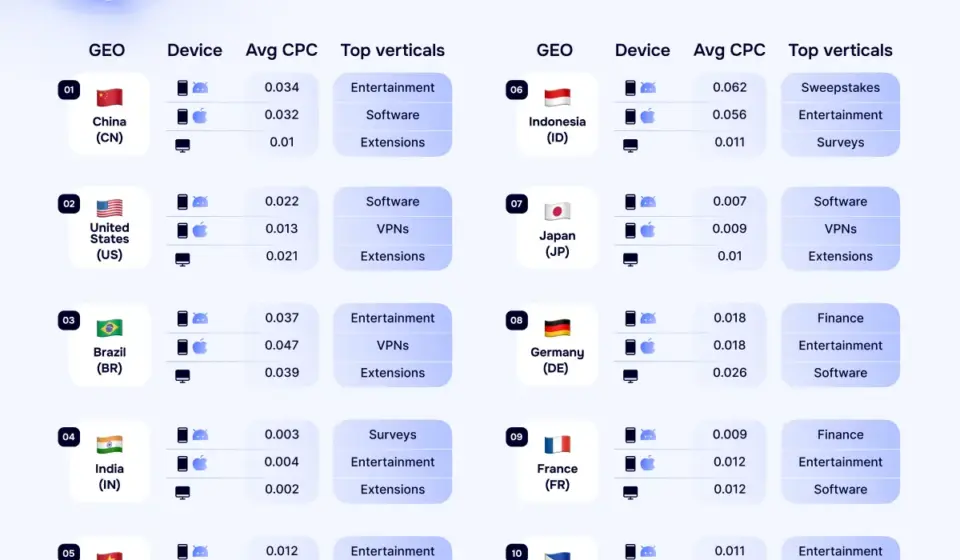
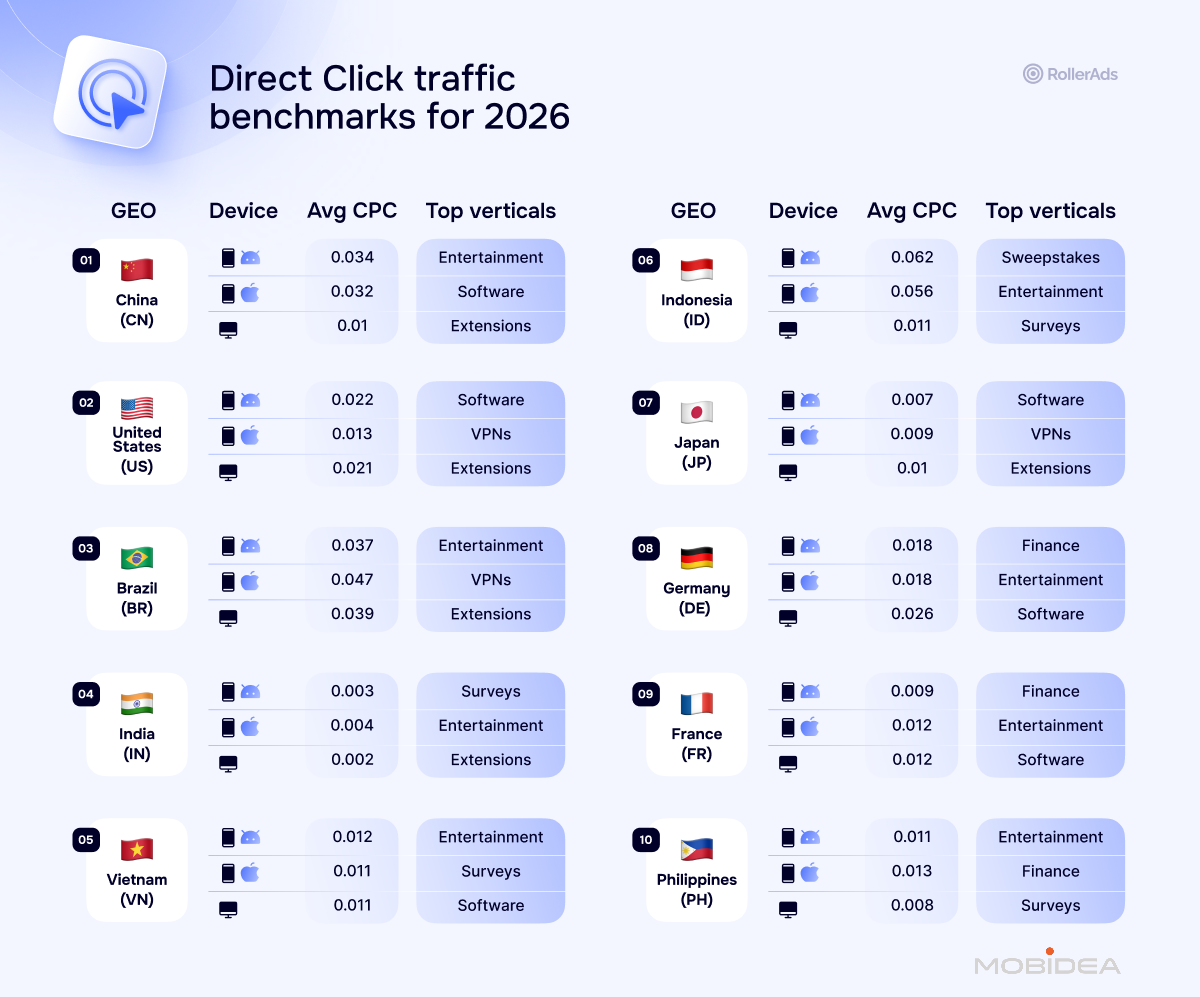
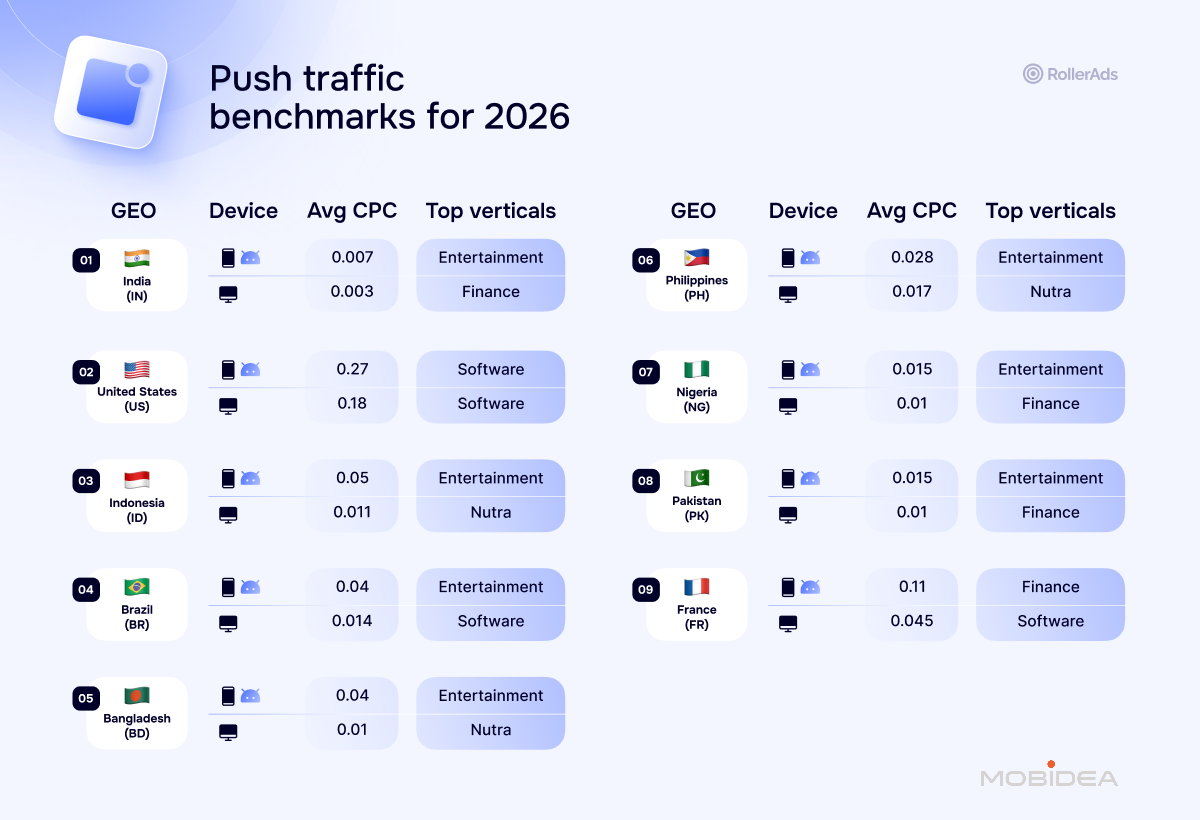
Selecting the right format requires robust empirical data. RollerAds experts have compiled exhaustive benchmarks mapping out recommended CPC and CPM ranges across major geographical regions (GEOs) and core verticals for 2026.
+---------------------------------------------------------------------------------+
|                         TRAFFIC FORMAT SELECTION MATRIX                         |
+-------------------+------------------------------+------------------------------+
| FORMAT            | PRIMARY BIDDING MODELS       | CREATIVE REQUIREMENTS        |
+-------------------+------------------------------+------------------------------+
| Push Traffic      | CPC, SmartCPC, CPA Goal      | Icon + Short Text            |
| Pop (OnClick)     | CPM, SmartCPM, CPA Goal      | None (Landing Page Only)     |
| Direct Click      | CPC, SmartCPC                | None (Landing Page Only)     |
+-------------------+------------------------------+------------------------------+
Navigating GEO Tiers and Vertical Alignment
-
Tier-1 GEOs (US, UK, CA, AU): Competition is fierce, requiring higher bids. Push traffic in Tier-1 requires nuanced angles, particularly for e-commerce, sweepstakes, and lead generation verticals. Pop and Direct Click can yield massive volume here, but landing page load speeds and aggressive pre-landers are critical.
-
Tier-2 & Tier-3 GEOs (LATAM, SEA, APAC): These regions offer massive traffic volume at significantly lower entry barriers. Push and Pop formats excel in mobile content subscriptions, utilities, and gaming verticals. Because CPMs and CPCs are lower, advertisers have more budgetary headroom to run extensive A/B tests on their funnels.
-
Advertisers leveraging RollerAds’ 2026 infrastructure can utilize proprietary platform infographics to cross-reference exact bid floors against specific vertical performance indexes, ensuring that ad spend is allocated to the most lucrative micro-niches.
Official Industry Insights and Expert Recommendations
To extract maximum profitability from these three formats, RollerAds optimization teams emphasize several core strategic pillars:
- The Necessity of A/B Testing: No amount of historical data can replace empirical validation. When in doubt between Push and Direct Click for a specific offer, media buyers should run parallel split-tests with controlled budgets. Isolate variables such as pre-lander variants, GEO subsets, and bidding algorithms (e.g., testing standard CPC against SmartCPC).
- Matching Verticals to Formats:
- Push shines brightest in verticals requiring continuous touchpoints, such as e-commerce flash sales, mobile utilities, and iGaming re-engagement.
- Pop is the undisputed king for mass-appeal offers where instant scale is required, including mainstream entertainment, sweepstakes, and broad-market lead generation.
- Direct Click dominates when user intent can be hijacked—such as software downloads, streaming services, and mobile app installs.
- Creative Fatigue Management: For Push traffic, creative fatigue sets in rapidly. Advertisers must rotate ad creatives (icons and headlines) every few days to maintain high CTRs and prevent ad blindness. Conversely, Pop and Direct Click campaigns bypass creative fatigue on the ad unit level, shifting the optimization burden entirely onto the landing page and pre-lander copy.
Future Outlook
As the digital advertising landscape continues to evolve toward privacy-first protocols and stricter browser regulations, the resilience of alternative traffic channels like Push, Pop, and Direct Click remains unrivaled. Traditional display advertising faces mounting friction from ad-blockers and banner blindness, whereas notification-based and intent-driven redirection traffic bypasses many of these roadblocks.
Looking forward, the integration of smarter, AI-driven bidding algorithms (such as SmartCPC and CPA Goal optimizations) will further automate campaign management, allowing affiliates to scale profitable funnels with unprecedented precision. Advertisers who master the nuances of GEO benchmarks, leverage platform-specific insights, and rigorously test their funnels will capture the lion’s share of market profits.
For media buyers seeking to elevate their campaigns, partnering with specialized ecosystems like RollerAds provides immediate access to top-tier traffic formats, cutting-edge optimization tools, and responsive support teams equipped to guide campaigns from initial testing to massive global scale.