
Feeding the Machine: How a Y Combinator Startup is Harnessing AI Swarms to Cool the Next Generation of AI Chips

Executive Overview
The global explosion of generative artificial intelligence has brought with it an unavoidable, energy-intensive paradox: the very silicon fueling the AI revolution is running dangerously hot. Modern data centers are buckling under the thermal loads generated by advanced AI chips, consuming staggering amounts of electricity not just for computation, but for the massive cooling infrastructures required to keep processors from melting down. Now, in a classic display of technology eating its own tail, entrepreneurs are deploying AI to solve the crisis that AI itself created.
Enter Discovered Materials, an emerging startup fresh out of Y Combinator that has quietly secured a $9 million seed funding round led by Lightspeed India Partners, with participation from Peak XV Partners and prominent angel investors including Paul Graham, Gokul Rajaram, and Thariq Shihipar. The company is tackling the semiconductor thermal crisis at the atomic level, utilizing autonomous swarms of AI agents to accelerate the discovery of novel materials capable of building vastly more efficient integrated circuits.
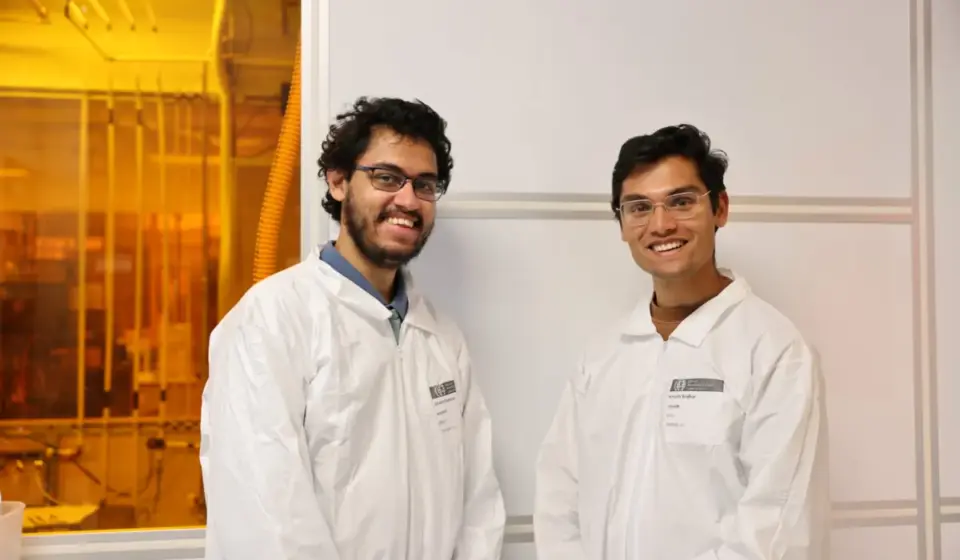
Founded by Stanford materials science PhD graduate Akash Ramdas and AI engineering specialist Advaith Sridhar—whose background includes agentic systems work at Persona AI and Luma Labs—Discovered Materials represents a new frontier in materials science. By pairing advanced language models with foundational physics simulations, the startup claims it can scale a process that once took human researchers months into a high-throughput, 24/7 digital laboratory.
Yet, as the company enters a crowded competitive field alongside startups like MatNex, SandboxAQ, and CuspAI, it runs headfirst into a brutal reality check that has plagued computational science for decades: predicting a molecule or atomic structure on a screen is a far cry from manufacturing it in a wet lab. Navigating the treacherous engineering trade-spaces of electrical properties, thermodynamic stability, and mass manufacturability will determine whether Discovered Materials can transition from digital theory to commercial silicon dominance.
Detailed Chronology and Technical Architecture
The genesis of Discovered Materials traces back to the grueling research rooms of Stanford University, where co-founder Akash Ramdas spent years manually exploring atomic structures and thermal properties for his doctorate in materials science. During his doctoral research, Ramdas faced the agonizingly slow pace of traditional academic inquiry, typically managing no more than 20 educated guesses or hypotheses per day.
Recognizing that the exponential rise of AI workloads required an equally exponential leap in hardware efficiency, Ramdas teamed up with Advaith Sridhar. Sridhar brought vital expertise in agentic software architecture, having built autonomous workflows at Persona AI and Luma Labs. Together, the duo set out to automate the cognitive grunt work of materials discovery.
The Software Pipeline: From LLMs to Physics Models
Discovered Materials has built a proprietary software pipeline that transforms how researchers interact with atomic physics. The system operates through a custom harness powered by Anthropic’s frontier language models. These models act as the "brain" of an autonomous swarm, generating thousands of hypothetical material leads by reasoning through chemical compositions, lattice structures, and theoretical behaviors.
However, generative models are notoriously prone to hallucinations and thermodynamic impossibilities. To solve this, the Discovered Materials pipeline immediately routes the AI-generated leads through a secondary layer: custom-trained foundational physics models. These models run rigorous simulations to verify whether the candidate materials possess real-world physical viability, filtering out the noise before human intervention is required.
"Ramdas was doing maybe 20 guesses a day during his PhD," Sridhar explained in an interview. "We’re able to do thousands of guesses a day now by having these agents run 24/7 on the cloud, exploring research directions that he gives them."
Benchmarking and Initial Discoveries
To prove the efficacy of their platform, Discovered Materials publicly unveiled "Material Discovery Bench," a specialized suite designed to track and evaluate how frontier AI models handle the complex physics of materials science. Simultaneously, the startup released data on hundreds of novel material formulations.
According to the founders, the AI swarms have already identified several candidate substances that closely match or exceed the thermal properties of existing materials currently utilized by major semiconductor manufacturers. While proprietary constraints prevent the company from revealing the specific atomic compositions of these substances, the discovery marks a dramatic acceleration in a traditionally conservative industry.
Supporting Context and Metrics: The Semiconductor Thermal Crisis
The urgency behind Discovered Materials’ mission cannot be overstated. As artificial intelligence models scale into parameters numbering in the hundreds of billions, the graphical processing units (GPUs) and tensor processing units (TPUs) powering them are operating at unprecedented thermal densities.
The Heat Equation in Modern Computing
Traditional silicon-based integrated circuits are hitting fundamental thermodynamic walls. When current density increases within a microchip, the localized heat generation threatens to warp silicon lattices, degrade electron mobility, and trigger thermal throttling—a protective mechanism that slows down processing speeds to prevent hardware failure. Consequently, modern hyper-scale data centers allocate up to 40% of their operational expenditures purely to cooling infrastructure, utilizing massive chillers, liquid cooling loops, and energy-hungry air conditioning systems.
Solving this at the manufacturing level requires fundamentally new materials—substances with superior thermal conductivity, lower electrical resistance at high temperatures, and compatibility with existing semiconductor fabrication processes (CMOS lines).
The Competitive Landscape
Discovered Materials is far from alone in recognizing this multi-billion-dollar bottleneck. A wave of deep-tech startups has emerged to leverage artificial intelligence for physical sciences:
- CuspAI: Focused on generative AI for structural material design.
- SandboxAQ: Spun out of Alphabet, leveraging quantum physics and AI for simulations.
- MatNex: Exploring advanced compounds, including rare-earth-free permanent magnets.
Despite this formidable competition, Discovered Materials is banking on its laser-like focus on the thermal and electrical constraints unique to semiconductors, combined with Ramdas’s deep domain expertise in actual material synthesis.
Official Statements and Industry Insights
The investment rationale behind Discovered Materials highlights both the immense promise and the sobering hurdles facing AI-driven physical sciences. Hemant Mohapatra, the Lightspeed India Partners partner who led the startup’s $9 million seed round, offered a candid assessment of the venture’s risk-reward profile during discussions with technology reporters.
Playing Whack-a-Mole with Atomic Structures
According to Mohapatra, the core difficulty of materials science is not merely generating novel candidates—a capability that will increasingly become a commoditized utility as foundation models improve. Rather, it is the multi-variable optimization problem required to make a material useful in the physical world.
"It’s a bit of playing whack-a-mole with atomic structures," Mohapatra noted. "A material is only useful in the real world if all of them converge at once, which is what makes this a really interesting search problem."
The engineering trade-spaces are notoriously unforgiving. If a newly discovered atomic structure successfully reduces heat generation and improves thermal dissipation, it may simultaneously present insurmountable manufacturing challenges—such as being too brittle to etch onto a silicon wafer, reacting violently with standard chemical etchants, or introducing unacceptable electrical capacitance that degrades chip performance.
The Bottleneck: Synthesis Over Discovery
This sentiment is echoed across the broader tech industry, where the intersection of artificial intelligence and physical science has experienced immense hype, balanced against a distinct lack of commercial deployments. While generative AI has accelerated drug discovery—notable examples include Insilico Medicine’s Renterosib becoming the first AI-derived drug to enter Phase II clinical trials—commercial impact in materials science has been remarkably slow to materialize.
While research partnerships between tech giants and chemical firms (such as Panasonic and Citrine Informatics, or Microsoft’s collaboration with Pacific Northwest National Laboratory) have yielded intriguing candidate lists, few have successfully translated from digital databases to high-volume manufacturing lines.
Mohapatra summarizes the current landscape with a defining industry maxim: "I don’t believe finding more candidates is the hold-up for AI materials science; instead, filtering them correctly and synthesizing them is the bottleneck."
Future Outlook and Commercial Strategy
For Discovered Materials, surviving the initial seed stage requires a clear-eyed roadmap that bridges the gap between algorithmic code and industrial manufacturing. The startup’s immediate commercial strategy hinges on intellectual property protection and strategic licensing.
The Patent-and-License Model
When the startup’s AI swarms and physics models successfully identify a high-value material candidate that survives simulated stress testing, Sridhar and Ramdas plan to aggressively pursue intellectual property protection. The company intends to file patents covering both the novel application of these materials within GPUs and accelerators, as well as the specialized chemical processes required to fabricate chips out of the substances.
Rather than attempting to build its own multi-billion-dollar semiconductor foundry—an economically unviable path for a seed-stage startup—Discovered Materials aims to operate as a high-margin IP licensor. The long-term vision is to partner directly with major chip designers and fabricators, licensing their thermally optimized material blueprints to the industry titans driving the global AI infrastructure buildout. Sridhar has expressed optimism that the company will generate its first wave of patentable, commercially viable materials within the next year.
The Un-Acceleratable Reality of Wet Labs
Yet, even as autonomous software agents churn through thousands of hypothetical atomic combinations per day, the founders remain grounded in the physical constraints of the natural world. Artificial intelligence can simulate quantum interactions and thermodynamic stability with breathtaking speed, but it cannot bypass the laws of chemistry in the physical realm.
"A lot of this will involve actually going into wet labs and making things as well," Sridhar acknowledged, conceding that the physical synthesis, testing, and stress-validation of materials remains a deliberate, analog process. "And this is the process that cannot be sped up."
Ultimately, the success of Discovered Materials will not be measured solely by the raw volume of digital leads generated by its Anthropic-powered agent swarms, but by the grit of its laboratory operations. If the startup can successfully bridge the chasm between cloud-based simulation and physical semiconductor manufacturing, it may provide the vital thermal relief valve needed to sustain the next decade of artificial intelligence expansion.