The rapid integration of generative artificial intelligence into the corporate and academic landscapes has reignited a pragmatic yet existential debate across product development, design, and user experience (UX) communities: Can artificial intelligence completely eliminate the need for human-led research?
With synthetic user simulators capable of mimicking demographic segments, and automated transcription and clustering engines able to organize terabytes of qualitative data into tidy thematic reports in mere seconds, the temptation to sideline human researchers is mounting. Why spend weeks scheduling, moderating, and analyzing sessions with real people—who are inherently unpredictable and difficult to pin down—when an algorithm can generate an entire research report on demand?
Current technological limitations, such as AI’s tendency to produce coherent yet superficial analyses or flat, emotionally sterile synthetic interviews, are diminishing daily. Industry forecasters project a near future where automated systems may design, execute, and synthesize studies with an output quality virtually indistinguishable from that of seasoned professionals.
However, a critical blind spot persists in the rush toward automation. This investigative analysis posits that framing user research merely as a mechanism for producing deliverables fundamentally misunderstands its purpose. Research yields two distinct assets: outputs (reports, themes, recommendations) and learning (the cognitive and emotional transformation experienced by teams while observing, wondering, and wrestling with raw data).
While AI excels at generating the former, it is structurally incapable of producing the latter. By outsourcing the messy, vital human endeavor of listening, observing, and sense-making to machines, organizations risk falling victim to the "illusion of learning"—consuming polished reports while retaining little institutional knowledge, empathy, or momentum for innovation.
Detailed Chronology: The Evolution of User Research and the AI Disruption
To understand where user research stands today, it is necessary to examine how the discipline evolved from an isolated, specialized function into a collaborative team sport, and how the current AI paradigm threatens to reverse that progress.
Phase 1: The Siloed Era and the Birth of "Team Sport" Research
Decades ago, user research was frequently treated as a boxed-off operational phase. Specialized researchers would retreat to the field, conduct interviews, analyze data in isolation, and eventually hand over static, multi-page PDF reports to engineering and design teams.
Recognizing the detachment this created, pioneering organizations—notably the UK Government Digital Service—coined a counter-mantra: "User research is a team sport." Leadership began encouraging multidisciplinary teams (designers, product managers, developers, and writers) to step out of their silos, observe usability tests live, and engage directly with the friction points experienced by real users. This collaborative participation transformed research from an administrative hurdle into a shared cultural baseline, anchoring product decisions in collective human empathy.
Phase 2: The Efficiency Promise of Automation
As digital products scaled, organizations faced mounting pressure to accelerate development cycles. Research cadence often struggled to keep pace with rapid agile sprints. Enter the era of automation tools: automated transcription services, AI-driven sentiment analysis, and natural language processing models capable of grouping qualitative feedback into themes. Initially embraced as administrative accelerators, these tools proved invaluable for heavy lifting—freeing up researchers to focus on synthesis.
Phase 3: The Generative AI Leap and the Synthetic User Threat
The commercialization of large language models (LLMs) catalyzed the next logical, albeit controversial, leap: synthetic research. Startups and enterprise platforms introduced tools capable of interviewing users via conversational bots or simulating user personas completely from baseline demographic data. The pitch was seductive: infinite scale, instantaneous results, and zero recruitment overhead.
Yet, as qualitative research veterans note, trading the friction of human engagement for algorithmic convenience strips the research process of its most transformative ingredient: the shared visceral experience of bearing witness to another person’s reality.
Supporting Context & Metrics: The Neurobiology of Storytelling and the Self-Generation Effect
The argument for human-led research is not merely philosophical; it is deeply rooted in cognitive science, neuroscience, and educational psychology. When teams step away from automated reports and actively engage in the messy work of research, several well-documented psychological phenomena occur.
1. Neural Coupling and Brain Synchronization
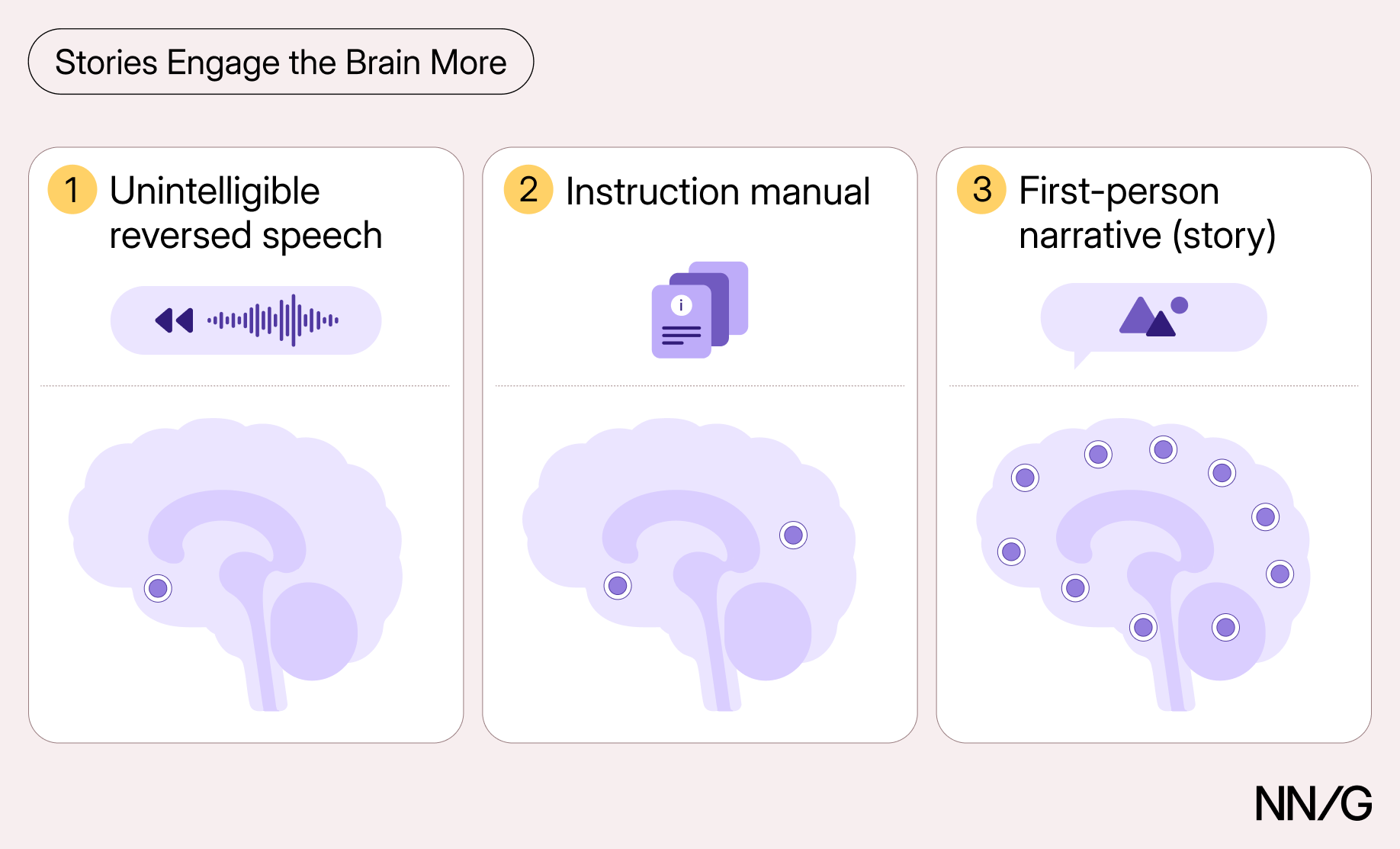
Neuroscientists studying human communication have long observed that stories possess a unique capacity to capture attention and orchestrate brain activity. Using functional magnetic resonance imaging (fMRI), researchers at Princeton University demonstrated that when an individual listens to a personal narrative, their neural activity mirrors that of the storyteller with a slight time lag. Crucially, studies published in the Journal of Communication and Proceedings of the National Academy of Sciences (PNAS) confirm that the degree of neural mirroring directly correlates with comprehension and long-term recall. Furthermore, listeners actively anticipate incoming narrative details, meaning that authentic, dynamic human storytelling engages social reasoning, memory, and emotional processing networks across the entire brain—an activation profile unachievable through static, AI-summarized bullet points.
2. The Biochemistry of Empathy and Action
In pioneering research conducted by neuroeconomist Paul Zak, participants exposed to narrative arcs characterized by rising tension, crisis, and resolution experienced measurable spikes in the neurochemical oxytocin. Elevated oxytocin levels directly correlated with empathetic engagement and prosocial behavior, such as charitable donations. This neurobiological trigger explains why hearing a user struggle firsthand moves cross-functional teams to action in ways that a sanitized executive summary never can.
3. The Self-Generation Effect
In educational psychology, the self-generation effect dictates that information generated by an individual’s own cognitive effort is retained significantly better than information merely read or passively consumed. Meta-analytic reviews in cognitive science confirm that students and professionals who actively wrestle with raw data, question assumptions, and formulate their own insights drastically outperform those who rely on rote consumption of pre-digested study notes or automated briefings.
When an organization outsources the intellectual wrestle of interviewing and analysis to an AI model, it creates an illusion of learning. The team reads a comprehensive report, experiences a temporary sensation of being informed, but fails to encode the knowledge into long-term organizational memory.
Official Industry Perspectives and Expert Insights
To gauge the shifting dynamics of the industry, leading UX practitioners, researchers, and technologists have weighed in on where automation adds value and where human oversight is non-negotiable.
"We were all there. We all saw it. We all heard it. We all lived it. And those moments were always the fodder for pushing our design forward and inspiring whatever we ended up designing."
— Senior UX Researcher and Enterprise Design Consultant
Reflecting on the irreplaceable nature of live observation, seasoned research leaders emphasize that shared exposure to human vulnerability is the primary catalyst for design innovation. When an engineering team sits in an observation room (physically or virtually) and watches a user stumble through an unintelligible navigation flow, the resulting empathy cannot be synthesized by an algorithm.
Industry analysts generally agree on a sensible demarcation line for artificial intelligence within research operations:
Appropriate AI Delegation (Support Work): Automating tasks that generate zero direct learning, such as participant recruitment, scheduling, session transcription, raw data cleanup, drafting initial discussion guides, and formatting reporting templates.
Protected Human Domains (Sense-Making): Preserving tasks where foundational learning occurs, including session moderation, live observation, team debriefs, and the interpretive work required to define what raw behavioral data means for the organization’s product strategy.
Future Outlook: Designing a Hybrid Research Ecosystem
As artificial intelligence continues to mature, the organizations that build the most resilient, user-centric products will not be those that automate away human contact, but those that strategically deploy technology to protect it.
The future of user research lies in a symbiotic hybrid model. By offloading mechanical, administrative toil to automated systems, human research teams can reclaim valuable hours to focus on high-fidelity engagement, creative interpretation, and cross-functional synthesis.
However, corporate leadership must resist the siren song of "frictionless" insights. Efficiency should never come at the expense of organizational empathy. If a team skips the journey of discovery, they forfeit the deep contextual understanding required to build transformative solutions.
Ultimately, research is valuable not simply because it outputs deliverables, but because it fundamentally changes the people who conduct it. As long as human beings continue designing digital and physical experiences for other human beings, the irreplaceable act of witnessing, interpreting, and learning from one another directly will remain the bedrock of true innovation.