
Analyzing Serpstat in 2026: An In-Depth Investigative Review by SearchEngineWatch

Executive Overview
The search engine optimization (SEO) landscape of 2026 is radically different from the keyword-stuffed paradigms of the past. Today, practitioners navigate a complex web of Google AI Overviews (AIO), multi-agent LLM systems, and evolving semantic algorithms. In this fast-changing environment, selecting an SEO software suite is no longer just about tracking rankings; it is a critical infrastructure decision.
As the world’s oldest SEO-focused publication, SearchEngineWatch has reclaimed its legacy of rigorous, independent technology evaluation. Led by our editorial team—drawing on over two decades of hands-on industry experience—we conducted a comprehensive, year-long audit of Serpstat. Once known primarily as a budget-friendly keyword research utility, Serpstat has positioned itself in 2026 as a comprehensive, multi-product ecosystem designed to challenge market leaders like Semrush and Ahrefs.
Our investigation reveals a platform defined by striking contrasts. Serpstat offers exceptional value for small to mid-sized teams, highly competitive API pricing, and forward-thinking AI integrations like the Model Context Protocol (MCP). Yet, these innovations exist alongside a legacy user interface that feels frozen in time, inconsistent data quality in smaller regional databases, and underdeveloped generative AI content features.

This review provides a transparent, data-driven analysis of Serpstat’s capabilities, performance metrics, and market standing in 2026.
Detailed Chronology: A Year of Testing Serpstat’s Core Ecosystem
To evaluate Serpstat’s claims of enterprise-grade versatility, our editorial team integrated the platform into our daily testing workflows for 12 months. Rather than relying on a sandboxed environment, we analyzed live, production-grade search data. To protect proprietary metrics, we used serpstat.com as our primary target domain, evaluating its visibility, technical health, and link profile using only the platform’s public-facing databases and live SERPs.
Phase 1: Onboarding and the Dashboard Experience
Our testing began with an evaluation of Serpstat’s entry mechanics. The platform is one of the few major SEO suites in 2026 to offer a fully functional 7-day trial. This trial provides complete access to core tools—including rank tracking, site audits, and keyword research—subject to daily query and project caps that scale based on real-time server demand.

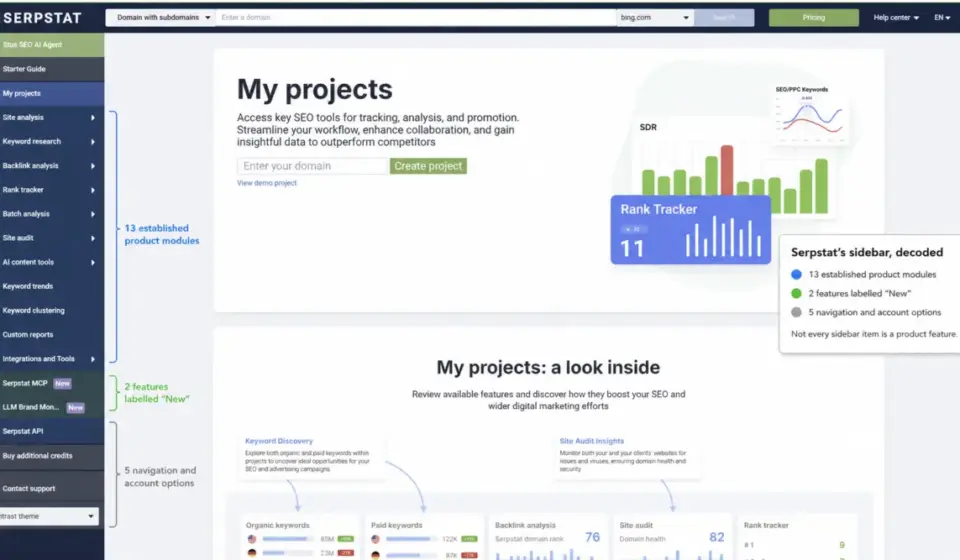
Upon logging in, users are met with Serpstat’s user interface (UI). While functional, the dashboard’s design remains a weak point.
+-------------------------------------------------------------------+
|                           SERPSTAT UI                             |
+-------------------------------------------------------------------+
|  [Left Sidebar]               |  [Main Workspace]                 |
|  - My Projects                |  - Domain Analysis Input          |
|  - Site Analysis              |  - Visibility Score (0-100)       |
|  - Keyword Research           |  - AI Overview (AIO) Metrics      |
|  - Backlink Analytics         |  - Estimated Traffic Graph        |
|  - Rank Tracker               |  - Insights & Alerts              |
|  - AI Content Tools (Beta)    |                                   |
|  - MCP & API Integrations     |                                   |
+-------------------------------------------------------------------+
The UI is highly functional but visually dated. The left sidebar serves as the primary navigation hub, housing a mix of classic modules and newer features like the "LLM Brand Monitor" and "AI Content Tools." Navigating the dashboard can sometimes feel disjointed, as clicking certain data points redirects users to different tool modules without clear contextual warnings.
Phase 2: Domain Analysis, Visibility, and AI Overviews
Entering a root domain into the primary analysis box generates a high-level performance snapshot. We analyzed serpstat.com targeting the Google US database, which revealed a key platform feature: the ability to toggle seamlessly between Google and Bing indexes. In an era where Bing continues to capture search market share through its Copilot integrations, this capability is highly valuable.

The overview screen provides several key metrics:
- Visibility Score (0–100): An index tracking how prominently a domain appears across Serpstat’s monitored top-20 search results.
- AI Overview (AIO) Visibility: A critical feature for 2026 that tracks how often a domain appears within Google’s AI-generated answer boxes, including citations and direct link cards.
- Conventional vs. ML Traffic Estimates: Serpstat displays both its legacy search-traffic estimates (based on keyword volumes and ranking positions) and a newer machine-learning (ML) model that factors in SERP clutter, user intent, and seasonal trends.
Phase 3: Keyword Analysis and the "Semantic Duplication" Challenge
Serpstat’s historical strength lies in keyword research. The keyword analysis module features a clean, dense interface designed to handle high volumes of data.
[Seed Keyword] ---> [Keyword Research Module] ---> Related Keywords (Volume, KD, Intent)
                                              ---> SERP Feature Analysis
                                              ---> Competitor Share of Voice
The platform allows users to filter large keyword lists down to high-value opportunities. Pre-configured filters, such as "low-hanging fruits" (keywords ranking in positions 11–20 with moderate search volume) and "low keyword difficulty (KD)," help teams quickly identify realistic targets.

However, our testing revealed a persistent issue: semantic duplication. When generating keyword variations, Serpstat often lists multiple near-identical phrases as separate entries (e.g., "backlink tool checker," "backlink website checker," and "check incoming links"). The platform’s inability to semantically group these phrases in the main keyword view requires manual cleanup. Without careful review, content teams risk creating redundant pages for terms that search engines already group under a single search intent.
Phase 4: Exact URL Analysis and Competitor Gap Mapping
To bypass domain-level clutter, we tested the Exact URL Analysis tool using a high-authority backlink checker page. Serpstat successfully narrowed down the domain’s 239,000+ keywords to the 1,670 specific terms driving traffic to that individual URL.
This feature is highly effective for reverse-engineering competitor content. It shows exactly how search engines group multiple keyword variations around a single page. By analyzing these clusters, content strategists can design comprehensive resources that match search intent, rather than publishing separate, overlapping articles.

The Keyword Gap tool builds on this capability by comparing up to three domains or specific URLs.
                    [Your Domain]
                     /
                    /   Shared
                   /   Keywords
         [Competitor A] ------- [Competitor B]
The tool’s Venn diagram clearly separates:
- Unique Keywords: Terms unique to each analyzed domain.
- Common Keywords: Terms shared across all target sites.
- Missing Keywords: High-value terms where competitors rank but the user’s domain does not.
While highly useful, this tool requires manual analysis. A "missing keyword" is not automatically worth targeting; users must evaluate relevance and intent rather than simply copying competitor footprints.

Phase 5: Technical Auditing and Backlink Profiling
The Site Audit module crawls target websites to identify technical issues, categorizing them into high, medium, and low priority. It flags common SEO roadblocks, including:
- Broken links and redirect loops.
- Missing, duplicate, or poorly formatted meta tags.
- Indexation issues and incorrect canonical tags.
- Page-speed bottlenecks and Schema markup errors.
At the Team plan level and above, the crawler supports JavaScript rendering, which is essential for auditing modern, JS-heavy web frameworks.
The Backlink Analysis module offers a reliable alternative to market leaders, though it operates on a smaller index than specialized link-intelligence tools. It tracks Serpstat Domain Rank (SDR), total backlinks, referring domains, and follow/nofollow ratios. While sufficient for routine competitive research and link-acquisition monitoring, it should not be treated as an exhaustive index of the web.

Supporting Context & Metrics
To help buyers make informed decisions, we compared Serpstat’s pricing, API limits, and performance metrics against its main competitors.
Platform Pricing Plans (As of August 2026)
The following table outlines Serpstat’s tier-based pricing structure when billed annually.
| Plan | Price (Annual) | Ideal Audience | Key Constraints & Limits |
|---|---|---|---|
| Individual | $50 / month | Freelancers & niche site owners | 5 projects; 100 searches/day; 10k monthly rank checks; 30k audit pages. No API access or JS rendering. |
| Team | $100 / month | Small agencies & in-house teams | 3 users; unlimited projects; 50k rank checks; 150k audit pages; 200k API credits. Full access to MCP. |
| Team x2 | $169 / month | Growing agencies | 6 users; unlimited projects; 100k rank checks; 300k audit pages; 400k API credits. |
| Agency | $410 / month | Large agencies & enterprise | 30 users; unlimited projects; 500k rank checks; 1.5M audit pages; 2M API credits. |
Note: Month-to-month pricing starts at $69/month for Individual and $129/month for Team.

API Performance and Economic Analysis
For agencies and data teams, Serpstat’s API offers a highly competitive rate structure. The platform uses a straightforward credit model where one returned row of data generally equals one API credit.
| Plan | Base Monthly Cost | Monthly API Credits | Rate Limits | Effective Cost per 1,000 Rows |
|---|---|---|---|---|
| Team | $100 | 200,000 | 1 request / second | $0.50 |
| Team x2 | $169 | 400,000 | 1 request / second | $0.42 |
| Agency | $410 | 2,000,000 | 10 requests / second | $0.21 |
API Market Comparison
When compared to other search data providers, Serpstat positions itself as an affordable middle-ground option.
| Provider | Entry-Level API Cost | Pricing Model | Key Constraints & Considerations |
|---|---|---|---|
| Serpstat | $100 / month (Team) | 1 credit per row; 200k base credits | Requires a platform subscription. Credits expire monthly. Team tier is rate-limited to 1 req/sec. |
| Ahrefs | $129 / month (Lite) | Variable unit costs; 50-unit minimum | High-value metrics like Search Volume or KD cost up to 10 units per request. |
| Semrush | ~$456 / month (Advanced) | Variable unit costs | API access requires higher-tier plans. Enterprise unit pricing is not publicly disclosed. |
| SE Ranking | $179 / month equivalent | Fixed request charges or per-record credits | Costs vary widely across different API endpoints. |
| DataForSEO | $50 minimum deposit | Pay-as-you-go | Highly flexible and cost-effective, but requires technical integration; does not include an end-user UI. |
Official Perspectives: The Editorial Assessment
Our evaluation of Serpstat focuses on its actual utility for search marketers, rather than marketing claims. To provide a balanced perspective, we rated each major module on a 10-point scale.

Serpstat Scorecard (2026)
=========================================
Keyword & Competitor Research : [ 7.8 / 10 ]
Backlink Analysis             : [ 7.0 / 10 ]
Rank Tracking                 : [ 8.5 / 10 ]
Site Auditing                 : [ 7.8 / 10 ]
PPC Research                  : [ 8.3 / 10 ]
API, MCP, & Integrations      : [ 9.0 / 10 ]
AI & Content Tools            : [ 6.0 / 10 ]
Usability & Data Confidence   : [ 7.0 / 10 ]
Pricing & Overall Value       : [ 9.2 / 10 ]
-----------------------------------------
OVERALL SCORE                 : [ 8.0 / 10 ]
=========================================
Why Serpstat Earns an 8.0 / 10
Serpstat is a highly capable platform, but it does not outperform market leaders in their core specialties. Ahrefs remains the industry standard for organic backlink profiles and link graphs, while Semrush offers a broader, more mature digital marketing ecosystem.
Serpstat’s strength lies in its overall value proposition. It provides a comprehensive set of SEO, PPC, tracking, and auditing tools to small teams at a fraction of the cost of its main competitors.
For $100 per month (billed annually), the Team plan offers three user seats, unlimited projects, and full API access. To get equivalent team seats and API access on Semrush or Ahrefs, organizations must spend significantly more.

However, users must accept some trade-offs for this lower price point:
- The AI Content Suite feels unfinished: The Text Editor and Article Builder lack advanced SEO data integration, such as competitor analysis, real-time keyword recommendations, or source citations. They function largely as generic AI writing assistants.
- Data inconsistencies require verification: During our tests, we noticed occasional data anomalies, such as incorrect search volume estimates for highly localized keywords and outdated language tags. Marketers should use Serpstat as an directional guide rather than an absolute source of truth.
Future Outlook: SEO in the Age of AI Search
As we look toward the late 2020s, the SEO industry is moving away from traditional keyword-to-landing-page models. The rise of search experiences driven by Large Language Models (LLMs) requires tools that can analyze AI-generated summaries and brand visibility within conversational search interfaces.
Serpstat has taken steps to address this shift with two key features:

1. Serpstat Model Context Protocol (MCP)
The platform’s MCP integration allows users to connect Serpstat’s database directly to LLM assistants like ChatGPT, Claude, and Gemini. Instead of manually exporting CSVs, users can query their AI assistant in plain language:
"Analyze
competitor.com‘s top-performing keywords in Google US, compare them to my project database, and output a 5-day content strategy targeting our highest-priority content gaps."
The assistant processes the request, pulls data via the Serpstat API, and generates the strategy. While this is an efficient workflow, users should note that every MCP query consumes API credits based on the underlying data retrieved.

+------------------+     Plain-Language Request     +------------------+
|   AI Assistant   | -----------------------------> |   Serpstat MCP   |
| (Claude/ChatGPT) | <----------------------------- |    Connector     |
+------------------+     Structured Data & Table    +------------------+
                                                             |
                                                             | API Query
                                                             v
                                                    +------------------+
                                                    |  Serpstat Engine |
                                                    +------------------+
2. LLM Brand Monitor
This tool monitors brand visibility across conversational AI platforms. Users input their brand name, set up specific prompts, and run them across various LLM models to track how often their brand is mentioned.
However, the tool’s visibility score should be interpreted carefully. The score is calculated as the percentage of successful prompt-and-model checks where the brand was detected. It does not reflect a brand’s overall share of voice across all global ChatGPT or Claude queries; rather, it measures visibility within a specific, user-defined set of prompts.
Additionally, this tool can quickly consume credits. The $39/month Pro plan allows for 200 checks, which only covers five complete monthly scans if testing ten prompts across four different LLM models.

Final Verdict
Serpstat is a highly practical, cost-effective SEO platform. It is not a direct replacement for Ahrefs for teams focused entirely on backlink acquisition, nor does it match the scale of Semrush’s marketing suite.
Instead, Serpstat is one of the most budget-friendly ways to equip a small marketing team with a comprehensive set of SEO, PPC, rank-tracking, and API automation tools.
- The $50 Individual Plan is best suited for freelancers and single-site owners who need basic research tools.
- The $100/month Team Plan (billed annually) is the platform’s strongest value proposition. It unlocks collaborative features, API access, and advanced tools at a highly competitive price point.
For teams that prioritize seat licenses, API access, and cost-effective automation over highly polished datasets, Serpstat is an excellent, practical choice.