
Beyond the Keyword: How Situation-Driven Content Briefs Are Reshaping SEO in the Generative AI Era

Executive Overview
For over two decades, search engine optimization (SEO) and digital content strategies have been anchored in a single, fundamental metric: keyword search volume. Marketing departments across the globe built massive editorial calendars around broad search terms, prioritizing algorithmic impression potential over actual audience intent. This methodology yielded a digital landscape saturated with superficial, low-intent content—generic 300-to-500-word articles designed to capture broad top-of-funnel traffic rather than solve complex user problems.
Today, that paradigm is undergoing a structural realignment. The rapid emergence of Large Language Models (LLMs), generative search interfaces (such as Google Gemini, ChatGPT, and Perplexity), and evolving user search behaviors have rendered traditional, keyword-first content creation inefficient—and often counterproductive.
Modern digital strategy requires a transition from keyword matching to situation-driven context engineering. By grounding content briefs in real-world human scenarios, enterprise search strategies are moving away from abstracted search volume metrics and toward qualitative brand science. Drawing on established marketing frameworks—specifically Professor Jenni Romaniuk’s Category Entry Points (CEPs) and the "7 W’s"—forward-thinking enterprise organizations are restructuring their content pipelines. This investigative analysis examines the historical failure of keyword-centric briefing, the structural mechanics of situation-based content creation, and the operational blueprint required to maintain visibility in a conversational search ecosystem.
Detailed Chronology: The Evolution of Search Strategy (2015 to Present)
Understanding the current crisis in digital content requires tracing the tactical shifts that brought enterprise publishing to its present inflection point.

+-----------------------------------------------------------------------------------+
|                            EVOLUTION OF CONTENT BRIEFING                          |
+-----------------------------------------------------------------------------------+
|  2015 - 2018: THE VOLUME GOLD RUSH                                                |
|  • Strategy: Chasing raw keyword volume (e.g., "What is a fiscal year?").          |
|  • Outcome: Proliferation of thin 300-word articles; search engine clutter.       |
+-----------------------------------------------------------------------------------+
                                         |
                                         v
+-----------------------------------------------------------------------------------+
|  2019 - 2023: ALGORITHMIC CLEANUP & INTENT DISCOVERY                              |
|  • Strategy: Google updates (BERT/MUM) prioritize intent over exact-match words.  |
|  • Outcome: Brands forced to audit and consolidate bloated legacy archives.       |
+-----------------------------------------------------------------------------------+
                                         |
                                         v
+-----------------------------------------------------------------------------------+
|  2024 - 2026+: THE GENERATIVE & SITUATIONAL ERA                                   |
|  • Strategy: Contextual, situation-driven content briefs based on the "7 W's."   |
|  • Outcome: Optimization for conversational LLMs, zero-click answers & deep intent.|
+-----------------------------------------------------------------------------------+
2015–2018: The Volume-Chasing Gold Rush
During this period, SEO software tools democratized search volume data, leading to a gold rush for top-of-funnel queries. Strategists instructed content teams to produce content targeting high-volume, low-intent queries regardless of whether the business had legitimate authority to answer them.
This era gave rise to widespread digital bloat. For example, certified public accounting (CPA) firms systematically published pages answering elementary definitions like "What is a fiscal year?" The strategic logic assumed that ranking for a broad term would capture prospect awareness. In practice, it placed private service firms in direct competition with authoritative regulatory entities—such as the Internal Revenue Service (IRS) or the Securities and Exchange Commission (SEC)—which naturally owned the canonical definition.
2019–2023: Algorithmic Refinement and the Content Clean-Up Era
As search engines deployed advanced natural language processing architectures (such as BERT and MUM), exact-match keyword density lost its influence. Search engines increasingly rewarded topical authority, entity relationships, and user satisfaction over raw page volume. Enterprises suddenly found themselves burdened by thousands of outdated, thin articles published during the volume gold rush.
Content operations shifted from mass production to aggressive pruning, content consolidation, and domain cleanup. The industry began to realize that ranking for basic informational queries yielded high bounce rates, minimal conversions, and diminished brand authority.

2024–2026+: The Generative Search Disruption
The deployment of conversational AI interfaces fundamentally altered how users interact with information. Search queries evolved from fragmented phrases (e.g., "best sweet snacks 2026") into complex, situational prompts (e.g., "I need a low-sugar afternoon snack for a team workshop with gluten-sensitive attendees").
Because LLMs digest context, sentiment, and circumstantial constraints, content structured purely around keyword frequency became invisible to generative search retrieval engines. The contemporary content strategy imperative focuses on answering the detailed, circumstantial realities of the target audience rather than targeting isolated phrases.
Supporting Context & Metrics: Category Entry Points and the "7 W’s" Framework
The fundamental flaw of traditional keyword research is its abstraction. Keyword volume metrics quantify how many times a string of text was typed into a search box, but they fail to capture why the user searched, what context triggered the query, or what solution is required next.
Moving from Keywords to Category Entry Points (CEPs)
To bridge this gap, progressive martech strategists are adopting brand science principles developed by the Ehrenberg-Bass Institute for Marketing Science. Central to this approach is the concept of Category Entry Points (CEPs)—the mental cues and situational triggers that lead a buyer to access a specific category or solution.
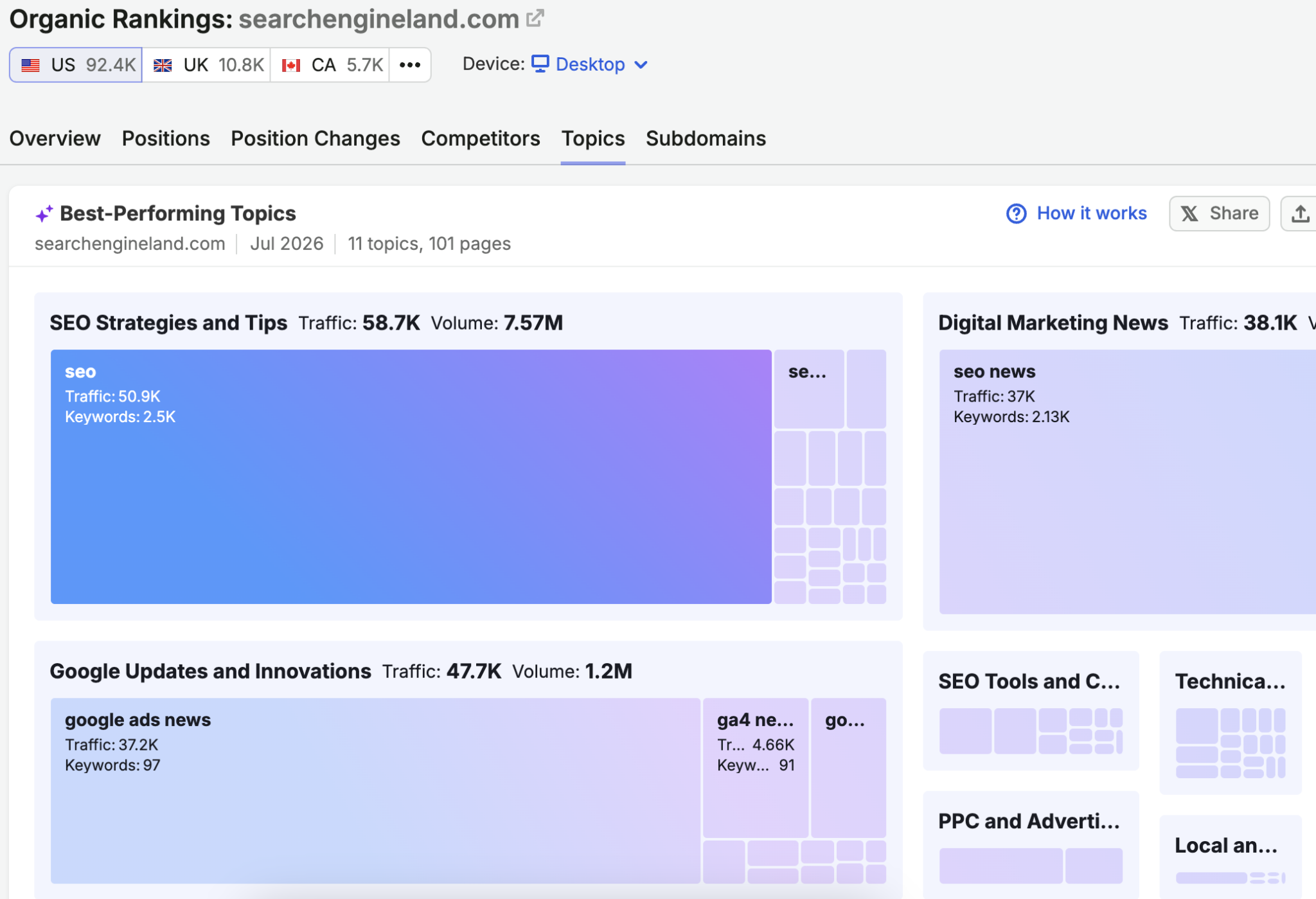
While keywords represent the final, digitized artifact of a thought process, CEPs represent the underlying real-world situation that generated the thought.
+---------------------------------------------------------------------------------+
|                       KEYWORD RESEARCH vs. CEP FRAMEWORK                        |
+---------------------------------------------------------------------------------+
| Metric / Perspective  | Legacy Keyword Briefing     | Situation-Driven Briefing |
+-----------------------+-----------------------------+---------------------------+
| Core Focus            | Search Volume & Density     | Human Intent & Context    |
| Data Source           | 3rd-Party Keyword Databases | Customer Support & Sales  |
| Content Structure     | Broad, Definition-Heavy     | Problem-Solving & Action  |
| Target Metric         | Impression Count & Clicks   | Engagement & Conversions  |
| LLM Optimization      | Low (Fails on Nuance)       | High (Rich in Context)    |
+---------------------------------------------------------------------------------+
The 7 W’s Framework for Content Creation
As outlined in brand health literature, mapping a Category Entry Point requires evaluating the situational context across seven qualitative dimensions:
- Why: What is the underlying motivation or pressing friction point?
- When: What specific time, event, or trigger forces the action?
- Where: In what location or environment (digital or physical) does the need arise?
- With Whom: Who else is involved in the decision-making process or affected by the outcome?
- What: What are the specific parameters, constraints, or tools required?
- Feeling What: What emotional state (e.g., stress, urgency, ambition) characterizes the situation?
- Who: What specific buyer profile or organizational role is experiencing this combination of factors?
Anatomy of a Situation-Driven Content Brief
Translating the 7 W’s into an operational workflow requires replacing legacy briefing templates with structured contextual parameters.
+-----------------------------------------------------------------------------------+
|                        MODERN CONTENT BRIEFING TEMPLATE                           |
+-----------------------------------------------------------------------------------+
|  1. Target Audience & Role (WHO)                                                  |
|     • Mid-market Finance Directors navigating audit preparation.                 |
|                                                                                   |
|  2. Triggering Event (WHEN / WHY)                                                 |
|     • End-of-quarter financial close reveals cross-departmental reporting errors.  |
|                                                                                   |
|  3. Operating Environment (WHERE / WITH WHOM)                                     |
|     • Remote finance team collaborating across disparate ERP software systems.   |
|                                                                                   |
|  4. Internal Front-Line Data Source                                               |
|     • Direct transcript analysis from Q3 Customer Support tickets.                |
|                                                                                   |
|  5. Primary Psychological State (FEELING WHAT)                                    |
|     • High stress, anxious about regulatory compliance penalties.                 |
|                                                                                   |
|  6. Prescribed Business Solution                                                  |
|     • Step-by-step reconciliation framework + proprietary audit checklist template.|
+-----------------------------------------------------------------------------------+
Official Statements & Industry Perspectives
The shift away from legacy keyword metrics has generated significant discourse among enterprise search consultants, brand managers, and editorial directors.

The Breakdown of Arbitrary Metrics
Search architecture specialists point out that relying on search volume databases creates an operational disconnect between marketing output and core business objectives.
"Keyword volume has always been an abstraction—a proxy metric that divorced content creators from the real-world concerns of their buyers," notes an enterprise strategy report on martech methodologies. "When a specialized accounting firm attempts to rank for generic terms like ‘fiscal year,’ they aren’t establishing authority; they are competing with governmental regulatory bodies while failing to address the specific, high-intent challenges of their actual client base."
Integrating Internal Front-Line Intelligence
Leading enterprise organizations are pivoting away from third-party keyword generation tools as their primary research engine, relying instead on internal qualitative intelligence.
Data gathered directly from front-line customer-facing teams—including customer support representatives, sales engineers, implementation specialists, and account management executives—offers a far more accurate reflection of buyer friction points than third-party search tools can provide.

                 +---------------------------------------+
                 |    Front-Line Qualitative Data        |
                 |  (Support, Sales, Customer Success)   |
                 +---------------------------------------+
                                     |
                                     v
                 +---------------------------------------+
                 |    Category Entry Point Analysis      |
                 |          (The 7 W's Framework)        |
                 +---------------------------------------+
                                     |
                                     v
                 +---------------------------------------+
                 |    Situation-Driven Brief Creation    |
                 |     (Targeted Context & Intent)       |
                 +---------------------------------------+
                                     |
                                     v
                 +---------------------------------------+
                 | High-Impact Conversational Content    |
                 |     (Optimized for LLMs & Humans)     |
                 +---------------------------------------+
As one senior martech editorial director framed the strategic choice:
"If leadership is asked to choose between funding a campaign based on third-party keyword volume estimates or funding a campaign based on recurring themes extracted from six months of customer support logs, the latter is vastly more defensible, actionable, and aligned with revenue creation."
Future Outlook: Testing, Validation, and the LLM Search Era
As digital search shifts from traditional link indexes to direct generative answers, the survival of enterprise content programs depends on their ability to adapt to situational briefing models.
Empirical Validation: Running Dual Briefing A/B Tests
To overcome organizational inertia and executive skepticism, content leaders are recommended to execute comparative performance trials within their digital ecosystems:
- Control Group (Legacy Brief): Construct a traditional keyword-optimized article targeting a high-volume broad query using exact-match guidelines and standard word-count targets.
- Test Group (Situation-Driven Brief): Construct a companion piece targeting a specific Category Entry Point, built using the 7 W’s framework and grounded in direct feedback from internal sales or support teams.
- Measurement Criteria: Evaluate performance over a 90-to-180-day window using engagement depth metrics rather than raw impressions:
- Scroll Depth & Dwell Time: Measuring true consumption of the material.
- Interaction Rates: Asset downloads, internal clicks, and direct inquiry submissions.
- Generative AI Citation Frequency: Tracking whether conversational models (e.g., ChatGPT, Gemini, Perplexity) reference and cite the content as an authoritative source when answering complex, long-tail user queries.
The Long-Term Strategic Dividend
The era of capturing web traffic by publishing superficial answers to elementary queries has ended. Generative AI engines now handle basic definitions directly within the search results page, eliminating zero-click traffic for thin informational content.
Organizations that continue to brief content solely around keyword volume risk total invisibility in generative search environments. Conversely, brands that realign their editorial workflows around Category Entry Points, human situational context, and front-line business intelligence position themselves as irreplaceable authorities. Building content tailored to the real-world situations of an audience creates a sustainable digital asset—one that drives meaningful business outcomes regardless of how search technology continues to evolve.
What do you feel about this post?

Like

Love

Happy

Haha

Sad

Angry