
The Great B2B SaaS Reckoning: Why True AI Transformation Demands Tearing Down the House

Executive Overview
For the modern B2B software executive, the Age of AI has proven to be less of a golden age and more of a protracted crucible. While venture capitalists, industry pundits, and media outlets breathlessly celebrate the frictionless rise of lean, AI-native startups scaling to $100 million in Annual Recurring Revenue (ARR) with micro-teams, the reality for incumbent SaaS operators is starkly different.
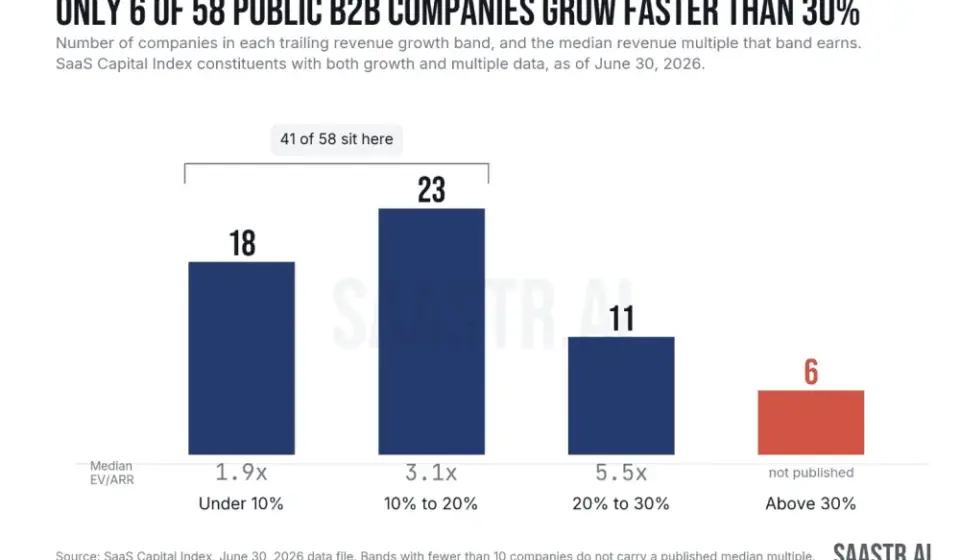
Most CEOs are not coasting; they are fighting for their operational lives. Yet, despite shipping AI features, embedding copilot interfaces, and rushing to update pricing pages, the vast majority find themselves trapped in a stubborn growth plateau. Industry data reveals that growth rates across the sector are largely stalled in the 10% to 30% range. The high-flying, 60%+ growth cohorts that once dominated public markets have effectively evaporated.
This is not a failure of execution; it is a failure of architecture. The CEOs earning the deepest respect today are not those who merely bolt AI capabilities onto legacy platforms. They are the leaders willing to undergo the agonizing process of tearing up their product roadmaps, overhauling go-to-market (GTM) motions, redesigning pricing architectures, and fundamentally reshaping their organizational charts.
Rebuilding a company from the ground up while flying the plane is arguably the hardest challenge in the history of enterprise software. With private equity acquisition offers looming at depressed multiples and boards demanding answers for stagnant mid-teen growth, the temptation to walk away has never been higher. Yet, for those willing to endure the structural pain, the prize at the end of the tunnel is category dominance for the next decade.
Detailed Chronology: The Evolution of the AI Pivot
To understand why so many B2B companies are currently stuck at the 40% completion mark of their transformations, one must trace the timeline of how the industry arrived at this crossroads.
Phase 1: The Initial Shock and Feature Rush (2023)
When foundational Large Language Models (LLMs) burst onto the scene in late 2022 and early 2023, the initial industry response was reactive. Founders and product teams scrambled to prove they were not "getting left behind." The playbook was straightforward: acquire API access, build a conversational wrapper, and ship an AI assistant.
Companies rushed to announce these capabilities. Product pricing pages were updated overnight with "AI Add-on" tiers. Boards nodded approvingly, assuming that sprinkling artificial intelligence across existing product suites would immediately reignite hyper-growth.
Phase 2: The Structural Wall and Metric Stagnation (2024–2025)
By late 2024, the limits of the "feature-bolting" strategy became glaringly obvious. Despite widespread AI adoption in product releases, top-line revenue growth refused to budge. Companies found themselves stuck in the 10% to 30% growth band.
Behind closed doors, engineering teams hit systemic data walls. Models were capable, but corporate data layers were a mess of siloed systems, duplicate customer records, and stale metadata that had been ignored for years. Furthermore, traditional per-seat pricing models began cannibalizing revenue: as AI tools made human workers more productive, fewer seats were needed, directly shrinking the customer’s billing base.
Phase 3: The Incumbent Transformation and High-Stakes M&A (2026)
By mid-2026, the divergence between superficial adopters and profound rebuilders became a chasm. The market began heavily penalizing companies stuck in growth doldrums, while rewarding radical reinvention.
A prime bellwether of this era is Intercom, a SaaS-era darling that bet its entire future on AI support agents built on early LLMs. Over a multi-year period, Intercom completely restructured its workflows around its AI engine, culminating in May 2026 when the 15-year-old company officially rebranded entirely around its flagship AI product, Fin. Just four weeks later, Salesforce announced a definitive agreement to acquire Fin for approximately $3.6 billion.
Fin’s trajectory—surpassing $100 million in ARR for the agent alone within a broader $400M+ ARR ecosystem—proved that complete structural reinvention could yield historic outcomes, even if it required nearly four years of arduous, foundational restructuring.
Supporting Context & Metrics: The Hard Numbers of SaaS
Public markets and independent research firms provide an unvarnished look at the economic reality facing software companies today. The era of cheap capital and blind multiple expansion is gone, replaced by a ruthless valuation framework tied directly to growth velocity.

The Death of High-Growth Public Cohorts
An analysis of the SaaS Capital Index data highlights a dramatic compression in public company growth rates. The once-common cohort of public SaaS companies growing at 60% or more has effectively vanished.
Instead, the distribution clusters heavily in the teens and twenties:
- Under 10% Growth: Heavily penalized, commanding median enterprise value multiples as low as 1.9x.
- 10% to 20% Growth: The struggle band, trading at roughly 3.1x multiples. Sliding from 22% growth down to 18% can literally slash a company’s enterprise value in half.
- 20% to 30% Growth: The new median baseline for scaled public companies, commanding approximately 5.5x multiples.
Private Markets Mirror Public Pressures
Private equity and venture capital data confirm that this plateau is not unique to public markets. PitchBook’s Q2 2026 data pegs estimated median B2B revenue growth at a modest 13.2%. Sectoral divergence is stark: DevOps, ITOps, and automation platforms lead the pack with median growth near 21.9%, while legacy CRM, sales, marketing, customer experience (CX), and productivity applications languish at the bottom.
Similarly, SaaS Capital’s 2026 private company survey shows bootstrapped B2B firms growing at a median rate of 20%, with equity-backed firms registering 25%. For a CEO currently sitting at 18% growth, the uncomfortable truth is that they are precisely average—a reality rarely spoken aloud in boardrooms.
Official Statements and Industry Perspectives
The psychological and operational toll of navigating this transition has prompted candid reflections from industry leaders, investors, and analysts.
Reflecting on the widespread temptation among founders to abandon their posts, prominent software investors and operators have noted a notable rise in executive attrition. Many founders are choosing to accept early private equity buyouts at depressed 3x multiples rather than face the grinding, multi-year slog of an AI rebuild.
However, industry veterans caution against the illusion of the hand-off. When a founder hands over the keys to an incoming private equity operator, the institutional memory and underlying vision often evaporate. Incoming operators frequently view experimental AI budgets or complex distribution strategies through a purely spreadsheet-driven lens. Mistaking vital product-market evolution for unnecessary operational cost, new management teams often slash investments that were destined to be the company’s next-generation engines.
Furthermore, industry analysts point to four structural reasons why shipping rudimentary AI features fails to move top-line numbers:
- Flawed Pricing Units: Sticking to legacy per-seat pricing models penalizes efficiency. True innovators are shifting toward outcome-based, consumption, or value-metric pricing.
- The Workflow Trap: Bolting an AI assistant onto a screen a human still has to manually navigate is merely a feature; eliminating the screen altogether requires an organizational redesign.
- Data Debt: Generative AI acts as a mirror for internal data hygiene. Organizations with fragmented, poorly maintained data layers find that autonomous agents amplify operational chaos rather than curing it.
- Misaligned Go-To-Market Motions: Selling transformative automation to budget holders accustomed to buying seat licenses requires an entirely new sales motion, champion, and value proposition.
Future Outlook: The Next Decade Belongs to the Resilient
As the enterprise software industry looks toward the remainder of the decade, the path forward is clear, albeit unforgiving.
The companies that successfully navigate the current turbulence will not be those that simply adopted superficial AI wrappers early on, nor will they be the fly-by-night startups lacking deep enterprise domain expertise. Instead, the ultimate winners will be the incumbent operators currently sitting at the 40% completion mark of their transformation—the leaders who chose to endure the grueling process of structural rebuilds rather than capitulate to private equity exits.
For CEOs currently battling board skepticism, compressed revenue multiples, and the daily friction of organizational transformation, the mandate is straightforward: keep going.
The enterprise software giants of the 2030s are being forged right now in the crucible of this transition. Those who possess the tenacity to finish what they started—overhauling their pricing, clearing their data debt, reimagining their GTM strategies, and refusing to hand over the keys—will own their respective categories for the next decade. The hardest stretch of the modern founder’s career is nearing its apex; the reward for endurance is lasting market dominance.
What do you feel about this post?

Like

Love

Happy

Haha

Sad

Angry