
The Death of Vanity Metrics: Why Modern Marketing Must Pivot from Activity to Accountability

Executive Overview
In the high-stakes world of global enterprise marketing, a silent crisis is draining corporate profits. While chief marketing officers (CMOs) celebrate soaring impression volumes and plunging acquisition costs, a deeper, more disciplined fiscal reality is being ignored. Recently, during a strategic consulting engagement for a multinational corporation operating across 75 countries, a chilling operational truth surfaced: teams were actively optimizing their budgets around a metric known as Cost Per Session (CPS)—prioritizing sheer traffic volume over financial return, effectively subsidizing ad platforms while actively eroding company margins.
This phenomenon highlights a systemic failure across modern digital marketing. For decades, organizations have rewarded marketing teams for activity rather than outcomes or accountability. Vanity metrics like impressions, views, and raw click-throughs have created a false sense of security, masking campaigns that generate high revenue while destroying bottom-line profit.
As artificial intelligence fundamentally reshapes search engines, advertising platforms, and consumer behavior, this superficial approach to performance measurement is no longer just inefficient—it is an existential threat. To survive the AI disruption, modern marketing organizations must undergo a cultural revolution: shifting their focus permanently from raw activity to verifiable financial accountability.
Detailed Chronology: The Anatomy of a Marketing Misalignment
The disconnect between marketing activity and financial reality usually begins innocently enough, driven by siloed departmental goals and misleading vendor dashboards.
Phase 1: The Discovery of the "Cost Per Session" Illusion
During the early diagnostic phases of the aforementioned global enterprise project, strategic teams reviewed regional campaign performance. Sub-teams proudly presented their primary Key Performance Indicator (KPI): Cost Per Session.
With decades of experience spanning the world’s largest corporations, authoring bestselling analytics books in multiple languages, and helping invent foundational digital analytics tools, the metric came as a profound shock. The only "CPS" familiar to veteran financial analysts was Cost Per Sale. The idea that a global brand would evaluate success based merely on shoveling raw traffic onto a website as cheaply as possible—regardless of whether those visitors engaged, converted, or destroyed margin—unmasked a staggering misalignment.
Phase 2: The Trap of Activity-Based Reporting
Most corporate reporting infrastructure is intentionally or unintentionally designed to flatter the marketing department. Standard weekly dashboards highlight top-of-funnel wins:
- Google Advantage+ campaigns are driving record traffic!
- Email response rates are up!
- Cost-per-click is dropping!
When executives review these initial activity metrics, they see green arrows and celebratory metrics. Trusting these surface-level victories, organizations instinctively channel more capital into these channels. However, legacy-minded CMOs and vigilant chief financial officers (CFOs) eventually ask the inevitable question: What are the actual business outcomes?
Phase 3: The Pivot to Outcomes and Inputs
When forced to mature, organizations add revenue and conversion rates to their dashboards. They discover that platforms like Google Advantage+ do indeed drive higher order volumes and top-line revenue. But top-line growth is a dangerous illusion if the cost to generate that revenue outweighs the gross margins.
To bridge the gap between marketing and finance, organizations must integrate fundamental financial inputs: Campaign Costs and Cost of Goods Sold (COGS). Only by factoring in the direct cost of running ads and the expense of manufacturing the products sold can a company calculate true profitability.
Supporting Context & Metrics: Unmasking the Profit Illusion
To understand how traditional digital marketing metrics obscure financial reality, one must examine the progression from activity-based reporting to true financial accountability.
The Evolution of Performance Metrics
- Activity View: Measures mere exposure and traffic (Impressions, Clicks, Sessions). It tells you people are showing up, but nothing about what they do or whether it makes money.
- Outcomes View: Measures behavioral conversions (Orders, Revenue, Conversion Rates). It shows that a campaign generated $17,000 in revenue, but ignores the price tag attached to acquiring it.
- Accountability View: Integrates expenses (Campaign Costs and COGS). This is where the narrative shifts dramatically.
A Real-World Case Study Comparison
Consider a comparative analysis between an AI-powered ad campaign (such as Google Advantage+) and an owned-media channel like Email:
- Google Advantage+: Generates massive traffic and $17,000 in revenue, but requires $7,000 in ad spend alongside substantial COGS, resulting in a net profit of just $5,000.
- Email Marketing: Generates significantly lower top-line revenue ($3,000) and far fewer orders (14 compared to Google’s 173), but operates at a fraction of the cost.
When evaluated purely on Return on Ad Spend (ROAS)—a metric that gives marketing full credit for revenue without subtracting ad spend—Google appears dominant. However, when financial leaders apply true accountability metrics, the tables flip entirely:
- Return on Investment (ROI): Subtracts campaign costs from revenue, revealing a stark divergence in capital efficiency.
- Profit on Ad Spend (POAS) & Profit on Investment (POI): This is where reality sets in. When calculating POI—measuring the exact profit returned for every dollar spent—Google Advantage+ campaigns in this case study returned a devastating $0.70 in profit for every $1.00 spent. The campaign was actively subsidizing the advertising platform while destroying corporate equity. Conversely, email marketing delivered $5.70 in profit for every $1.00 spent.
Despite Google delivering 12 times more revenue, it was an engine for destroying enterprise value, whereas email was a precision profit instrument.
Official Industry Guidance & Expert Recommendations
The mandate for financial accountability is supported by evolving platform standards and strategic frameworks.
The Strategic Cure: Cutting the Fat to Rebuild Strategy
When confronted with negative or marginal Profit on Investment (POI) from major paid acquisition channels, leadership must act decisively rather than accepting sunk-cost rationalizations.
- Immediate Discontinuation: Cut toxic spend on underperforming paid campaigns to zero. Allow the resulting drop in traffic and revenue to wake up the organization, reminding stakeholders that top-line traffic is worthless if it destroys bottom-line profit.
- Challenge Stakeholders: Give internal media teams, external agencies, and platform representatives a strict mandate to prove they can deliver green POI (positive, sustainable profit).
- Rethink Intent, Tactics, and AI Integration: Construct a rigorous three-part strategy:
- Intent: What true buyer intent is actually available on the ad platform?
- Tactics: What creative, audience segmentation, and offers match that intent?
- AI Automation: How are AI-powered platform features being leveraged to turbocharge tactical execution without blindly handing cash over to algorithms?
Upgrading Your Metrics: From Cost Per Session to Cost Per Non-Bounced Session
If corporate culture or internal inertia prevents an immediate shift to full profit accountability, organizations must at least "suck less" by abandoning pure Cost Per Session.
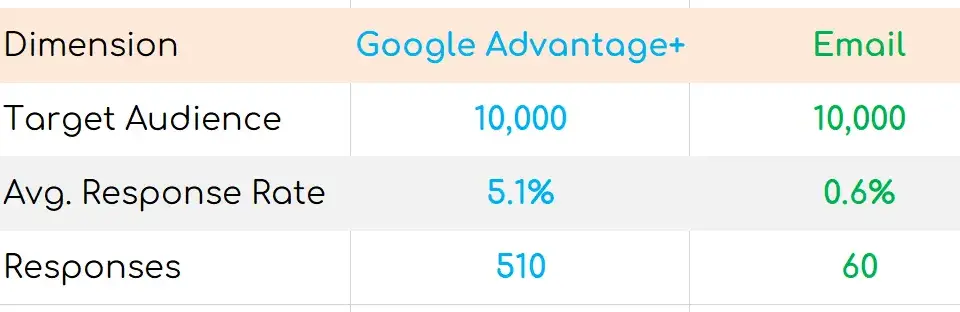
In the case study data, 510 sessions cost $7,200, resulting in a Cost Per Session of $14. However, with a bounce rate of 52%, more than half of those visitors arrived, contributed nothing, and immediately left—wasting paid capital. By removing these unproductive visits, the Cost Per Non-Bounced Session rises to $27.
When internal teams see a realistic $27 price tag for a single engaged session, the psychological illusion shatters, opening the door for critical tactical optimization.
Future Outlook: AI Search and the AI Mode Imperative
The urgency to abandon vanity metrics is accelerating due to macroeconomic shifts and structural changes in search engine architecture. Google’s recent guidance on succeeding in AI Search (including ChatGPT- and Perplexity-style AI Overviews) explicitly warns marketers against optimizing for shallow engagement.
Why AI Overviews Change Everything
Google’s official documentation highlights a fundamental shift in user behavior driven by AI-generated results:
“We’ve seen that when people click to a website from search results pages with AI Overviews, these clicks are higher quality, where users are more likely to spend more time on the site… Consider looking at various indicators of conversion on your site, be it sales, signups, a more engaged audience, or information lookups about your business.”
In an AI-driven search ecosystem, superficial clicks and low-intent traffic are diminishing assets. Platforms are increasingly filtering out casual window-shoppers, rewarding content and experiences that deliver substantive, high-intent engagement.
Marketers who continue to chase Cost Per Session, impression volume, and raw clicks are preparing their strategies for a dead internet. Conversely, organizations that align their measurement frameworks with Outcomes and Accountability will build resilient, AI-proof marketing operations.
Conclusion
The era of marketing impunity is over. CMOs who wish to secure sustained, multi-year budget increases must willingly embrace the friction of financial accountability. By moving past the comforting fog of activity-based vanity metrics—burying obsolete indicators like Cost Per Session once and for all—marketing leaders can align their efforts directly with the CFO’s mandate for profitable growth.
It requires rigorous thinking, uncomfortable cultural conversations, and a willingness to turn off unprofitable ad spend. But the reward is clear: an analytics-driven, AI-resilient career and a marketing organization that acts as a true engine of enterprise value rather than a sinkhole for corporate profit. Carpe diem.