Mastering the Feed: A Masterclass in High-Impact, Human-First LinkedIn Content Strategy

Executive Overview
In an era dominated by automated prompt engineering and generative writing tools, a quiet counter-revolution is taking place across professional networks. While millions of digital creators lean heavily on artificial intelligence to pump out high-volume, generic copy, organic reach on platforms like LinkedIn is experiencing a severe structural fatigue. Audiences have developed an intuitive filter for machine-generated phrasing, hollow thought-leadership tropes, and superficial engagement bait.
Yet, a massive economic opportunity remains wide open for those willing to do the deep, strategic work. Statistical analyses of professional platforms reveal a staggering supply-and-demand imbalance: only 1% of LinkedIn’s active user base regularly creates content. This profound content gap means the algorithm aggressively rewards accounts that show up with substance, authenticity, and precise psychological architecture.
Co-created by digital growth strategist Kasey Brown and industry authority Michael Stelzner, a tactical blueprint has emerged for cutting through the noise without relying on AI shortcuts. Known as the Triple S Framework, this methodology focuses on three distinct phases of user interaction: Stop, Stay, and Share. By anchoring content in an hyper-specific Ideal Client Profile (ICP) and executing a masterclass in behavioral psychology, content creators can transform LinkedIn from a passive scrolling graveyard into an engine for compounding business growth.
Detailed Chronology: The Evolution of Organic Reach and the Triple S Methodology
To understand why traditional, safe content strategies are failing on LinkedIn, one must examine the evolution of the platform’s algorithmic priorities. Years ago, basic text updates and standard self-promotional wins could reliably capture broad visibility. As the platform matured and professionals flooded the feed, noise levels skyrocketed. Standard updates dissolved into an indistinguishable blur of corporate cheerleading.
Recognizing this saturation, growth experts like Kasey Brown—founder of the digital growth agency Digital Kairos—began systematically deconstructing what actually halts a reader’s momentum. Through rigorous split-testing, content audits, and real-world campaign tracking, Brown formulated a structural approach that rejects the sterile, corporate-polished aesthetic in favor of raw, human-centric design.
The Foundational Prerequisite: Precision Targeting
Before a single word of a post is drafted, Brown argues that creators must secure three foundational pillars. Without these, even the cleverest copywriting will fail to convert impressions into pipeline.
- The Ultra-Specific ICP (Ideal Client Profile):
Most creators define their target audience with sweeping generalities, such as "entrepreneurs," "marketers," or "people who want to build a brand online." Brown insists on an operational level of precision. An effective ICP must be specific enough that a virtual assistant could plug its exact keywords into LinkedIn’s search engine and instantly yield a qualified roster of prospects. Instead of targeting "coaches," a high-utility ICP is framed as: "Speakers, coaches, and consultants earning at least $20K per month who need systems for organic content so they can scale their impact and their business." - The 30-Day Transformation Arc:
Every piece of content must contribute to a clearly defined psychological and operational transformation. What state of mind, skill set, or clarity will a follower walk away with after consuming 30 days of your material? This transformation frames the narrative arc before pen touches paper. - The Reader-Centric Paradigm Shift:
The vast majority of creators post with inward-facing motivations: Did I sound intelligent? Did I showcase enough client wins? Will this drive a direct sale? High-performing content completely inverts this paradigm. The operative question shifts entirely to: What tangible value, perspective shift, or tactical takeaway does the reader walk away with? When the audience’s outcome takes center stage, organic engagement naturally compounds.
Supporting Context & Metrics: The Triple S Framework in Action
With the foundational framework locked in, the Triple S Framework becomes operational. This three-part model systematically addresses the chronological journey of a LinkedIn user: stopping the scroll, holding attention, and inspiring viral distribution.

[ THE TRIPLE S FRAMEWORK ]
 ├── 1. STOP  ──► Visual Pattern Interrupts + The Five Cs Hooks (80% of impressions)
 ├── 2. STAY  ──► The Re-Hook, Rhythmic Formatting, & Reading Level Optimization
 └── 3. SHARE ──► Tangible Takeaways ("Goodie Bag" Value & Share-per-Impression Metrics)
1. Stop: Pause a Viewer’s Scroll With Images and Hooks
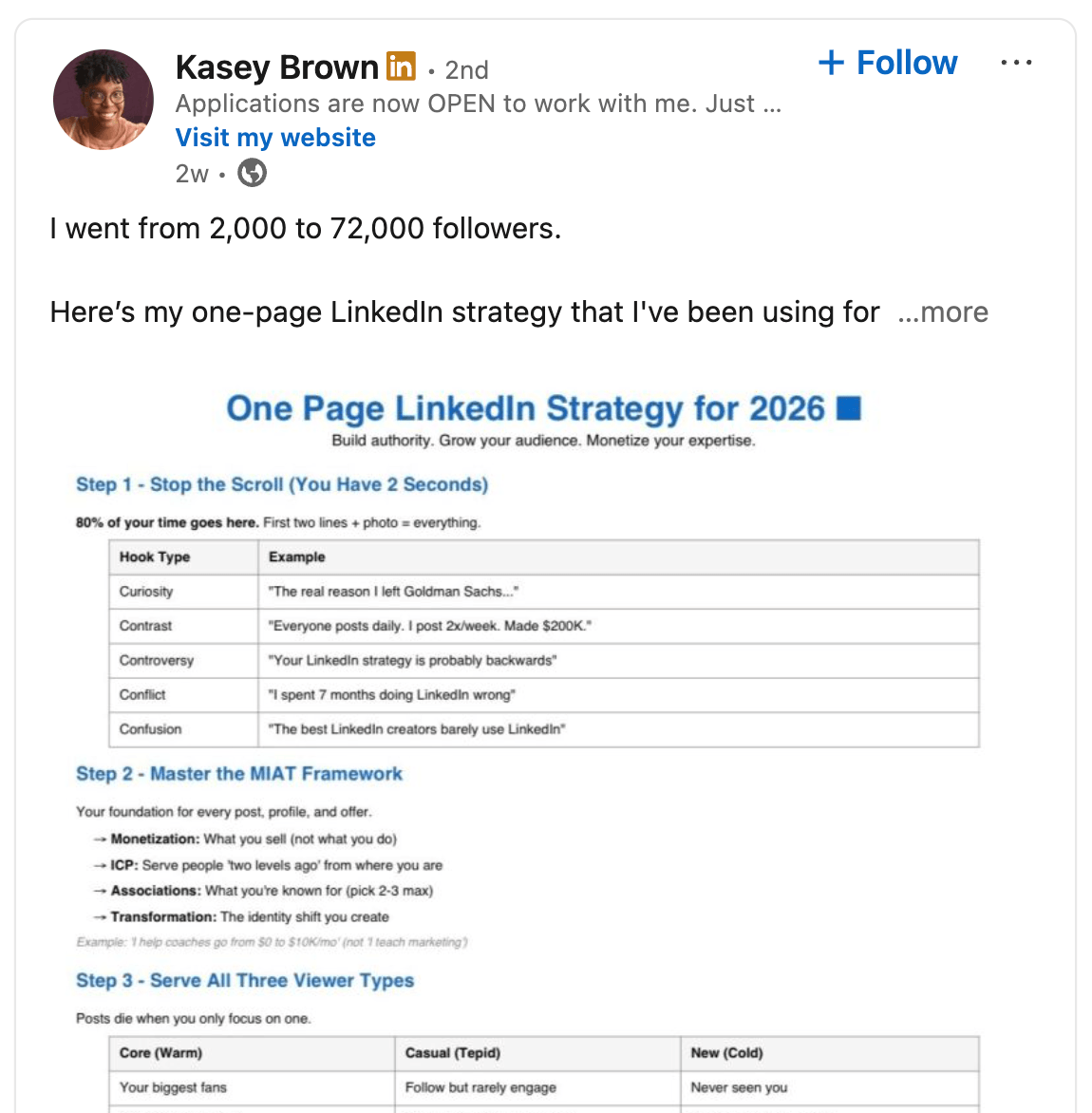
The immediate barrier to content distribution on LinkedIn is human inertia. Users rapidly flick their thumbs down a continuous stream of updates. According to platform metrics, roughly 80% of a post’s impressions are determined entirely by two elements working in tandem: the attached visual asset and the opening two lines of text.
Visual Strategy: The Power of Being Different
Most professionals instinctively reach for corporate headshots, polished studio portraits, or pristine speaker photos. Because everyone utilizes this clean aesthetic, uniformity breeds invisibility.
Brown tested this hypothesis empirically. Following a major speaking engagement, she captured a wide-angle selfie utilizing her smartphone’s back camera set to a 0.5x zoom. The resulting frame was unpolished, casual, and revealed the sprawling live audience behind her. Paired with a caption offering her presentation slides in exchange for a comment, this single asset generated 3,000 targeted leads.
Seeking to verify the data, Brown subsequently reposted the identical offer paired with a professionally lit, high-resolution photo of herself on stage holding a microphone. That polished asset yielded only 200 leads.
"We don’t have to be better. We have to be different," Brown notes.
Tactically, vertical imagery consumes more vertical screen real estate within the mobile feed, naturally resisting automated cropping. Furthermore, wide-angle 0.5x mobile shots introduce contextual environments that trigger human curiosity—the exact psychological friction required to halt a scroll.
For infographics and guide-style assets, standard generic title cards (e.g., “Framework for Winning on LinkedIn”) perform poorly. High-performing assets display the entire framework directly within the thumbnail, styled deliberately to resemble a screenshot of a raw, working document. This creates an immediate visual pattern interrupt.
Copywriting Strategy: Triggering the Five Cs
Once the visual asset halts the thumb, the opening two lines of text must convince the user to click the "see more" expansion button. To evaluate the potency of a hook, Brown utilizes a framework adapted from short-form video strategy known as The Five Cs:
- Curiosity: Creating an unanswered question in the reader’s mind.
- Contrast: Highlighting a stark difference between two states, eras, or mindsets.
- Contradiction: Presenting ideas that challenge conventional wisdom.
- Controversy: Touching upon polarizing industry debates safely and ethically.
- Confusion: Introducing an unexpected detail that demands immediate clarification.
A weak hook—such as a vacation photo captioned "On vacation in Bali, having a great summer"—triggers zero elements of the Five Cs. It offers no tension or unresolved questions. Conversely, positioning that same visual with a razor-sharp opening hook transforms its performance:
- Line 1: "I was at a job I hated. 2021."
- Line 2: "2026. I just spent $30K to come here…"
This structure immediately activates confusion regarding the financial figure, curiosity about the journey, and a sharp contrast between past misery and present liberation.
2. Stay: Keep Readers Engaged From Hook to Finish
Earning the initial click is merely the first hurdle. The second challenge—and the true test of content quality—is keeping the reader engaged through to the final line.
The Re-Hook Mechanism
When a user clicks "see more," the third line of the post acts as a vital re-hook. Its singular function is to escalate tension, not resolve it.
Amateur writers frequently commit the error of delivering the punchline immediately upon expansion: "I’m here in Bali with the family. I took five weeks off from my business, and it’s thriving without me." By resolving the narrative arc instantly, the reader loses all incentive to continue reading.
The correct structural approach continues building psychological pressure:
"It was a wild dream I had last February. I never thought I could actually leave my business and spend this kind of money to come here, especially with so many fires burning in the operations and everything feeling like it was about to fall apart. But somehow I made it."
This approach introduces layers of unresolved conflict. The reader remains anchored to the text because they desperately desire the resolution.
Rhythmic Formatting and Readability
Beyond narrative pacing, typographic structure dictates whether a reader finishes a post. Dense walls of text trigger cognitive fatigue, resulting in immediate drop-offs.
Brown recommends designing for rhythmic variance: a deliberate alternation between single-sentence micro-lines and short, multi-sentence narrative blocks.
- Micro-lines (one sentence) act as punctuation marks to land hard-hitting tactical points.
- Blocks (two to three sentences) develop and contextualize complex ideas.
Furthermore, reading level is heavily correlated with retention. High-performing posts consistently score at a fourth-to-seventh-grade reading level, verified using accessibility tools like the Hemingway App. Because roughly 70% of LinkedIn consumption occurs on mobile devices, creators must preview drafts directly inside the mobile app or via specialized render-testing software like Authored Up to ensure line breaks do not collapse into unreadable paragraphs on smaller displays.
3. Share: Driving Organic Distribution
The ultimate validation of professional content is not views, impressions, or surface-level comments—it is the share. A share (or repost) represents the ultimate endorsement: a user finding the material valuable enough to attach their personal reputation to it and broadcast it across their own network.
The Metrics of Distribution
To objectively measure content effectiveness, Brown tracks shares per impression:
- 0.3 Ratio: A solid benchmark indicating healthy resonance.
- 0.5+ Ratio: Exceptional performance. Any post reaching this threshold is designated for automated content recycling, placed into a rotating queue to be republished every 60 to 90 days utilizing identical text and imagery.
The "Goodie Bag" Closing Strategy
Posts that consistently drive high share ratios share a common structural architecture: they conclude with a concrete, actionable transformation for the reader.
Returning to the Bali travel narrative, rather than ending on a purely reflective or self-congratulatory note, the post delivers an explicit, step-by-step framework: "Step 1: Audit your operational dependencies. Step 2: Establish asynchronous communication protocols…"
This transforms an anecdotal personal story into an operational "goodie bag"—a tangible resource that a professional will readily forward to a colleague facing identical challenges, save to a personal archive, or engage with to secure an offered lead magnet. When this substantive takeaway is organically baked into the conclusion, explicit calls-to-action ("tag a friend who needs to see this") feel natural rather than coercive.
Official Statements and Industry Insights
Reflecting on the psychological shifts required to succeed in modern professional networking, industry authorities emphasize that authenticity cannot be successfully automated.
"When creators shift their internal monologue from ‘Did I sound smart?’ to ‘What tangible value does the ideal reader walk away with today?’, the entire dynamic of their digital presence shifts," notes Kasey Brown during strategic briefings on organic network growth.
As artificial intelligence tools flood professional channels with hyper-optimized, generic syntax, the market value of genuine human experience, empirical testing, and vulnerable storytelling has skyrocketed. Platforms do not reward tools; platforms reward resonance. By stripping away corporate pretense and embracing structured, reader-first frameworks like the Triple S methodology, executives and founders can reclaim organic reach and build defensible, human-led brand equity.
Future Outlook: Navigating the Post-AI Content Landscape
As generative AI models continue to saturate digital feeds with high-volume, low-friction text, the long-term trajectory of professional platforms points toward intense polarization. Content that relies purely on generalized summaries, recycled listicles, and superficial thought leadership will face diminishing algorithmic returns as users and platform filters tune them out entirely.
Conversely, the future belongs to practitioners who treat content creation as an empirical science grounded in deep audience empathy. We can expect to see:
- Richer Visual Diversity: A continued flight away from sterile corporate stock imagery toward raw, unpolished, mobile-first visual assets that trigger authentic curiosity.
- Elevated Editorial Rigor: Shorter, punchier copy structures optimized for rapid mobile consumption, prioritizing cognitive ease and narrative tension over bloated word counts.
- Community-Centric Amplification: A heavier reliance on content that serves as a direct, actionable utility—resources so immediately useful that professionals willingly act as distribution channels through organic shares.
Ultimately, the 1% content supply-and-demand gap on LinkedIn remains the single greatest untapped asset for modern business builders. Those who abandon the AI shortcut in favor of the disciplined execution of Stop, Stay, and Share will continue to capture disproportionate mindshare, authority, and revenue in the years to come.