
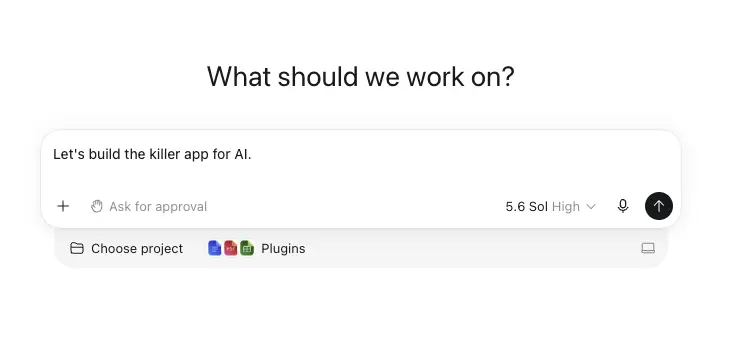
Navigating the Agentic Frontier: Inside OpenAI’s Push to Automate the Digital Workplace

Executive Overview
How much control are you willing to cede to a Large Language Model (LLM) over the operational landscape of your digital existence? For the chronically AI-hesitant or the professionally protective control freak, the proposition feels fraught with risk. Yet, for Andrew Ambrosino, lead engineer for OpenAI’s desktop application, granting an AI sweeping, unfettered access to his inbox, Slack channels, mobile device, and software suites like Notion and Figma is the only viable method for testing tomorrow’s reality today.
"If I’m asking it to write a document, is there a possibility that it’s going to pull from a private DM on that subject and not know that it’s not supposed to share some info? Yes," Ambrosino acknowledges. "I’ll do it for the job. I will take the personal hit here and there if I have to. And I haven’t had to."
Ambrosino is working on the bleeding edge of OpenAI’s most ambitious commercial play to date: ChatGPT Work. Rolled out recently at a baseline subscription tier of $20 per month, this product is designed to transition AI from a passive conversationalist into an active, multi-step digital agent. By linking models directly to the software workflows that govern white-collar labor—spanning accountants, corporate executives, medical administrators, and analysts—OpenAI aims to fulfill its core corporate mandate: a world where artificial intelligence transcends basic query-and-response mechanics to actively manifest human intent.
However, bridging the chasm between developer-centric tools and mainstream white-collar adoption remains the tech industry’s defining bottleneck. While software engineers have rapidly embraced agentic coding assistants, expanding that utility to the broader professional market requires navigating profound hurdles in user experience, data privacy, economic sustainability, and the fundamental psychology of work.
Detailed Chronology: From Code-Centric Experiments to General-Purpose Agents
To trace the evolution of ChatGPT Work is to examine a rapid, sometimes chaotic timeline of iterative product design driven by intense competitive pressures.
The Codex Era and the Developer Advantage
The foundation of ChatGPT Work lies in Codex, an agentic coding tool initially tailored exclusively for software developers. For engineers operating within command-line interfaces (CLIs), Codex was revolutionary. It abstracted away the boilerplate writing of software, giving rise to the phenomenon of "vibe coding," where users simply prompt the model to build functional applications.
Internally, OpenAI’s adoption of Codex was near-total. Company metrics reveal that by June, roughly 98% of OpenAI employees were actively utilizing Codex. However, that figure plummeted outside corporate walls, where a mere 17% of organizational subscribers and less than 1% of individual users engaged with the agentic tool.
The Transition to "Normie" Workflows
Recognizing this stark disparity, OpenAI began modifying Codex between February and August to transform it into a general-purpose agent. Non-engineering internal teams—spanning communications, legal, and finance—were initially forced to use a tool that Ambrosino describes as "actively hostile to them," throwing technical errors and displaying readouts meant for software diffs.
Smoothing out these rough edges was essential for mass adoption. As Thibault Sottiaux, head of OpenAI’s core product work, notes, the goal is to execute complex, multi-step tasks autonomously in a way that feels both delightful and safe. This evolution culminated in the release of ChatGPT Work, an application designed to handle the messy, unstandardized workflows of everyday office environments.
The Anthropic Rivalry and Interface Iterations
OpenAI’s pivot toward a more conversational, step-by-step assistant was heavily influenced by its fiercest rival, Anthropic. When OpenAI first launched its early agentic prototypes, engineers fell victim to being "AGI-pilled"—believing the underlying models were already intelligent enough to handle complex tasks with minimal user intervention.
Anthropic’s rival product, Claude Code, flipped this paradigm by prioritizing an interactive, back-and-forth conversational loop. If given a problem, Claude would evaluate options and present three or four paths forward, constantly checking in with the user. This reduced hallucinations and execution errors.
Although Anthropic initially dominated download statistics through the spring, OpenAI’s aggressive redesign of its desktop and mobile apps—coupled with the sheer computational muscle of its frontier models—has allowed Codex and ChatGPT Work to slowly close the gap in enterprise engagement.
Supporting Context & Metrics: The Economics and Real-World Usability of Agents
The commercial stakes for OpenAI and the wider AI sector are staggering. Basic chatbot interactions generate low token consumption and limited margins. Conversely, autonomous agents that operate continuously over long stretches burn through substantial compute, making them far more lucrative on a per-user basis—provided the customer base can be scaled beyond software engineers.
The Complementary Asset Dilemma
Industry analysts warn that labs ignoring vertical integration risk losing long-term market value. Christian Catalini, writing on a16z’s "It’s time to build" blog, emphasized that if AI labs fail to rapidly secure the key complementary assets needed to scale AI into specific market segments, commercial value will inevitably accrue to vertical-specific competitors like Harvey (for law) or Clay (for sales).
+-----------------------------------------------------------------+
|                      THE VALUE RETENTION FUNNEL                 |
|                                                                 |
|  [ Frontier Models ] ---> [ Agentic Harness ] ---> [ Enterprise |
|  (High Compute)           (Context & Tools)         Workflows ] |
|                                                             ^   |
|                                                             |   |
|   Risk: If labs don't own the harness/workflow,             |   |
|   value shifts to vertical competitors (Harvey, Clay).        |
+-----------------------------------------------------------------+
Usability Realities and Token Costs
Testing ChatGPT Work reveals both the profound promise and the administrative friction of current agentic harnesses. Reviewers using the platform to extract preschool calendars from convoluted email threads, build auto-updating financial dashboards for publicly traded stocks, or programmatically organize academic research feeds find genuine utility.

Yet, setup friction remains high. Configuring permissions for cloud drives often results in confusing loops where granular "read-only" access triggers error messages, ultimately forcing users to grant sweeping, all-or-nothing permissions. Furthermore, platform fragmentation requires multitasking across web and desktop applications, while vital performance levers—such as reasoning effort levels—remain opaque to novices.
Token consumption also poses an underlying economic challenge. Casual experimentation over a four-day span can easily surpass 80 million tokens, translating to an actual compute cost roughly triple the price of a standard $20 monthly subscription. While OpenAI routinely slashes model pricing (such as recent 80% cost reductions for its Luna models), achieving structural efficiency remains a race against token inflation.
Official Statements and Internal Perspectives
OpenAI’s leadership remains steadfast in its belief that model capability will ultimately eclipse complex, overly engineered software harnesses—a philosophy tied to the famous "bitter lesson" of AI research.
-
On Harness Philosophy: Joe Gershenson, engineering lead for OpenAI’s harness, dismisses the notion of copying competitor interfaces:
"You could get good results in the short term by adding a whole bunch of extras… but like, come on, the next model is going to come out in a couple of months and make that obsolete. The goal of good harness engineering is to be more precise about what information the model really needs to solve your problem."
-
On Accessibility and Design: Thibault Sottiaux emphasizes that natural language interfaces will always supersede traditional software navigation:
"The more value and the more utility that we generate for users, the more they will be willing to also pay for some part of that utility… You sit there and you’re like, ‘Of course I want to pay $20 bucks a month for this,’ because the value that you get is so much more."
-
On Information Overload: Akshay Nathan, product engineering lead, highlights the core problem facing the modern white-collar workforce:
"There is a deluge of information for the average worker… We’re actually quite limited by our ability to parse everything that’s available to us, and then take action on it. The value of ChatGPT is you already have access to this, but now you truly have access to it."
Future Outlook: Challenges on the Horizon for Agentic AI
As OpenAI charges forward into the broader enterprise market, several critical questions will determine whether ChatGPT Work becomes a permanent fixture of modern office life or remains an enthusiast-tier curiosity.
1. The Evaluation Problem
Unlike software engineering—where code either compiles and passes unit tests or fails—knowledge work lacks clear, binary metrics. Evaluating the quality of a strategic business presentation, a marketing pitch, or a financial memo is inherently subjective. OpenAI is attempting to bridge this gap using its internal benchmark, GDPval, which synthesizes tests across 44 distinct knowledge-work occupations, supplemented by continuous user feedback loops.
2. The Open Source Counter-Offensive
Open-source developer communities continue to challenge proprietary lab harnesses. Lightweight, highly malleable frameworks like Mario Zechner’s Pi harness (utilized in projects like OpenClaw) demonstrate that minimalist codebases can often outperform heavily managed lab interfaces. Open-source advocates argue that big labs are pushing monolithic harnesses primarily to enforce user lock-in, warning that companies must own the entire software stack to avoid being commoditized into mere model providers competing against cheaper overseas alternatives.
3. The Path to Ubiquity
Inside OpenAI’s headquarters, the atmosphere is electric with urgency. Product teams are acutely aware that moving from one billion casual web prompt users to tens of millions of deeply integrated enterprise workers requires stripping away residual complexity.
"The promise of the magic box is there," concludes Akshay Nathan, "but I still think there’s too much complexity… I’m very optimistic that we can solve it, with the model and in a truly AI-native way."
Ultimately, the success of ChatGPT Work will not be decided by benchmarks or venture capital hype, but by a quiet, daily calculation made by millions of office workers: whether the administrative friction of setup and the minor privacy compromises are genuinely outweighed by an AI assistant that can finally take the wheel of the digital workday.