
Supercharging Android Asynchronous Programming: How the R8 Compiler Delivers Up to 2x Faster Kotlin Coroutines

Executive Overview
In the modern landscape of mobile application development, performance optimization is a relentless pursuit. As developers push the boundaries of what smartphones can achieve, UI frameworks must render at buttery-smooth frame rates, background tasks must complete instantaneously, and memory footprints must remain as lean as possible. For the Android ecosystem, Kotlin has firmly established itself as the lingua franca, and with it, kotlinx.coroutines has become the absolute standard for asynchronous programming.
However, beneath the clean, expressive syntax of suspending functions and structured concurrency lies an intricate machinery of thread management, state updates, and atomic primitives. Recently, a joint investigation by Google’s Android Toolkit and R8 compiler engineering teams uncovered a hidden performance bottleneck buried deep within these foundational layers.
Starting with Android Gradle Plugin (AGP) 9.2.0, the R8 compiler introduces a transformative optimization that automatically translates high-level Atomic*FieldUpdater calls into low-level Unsafe variants. This architectural shift slashes the overhead of runtime reflection checks, yielding a 2x to 4x performance improvement on core atomic operations. For developers utilizing the kotlinx.atomicfu library—which underpins kotlinx.coroutines—this optimization translates into a staggering 2x speed boost when launching and cancelling coroutines.
This article explores the technical genesis of this performance bottleneck, the deep-dive investigation using ART method traces and microbenchmarks, the mechanics of how the R8 compiler surgically restructures JVM bytecode, and what this milestone means for the future of high-performance Android applications, particularly those powered by Jetpack Compose.
Detailed Chronology: Uncovering the Coroutine Bottleneck
To understand how Google engineers arrived at this breakthrough, one must retrace the diagnostic journey that began within the Jetpack Compose team. As Compose cemented its position as Android’s premier declarative UI toolkit, developers naturally integrated coroutines to manage complex UI behaviors, ranging from animated state transitions to fine-grained pointer and touch events. Under the hood, nearly every concurrent API in Compose relies on suspend functions, repeatedly spinning up and tearing down coroutines to handle asynchronous data streams and UI state updates.
The Compose Performance Audit
During routine performance profiling, the Compose engineering team identified an unexpected anomaly: coroutines were introducing measurable latency outside of actual UI composition phases.
A striking case study emerged from investigating Modifier.clickable. Profiling data revealed that an astonishing 80% of the CPU time consumed during the creation and updating of Modifier.clickable was being spent purely on launching and cancelling internal coroutines designed to track and process InteractionSource updates.
This revelation shifted the early optimization paradigm. Instead of tweaking layout passes or modifier trees, engineers realized they had to investigate the foundational cost of coroutine lifecycle management itself. To diagnose the root cause, the team turned to Android Runtime (ART) method traces—a profiling utility capturing the exact execution flow, call stack ordering, and execution duration of application methods.

Deconstructing the ART Method Trace
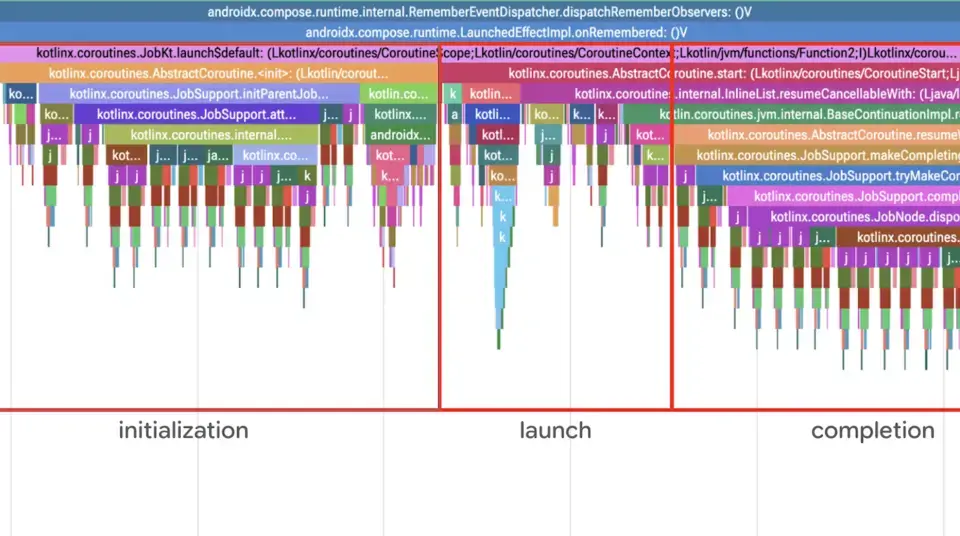
When profiling an empty, seemingly trivial call like LaunchedEffect , the ART method trace exposes a surprising depth of internal operations. Initialization, execution, and cancellation phases all register distinct footprints. Crucially, cancelling a LaunchedEffect triggers the instantiation of a CancellationException, adding further computational overhead.
[LaunchedEffect Initialization] ---> [State Registration & Job Creation] ---> [Atomic Updates & Tree Linking]Upon zooming into the method traces using modern visualization suites like the Perfetto UI, a suspicious pattern emerged. The execution graph was peppered with frequent, repetitive calls to java.util.concurrent.atomic.AtomicReferenceFieldUpdater.
While individual invocations appeared fleetingly fast, their cumulative frequency was alarming. In performance engineering, minor inefficiencies executed millions of times across an app’s lifecycle compound into devastating regressions. An up-close inspection of these updater calls (AtomicReferenceFieldUpdater.get and compareAndSet) revealed a shocking reality: a substantial portion of execution time was being consumed not by actual atomic computation, but by reflective safety checks.
The Anatomy of Atomic Field Updaters
Coroutines rely on a lock-free, tree-structured parent-child hierarchy to enforce structured concurrency—a design that ensures cancellation cascades cleanly and memory leaks are prevented. To maintain this tree safely across multiple threads without locking, kotlinx.coroutines leverages the kotlinx.atomicfu library, which relies heavily on JVM primitives like AtomicReferenceFieldUpdater.
An AtomicReferenceFieldUpdater operates by taking a target class reference and a field name at runtime, utilizing reflection to resolve memory offsets. To guarantee safety and prevent illegal access, the JVM must execute several reflective checks every time the updater is invoked to verify that the target field actually exists, is marked volatile, and is accessible by the caller. Because nearly every fundamental coroutine operation—starting, suspending, resuming, and cancelling—triggers at least one atomic transaction, these reflective safety checks act as an architectural bottleneck throttling asynchronous performance.
Supporting Context & Metrics: Quantifying the Overhead
Skeptical that standard JVM optimizations might mitigate these reflective costs, the engineering team set out to construct empirical benchmarks comparing standard atomic references against kotlinx.atomicfu implementations.
Empirical Microbenchmarking
Using Android Jetpack Macrobenchmark and JUnit4, engineers isolated the atomic compare-and-set operations. The test structure compared standard java.util.concurrent.atomic.AtomicReference instances directly against kotlinx.atomicfu.atomic equivalents:
@RunWith(AndroidJUnit4::class)
class AtomicReferenceBenchmark
    @get:Rule
    val benchmarkRule = BenchmarkRule()

    private val atomicReference = java.util.concurrent.atomic.AtomicReference(false)
    private val atomicRef = kotlinx.atomicfu.atomic<Boolean>(false)

    @Test
    fun atomicReference_compareAndSet()
        benchmarkRule.measureRepeated
            atomicReference.compareAndSet(true, false)
            atomicReference.compareAndSet(false, true)


    @Test
    fun atomicRef_compareAndSet()
        benchmarkRule.measureRepeated
            atomicRef.compareAndSet(true, false)
            atomicRef.compareAndSet(false, true)
Executed on a Google Pixel 5 running API 33 (with sufficient warm-up iterations to ensure JIT compilation stabilization), the benchmark results quantified the performance penalty:

atomicReference_compareAndSet(Standard Java): ~50.7 nanosecondsatomicRef_compareAndSet(kotlinx.atomicfu): ~135 nanoseconds
The measurements exposed an undeniable performance gap: the kotlinx.atomicfu implementation was approximately 2.7x slower. This conclusively disproved the hypothesis that Just-In-Time (JIT) or Ahead-Of-Time (AOT) compilation within ART was magically stripping away the reflective overhead. The reflective checks imposed a persistent runtime tax.
The Solution: Shifting Work to the Compiler
Analyzing the raw mechanics of an Atomic*FieldUpdater, engineers noted that once initialization concludes, the updater does little more than wrap a raw memory offset and delegate calls to internal Unsafe methods (Unsafe.getObjectVolatile, Unsafe.compareAndSwapObject, etc.).
In the vast majority of production codebases, updater initializations are static final declarations bound to compile-time constants. The holder class, field name, and expected types are statically obvious. Therefore, a sufficiently advanced, whole-program optimizing compiler should be able to deduce field offsets statically, eliminate reflection entirely, and substitute direct Unsafe memory operations at build time.
Fortunately, the Android build toolchain already possesses such a compiler: R8.
Architectural Deep Dive: How R8 Optimizes Atomic*FieldUpdater
R8 is a bytecode engineering tool designed for code shrinking, obfuscation, and optimization. Starting with AGP 9.2.0, R8 extends its capabilities to inspect, rewrite, and optimize Atomic*FieldUpdater patterns through a meticulous three-phase transformation process: Instrumentation, Replacement, and Clean-up.
Phase 1: Instrumentation
To bypass reflection, R8 injects synthetic memory offset fields directly alongside the existing updater fields within the target class.
Consider a standard Java/Kotlin source representation of an atomic updater pattern:
class Example
    volatile String data = "";
    static final AtomicReferenceFieldUpdater updater =
        AtomicReferenceFieldUpdater.newUpdater(Example.class, String.class, "data");

    void example()
        updater.compareAndSet(this, "", "new");
During the instrumentation phase, R8 introduces a companion offset field initialized via low-level reflection primitives executed purely at class loading time, while preserving the original updater infrastructure to maintain fallback compatibility for un-optimizable edge cases:

static final long updater$offset =
    SyntheticUnsave.UNSAFE.objectFieldOffset(Example.class.getDeclaredField("data"));
Phase 2: Replacement
Once the compiler maps and instruments the target fields, R8 analyzes every call site where the updater is invoked. If an invocation meets strict criteria—namely, that the holder, field type, and variable names can be resolved statically without ambiguity—the compiler executes a surgical replacement.
The high-level reflection-bound call:
updater.compareAndSet(holder, expectedValue, newValue);Is transformed into a direct, high-performance Unsafe invocation:
SyntheticUnsave.UNSAFE.compareAndSwapObject(holder, Example.updater$offset, expectedValue, newValue);To ensure memory safety and maintain identical behavioral contracts, R8 automatically injects null-checks for both the updater and holder references wherever nullity cannot be statically ruled out.
Phase 3: Clean-up
With call sites successfully transitioned to raw Unsafe memory offsets, the original updater fields and their initialization blocks often become dead code. R8’s clean-up phase evaluates the usage matrix:
- If no call sites were optimized, the injected offset field is pruned.
- If all call sites were optimized, the redundant
AtomicReferenceFieldUpdaterfield is entirely stripped from the class file.
Ordinarily, removing initialization code like newUpdater or getDeclaredField is complex because these methods can throw exceptions, preventing standard dead-code elimination. However, R8 treats these instrumented fields with explicit semantic awareness, safely stripping away initialization baggage without risking runtime verification errors.
The fully optimized output structure resembles this lean architecture:
class Example
    volatile String data = "";
    static final long updater$offset =
        SyntheticUnsave.UNSAFE.objectFieldOffset(Example.class.getDeclaredField("data"));

    void example()
        SyntheticUnsave.UNSAFE.compareAndSwapObject(this, Example.updater$offset, "", "new");
Official Statements and Real-World Impact
The integration of this optimization into the mainstream Android toolchain marks a milestone for Kotlin developers.

"Starting from AGP 9.2.0, R8 optimizes most `AtomicFieldUpdater
calls intoUnsafe` variants that perform 2x to 4x better on common operations," note Andrei Shikov, Senior Software Engineer on the Android Toolkit team, and Jonathan Starup, Software Engineer on the R8 Team. "This has a particularly large impact on the kotlinx.atomicfu library that implements atomics for kotlinx.coroutines, making launching and cancelling coroutines up to 2x faster."*
Verified Benchmarks in Jetpack Compose
The practical benefits of this compiler advancement were immediately visible in Jetpack Compose microbenchmarks. When the Compose runtime test suite was compiled using the updated R8 pipeline, engineers recorded an extraordinary 2x performance improvement when executing LaunchedEffect lifecycle transitions (launching and cancelling coroutines).
[Pre-R8 Update]  ======================================== (Baseline Latency)
[Post-R8 Update] ====================                      (50% Reduction in Latency)
Lower latency in coroutine creation directly translates to smoother UI thread responsiveness, fewer dropped frames during complex gesture interactions, and a reduction in CPU power consumption across the entire application lifecycle.
Future Outlook: Hardware-Software Co-Optimization
While R8 brings compile-time relief to existing devices across a broad spectrum of Android API levels, the evolution of the Android Runtime (ART) ensures that native performance will continue to compound.
Concurrently with the R8 compiler enhancements, the ART engineering team has been implementing native VM-level optimizations targeting atomic field updaters. Devices running recent Android versions targeting API level 37 and above benefit from built-in Just-In-Time (JIT) optimizations within ART that mirror these memory offset patterns, yielding an additional ~15% performance boost in coroutine execution benchmarks independently of compiler shrinking.
Action Plan for Developers
Adopting this performance multiplier requires minimal friction:
- Upgrade your tooling: Update your project’s Android Gradle Plugin (AGP) to version 9.2.0 or higher (or directly integrate R8 version 9.2.0+).
- Verify dependencies: Ensure that your project utilizes modern versions of
kotlinx.coroutinesandkotlinx.atomicfu, allowing the compiler plugin to seamlessly inline atomic instances. - Profile and Measure: Capture updated Perfetto method traces to observe the virtual disappearance of
AtomicReferenceFieldUpdaterreflection overhead in your application’s hot paths.
By bridging high-level asynchronous abstractions with low-level memory efficiency, the collaboration between the Android Toolkit, R8, and ART teams ensures that Kotlin coroutines remain lightning-fast, scalable, and fully prepared for the next generation of high-performance Android experiences.