
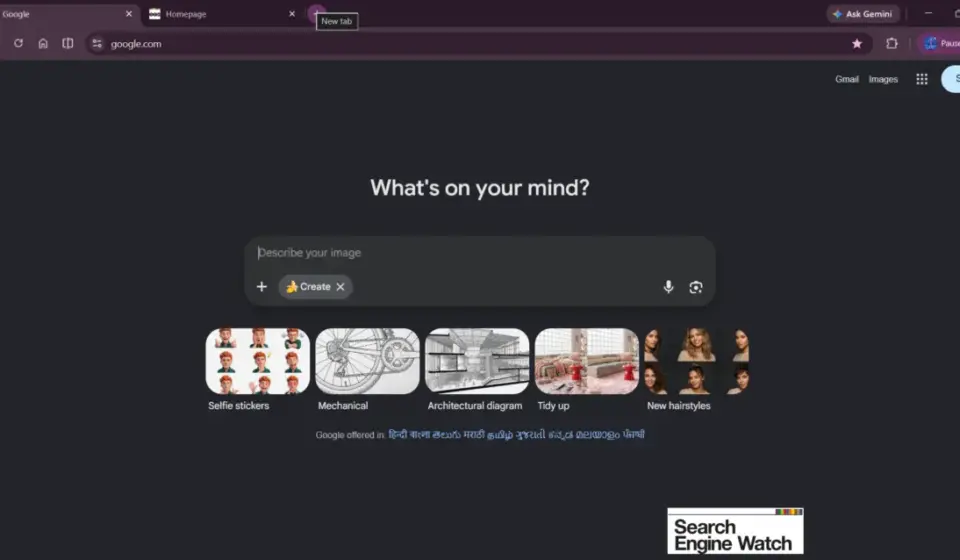
The Death of the Classic Search Box: Google Tests Radical AI-First Homepage for Signed-Out Users

Executive Overview
For nearly three decades, the Google homepage has stood as the ultimate monument to digital minimalism. A vast expanse of white, a multicolored logo, a single input field, and two iconic buttons—"Google Search" and "I’m Feeling Lucky"—defined the gateway to the global internet. However, a quiet but revolutionary shift is underway. In an experimental update spotted in August 2026, Google has begun testing an AI-first homepage that fundamentally alters this classic layout, removing the legendary "Google Search" button entirely for unauthenticated (signed-out) users.
In its place, Google is introducing a suite of dynamic generative AI controls: Create images, Ask about files, and Brainstorm. Furthermore, a dedicated AI Mode toggle has been integrated directly into the search input field. This paradigm shift signals more than just a cosmetic facelift; it represents a defensive and offensive pivot by Alphabet Inc. to capture casual, unauthenticated traffic and counter the rising threat of conversational search engines. By offering advanced capabilities like file-parsing and brainstorming without requiring a Google Account, the tech giant is lowering the friction of AI adoption to historic lows.
Detailed Chronology & Feature Breakdown
The experimental homepage was first detected on August 10, 2026, by industry observers monitoring Google’s unauthenticated search environments. The layout was observed across multiple web browsers in their stable, public releases, including Google Chrome, Microsoft Edge, and Comet—the proprietary browser developed by conversational search competitor Perplexity.

The appearance of this interface across diverse browsers indicates a broad, server-side A/B bucket test targeting specific user-agent configurations and regional IP addresses rather than a browser-specific feature or extension.
+-------------------------------------------------------------+
|                           Google                            |
|                                                             |
|   +------------------------------------------+ [AI Mode]    |
|   |  Search or ask anything...               |   Button     |
|   +------------------------------------------+              |
|                                                             |
|    [Create images]   [Ask about files]   [Brainstorm]       |
|                                                             |
|                    [I'm Feeling Lucky]                      |
+-------------------------------------------------------------+
The Anatomy of the AI-First Homepage
When an unauthenticated user lands on this experimental version of google.com, the visual and functional departures from the classic experience are immediately apparent:
- The Disappearance of "Google Search": The primary execution button that has anchored the web since 1997 has been removed. Its absence shifts the user’s cognitive model from keyword querying to task-oriented AI prompting.
- The AI Mode Toggle: Inside the search bar itself, a new "AI Mode" button resides on the right-hand side. Activating this toggle shifts the search engine’s backend processing from standard index retrieval to a generative, conversational model.
- The "Ask about files" Portal (+ Button): Clicking this shortcut reveals a "+" icon within the search box. This allows users to drag and drop or upload local files (such as PDFs, spreadsheets, or text documents) directly onto the homepage. In testing, users could upload documents and execute complex queries against them—such as summarization or data extraction—completely anonymously, without logging into a Google Account.
- The "Brainstorm" Utility: This button triggers a conversational interface designed for ideation, planning, and creative writing. Like the file utility, this feature operates fully in a signed-out state, bypassing the typical authentication walls that govern Google’s Gemini platform.
- The "Create images" Gate: While the shortcut is prominently displayed alongside the other two utilities under the search bar, it behaves differently. Clicking "Create images" prompts a redirect or a modal overlay requiring the user to sign in to a Google Account. This gate is likely maintained to prevent anonymous abuse of image generation APIs, enforce content moderation guidelines, and track potential deepfake generation back to verified accounts.
- The Survival of "I’m Feeling Lucky": Interestingly, while the classic search button was axed, the "I’m Feeling Lucky" button remains. This retention serves as both a nostalgic nod and a quick-access vector for direct navigation, contrasting sharply with the highly structured AI options surrounding it.
The Authentication Paradox
One of the most notable aspects of this test is its behavior upon user authentication. When a user signs into a Google Account, the three AI-focused buttons disappear, and the homepage reverts to its traditional, classic layout.

This selective deployment suggests that Google is using the AI-first homepage as a highly strategic acquisition funnel. By showcasing high-value, friction-free utilities to anonymous visitors, Google can demonstrate its AI capabilities immediately, later leveraging more advanced features (like image generation or personalized history) to incentivize account creation.
Supporting Context & Industry Metrics
To understand why Google is willing to alter the most valuable real estate on the internet, one must examine the broader competitive landscape of search in 2026.
The Rise of the "Zero-Click" and Conversational Threat
For years, Google has faced criticism and legal scrutiny over "zero-click" searches—queries where users find their answers directly on the Search Engine Results Page (SERP) without clicking through to publisher websites. However, the threat has evolved. Startups like Perplexity AI, alongside OpenAI’s SearchGPT and Microsoft Copilot, have popularized a search model that bypasses the classic list of blue links entirely.

According to industry data, conversational search queries have grown exponentially over the last 24 months. Users—particularly younger demographics—increasingly expect answers to be synthesized, compared, and formatted on demand. By embedding features like "Brainstorm" and "Ask about files" directly on its front page, Google is attempting to normalize these workflows within its own ecosystem before users build habits on competing platforms.
| Feature Comparison | Google Classic Homepage | Google Experimental AI Homepage (Signed-Out) | Perplexity / SearchGPT |
|---|---|---|---|
| Primary Interaction | Keyword Search | Conversational / Task-Based | Conversational Prompting |
| Authentication Required? | No | No (Except for Image Generation) | No (Basic) / Yes (Advanced) |
| File Parsing (RAG) | No | Yes (via "Ask about files") | Yes |
| Direct Image Generation | No | Yes (Requires Sign-In) | Yes |
| Ad-Supported Layout | Yes (on SERP) | Minimal / To Be Determined | Subscription / Sponsored Models |
The High Cost of Anonymous Compute
Processing generative AI queries is orders of magnitude more expensive than executing standard index lookups. Traditional search relies on highly optimized database queries, whereas generative models require massive GPU clusters to process transformer layers for every single token generated.
Offering "Ask about files" (which utilizes Retrieval-Augmented Generation, or RAG) and "Brainstorming" to anonymous, signed-out users represents a massive financial commitment by Google. It signals that the company is willing to absorb significant computational overhead to defend its market share and prevent user migration to rival platforms.

Official Position & Testing Frameworks
As is standard with Google’s user interface experiments, the company has not issued a formal press release or public documentation detailing the mechanics of this specific homepage variation. Historically, Google conducts thousands of simultaneous A/B tests (often referred to as "canary" testing or "live traffic experiments") to measure user engagement, click-through rates, and task completion times.
Technically, these tests are managed via server-side flags. When a user requests google.com, Google’s load balancers evaluate the request’s metadata—including IP address, geographic location, device type, cookie state, and browser user-agent. If the request matches the target criteria for the test cohort and lacks an active session cookie (indicating a signed-out state), the server delivers the alternative HTML and Javascript package containing the AI-first interface.
This silent rollout strategy allows Google to gather objective, real-world data on how everyday users interact with AI tools when they are presented as default options. If the data shows a significant lift in user retention and a reduction in bounce rates to competitor sites, elements of this layout could soon transition from a temporary experiment to the global standard.

Future Outlook: The End of Search as We Know It?
The testing of an AI-first homepage marks a critical milestone in the evolution of the web. For decades, the internet was structured around directories and indexes; Google was the librarian pointing users toward external sources. By positioning itself as a direct creator of images, a synthesizer of personal files, and a collaborative brainstorming partner right on its landing page, Google is signaling its transition from a search engine to an execution engine.
Implications for the Web Ecosystem
This transition carries profound implications for the open web:
- Publisher Traffic Erosion: If users can upload documents, brainstorm ideas, and get direct answers on the homepage without ever seeing a traditional SERP, referral traffic to independent websites, blogs, and news outlets could experience unprecedented declines.
- The Shift in Search Engine Optimization (SEO): SEO professionals will need to pivot from optimizing for keywords and click-through rates to optimizing for LLM training datasets and real-time API integrations. "Generative Engine Optimization" (GEO) will become the dominant paradigm.
- Monetization Redesign: Google’s multi-billion-dollar advertising empire is built on the auction of keywords displayed alongside search results. An AI-first homepage that resolves queries instantly bypasses traditional ad units. Google will need to pioneer new monetization vectors, such as sponsored references within AI answers or premium subscription tiers for advanced computational tasks.
Ultimately, whether this specific design becomes permanent or undergoes further iteration, the direction of travel is clear. The era of the simple, passive search box is drawing to a close. In its place, the gateway to the internet is becoming an active, intelligent workspace—one where the user no longer just searches for information, but actively collaborates with it from the very first click.