In an era defined by rapid technological disruptions, budgetary contractions, and widespread corporate restructuring, the tech and design sectors are experiencing an existential crisis regarding their own identity. Practitioners, design leaders, and strategists have increasingly begun to question whether the foundational terminology that built the industry—specifically terms like "UX" (User Experience) and "user experience design"—still adequately serve the profession. Amid layoffs and heightened pressures to empirically prove the value of user-centric work, debates have swirled over whether adopting a fresh label might better articulate the discipline’s relevance, business impact, and strategic evolution.
To cut through the speculation and unearth how professionals genuinely view their own ecosystem, a comprehensive global survey was conducted. The study gathered insights from 604 tech and design professionals worldwide to see what terminology they would organically use when describing the core tenets of user experience work.
The findings offer a definitive, albeit sobering, reality check for the design community: "UX" remains firmly entrenched as the default, overarching name for the field.
While alternative labels—such as "product design," "experience strategy," "service design," and "human-centered design"—frequently circulate in executive boardrooms and job descriptions, they remain heavily fragmented. No single challenger has captured the collective imagination or unseated UX as the universal shorthand for human-centered digital craftsmanship. Approximately 70% of survey respondents naturally integrated UX-associated terminology into their definitions, leaving competing labels trailing far behind.
This deep-dive investigation explores the historical context of the industry’s nomenclature, breaks down the empirical data from the study, analyzes how distinct job roles shape our vocabulary, and outlines actionable strategies for design leaders navigating this identity landscape.
Detailed Chronology: The Evolution of UX Terminology
To understand why the design community is experiencing a crisis of nomenclature today, it is essential to trace how the vocabulary of the field has morphed over the past few decades. The shifting terminology has been driven by a combination of genuine expansions in the scope of digital work and what industry analysts term "vocabulary inflation"—the continuous rebranding of standard practices to sound fresher, more strategic, or more executive-friendly.
1. The Era of Usability and Early Efficiency
In the earliest days of interactive digital systems and software development, the discipline was broadly discussed under the banner of "usability." Rooted deeply in human factors and ergonomics, usability focused primarily on functional mechanics: Can a human being use this system effectively, efficiently, and with reasonable satisfaction? It was an evaluative, task-oriented discipline centered on reducing friction and errors.
2. The Shift to Human- and User-Centered Design
As digital products grew more complex, the industry recognized that evaluating a system after it was built was insufficient. This realization birthed "user-centered design" (UCD) and, subsequently, "human-centered design" (HCD). These terms described a holistic methodology: grounding every design decision in a deep, empathetic understanding of users’ needs, workflows, physical environments, and contexts through iterative research, prototyping, and evaluation.
3. The Rise of "User Experience" (UX)
Eventually, the scope broadened further to encompass not just task completion and task efficiency, but the entire emotional and cognitive journey a person undergoes when interacting with a product, service, or organization. Enter "user experience" (UX). Coined to capture perceptions, emotional responses, and holistic interactions, UX quickly became the dominant descriptor. Concurrently, marketing and customer service professionals popularized "customer experience" (CX)—a parallel term that often overlaps with UX despite having distinct organizational origins.
4. The Proliferation of Modern Umbrellas
In recent years, organizations seeking to streamline internal structures have increasingly adopted "design" or "experience design" as expansive umbrella terms. These broader labels are often deployed to signal that a team’s scope extends far beyond individual user interfaces or isolated software screens. Yet, rather than systematically replacing one another, these historical terms have simply piled on top of each other, creating a dense, ambiguous, and overlapping lexicon where practitioners across different departments use entirely different words to describe the exact same daily work.
Supporting Context & Metrics: How the Study Uncovered the Truth
To move past anecdotal arguments and social media echo chambers about what the industry should be called, researchers undertook a targeted investigation in April 2026. Utilizing professional panels, digital newsletters, and social channels, 604 tech and design practitioners worldwide were surveyed to evaluate their unprompted perceptions of the field.
The Indirect Research Methodology
A critical flaw in standard industry surveys is that asking a direct question—such as "What terms do you use to define our field?"—inevitably triggers recency bias and buzzword pollution. Participants tend to parrot whatever trendy label is currently dominating LinkedIn discourse rather than revealing their true mental models.
To bypass this behavioral bias, the survey employed an indirect evaluation method. Participants were presented with an objective, plain-language definition of the core work performed by the profession, completely devoid of any buzzwords:
"An individual gathers insights about people’s needs and experiences and turns those insights into recommendations for how a product or service should be planned, built, and improved."
Participants were then instructed to name the single professional field or discipline that best described this work. By analyzing the raw, unprompted responses, researchers could map out the exact vocabulary that naturally surfaced in the minds of tech and design practitioners.
Key Quantitative Findings
When the data was tallied and standardized, the dominance of the legacy term was undeniable:
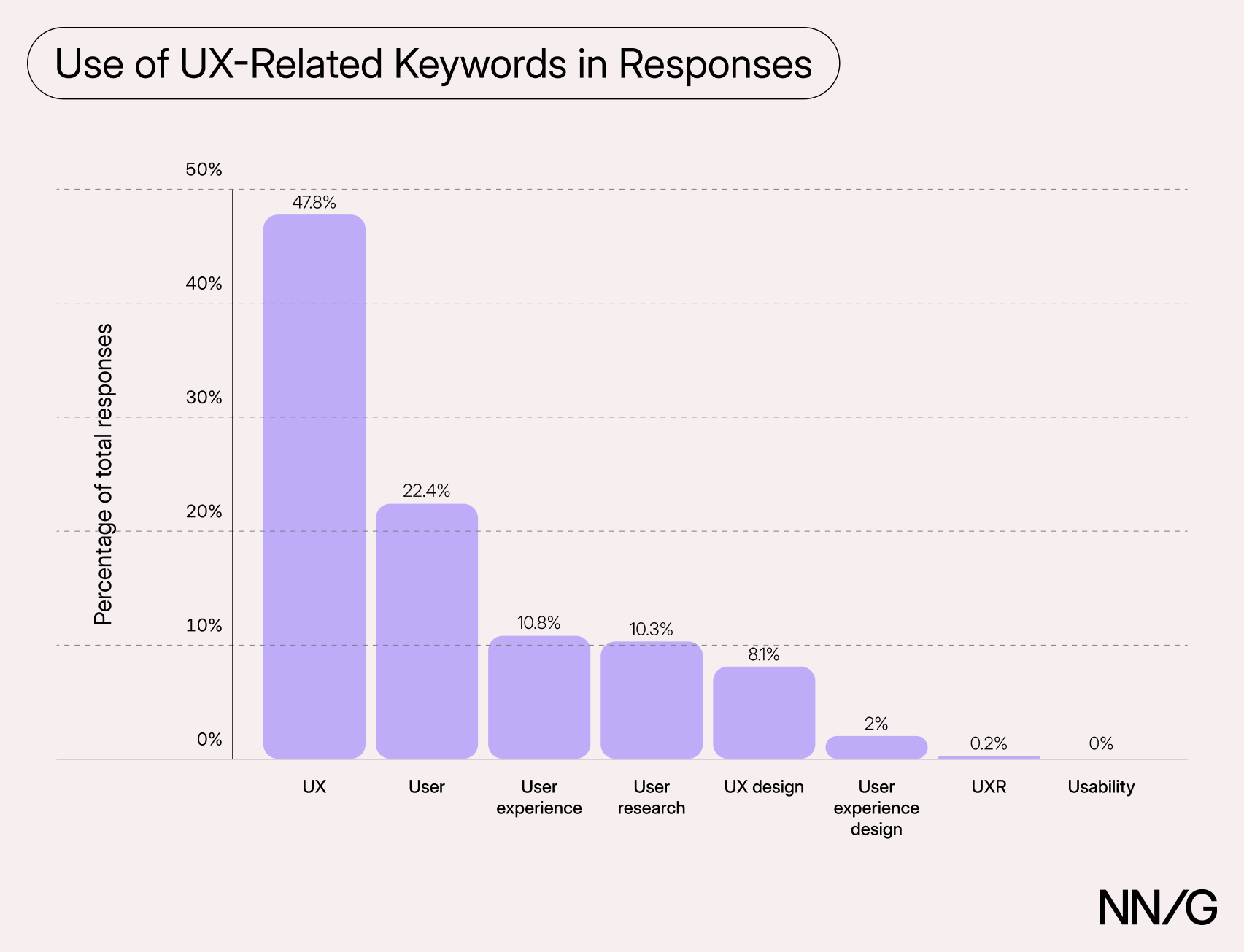
UX Leads Universally: The acronym "UX" was the single most common label, appearing explicitly in 47.8% of all responses.
The 70% Threshold: In total, 70% of all participants incorporated terminology directly associated with UX in their answers. This includes "UX" (47.8%), "user" (22.4%), and "user experience" (10.8%).
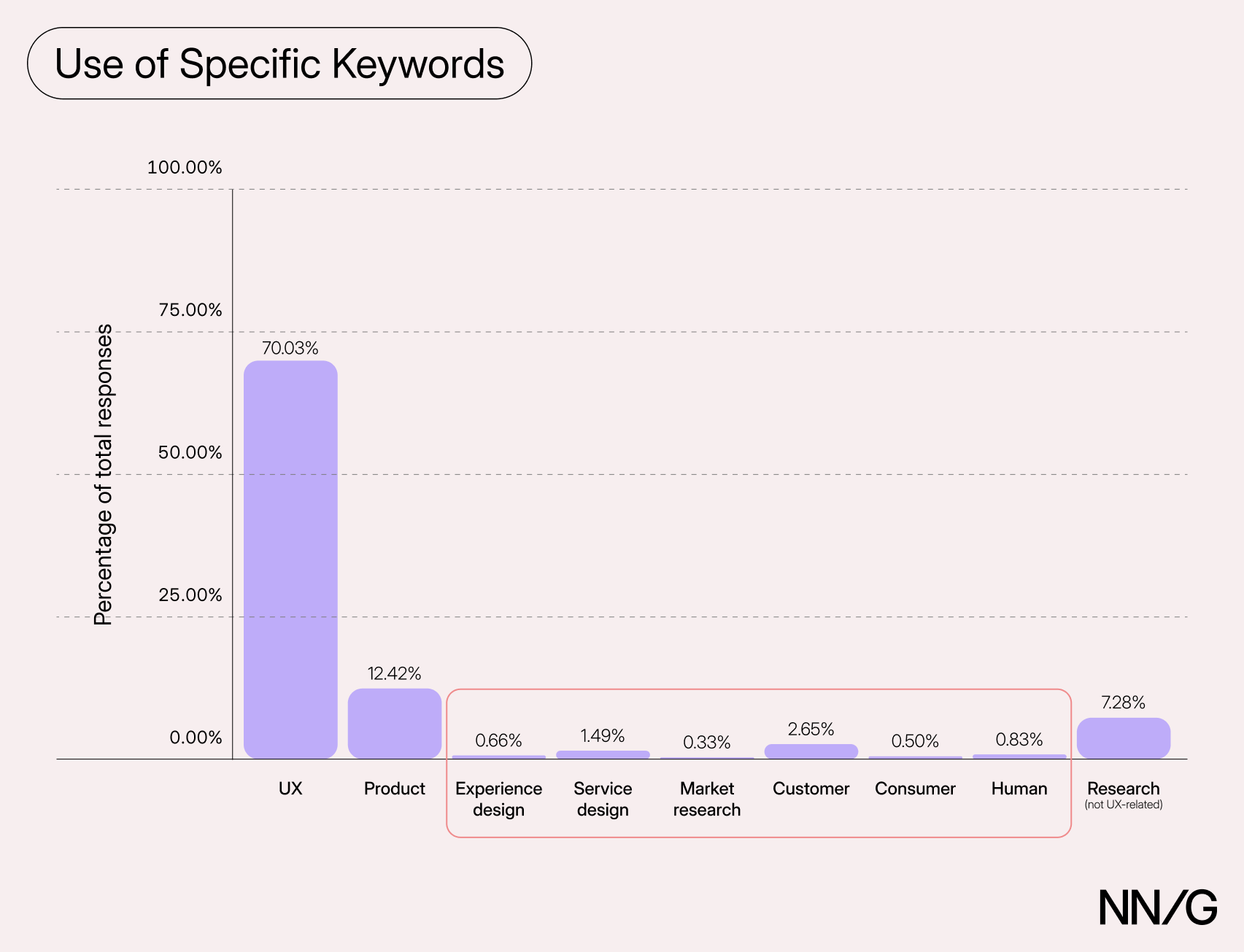
The Fragmented Alternatives: No competing umbrella term came close. Alternative labels were heavily fractured across dozens of niche categories, with fewer than 1% of respondents spontaneously utilizing terms like "experience design" or "human-centered design" in isolation without UX anchors.
[Use of Specific Keywords in Survey Responses]
------------------------------------------------------------
UX-Related Keywords (UX, User, User Experience): 70.03%
Product-Related Keywords:                        12.42%
Research Keywords (Non-UX):                       7.28%
Experience Design / Human / Customer / Others:    < 3.00% each
------------------------------------------------------------
The Fragmentation of Alternative Labels
For those respondents who deliberately avoided UX terminology, the alternative labels spanned a massive spectrum of corporate jargon, functional specialties, and strategic disciplines. The breadth of these responses underscores just how fragmented the non-UX nomenclature remains:
Business Analysis & Data: Business analysis, data analysis, IT business analysis, requirements gathering.
General Research: Qualitative research, contextual inquiry, discovery research, observational research, research operations.
Official Insights: Job Roles Shape Our Vocabulary
One of the most revealing nuances uncovered during the investigation is that a practitioner’s chosen terminology is rarely accidental; it is heavily dictated by their current job title and organizational positioning.
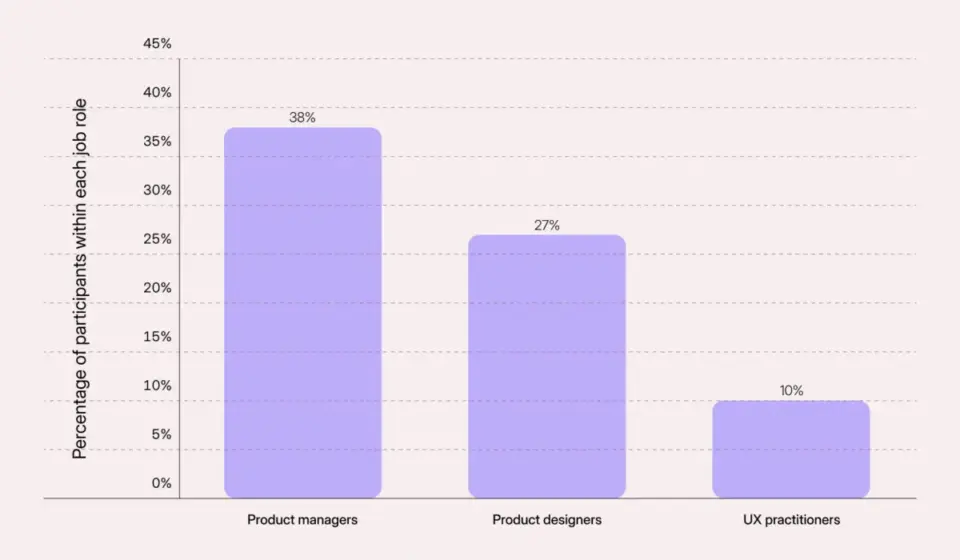
While "product" appeared as a keyword in roughly 12% of overall responses, a deeper segmentation by job role revealed striking disparities:
38% of Product Managers used the term "product" to describe the work.
27% of Product Designers incorporated "product" into their answers.
Only 10% of dedicated UX practitioners relied on the word "product."
This statistical divergence highlights a broader industry trend: as product managers and cross-functional teams increasingly absorb user research and prototyping tasks into their daily workflows, they naturally describe those activities through the lens of their own professional titles.
A similar trend emerged with the term "customer." While only 2.65% of total participants used the word, 18.18% of customer insights professionals utilized it, compared to a negligible 0.50% of UX practitioners. These findings demonstrate that our vocabulary is often a reflection of our organizational silo rather than an objective consensus on the discipline’s true nature.
Future Outlook: Navigating the Identity Crisis
With artificial intelligence accelerating the democratization of user research, lowering the barriers to prototyping, and fueling the resurgence of the "UX generalist," the boundaries of traditional roles will continue to blur. Product managers are running customer interviews; engineers are generating interface layouts with AI assistants; and marketing teams are deep-diving into usability metrics.
Yet, despite these seismic shifts, the empirical data provides a clear directive for the immediate future: Adopting a new overarching umbrella term for the field is neither necessary nor supported by industry consensus.
Renaming the discipline will not magically solve the structural challenges currently facing design teams, such as budget cuts, proving ROI, or earning a seat at the executive table.
Recommendations for UX Leaders
Rather than expending precious energy trying to rebrand the entire profession, UX leaders and practitioners should redirect their focus toward what truly matters: making the tangible value of human-centered work hyper-visible to executive stakeholders.
Tie UX to Business Outcomes: Stop positioning UX as an aesthetic exercise or a collection of isolated design deliverables. Instead, explicitly connect human-centered research and design to the business risks, financial metrics, and strategic goals that stakeholders already care about.
Highlight Risk Mitigation: Demonstrate how early user research and rapid experimentation prevent catastrophic, costly rework down the line, uncover unmet customer demands, and safeguard accessibility compliance.
Embrace Cross-Functional Collaboration: Rather than gatekeeping terminology, lean into the collaborative reality of modern product development. As product managers and engineers adopt elements of design work, UX professionals should act as strategic orchestrators who elevate the quality and empathy of everything the team ships.
Ultimately, while the debate over what to call ourselves will undoubtedly persist at conferences and across digital forums, "UX" remains the most robustly recognized lingua franca of our industry. Practitioners would be far better served by communicating what their work contributes, which critical business decisions it improves, and what costly pitfalls it helps organizations avoid.