

Masterminding the Modern Supply Chain: How E-Commerce Brands Eliminate Peak-Season Inventory Disasters

Executive Overview
For digital retailers, the holiday shopping season—anchored by the economic juggernauts of Black Friday and Cyber Monday (BFCM)—represents both the highest-grossing opportunity of the fiscal year and a ticking time bomb of logistical vulnerability. Selling out of a flagship product is theoretically the hallmark of a successful marketing campaign; however, when your front-end storefront continues to accept orders for inventory that no longer exists in the warehouse, jubilation quickly morphs into an operational nightmare.
The root cause of these high-stress scenarios is rarely a lack of consumer demand. Rather, it is a chronic, systemic failure of inventory synchronization across increasingly fragmented sales ecosystems. Inaccurate stock counts not only result in immediate revenue leakage and high processing costs for refunds, but they also inflict long-term damage on brand equity. Sending an awkward "oversell apology email" to a disappointed shopper during the peak of the holiday shopping cycle can permanently alienate a high-value customer.
As omnichannel retail continues to mature, modern brands can no longer rely on disparate spreadsheets, manual data entry, or siloed platform dashboards. Achieving bulletproof reliability during peak retail windows requires a fundamental shift in architecture: establishing a single, immutable source of truth, rigorously stress-testing SKU pipelines, and deploying robust automated integrations that bridge e-commerce platforms, Enterprise Resource Planning (ERP) systems, Warehouse Management Systems (WMS), Point of Sale (POS) terminals, and third-party marketplaces. This report investigates the structural flaws causing seasonal overselling and details the strategic frameworks and technological solutions high-growth merchants use to safeguard their supply chains.
Detailed Chronology: The Anatomy of a Mid-Year Inventory Audit and Sync Test
Smart e-commerce organizations understand that peak-season preparation does not begin in November; it is an operational discipline that must be executed at least six months in advance. Mid-year inventory audits serve as the critical baseline for holiday readiness. However, an inventory audit is only as valuable as the trustworthiness of the underlying data.
To bridge the gap between static counting and dynamic fulfillment, forward-thinking operations teams are deploying rigorous SKU synchronization tests. This methodology moves beyond traditional physical stock-takes to evaluate how inventory data travels through a digital ecosystem under real-world pressure.

Phase 1: Test Selection and Baseline Recording
The synchronization testing protocol begins well ahead of the holiday rush by selecting three specific Stock Keeping Units (SKUs) to track from initial customer purchase through final fulfillment:
- The Best Seller: A high-velocity product that experiences rapid stock depletion.
- The Low-Stock Item: A product operating near its safety stock threshold, highly susceptible to stockouts.
- The Omnichannel Product: An item listed simultaneously across the brand’s primary e-commerce website, physical retail locations, and external marketplaces.
Before injecting test orders into the system, auditors record the precise available inventory levels reported across every connected node: the core e-commerce platform (such as WooCommerce), physical POS registers, backend ERP/WMS databases, and external marketplace dashboards.
Phase 2: Controlled Order Injection and Latency Measurement
The next phase involves placing controlled, test transactions across every major sales channel. Auditors meticulously document:
- The exact timestamp of purchase initiation.
- The specific transactional event that triggers a decrement in inventory (e.g., order placement, payment gateway authorization, fulfillment initiation, or a custom status change).
- The precise latency window required for the updated inventory quantity to propagate across every connected system.
This step uncovers the hidden dangers of operational lag. For example, if a primary e-commerce website updates stock levels instantaneously upon order placement, but a third-party marketplace API feed requires a multi-hour batch update, that operational window becomes an invitation for devastating oversells. If any link in this chain still relies on manual data handoffs, spreadsheets, or internal messaging apps, it must be meticulously documented, assigned an accountable owner, and prioritized for automation.
Phase 3: Reverse-Flow Validation and Complex Workflows
A comprehensive sync test cannot stop at outbound orders; it must also validate the reverse inventory lifecycle. Auditors process simulated cancellations and refunds to confirm that stock quantities are automatically restored across all connected channels. Furthermore, organizations that support advanced commerce features—such as backorders, product bundles, or partial fulfillments—must subject these complex workflows to the same rigorous stress testing. Ultimately, the ERP, WMS, or dedicated inventory platform must emerge as the undisputed single source of truth, with all peripheral systems configured to read from it or dispatch instant inventory-changing events back to it.

Supporting Context & Metrics: The Cost of Disconnected Ecosystems
The multiplication of sales channels—social commerce, live shopping, mobile marketplaces, and physical pop-ups—has exponentially increased the surface area for inventory discrepancies. When an e-commerce website operates in a vacuum, completely blind to inventory movements occurring on Amazon, Walmart, or a brick-and-mortar flagship store, a holiday inventory disaster is practically guaranteed.
Industry analyses consistently highlight that supply chain friction and stockouts cost global retailers hundreds of billions of dollars annually in lost sales and diminished customer lifetime value. Furthermore, the modern consumer’s tolerance for fulfillment errors is near zero. Modern digital natives expect real-time stock visibility, lightning-fast shipping, and frictionless returns.
The Technical Mechanics of Integration
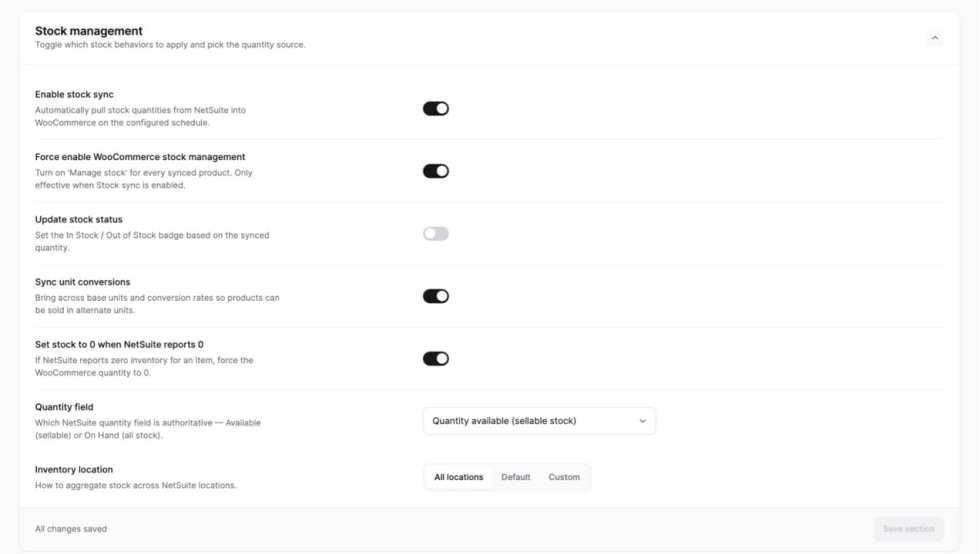
While platforms like WooCommerce should rarely act as the master inventory ledger for large-scale, multi-channel enterprises, they remain vital operational hubs. WooCommerce acts as a high-performance storefront that continuously exchanges order, product, and stock data with the heavier backend systems holding the full inventory picture.
To prevent systemic failures, merchants utilize native APIs, webhooks, and enterprise-grade integrations. A prime example is the deployment of robust ERP connectors, such as the NetSuite Integration for WooCommerce. By establishing bidirectional synchronization, the ERP maintains absolute authority over inventory metrics—updated as frequently as every hour—while seamlessly ingesting website orders and transmitting accurate, real-time stock levels back to the storefront.
[Customer Channels]
  ├── WooCommerce Storefront ──┐
  ├── Brick-and-Mortar (POS) ──┼──> [Centralized ERP / WMS] <──> [Single Source of Truth]
  ├── Amazon / Walmart / TikTok ┘         (e.g., NetSuite / Brightpearl)
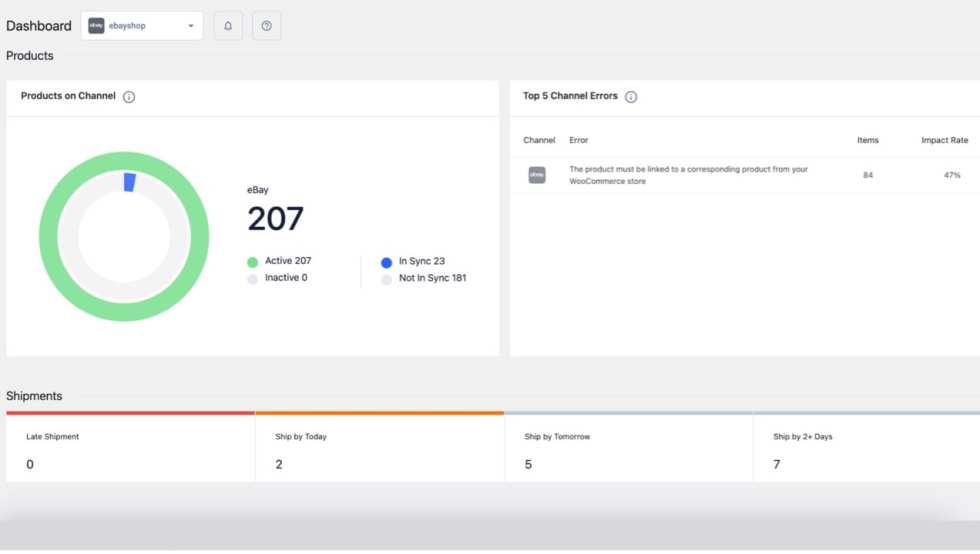
For omnichannel brands operating physical retail spaces alongside digital storefronts, solutions like Square for WooCommerce ensure that walk-in traffic and online checkout carts draw from the exact same pool of physical inventory. Similarly, multichannel aggregation tools—such as M2E Multichannel Connect and Multichannel for WooCommerce—empower brands to distribute accurate stock updates and ingest orders effortlessly from diverse ecosystems, encompassing traditional giants like Amazon, eBay, and Walmart, alongside modern social commerce powerhouses like TikTok Shop and Temu.
Official Statements & Case Studies: Real-World Resilience
The theoretical advantages of unified inventory management are best understood through the operational triumphs of brands that have successfully scaled their omnichannel capabilities using flexible, open-source infrastructures.
Scratch Pet Food: Automating Warehouse Fulfillment from Day One
For Australia-based Scratch Pet Food, building a resilient operational foundation was a priority established at company inception. Recognizing that manual data entry and human intervention introduce friction and delay, the founders engineered a tightly coupled fulfillment pipeline connecting their WooCommerce platform directly to their local manufacturing and warehousing partners.
"An order comes in and we don’t touch a thing. We have a manufacturer who makes the food to our recipe, orders get sent straight to the warehouse, and they ship it."
— Mike Halligan, Cofounder, Scratch
By choosing local fulfillment partners equipped to integrate directly with their e-commerce architecture and tracking systems, Scratch eliminated the risk of human error. This automated alignment ensures that as subscription renewals process and new customer orders roll in, inventory registers adjust instantaneously without manual intervention, allowing the brand to scale rapidly without proportional increases in administrative overhead.
Dan-O’س Seasoning: Surviving Viral Spikes via Omnichannel Integration
Dan-O’s Seasoning enjoys massive retail distribution across more than 40,000 brick-and-mortar storefronts, including national giants like Walmart and Kroger. Simultaneously, the brand maintains a booming direct-to-consumer (DTC) digital presence powered by WooCommerce, capitalizing heavily on social commerce and viral video marketing campaigns.
When a single promotional video featuring the brand’s founder generated over four million views on TikTok, Dan-O’s experienced an instantaneous, massive surge in digital order volume. For many brands, such sudden surges overwhelm manual fulfillment teams and break disconnected inventory feeds. However, Dan-O’s successfully weathered the surge by channeling all online transactions—spanning their WooCommerce store, Amazon, Walmart, and social channels—directly into Brightpearl, their centralized inventory management system. Brightpearl maintains the master inventory picture and synchronizes order data back to WooCommerce in real time.
"WooCommerce allowed us to go from something as simple as we needed in the beginning to a full-size, customizable site. It gave us the flexibility that we wouldn’t get with Shopify or another platform."
— Ryan Fertig, Senior Marketing Activation Director, Dan-O’s Seasoning
This unified tech stack shields Dan-O’s from the administrative chaos of channel-by-channel reconciliation, allowing their marketing and logistics teams to focus on growth rather than damage control.
Future Outlook: The Imperative of Proactive Architecture
As e-commerce continues its rapid evolution toward hyper-personalized, multi-touch shopping experiences, the complexity of inventory management will only intensify. Future-proof retail strategies demand that merchants transition from reactive problem-solving to proactive architectural design.
Before the next major holiday shopping season accelerates order volumes, executive leadership teams must conduct exhaustive operational audits of their entire technology stack:

- Identify the Master Ledger: Does every stakeholder within your organization know definitively which system holds your true available inventory?
- Validate Automation Pipelines: When an item is purchased on a secondary marketplace, do all other channels update automatically, or is an employee manually transferring data across spreadsheets?
- Establish Circuit Breakers: If an API feed fails or a warehouse synchronization stalls, does your system alert your technical team immediately, or do you only discover the failure when frustrated customers begin filing complaints about unfulfilled orders?
By tracing high-velocity SKUs through every node of your operational ecosystem today, you expose hidden structural gaps long before peak shopping traffic arrives. Investing in robust APIs, automated bidirectional syncing, and flexible open-source frameworks like WooCommerce ensures that your team can trade late-night panic for holiday peace of mind—transforming your supply chain from a potential liability into your most reliable competitive advantage.