
Engineering the Adaptable Future: Android’s Developer Response to Samsung’s Galaxy Unpacked 2026

Executive Overview
The landscape of modern mobile computing underwent a definitive transformation on July 22, 2026. At the latest Galaxy Unpacked event, Samsung unveiled its next-generation hardware ecosystem, headlined by groundbreaking foldable devices—most notably the landscape-first, ultra-wide Galaxy Z Fold8—alongside advanced wearables running Wear OS 7. For the Android developer community, this launch represents both an extraordinary design opportunity and an immediate architectural challenge.
With screen geometries, aspect ratios, and device postures diversifying faster than ever, the era of hardcoded UI layouts has officially drawn to a close. Users unfolding a landscape-first foldable, flipping open a compact cover screen, or glancing at a wrist-worn widget now expect seamless, fluid continuity.
To bridge the gap between ambitious hardware and application software, Android Developer Experience leads Fahd Imtiaz and Miguel Montemayor have released a robust suite of actionable guidance, migration tools, and architectural paradigms. This article provides an authoritative, deep-dive examination into the developer tooling announced in the wake of Galaxy Unpacked 2026. We will explore how engineers can leverage responsive UI frameworks, CameraX enhancements, Wear OS 7 glanceable widgets, and Gemini Nano 4 on-device artificial intelligence to build truly adaptive applications for the next generation of computing.
Detailed Chronology: The Evolution of Form Factors at Galaxy Unpacked 2026
The trajectory of mobile engineering has always been dictated by hardware innovation. Over the past half-decade, the industry has migrated from rigid slate devices to flexible, multi-state foldable displays. However, the unveiling of the Galaxy Z Fold8 at the July 2026 Galaxy Unpacked event marks a sharp pivot in design philosophy.
The Paradigm Shift of Landscape-First Devices
Historically, foldable devices utilized a portrait-first natural orientation when closed, expanding into a near-square or portrait-oriented tablet state when unfolded. Applications were primarily engineered to handle vertical stretching and simple multi-window splits.
The Galaxy Z Fold8 shatters these historical assumptions. Featuring a natural landscape-first orientation and a radically wider aspect ratio in its primary display state, the device behaves fundamentally differently from its predecessors. When a user transitions from the outer cover screen to the expansive inner canvas, the spatial dynamics invert. Applications that rely on legacy assumptions regarding screen width versus height immediately suffer from clipping, awkward whitespace, or distorted user flows.
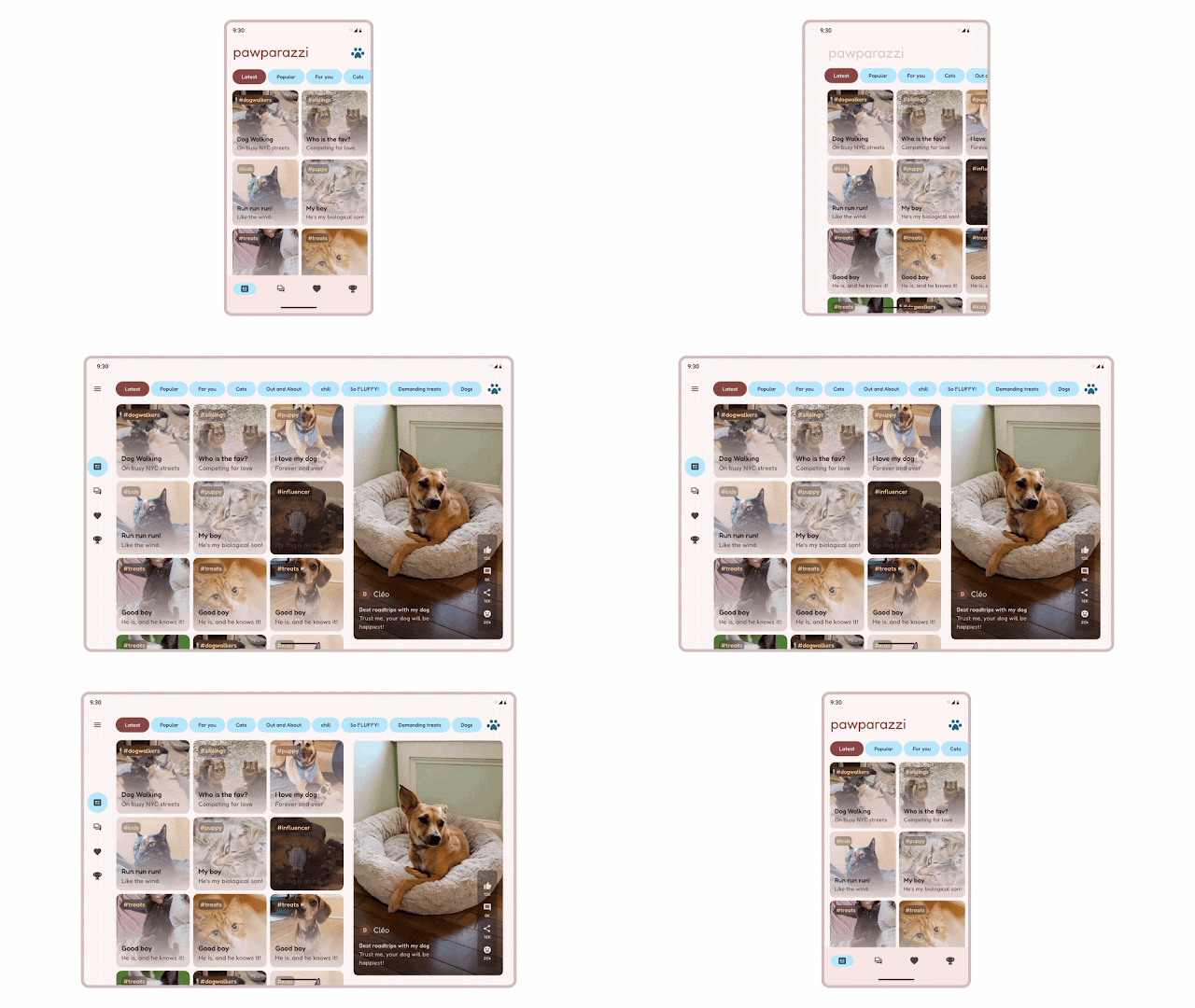
Recognizing this critical friction point, the Android developer relations team rolled out comprehensive architectural guidance specifically tailored for landscape foldables and multi-fold trifolds. The chronological rollout of these developer resources emphasizes a proactive shift: moving away from reactive scaling and toward intrinsically fluid, responsive design frameworks.
.png)
The Wear OS 7 and On-Device AI Timeline
Simultaneously, the 2026 Unpacked showcase brought wearables back to the forefront with the introduction of Wear OS 7. The timeline for wearable app development accelerated dramatically with the introduction of Wear Widgets, moving away from isolated notifications toward rich, glanceable multi-widget tiles.
Parallel to these UI developments, the integration of on-device intelligence reached a milestone with Samsung’s adoption of Gemini Nano 4. Providing localized, multimodal understanding across more than 140 languages, Nano 4 transitioned from a cloud-tethered novelty to a core, on-device utility accessible via updated ML Kit Prompt APIs.
Supporting Context & Metrics: Why Adaptive Architecture is Non-Negotiable
The urgency behind Android’s 2026 developer push is rooted in shifting consumer expectations and hardware diversification metrics. Market analysis consistently indicates that foldable phone adoption has transitioned from an early-adopter novelty into a mainstream product category.
Breaking Hardcoded Assumptions
When developers hardcode layout dimensions—such as assuming a minimum portrait width of 400dp or a fixed 16:9 media playback ratio—they alienate a rapidly growing demographic of users. On a landscape-first ultra-wide foldable like the Galaxy Z Fold8, a hardcoded portrait layout forces applications into cramped letterboxed columns, wasting valuable screen real estate and degrading the user experience.
To combat this, the modern Android UI stack emphasizes three foundational pillars:
- Window Size Classes: Utilizing Jetpack WindowManager to categorize application windows into compact, medium, and expanded buckets, allowing layouts to reflow dynamically rather than breaking at arbitrary pixel thresholds.
- Canonical Layouts: Adopting proven design patterns such as List-Detail views, supporting panes, and feeding interfaces that naturally adapt whether the device is held in portrait, landscape, tabletop posture, or fully unfolded.
- Flexible Navigation: Ensuring that navigation rails, bottom bars, and drawer components transform seamlessly based on available horizontal and vertical real estate.
Media Pipelines and Camera Portability Metrics
Hardware evolution introduces severe edge cases in media capture. Historically, camera implementations assumed a fixed relationship between the camera sensor’s native orientation and the device’s portrait frame.
On foldables, as a user moves from a compact outer display to an expanded inner canvas, the aspect ratio of the active viewfinder changes drastically while the physical sensor orientation remains constant. Without intervention, this results in stretched, rotated, or severely cropped camera feeds.

Addressing this metric-driven pain point required a fundamental overhaul of how Android handles media streams. By migrating legacy codebases to CameraX, developers leverage the built-in PreviewView, which automatically orchestrates sensor orientation, device rotation, and scaling transformations behind the scenes. For engineering teams maintaining legacy Camera2 codebases, the introduction of the CameraViewfinder library provides a drop-in solution to apply these complex matrix transformations without necessitating a complete rewrite of their underlying architecture.
Official Statements and Technical Insights
The release of these developer tools was accompanied by deep technical documentation and guidance from Android engineering leadership.
"Building for the latest foldables means dropping assumptions about display orientation and size," noted Fahd Imtiaz, Senior Product Manager for Android Developer Experience. "Devices with this landscape-first natural orientation show the limitations of hardcoded layout rules when users unfold the device. Whether a user is unfolding a large display, flipping open a cover screen, or glancing at their wrist, they expect a flawless experience. We are providing the tooling to enable developers to build adaptively proactively."
Miguel Montemayor, Developer Relations Engineer, emphasized the integration of media and wearable frameworks:
"Our goal is to abstract away the complex hardware quirks of modern foldable sensors and multi-state displays. By utilizing CameraX and CameraViewfinder, engineers can protect their media pipelines against rotation and aspect ratio shifts effortlessly. Furthermore, with Wear OS 7 and Jetpack Glance, developers can extend their app surfaces straight to the wrist with unprecedented expressive power."
Unleashing Wear OS 7 and Jetpack Glance
Wear OS 7 introduces a paradigm shift in how users interact with wrist-based devices. Previously, rich, multi-widget tiles were restricted to first-party system applications. With the latest updates to Jetpack Glance and RemoteCompose, third-party developers can now populate these coveted multi-widget tiles.
This capability allows applications to deliver instant, glanceable interactions—such as fitness metrics, smart home controls, and live travel updates—directly to the watch face without forcing the user to open a full application. The underlying reactive programming model of Jetpack Glance ensures that these widgets update efficiently, preserving battery life while maximizing visual fidelity.

Intelligent Features with Gemini Nano 4 and ML Kit
Artificial intelligence is no longer an isolated cloud feature; it is an on-device utility. Samsung’s integration of Gemini Nano 4 into its 2026 hardware lineup unlocks powerful capabilities directly on the local silicon, ensuring low latency and robust user privacy.
Developers can experiment with these capabilities using ML Kit’s updated Prompt API. Key features include:
- Structured Output: Ensuring that LLM responses return in predictable, parseable data formats (such as JSON) directly usable by application logic.
- Thinking Mode: Allowing the on-device model to process complex reasoning tasks transparently before rendering a final output to the user.
- Multimodal Understanding & Expanded Localization: Harnessing Nano 4’s enhanced support for over 140 languages and rich contextual comprehension to build intelligent, context-aware applications that anticipate user needs across global markets.
Future Outlook: Unfolding the Next Era of Computing
As the mobile ecosystem matures past the constraints of traditional form factors, the demarcation lines between phones, tablets, foldables, and wearables continue to blur. The announcements at Galaxy Unpacked 2026 signal a clear industry trajectory: software must become as malleable and dynamic as the hardware it inhabits.
For developers and engineering organizations, the mandate is clear. Moving forward, application success will not be measured solely by core feature sets, but by fluid adaptability. An app that fails to reflow gracefully across an ultra-wide landscape foldable, or one that neglects glanceable wearable integration, risks feeling obsolete in an ecosystem designed for continuous, multi-surface interaction.
Actionable Next Steps for Development Teams
To prepare for this adaptive future, engineering teams should immediately adopt the following roadmap:
- Audit Existing Layouts: Review applications against the latest Jetpack WindowManager guidelines to identify hardcoded UI assumptions and integrate Window Size Classes.
- Modernize Media Pipelines: Migrate camera capture modules to
CameraXor integrate theCameraViewfinderlibrary to eliminate foldable preview distortion bugs. - Extend to the Wrist: Explore Jetpack Glance and RemoteCompose to design rich, multi-widget tiles for Wear OS 7.
- Experiment with On-Device AI: Leverage ML Kit’s Prompt API, structured output, and Gemini Nano 4 to embed intelligent, localized automation directly into app workflows.
- Consult Official Resources: Review the comprehensive adaptive app documentation and developer trifold/landscape guidelines provided by the Android Developer portal.
The hardware of the future is already in users’ hands. By embracing these modern design systems and architectural frameworks, developers can ensure their applications are fully prepared to unfold the future today.