
Shopify’s Q2 2026 Masterclass: How Agentic Commerce and Structured Data Ignited an 18% Stock Surge

Executive Overview
In a single trading session following its Q2 2026 earnings release, Shopify saw its stock skyrocket by roughly 18%, effectively erasing the majority of a 25% year-to-date decline. This isn’t merely a rebound fueled by cyclical optimism or a temporary correction in software multiples. Instead, it marks a pivotal moment in the evolution of digital commerce: proof positive that generative artificial intelligence and agentic workflows are not terminal threats to e-commerce infrastructure, but rather massive growth accelerators.
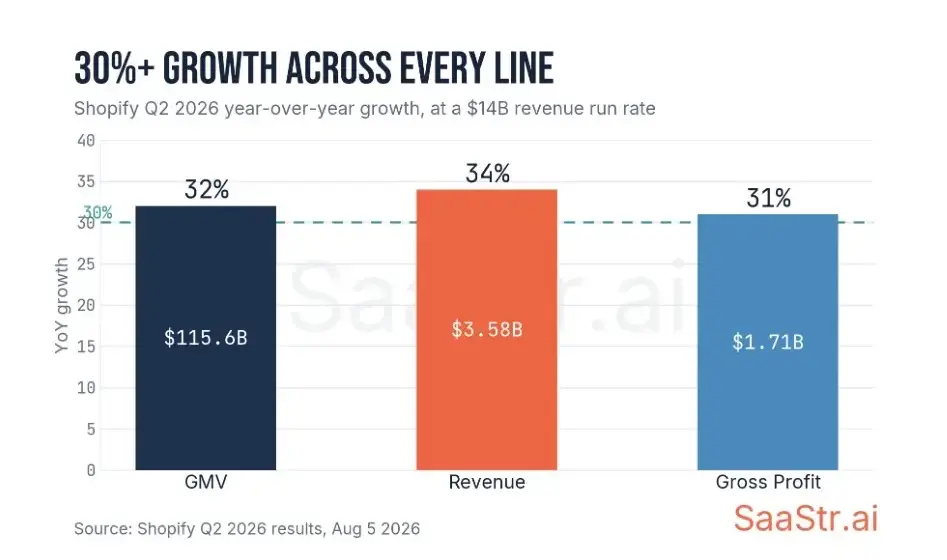
Operating at a staggering $14 billion annualized revenue run rate, Shopify posted a phenomenal 34% year-over-year revenue growth rate, alongside $116 billion in merchant sales (Gross Merchandise Volume, or GMV)—up 32% year-over-year. What makes these headline numbers extraordinary is the simultaneous expansion of its free cash flow margins to 18%, yielding $654 million in free cash flow for the quarter.
Far from being disrupted by autonomous AI shopping agents, Shopify has firmly entrenched itself as the bedrock infrastructure layer for agentic commerce. By meticulously building out structured product catalogs over the last decade, the company has transformed itself into the essential querying layer for AI-driven buyers. This deep dive analyzes the five critical takeaways from Shopify’s watershed Q2 2026 performance, examining how structural data advantages, shifting monetization models, and disciplined operational leverage are reshaping the future of global commerce.
Detailed Chronology and Headline Metrics
The road to Shopify’s Q2 2026 blockbuster earnings was paved with strategic pivots, painful restructuring decisions made years prior, and a relentless focus on merchant success over software aesthetics.
During the earnings call, President Harley Finkelstein characterized the period as a "monster quarter," highlighting a rare trifecta in modern technology and retail:
- Gross Merchandise Volume (GMV): $116 billion, marking a 32% year-over-year increase and representing the fifth consecutive quarter of greater than 30% GMV growth.
- Total Revenue: $3.6 billion, up 34% year-over-year.
- Free Cash Flow: $654 million, translating to an 18% free cash flow margin.
To understand the sheer scale of this execution, one must look at the historical context. Companies operating at a $14 billion revenue run rate rarely post growth metrics north of 30%. When they do, they typically sacrifice profitability to chase top-line expansion. Shopify, however, managed to achieve a Rule of 52 score while simultaneously reducing operating expenses as a percentage of revenue and expanding free cash flow.
The market’s immediate 18% valuation adjustment reflects a broader realization among institutional investors: Shopify is no longer just a digital storefront builder. It has successfully evolved into a global transactional utility, monetizing the entire lifecycle of merchant operations—from automated inventory discovery via AI to global payment routing, capital lending, and cross-border logistics.
Supporting Context & Metrics: The Five Pillars of Growth
1. AI Traffic Tripled: The Unseen Power of Structured Data
For months, market pundits have debated whether generative AI tools and conversational search engines would disintermediate e-commerce platforms by routing consumers directly to aggregated products without visiting merchant sites. Shopify’s Q2 data decisively answers this question: AI is driving unprecedented demand generation.
Traffic to Shopify merchant storefronts originating from AI channels tripled year-over-year, while orders stemming from AI searches experienced an identical threefold increase. More importantly, the new-buyer order rate from AI channels ran at twice the rate of traditional search and social channels.
Why are AI shoppers converting into new buyers at double the rate? The answer lies in structured data. Shopify Catalog now maintains over 1 billion products formatted specifically for AI agents to read, parse, and evaluate. AI searches powered by structured catalogs convert at twice the rate of searches reliant on scraped, unstructured web pages. When an AI shopping agent can access real-time inventory, exact pricing, and verified product variants, it recommends with high fidelity.
The B2B Takeaway: The ultimate winners in the age of agentic buying will not necessarily be the companies with the flashiest user interfaces or the most advanced foundational models. They will be the enterprises that own clean, structured, proprietary data that autonomous agents are forced to query. Shopify spent a decade organizing messy retail inventory into uniform data structures for basic operational utilities—and that unglamorous plumbing became its ultimate economic moat.
2. Transactional vs. Subscription: Following the Usage Revenue
A persistent misconception among equity analysts is viewing Shopify through the lens of traditional Business-to-Business (B2B) Software-as-a-Service (SaaS). A close examination of the revenue split dispels this notion entirely:
- Merchant Solutions (Transactional/Usage): Grew by 37% year-over-year.
- Subscription Solutions (Recurring Software): Grew by 22% year-over-year.
- Revenue Mix: Subscription solutions now account for roughly 22% of total revenue, while transactional elements dominate the remaining 78%.
While monthly recurring revenue (MRR) sits at a healthy $221 million—compounding at roughly 18% annually over a five-year horizon—it represents the slower-growing minority of the business. The hyper-growth engine resides in Merchant Solutions: payments, capital advances, shipping solutions, cross-border tools, and variable platform fees. Even within the subscription bucket, usage-weighted components (such as applications, themes, domains, and variable platform fees) have expanded from 11% of Subscription Solutions in Q1 2023 to 21% today.
The B2B Takeaway: This mirrors a structural shift across the entire public B2B software sector. Traditional seat-based licensing models are plateauing in the teens and low twenties, whereas consumption-, transaction-, and outcome-based monetization models are routinely expanding at 35%+. Shopify’s success underscores a fundamental truth: modern platforms achieve hyper-growth not by charging higher flat software subscription fees, but by directly sharing in the economic success of their customers.
3. Payments Penetration and the Trillion-Dollar GPV Milestone
Shopify’s payments engine hit a monumental milestone in Q2 2026, with Gross Payments Volume (GPV) crossing the $1 trillion mark cumulatively since inception. In the quarter alone, Shopify processed $78 billion in GPV, representing a staggering 68% attach rate of total platform GMV.
Two out of every three dollars transacted on Shopify now flow through its proprietary payment rails rather than third-party gateways. What began years ago as an auxiliary checkout feature has matured into the primary revenue and operational anchor of the corporation.
This payments-heavy model introduces a distinct financial profile. Because payments carry lower gross margins than pure software, Shopify’s overall gross margin landed at 47.7% for the quarter (gross profit grew 31% against 34% revenue growth). Furthermore, transaction and loan losses—primarily driven by the Shopify Capital lending program—hovered at 3.9% of revenue.
Management has embraced this trade-off deliberately. By accepting a lower gross margin percentage, Shopify captures vastly more absolute gross profit dollars while creating profound switching costs that lock merchants into its ecosystem.
The B2B Takeaway: Founders obsessed with maintaining an idealized 85% gross margin often leave massive revenue pools unclaimed. A lower gross margin business can generate superior shareholder returns if its attach rate is high, customer lifetime value is maximized, and structural switching costs are insurmountable.
4. Operational Leverage: 34% Growth Meets Disciplined Opex
The efficiency narrative accompanying Shopify’s Q2 results is just as compelling as its top-line expansion. Operating expenses dropped by 300 basis points as a percentage of revenue, cementing a Rule of 52 performance at a massive $14 billion revenue scale.
As Harley Finkelstein noted, achieving simultaneous growth above 30% across GMV, total revenue, gross profit, and free cash flow is exceptionally rare because these metrics typically require internal trade-offs. Shopify’s ability to scale top-line growth while guiding Q3 operating expenses down to 33%–34% of revenue stems from difficult structural decisions made years prior.
The painful restructuring that involved shedding 20% of its workforce and divesting its capital-intensive logistics network transformed Shopify from an operationally bloated fulfillment house into a streamlined software and financial infrastructure provider.
5. Cohort Longevity and Upmarket Enterprise Momentum
Critics of Shopify have historically pointed to SMB (Small and Medium Business) churn as an inherent vulnerability, arguing that small merchants frequently fail and cause underlying revenue leakage.
Shopify’s cohort data categorically refutes this narrative. The merchant cohort originating from Q1 2015 has expanded its aggregate revenue 3.3x since signup, representing a robust 12% compound annual growth rate sustained for over a decade. While individual mom-and-pop shops do churn out, the surviving merchants grow their GMV, adopt integrated payments, expand cross-border sales, and utilize advanced apps at a rate that more than compensates for natural attrition.
Complementing this resilient SMB base is Shopify’s aggressive upmarket enterprise expansion. Q2 alone welcomed major retail brands such as Holt Renfrew, Guess, Fred Segal, Avon, Country Road, and Arhaus, joining an elite enterprise roster that already includes Canada Goose, Starbucks, Estée Lauder, General Motors, and L’Oréal.
Official Statements and Industry Reactions
Executive leadership was quick to emphasize that Shopify’s current success is the culmination of years of deliberate architectural positioning. In his public remarks, President Harley Finkelstein emphasized the unique nature of the quarter:
"Q2 is in, and it was a monster quarter. $116B in merchant sales, up 32% YoY; $3.6B revenue, up 34% YoY; $654M free cash flow, 18% margin. Five quarters running, GMV has grown more than 30%. The bigger story is underneath the numbers: every shift AI is creating happens to play directly into our infrastructural strengths."
Market analysts echoed these sentiments, pointing out that Shopify has effectively neutralized the existential dread surrounding generative AI. Rather than being bypassed by conversational search bots, Shopify’s structured data catalog has positioned the company as the foundational directory that AI systems must consult to complete economic transactions.
Future Outlook: What Shopify’s Q2 Means for the Broader Economy
Shopify’s Q2 2026 earnings report serves as much more than a strong quarterly update for a single e-commerce titan; it acts as a bellwether for the future of digital commerce and B2B SaaS. Three overarching lessons emerge for operators across the technology landscape:
- Data Structure Trumps AI UI Wrappers: Building a superficial user interface over someone else’s data is a fragile business model. True enterprise leverage belongs to entities that curate, own, and structure proprietary operational data required by autonomous agents.
- Usage-Based Monetization Wins at Scale: Transitioning from rigid, seat-based subscriptions to consumption- and transaction-aligned revenue models unlocks massive total addressable markets, aligning corporate revenues directly with customer success.
- Operational Discipline Enables Compound Growth: True operating leverage is not achieved through superficial, year-over-year cost-cutting, but through clear, structural definitions of core business competencies—letting go of non-core distractions to focus ruthlessly on high-margin infrastructure.
As Shopify marches past a $14 billion revenue run rate while maintaining a Rule of 52 performance profile, it proves that disciplined execution, combined with early alignment to agentic commerce infrastructure, can turn headwinds into historic tailwinds.