
Building the Next Generation of Intelligent Android Apps: Unlocking Cloud, Hybrid, and Agentic Architectures with Firebase AI Logic

By the Android Developer Relations Team: Thomas Ezan, Jolanda Verhoef, and Caren Chang
Executive Overview
The paradigm of mobile software engineering is undergoing its most profound transformation since the advent of the smartphone. As mobile users demand applications that are not merely functional, but deeply intuitive, context-aware, and autonomous, developers face a complex architectural challenge: how to seamlessly blend the raw computational power and vast world knowledge of cloud-hosted Large Language Models (LLMs) with the low-latency, privacy-first execution of on-device processing.
Google’s latest installment in the "Build Intelligent Android Apps" blog series addresses this very challenge. Following previous explorations into purely on-device intelligence via Gemini Nano and ML Kit’s Prompt API, this third installment pivots to Firebase AI Logic. This robust framework serves as a bridge, empowering developers to construct cloud-hosted and hybrid AI features that scale effortlessly while preserving cost efficiency and security.
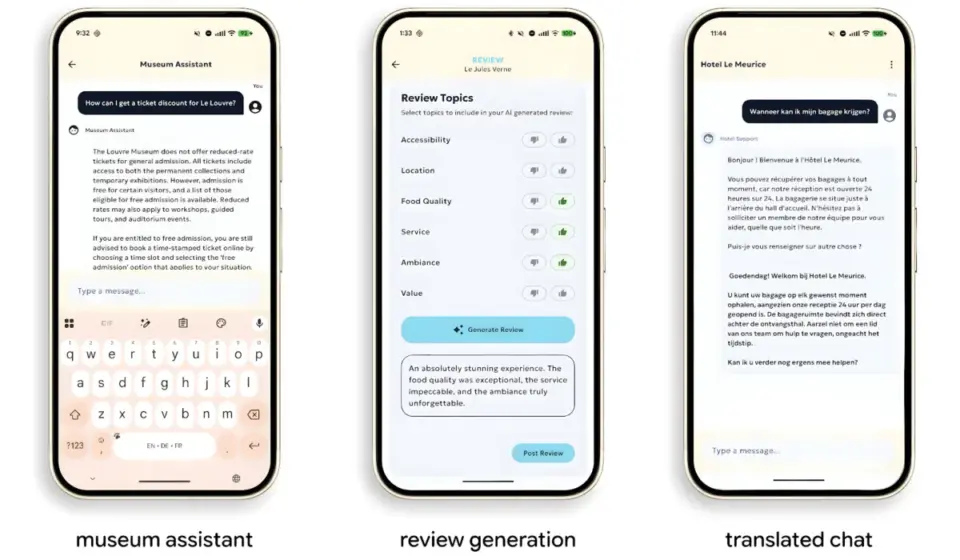
This report provides a deep-dive analysis into the architectural frameworks, real-world implementations, and security measures demonstrated within the open-source Jetpacker sample application. By examining three distinct features—a web-grounded museum assistant, a hybrid restaurant review generator, and a custom-routed multilingual support chat—we uncover how modern Android applications are achieving unprecedented levels of intelligence without sacrificing reliability or performance.

Detailed Chronology: The Evolution of Intelligent Android Architecture
Phase 1: The On-Device Baseline and the Need for Cloud Scale
In the early stages of mobile artificial intelligence, developers operated within strict device boundaries. On-device models like Gemini Nano revolutionized privacy-first tasks, executing directly on device hardware to process sensitive user data without network overhead. However, engineers quickly encountered hard physical limitations. Local models, by design, are constrained by memory footprints and static training cutoffs. They lack real-time world knowledge, extensive context windows, and the capacity to resolve complex, multi-variable queries requiring vast external databases.
Phase 2: Introducing Firebase AI Logic and Hybrid Inference
To transcend these local boundaries, Google introduced Firebase AI Logic, a comprehensive suite designed to unify cloud and on-device machine learning workflows. Recognizing that a one-size-fits-all approach fails in mobile development, the framework introduced Hybrid Inference.
Hybrid inference introduces an adaptive routing philosophy: execute lightweight or latency-sensitive tasks on-device using Gemini Nano to minimize cloud costs and operate offline, while seamlessly falling back to cloud-hosted powerhouses (such as variants of the Gemini 3 family) when complex reasoning, real-time web grounding, or broad device compatibility is required.
Phase 3: Implementing Grounded, Context-Aware Workflows in Jetpacker
With the architectural foundation laid, the Android Developer Relations team integrated these concepts into Jetpacker, a reference application showcasing state-of-the-art AI patterns. The implementation strategy focused on solving three distinct real-world use cases:

- Real-Time Data Grounding: Solving the "hallucination" and staleness problem in chatbots.
- Cost-Optimized Hybrid Execution: Balancing local hardware availability with cloud fallback.
- Custom Multilingual Routing: Dynamically directing translation workloads based on source language complexity.
Supporting Context & Metrics: Architecture in Action
To understand the practical application of Firebase AI Logic, we must examine how specific technical challenges were engineered within the Jetpacker codebase.
1. LLM Grounding: The Museum Assistant Chatbot
When designing an interactive assistant for cultural institutions—such as planning a visit to the Louvre—developers face the challenge of temporal drift. Cloud models, despite their vast parameters, lack intrinsic knowledge of today’s special exhibitions, unexpected closures, or dynamic ticketing promotions.
To bridge this gap, Jetpacker utilizes the Firebase AI Logic SDK to dynamically construct generation tools based on application feature flags:
// implementation("com.google.firebase:firebase-ai-logic")

private var toolList = mutableListOf<Tool>()

init
    if (ENABLE_SEARCH_GROUNDING)
        toolList.add(Tool.googleSearch())

    if (ENABLE_URL_GROUNDING)
        toolList.add(Tool.urlContext())


private val generativeModel = Firebase.ai(backend = GenerativeBackend.googleAI())
    .generativeModel(
        modelName = "gemini-3-flash",
        systemInstruction = content
            text("You are a helpful museum assistant answering questions about a museum. Use plain text.")
        ,
        tools = toolList
    )
By appending specific museum resource URLs directly into the prompt context when URL grounding is active, the model bypasses its training cutoff, retrieving hyper-accurate, verifiable data in real time:

val groundingText = if (FeatureFlags.ENABLE_URL_GROUNDING)
    "n If the following message above is about the rules and terms to visit Le Louvre, " +
    "if needed answer this urls $urlList.joinToString()"
 else
    ""


val prompt = "$text $groundingText"
var response = chat.sendMessage(prompt)
2. Hybrid Inference: On-Device Review Generation with Deep Links
Not every user possesses a high-end device equipped with the latest on-device AI accelerators, nor are they always connected to a stable cellular network. The Firebase API for Hybrid Inference solves this by offering granular control over execution paths.
In Jetpacker’s restaurant review drafting feature, the application prioritizes local execution via Gemini Nano, automatically falling back to cloud-hosted flash models on unsupported hardware:
// implementation("com.google.firebase:firebase-ai-logic")
// implementation("com.google.firebase:firebase-ondevice-ai:...")

val reviewModel = Firebase.ai.generativeModel(
    modelName = "gemini-3.1-flash-lite",
    onDeviceConfig = OnDeviceConfig(
        inferenceMode = InferenceMode.PREFER_ON_DEVICE
    )
)
Once the review is synthesized based on user-selected topics, it is cached to the system clipboard and piped directly into Google Maps via a deep-linking intent, establishing a frictionless user journey:
private fun copyAndOpenMapsReview(context: Context, reviewText: String, placeId: String)
    val clipboard = context.getSystemService(Context.CLIPBOARD_SERVICE) as ClipboardManager
    val clip = ClipData.newPlainText("User Review", reviewText)
    clipboard.setPrimaryClip(clip)

    val uri = Uri.parse("https://search.google.com/local/writereview/mobile?placeid=$placeId")
    val intent = Intent(Intent.ACTION_VIEW, uri).apply
        setPackage("com.google.android.apps.maps")

    context.startActivity(intent)
3. Custom Multilingual Routing: Hotel Support Chat
Complex enterprise applications often demand bespoke routing logic that extends beyond basic binary preferences. In Jetpacker’s hotel support chat, users converse with a localized receptionist persona configured via strict system instructions:

private val generativeModel = Firebase.ai(backend = GenerativeBackend.googleAI())
    .generativeModel(
        systemInstruction = content
            text("""
              You are a helpful hotel receptionist at $hotelName only speaking $language.
              Answer politely in $language. The bar closes at 10pm and breakfast is from 7am to 10am.
              There's someone at the desk 24/7. You can retrieve your luggage from the storage room
              at the back of the lobby at any time.
              """)
        ,
        modelName = "gemini-3-flash-preview"
    )
Because responses are delivered in the hotel’s native tongue (e.g., French for a Parisian property), incoming messages must be translated into the user’s preferred language. Rather than blindly sending every translation request to the cloud—which incurs latency and cost—Jetpacker implements a custom routing stack powered by ML Kit Language Identification and hybrid model selection:
// ML Kit for Language Identification (powered by Google Play Services)
private val languageIdentifier = LanguageIdentification.getClient()

// On-device translator model for verified high-quality language pairs
private val hybridTranslationModel = Firebase.ai(backend = GenerativeBackend.googleAI())
    .generativeModel(
        modelName = "gemini-3-flash",
        onDeviceConfig = OnDeviceConfig(mode = InferenceMode.PREFER_ON_DEVICE)
    )

// Cloud translator model for complex linguistic parsing
private val cloudTranslationModel = Firebase.ai(backend = GenerativeBackend.googleAI())
    .generativeModel(
        modelName = "gemini-3-flash"
    )

fun translateMessage(message: SupportChatMessage)
    viewModelScope.launch
        val sourceLang = try
            Tasks.await(languageIdentifier.identifyLanguage(message.text))
         catch (e: Exception)
            "Undefined"


        // Custom Routing: Route English and Korean on-device; route others to cloud
        val routeToCloud = sourceLang != "en" && sourceLang != "kr"
        val prompt = "Translate the following text to $selectedLanguage. Just return the translated sentence: $message.text."

        val (translatedText, routePrefix) = if (routeToCloud)
            val result = cloudTranslationModel.generateContent(prompt)
            result.text to "[Cloud]"
         else
            val result = hybridTranslationModel.generateContent(prompt)
            result.text to "[On-Device]"


        if (translatedText != null)
            _translations.update  current ->
                current + (message.id to "$routePrefix: $translatedText")
This routing paradigm can be dynamically expanded to factor in network telemetry, battery health states, and hardware acceleration tiers, ensuring optimal resource utilization under any operating condition.
4. Securing the AI Pipeline with Firebase App Check
Exposing powerful cloud-hosted LLM endpoints directly from mobile applications introduces severe security vulnerabilities, including API key harvesting, unauthorized request flooding, and runaway cloud billing.
To safeguard backend infrastructure, Jetpacker integrates Firebase App Check, utilizing Play Integrity for production environments and a local Debug Provider for development and emulator testing:

override fun onCreate()
    super.onCreate()
    Firebase.initialize(context = this)
    Firebase.appCheck.installAppCheckProviderFactory(
        DebugAppCheckProviderFactory.getInstance()
    )
    Firebase.auth.signInAnonymously()
By registering local debug tokens generated during emulator boot within the Firebase Console, developers can rigorously verify request authenticity without compromising local development velocity.
Official Statements & Architectural Philosophy
The Android Developer Relations team emphasizes that the future of mobile AI is neither exclusively on-device nor strictly cloud-dependent.
"By combining cloud model capabilities—such as advanced grounding and system instruction tuning—with robust on-device foundations including hybrid routing, real-time translation, and strict security verification, developers can construct travel and utility applications that are brilliantly smart, utterly secure, and reliably available offline."
This philosophy underscores a critical shift in software engineering: applications must no longer treat AI as an isolated, bolt-on feature. Instead, generative intelligence must be treated as a core architectural primitive, dynamically adapting its execution environment based on real-time hardware capabilities, network availability, and privacy requirements.

Future Outlook: The Road Ahead for Intelligent Android
As the "Build Intelligent Android Apps" series progresses, the horizon of mobile AI expands further into autonomous agentic behavior. Looking toward upcoming installments, developers can anticipate deep dives into:
- System Integration via AppFunctions: Allowing external systems and OS-level intelligence layers to invoke application actions natively.
- Agentic Workflows & A2UI: Extending mobile applications with end-to-end booking assistants powered by advanced agentic UI frameworks and developer kits.
Summary of the Blog Series Roadmap
- Part 1: Introduction to intelligent app architecture and high-level strategy.
- Part 2: Deep-dive into on-device intelligence utilizing ML Kit GenAI APIs and Gemini Nano for privacy-first tasks (summarization, receipt parsing, audio processing).
- Part 3 (Featured): Hybrid and cloud reasoning via Firebase AI Logic, grounding models in real-world data like Google Maps and web context.
- Part 4: System-level integration using AppFunctions.
- Part 5 (Upcoming): End-to-end agentic workflows and automated booking assistants.
Getting Started
Developers eager to explore these patterns can inspect the complete, production-ready source code via the Jetpacker GitHub Repository and review official implementation guidelines at the Firebase AI Logic Documentation.
Copyright © 2026 Google LLC. SPDX-License-Identifier: Apache-2.0