

Navigating the E-Commerce Exodus: Analyzing BigCommerce’s Plan Overhauls, Transaction Fees, and the Strategic Pivot to Open-Source Alternatives

By Renzo Bojanovich
Product Marketing Manager, Woo
Executive Overview
The landscape of e-commerce platform economics is undergoing a seismic shift. In an aggressive restructuring move, BigCommerce implemented a comprehensive overhaul of its global pricing and plan architecture. Effective June 1, the platform instituted a complete renaming of its subscription tiers, systematically lowered Gross Merchandise Value (GMV) thresholds, and introduced a punitive transaction fee of up to 2% for merchants utilizing payment gateways outside its curated list of approved providers.
While enterprise-level platform pivots are common in the fast-paced SaaS industry, this particular adjustment has sent shockwaves through the merchant community. For years, platforms like BigCommerce have marketed themselves on predictability, scale, and competitive positioning against market giants like Shopify. However, these recent alterations signal a philosophical shift toward revenue-indexed taxation. By penalizing businesses for scaling, restricting payment flexibility, and narrowing feature access behind higher paywalls, the platform has inadvertently catalyzed a broader conversation about digital sovereignty.
This investigative report examines the mechanics of BigCommerce’s structural changes, dissects the true cost of closed-ecosystem platforms, and provides a transparent, analytical framework for merchants evaluating whether a migration to an open-source alternative like WooCommerce is the right strategic move for their business.
Detailed Chronology: The Anatomy of BigCommerce’s Structural Pivot
The changes announced by BigCommerce did not happen in a vacuum; they represent the culmination of a broader industry trend where SaaS providers seek to maximize Average Revenue Per User (ARPU) by squeezing mature storefronts.

The Notice Period and Immediate Rollout
Merchants were given a 60-day window to digest the new pricing schema following the initial announcement. For a growing digital storefront, two months is a remarkably narrow timeline to audit financial modeling, renegotiate payment gateway contracts, or orchestrate a platform migration.
The Plan Restructuring and GMV Threshold Contraction
The core of the restructuring involved renaming legacy tiers and shifting the goalposts for revenue brackets:
- The Standard to Core Transition: Previously, smaller merchants enjoyed breathing room up to a trailing twelve-month (TTM) GMV of $50,000 on the Standard plan. Under the new Core designation, that threshold has been aggressively lowered to $30,000. This structural shift effectively forces growing small businesses out of entry-level tiers far earlier in their lifecycle.
- The Growth and Scale Compression: Mid-to-large merchants experienced an equally restrictive squeeze. Once a store surpasses $100,000 in TTM GMV, it is automatically transitioned into the Growth plan. Crucially, the old Pro plan’s fixed per-block charges have been replaced by Scale’s continuous 0.9% rate on GMV exceeding $33,333 per month. This overage model directly penalizes high-volume periods, transforming seasonal success into a financial penalty.
The Death of "Zero Transaction Fees"
Historically, one of BigCommerce’s primary value propositions was its promise of zero platform-level transaction fees—a direct jab at competing proprietary builders. That marketing narrative has officially retired. The platform now imposes a tariff of up to 2% on orders processed through external payment gateways that fall outside its "Embedded Payment Providers" whitelist.
For specialty merchants, regional brands, and B2B wholesalers who rely on localized, niche, or highly specific merchant accounts, this fee is crippling. Wholesalers handling high-ticket, manual, or offline B2B transactions find themselves paying steep platform taxes on sales that have little to do with standard consumer checkout flows.
Supporting Context & Metrics: Taxing Success vs. Owning Infrastructure
To truly understand the impact of these updates, one must analyze the underlying business model: proprietary SaaS platforms monetize by taxing your commercial growth. As your business succeeds, your operational expenses scale automatically, often disproportionately to the value received from the platform.

The True Cost of Closed Ecosystems
When calculating the Total Cost of Ownership (TCO) on a closed platform, merchants must account for three invisible taxes:
- Revenue-Indexed Plan Escalations: Being bumped to a higher tier simply because your revenue crossed an arbitrary line, regardless of whether your profit margins can absorb the increase.
- Payment Processing Lock-in: Being forced to use specific payment providers under the threat of a 2% penalty.
- Feature Gating: Essential operational tools—such as stored payment methods on lower tiers or native product filtering reserved exclusively for Scale/Pro plans—are locked away until you pay a ransom.
The Open-Source Counter-Model: WooCommerce
In stark contrast, open-source infrastructures operate on a fundamentally different economic theorem. WooCommerce software is free and open source. There are no revenue thresholds, no arbitrary plan upgrades, and no platform-imposed taxes on your success.
Running a WooCommerce store is not free—nor should it be, as enterprise-grade commerce requires robust infrastructure. Merchants still invest in high-performance hosting, secure payment processing, premium extensions, and development resources. However, every single dollar spent is tied directly to a deliberate business decision made by the merchant, rather than an arbitrary corporate mandate.
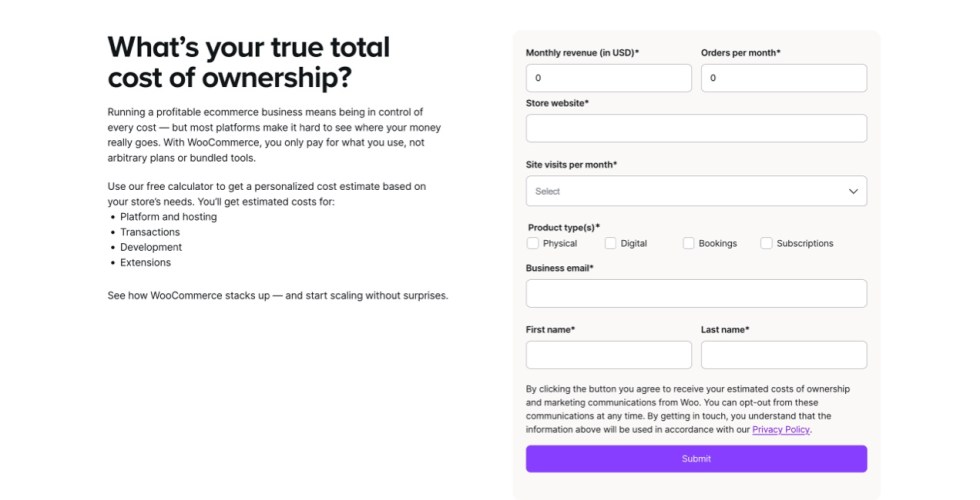
By utilizing the TCO calculator tool provided by WooCommerce, merchants can accurately model their actual expenditures across hosting, transaction costs, extensions, and custom development, comparing them line-by-line against their historical SaaS invoices.
+--------------------------------+----------------------------------+
|      PROPRIETARY SAAS (e.g.)   |      OPEN-SOURCE (WooCommerce)   |
+--------------------------------+----------------------------------+
| - Revenue-tiered pricing       | - Free, open-source core         |
| - Forced transaction penalties | - Absolute payment freedom       |
| - Feature gating by plan       | - Modular, scale-as-you-grow     |
| - Centralized, rigid hosting   | - Total infrastructure control   |
+--------------------------------+----------------------------------+
Official Perspectives and Industry Implications
The e-commerce community’s reaction to BigCommerce’s pivot has been intensely polarized. While platform representatives argue that these updates align pricing with the advanced feature sets and infrastructure costs associated with high-volume merchants, industry analysts and independent store owners view the move as a breach of trust.
The Loss of Architectural Control
Beyond financial considerations, proprietary platforms dictate how your store operates. Cloud-hosted SaaS environments manage performance decisions centrally. While convenient for early-stage operations, this centralization becomes a liability during high-traffic events like Black Friday or Cyber Monday.
If a proprietary platform’s infrastructure struggles under peak load, merchants have zero authority to optimize server-side caching, adjust database configurations, or scale server resources. Every second of platform-induced downtime translates directly to lost revenue.
Conversely, WooCommerce places the entire foundational architecture in the hands of the merchant:
- Hosting Freedom: Select high-performance hosting providers specifically engineered for high-traffic WordPress and WooCommerce deployments.
- Data Ownership: Complete, unmitigated access to your database, product files, customer records, and order history. Your data lives where you want it to live, safeguarded against sudden policy or pricing shifts.
- Ecosystem Flexibility: If a required integration—such as subscription billing—is missing from a closed platform, merchants are often at the mercy of third-party vendors whose software can be abruptly deprecated or restricted. In contrast, the open WordPress ecosystem features thousands of developer-supported extensions, ensuring long-term roadmap independence.
Future Outlook: Is Migration Right for Your Business?
Not every merchant affected by BigCommerce’s updates should migrate. If your business operates comfortably below the newly lowered payment thresholds, and if you already utilize preferred payment gateways like Stripe or PayPal without friction, the upheaval of a platform migration may outweigh the immediate financial benefits.
However, if your enterprise is experiencing any of the following warning signs, a strategic migration should be seriously evaluated:

- Fee Fatigue: Plan fees, overage charges, and new payment penalties are consuming a rapidly expanding percentage of your gross margins.
- Catalog Constraints: Your inventory is hitting platform limits, such as BigCommerce’s notorious 60-variant cap per product.
- The Desire for Control: You require absolute ownership over your hosting performance, database management, and custom workflow integrations.
Demystifying the Migration Roadmap
Migrating from BigCommerce to WooCommerce is significantly more manageable when decoupled from cosmetic redesigns. The transition process can be broken down into structured phases:
- Data Transfer: Product catalogs, customer profiles, and historical order data can be smoothly migrated using CSV exports, direct API connections, or specialized migration services like Cart2Cart. Focus heavily on mapping critical data fields, including SKUs, variations, categories, and customer metadata.
- Redesign and Extension Selection: Treat the migration as an opportunity to audit your technology stack. Discard bloated, underutilized tools and replace them with agile WooCommerce extensions and responsive WordPress themes.
- SEO Preservation: Maintain legacy URL slugs wherever possible. For any structural changes, implement strict 301 redirects to preserve search engine equity, category metadata, and internal link structures.
Conclusion: Taking Back Your Roadmap
The recent changes to BigCommerce’s pricing model serve as a stark reminder of the risks inherent in building a business on rented land. When platforms tax your success, they are monetizing your hard work while stripping away your operational autonomy.
By evaluating your past 12 months of expenditures—factoring in plan fees, overages, and transaction penalties—against a transparent TCO analysis on WooCommerce, you can clearly separate the costs you chose from the costs imposed upon you.
On WooCommerce, you own the foundation, you control the infrastructure, and you alone decide what your growth costs. When you are ready to reclaim your independence, the path forward is clear, supported by extensive documentation, a thriving global community, and a flexible ecosystem built to scale with your ambition.