The Great UX Identity Crisis: Why "User Experience" Still Reigns Supreme Despite Industry Fragmentation

Executive Overview
In an era defined by rapid technological pivots, widespread industry layoffs, tightening corporate budgets, and the relentless creep of artificial intelligence into traditional creative workflows, the digital design sector is undergoing a profound existential reckoning. Practitioners, leaders, and stakeholders across the tech ecosystem are increasingly questioning whether the terms "UX" (User Experience) and "user experience" still adequately serve a discipline that has evolved far beyond wireframes and usability tests. Amid mounting pressure to tangibly prove the business value of human-centered work, some within the community have wondered if a fresh label might better articulate the industry’s strategic relevance and ultimate impact.
To cut through the speculative noise and discover how tech and design professionals actually perceive their own discipline, a comprehensive global study was conducted in April 2026. Surveying 604 professionals worldwide through the Nielsen Norman Group Practitioner Panel, newsletters, and digital channels, the research deployed an indirect methodology. Rather than asking participants to evaluate trendy labels head-on, researchers presented a universal definition of UX work devoid of industry jargon and asked respondents to name the corresponding field in their own words.
The results provide a definitive, if surprising, reality check for an industry prone to semantic reinvention: "UX" remains the undisputed default name for the field.
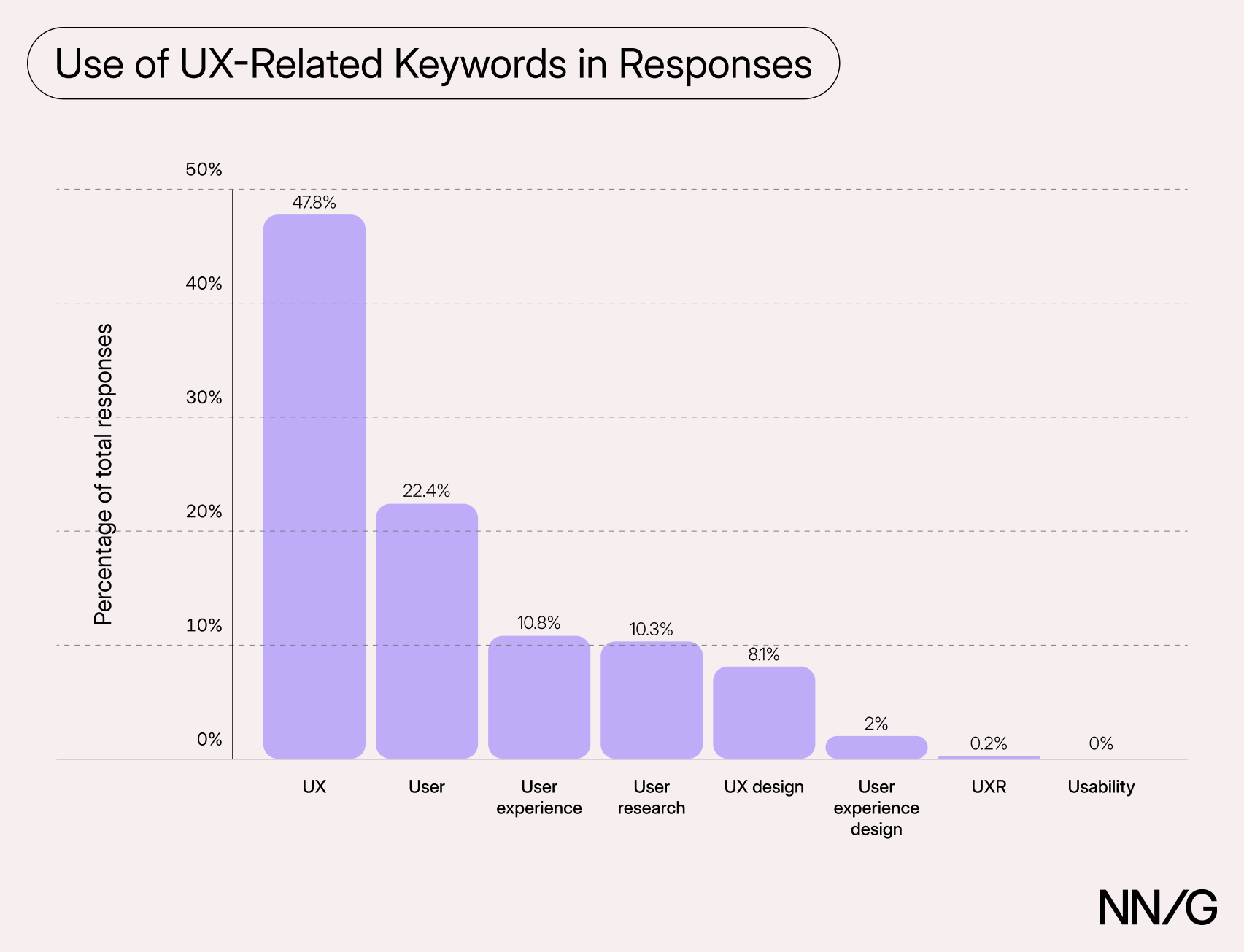
A commanding 70% of participants naturally utilized terminology associated with UX in their responses—with "UX" alone appearing in 47.8% of submissions, "user" in 22.4%, and "user experience" in 10.8%. No competing umbrella term came close. While alternative labels abound, ranging from "product design" and "customer experience research" to "human-centered design" and "service-design strategy," these secondary terms remain heavily fragmented. Furthermore, the data reveals that an individual’s specific job role heavily biases their terminology choices: product managers and product designers are significantly more likely to frame the work through a "product" lens, just as customer insights professionals lean heavily on the "customer" moniker.
Ultimately, this landmark study suggests that wholesale rebranding is neither practical nor warranted at this juncture. Instead of chasing semantic perfection, industry leaders are advised to redirect their energies away from boardroom debates over nomenclature and toward making the concrete, bottom-line contributions of UX work undeniably visible to executive stakeholders.
Detailed Chronology: The Evolution and Inflation of UX Terminology
To understand why the digital design community finds itself fixated on terminology today, one must trace the evolutionary arc of the field’s vocabulary. The language used to describe human-centered design has transformed dramatically over the decades, driven partly by genuine expansions in professional scope and partly by classic vocabulary inflation.
From Usability to Human-Centered Design
In the early days of digital interfaces, the discipline was broadly understood under the banner of "usability." This early focus was primarily evaluative: determining whether people could use a system effectively, efficiently, and with minimal friction. As digital systems grew more complex, practitioners recognized that evaluating a finished product was insufficient. This realization gave rise to "user-centered design," an approach that deliberately grounded design decisions in a deep understanding of users’ needs, tasks, and real-world contexts through iterative research and evaluation. Before long, this term was joined—and frequently superseded—by "human-centered design," signaling a broader scope that encompassed human well-being alongside task completion.
The Rise of "UX" and the Corporate Pivot to CX
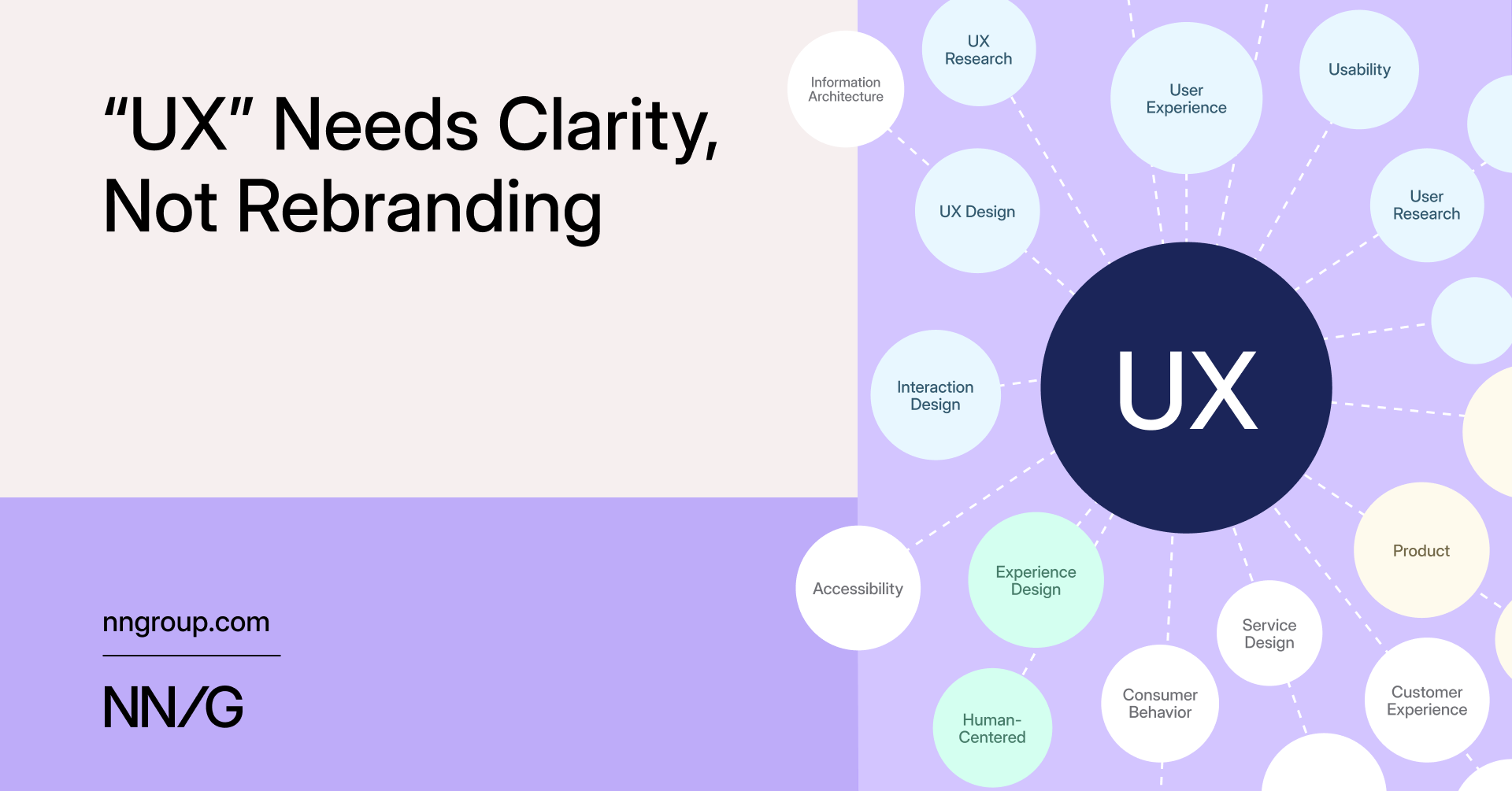
As digital products evolved into holistic ecosystems spanning multiple devices and touchpoints, the term "user experience" emerged to capture not just utility, but people’s subjective perceptions, emotions, and overarching interactions with an organization.
Simultaneously, practitioners originating from marketing and customer-service backgrounds popularized "customer experience" (CX). While often treated as functionally interchangeable with UX by executive leadership, CX carried distinct historical origins and organizational emphases. More recently, organizations have swung between treating "design" as a sweeping umbrella term and utilizing "experience design" to signal a scope that transcends individual screens, applications, or products. Rather than cleanly replacing one another, these overlapping terms have accumulated over time, creating a dense thicket of industry ambiguity.
The Modern Pressures: Blurring Boundaries and AI
This semantic sprawl is colliding with structural changes in the modern workplace. The rigid walls surrounding traditional UX roles are rapidly dissolving:
- The Expansion of Product Management: Product managers are increasingly taking direct ownership of research, discovery, and design tasks.
- Research Democratization: Organizations are systematically widening the circle of who participates in user research, breaking down historical silos between creators and consumers of insights.
- The AI Acceleration: Artificial intelligence tools are dramatically fast-tracking this democratization. Non-UX professionals now routinely utilize generative AI to draft research plans, rapidly prototype interface concepts, synthesize qualitative feedback, and assemble design artifacts.
These technological and organizational shifts have supercharged the return of the UX generalist, forcing the community to ask a foundational question: When professionals describe a human-centered approach to building products and services, what language actually comes to mind?
Supporting Context & Metrics: Inside the 2026 Terminology Study
To uncover the true linguistic baseline of the industry, researchers bypassed direct queries about favorite buzzwords. Instead, they tested participants using a neutral, descriptive behavioral prompt:
"An individual gathers insights about people’s needs and experiences and turns those insights into recommendations for how a product or service should be planned, built, and improved."
Participants were instructed to name just one field or discipline that best described this work. The resulting text responses were subsequently standardized—converting job titles like "UX researcher" into disciplines like "UX research"—and analyzed for keyword frequencies.
The Dominance of UX-Related Keywords
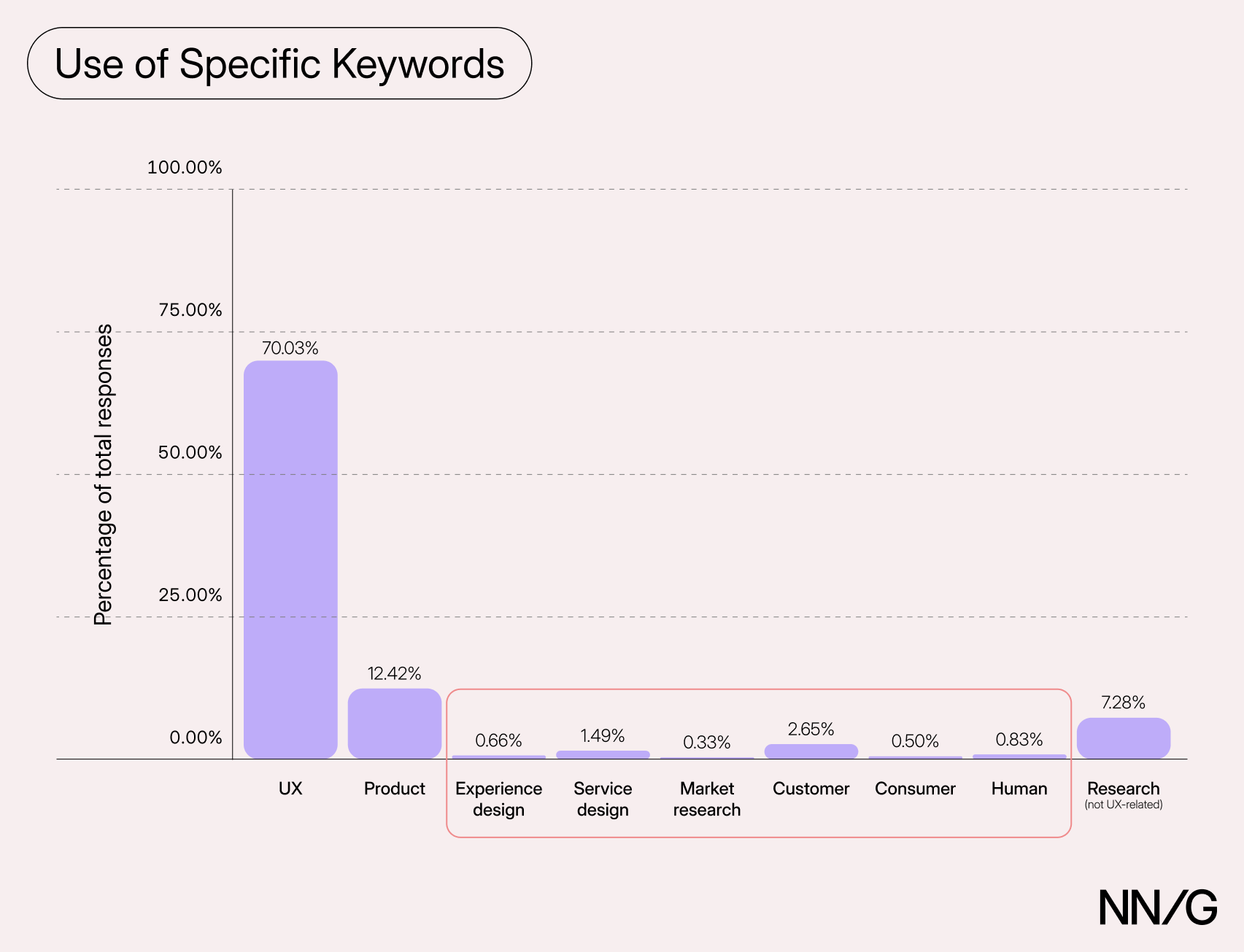
The quantitative findings left zero ambiguity regarding which term anchors the collective consciousness of the tech and design workforce:
[Use of Specific Keywords in Responses]
--------------------------------------------------
UX-Related Keywords (UX, User, User Experience)  : 70.03%
Product-Related Keywords                        : 12.42%
Research (Non-UX Related)                       :  7.28%
Experience Design / Human / Customer (Each)     : < 3.00%
A deeper breakdown of the specific UX-related terminology reveals that abbreviations reign supreme:
- "UX": 47.8% of total responses
- "User": 22.4% of total responses
- "User experience": 10.8% of total responses
- "User research": 10.3% of total responses
- "UX design": 8.1% of total responses
- "User experience design": 2.0% of total responses
- "UXR": 0.2% of total responses
- "Usability": 0.0% of total responses
The Extreme Fragmentation of Alternatives
While roughly three-quarters of the industry anchors its thinking around the UX umbrella, the remaining 30% of responses showcase a dizzying array of alternative labels. Rather than consolidating around a single challenger—such as "product design" or "human-centered design"—alternative terminology remains profoundly fractured.
The study categorized these divergent alternative labels into distinct functional buckets:
| Category | Representative Participant Responses |
|---|---|
| Business Analysis, Data & Requirements | Business analysis, data analysis, IT business analysis, requirements gathering |
| Customer, Consumer & Market | Customer experience (CX) research, content strategy, consumer behavior research, consumer insights, journey management, market research |
| Design | Service design, design research, DesignOps, art direction, human-centered design research, interaction design |
| Experience | Experience design, digital experience strategy, experience insights, human experience design |
| Human Factors & HCI | Human factors, human factors engineering, human-computer interaction (HCI) |
| Product | Product design, product management, product development, product engineering, qualitative product research |
| Research | Qualitative research, contextual inquiry, discovery research, observational research, research analysis |
| Strategy, Management & Operations | Strategy, digital management, project management |
How Job Roles Shape Vocabulary
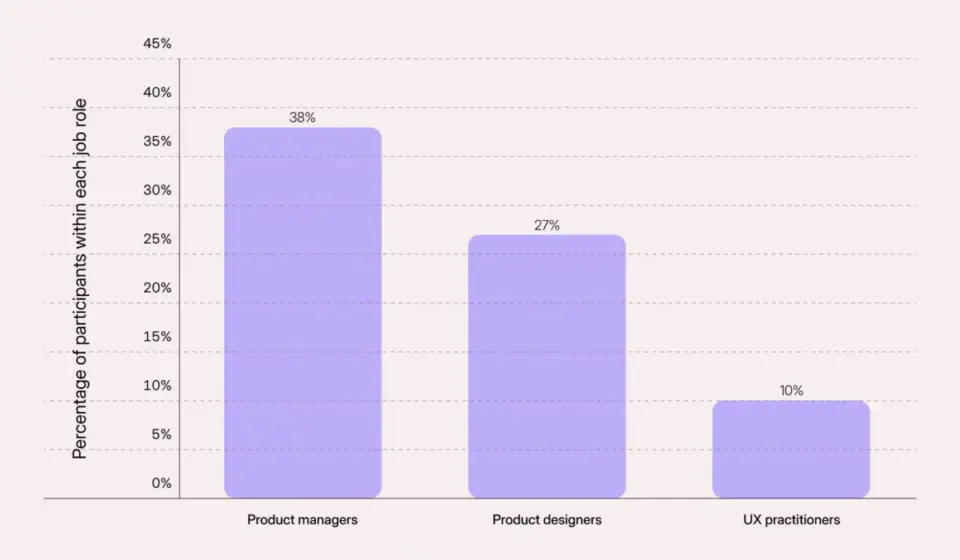
A critical revelation of the study is that an individual’s professional silo actively warps their linguistic perception of the wider discipline. While only 12.42% of all participants used the word "product" in their response, this figure spiked dramatically when segmented by role:
- Product Managers: 38% used the term "product."
- Product Designers: 27% used the term "product."
- Traditional UX Practitioners: Only 10% used the term "product."
A similar tribal bias appeared around customer-centric phrasing. While just 2.65% of the total sample used the word "customer," 18.18% of customer insights professionals relied on it, compared to a negligible 0.50% of core UX practitioners. These statistically significant variances prove that professionals naturally view human-centered work through the conceptual lens of their own daily job descriptions.
Official Insights: Interpreting the Data and Navigating the Future
Reflecting on the study’s implications, industry analysts point out an essential distinction: while the research successfully mapped which terminology spontaneously springs to mind, it did not measure how effectively those terms communicate the value or scope of the work to executive stakeholders.
Why Wholesale Rebranding is a Distraction
For design leaders wrestling with budget cuts and proving ROI in boardrooms, the temptation to adopt trendier corporate vocabulary—such as "business growth enablement" or "strategic experience architecture"—can be strong. However, this study demonstrates that no alternative term possesses the widespread baseline recognition that "UX" currently enjoys.
Attempting to force a new umbrella term upon an industry that naturally gravitates toward "UX" is likely to create more confusion than clarity. Rebranding does not fix structural misunderstandings about a discipline’s worth; rather, it often signals an inward-looking industry obsessed with semantics while its foundational impact remains opaque to the rest of the enterprise.
Actionable Strategies for UX Leaders
Rather than sinking valuable capital and cultural capital into search of a semantic silver bullet, design leadership must pivot toward operational visibility. To secure budgets and cement organizational relevance, UX leaders should focus on anchoring their teams’ work to the core metrics that executives already monitor:
- Quantify Risk Reduction: Explicitly demonstrate how upfront user research and iterative testing prevent catastrophic and expensive post-launch rework.
- Expose Unmet Needs: Show how human-centered discovery phases unearth latent customer requirements that directly inform profitable product roadmaps.
- Elevate Technical Quality: Link accessibility compliance and usability improvements directly to customer retention and brand equity.
- Connect to Business Outcomes: Translate design deliverables—from journey maps to qualitative insights—into the shared language of business stakeholders, framing UX not as a cost center, but as an indispensable de-risking engine.
Future Outlook: The Path Ahead for Human-Centered Disciplines
As artificial intelligence continues to automate routine artifacts and democratize research capabilities, the daily responsibilities of digital creators will undoubtedly continue to evolve. The lines separating product managers, software engineers, data analysts, and UX generalists will blur even further in the coming years.
Yet, this ongoing structural mutation does not negate the fundamental need for human-centered advocacy. As the data decisively shows, "UX" remains the most robust, universally recognized linguistic anchor the industry has. While alternative terms will continue to thrive in specialized niches—and while professionals will continue to view the field through the prism of their specific job titles—the core discipline remains resilient.
For practitioners navigating the uncertainties of the mid-2020s tech landscape, the message is clear: stop worrying about what to call the discipline, and start relentlessly proving what the discipline can achieve. The future belongs not to those who invent the cleverest label, but to those who make the human impact of their work impossible for the rest of the business to ignore.