

Executive Overview
As artificial intelligence rapidly automates the mechanical execution of software development—handling everything from boilerplate code generation to automated interface layouts—designers, engineers, and product builders find themselves facing an unprecedented strategic evolution. The core professional challenge has fundamentally shifted. It is no longer about how to build products efficiently, but rather what to build strategically.
This transformation has popularized the term “product sense,” a catch-all phrase traditionally used to describe an elite, almost mystical intuition for what succeeds in the market. Yet, as currently defined across tech culture, product sense remains frustratingly vague. Industry leaders often describe it as an amorphous blend of user empathy and creative problem-solving, advising practitioners to consume endless streams of product case studies, podcasts, and competitor tear-downs to sharpen their instincts.
This article argues that this conventional wisdom is fundamentally flawed. Gathering scattered external inputs does not build reliable intuition. True product sense is not an innate talent or a passive byproduct of consuming industry content; it is a rigorous, pattern-matching cognitive skill grounded in domain expertise. By examining cognitive science frameworks established by decision-making experts like Daniel Kahneman, Gary Klein, and Robin Hogarth, we can deconstruct product sense into a measurable, improvable capability. Ultimately, true product sense relies on closing the full experimentation loop—owning a decision from its initial hypothesis through to its measurable outcome—and, crucially, recognizing when past patterns no longer apply.
Detailed Chronology: The Evolution of Product Sense
To understand how product sense became the defining competency of the modern product builder, we must trace its evolution alongside the shifting landscape of software development and artificial intelligence.
Phase 1: The Era of Execution (Pre-2015)
For decades, the primary bottleneck in software creation was technical execution. Writing code, architecting databases, and designing functional user interfaces required specialized, scarce labor. In this environment, product builders were rewarded primarily for velocity and precision. Product management existed to translate business requirements into developer tickets, and design systems focused on visual polish and accessibility. "Sense" was largely implicit, siloed within executive leadership or visionary founders who dictated product roadmaps top-down.
Phase 2: The Proliferation of "Best Practices" (2015–2022)
As software scaled globally and agile methodologies saturated the market, the industry sought frameworks to replicate success. This era gave birth to modern definitions of product sense. In 2022, Jules Walter published a widely cited definition in Lenny’s Newsletter, describing product sense as the ability to consistently craft products with intended user impact through a combination of user empathy and creativity. Concurrently, thought leaders like Julie Zhuo, Jackie Bavaro, and Marty Cagan attempted to operationalize this concept. Their advice largely centered on consumption: studying teardowns, analyzing successful apps, and cultivating a deep mental library of UX patterns. However, this advice treated product sense as a collection of aesthetic preferences rather than a measurable cognitive process.
Phase 3: The AI Acceleration and the Strategic Shift (2023–Present)
The sudden maturity of generative AI and automated software engineering tools compressed execution timelines dramatically. Tasks that once required entire teams of engineers—such as refactoring code, generating data migrations, and prototyping wireframes—can now be executed in seconds.
This automation wave forced a reckoning. With execution costs plummeting, the market value of simply knowing how to build plummeted alongside it. Professionals were thrust into the driver’s seat of what to build. The term "product sense" surged in job descriptions and leadership interviews, yet the industry lacked a rigorous, scientific framework to define, measure, or teach it. The historical reliance on passive input consumption proved inadequate for an era where professionals must make high-stakes, ambiguous decisions faster than ever before.
Supporting Context & Metrics: The Cognitive Science of Decision-Making
To move beyond vague definitions, we must look outside the tech industry to fields where split-second, high-stakes decision-making has been studied for decades: firefighting, emergency medicine, and competitive strategy.
Recognizing the Mechanics of Expertise
In their foundational research on intuitive expertise, psychologists Daniel Kahneman and Gary Klein explored how seasoned professionals make exceptional decisions in fast-paced, low-information environments. Their research demonstrated that true intuition is not magical; it is pattern recognition.
When a veteran firefighter walks into a burning building and instantly senses that the roof is about to collapse—often before consciously registering specific visual cues—they are executing Recognition-Primer Decision (RPD) making. They are subconsciously matching the current, complex environment against a vast mental repertoire of past experiences where they saw the full cycle through to the end.
Product sense operates on the exact same cognitive mechanism. True product sense is the ability to recognize when current problems match past successes or failures and reliably estimate how similar solutions will affect desired outcomes.
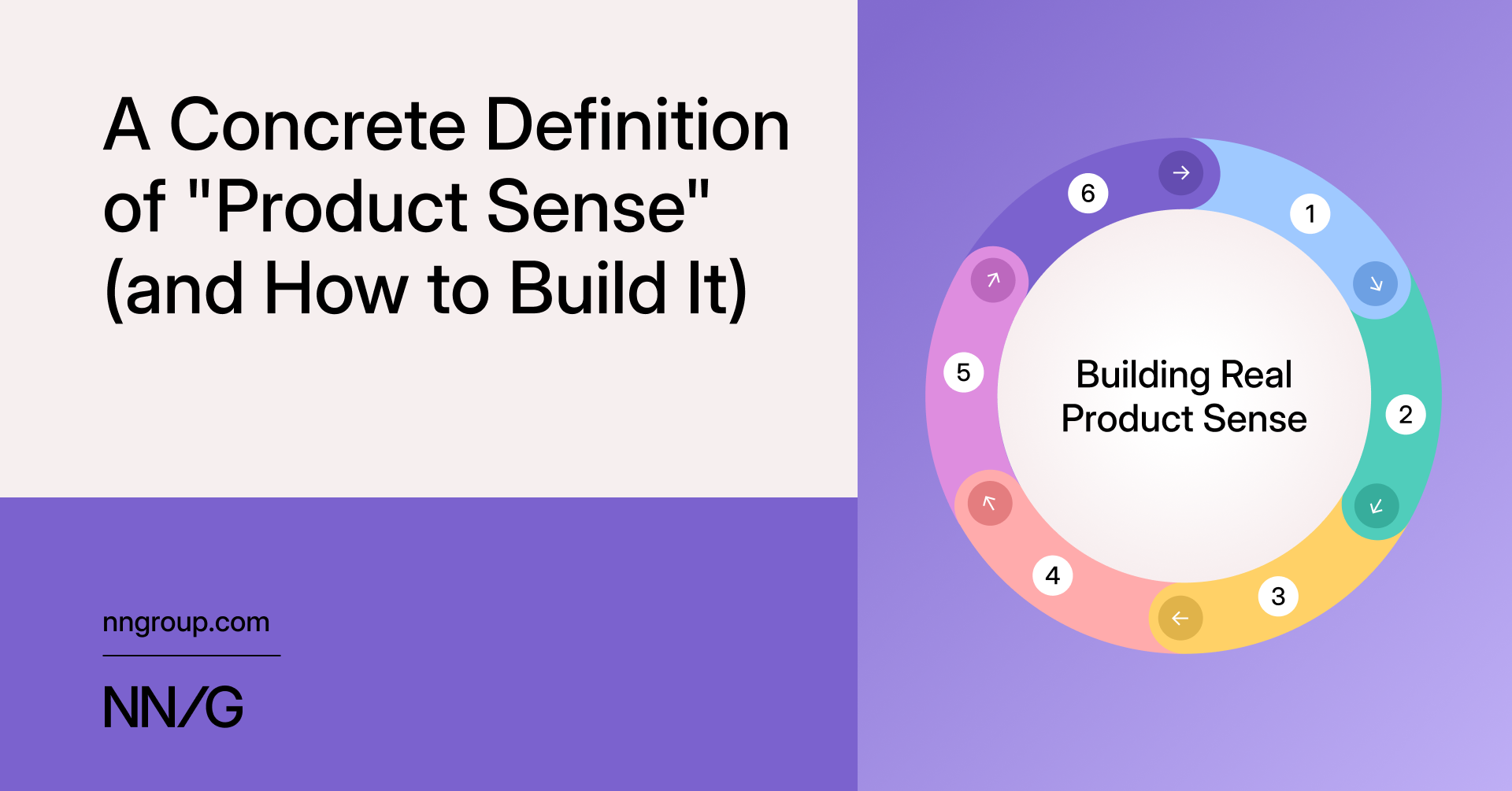
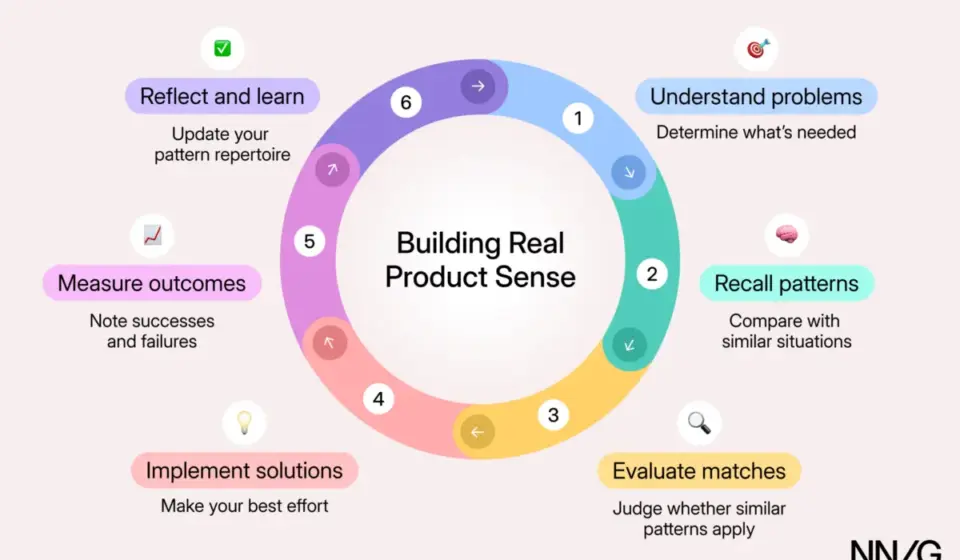
[Understand Problem] ➔ [Recall Patterns] ➔ [Evaluate Match] ➔ [Implement Solution] ➔ [Measure Outcome] ➔ [Reflect & Learn]The Three Decision Environments
However, pattern matching is only as reliable as the environment in which it occurs. Drawing on organizational theorist Robin Hogarth’s work on learning environments, decision-making scenarios can be categorized into three distinct validity types:
- High-Validity Situations: These environments mirror the context in which patterns were originally learned. Cues are clear, feedback is rapid, and historical precedent holds true. For example, a senior product designer optimizing a mobile checkout flow for an e-commerce platform where user intent and constraints are well-documented can reliably trust their pattern-matching instincts.
- Low-Validity Situations: These contexts differ significantly from past experiences or lack clear feedback loops. Zero-to-one product launches or pioneering entirely new interaction paradigms fall into this category. Here, historical precedent is thin. Relying solely on product sense is dangerous; practitioners must deliberately challenge assumptions and gather empirical data.
-
Wicked Situations (The Most Dangerous Category): Coined by Robin Hogarth, "wicked situations" occur when a current problem bears superficial resemblance to a past success, but underlying structural variables have changed. Unlike low-validity environments—which leave the decision-maker healthily uncertain—wicked situations feel identical to high-validity ones. They trick the brain into false confidence.
Case Example: A product team builds a new enterprise feature that closely mirrors a wildly successful consumer product feature they launched previously. Confident in their past success, they bypass rigorous user research and testing. Upon launch, the feature underperforms because enterprise buyers have fundamentally different organizational motivations and security constraints than individual consumers. The team fell victim to a wicked situation: their experience reinforced a false pattern while inflating their misplaced confidence.
Official Perspectives & Industry Insights
As the debate over product intuition intensifies, organizational leaders and cognitive researchers are increasingly vocal about the structural flaws in how tech companies develop talent.
"The most important thing you can do is participate in entire product-development cycles. The more pieces of this fundamental product-building cycle are missing, the weaker your future product sense will be."
— Product Strategy Researchers
Industry analysts point out a growing systemic risk: hyper-specialization and AI acceleration are fragmenting the product lifecycle. In many modern organizations, product managers define requirements, AI generates the code, outsourced contractors handle visual design, and dedicated data science teams analyze the metrics weeks later.
This hyper-partitioned workflow creates a generation of professionals analogous to the firefighter who regularly works the first half of a shift—taking initial emergency calls and arriving at the scene—but leaves before the fire is extinguished, never learning whether the building survived or collapsed. That worker accumulates years of chronological tenure, but zero actionable expertise. They feel experienced because of the hours invested, yet they are fundamentally unqualified to lead because they have been severed from the consequences of their decisions.
Furthermore, leadership experts emphasize that true product sense requires intellectual humility. Knowing when not to trust your gut is just as vital as knowing when to act on it. In an ecosystem saturated with AI-generated recommendations and rapid deployment cycles, the ability to pause, audit the validity of the situation, and demand empirical validation is becoming the ultimate differentiator between mediocre builders and visionary product leaders.
Future Outlook: Navigating the AI Era with Rigor
Looking forward, the commoditization of software execution will place an even greater premium on authentic product sense. As AI democratizes coding and design output, the market will experience an unprecedented flood of software features, apps, and digital experiences. In a world where building things is virtually free, knowing what to build becomes the only remaining strategic moat.
However, organizations that fail to adapt their talent development models face a looming crisis of judgment. If companies continue to outsource decision-making to algorithms or fragment the product lifecycle to maximize short-term velocity, they will starve their workforce of the one ingredient necessary for true intuition: feedback loops.
To future-proof product organizations and individual careers, builders must adopt a rigorous approach to cultivating product sense:
- Own the Full Lifecycle: Whenever possible, resist the temptation to silo your work solely within ideation or execution. Demand visibility into the post-launch metrics of the features you help shape. If you build it, track it.
- Audit Your Mental Models: Actively categorize your upcoming decisions. Are you operating in a high-validity environment where historical patterns apply, or are you sleepwalking into a wicked situation where past success blinds you to new realities?
- Embrace Post-Mortems as Learning Engines: Treat every failed experiment not as a professional setback, but as a critical data point to update your internal pattern-matching library.
Buzzwords will continue to rise and fall, and artificial intelligence will continue to redefine the mechanics of technology creation. But human judgment—grounded in deep domain experience, tested through rigorous experimentation, and tempered by intellectual humility—remains irreplaceable. Stay in the ring, own your decisions, and face the results. That is the only path to cultivating enduring product sense in the years ahead.