

Beyond the Ladder: Reimagining Design-System Maturity Through a Multidimensional Lens

Executive Overview
For years, the conventional wisdom surrounding design systems has relied on a linear narrative. Organizations were told to imagine maturity as a straightforward staircase: you start by building individual atomic components, move on to driving adoption across early-adopter product squads, navigate the growing pains of enterprise scale, and eventually ascend to a mythical steady state of automated governance and continuous evolution.
Yet, any practitioner who has spent time managing an enterprise design system knows that this linear blueprint rarely survives first contact with organizational reality. Design systems do not mature in a straight line. They regress when budgets tighten, fracture when companies merge, stagnate when priorities pivot, and face constant cultural friction that no sequential growth ladder can adequately capture.
Enter a paradigm shift: treating design-system maturity not as a linear climb up a single ladder, but as a dynamic, multidimensional assessment. By evaluating a design system across six independent, core dimensions—Organizational Alignment, Team Effectiveness, Infrastructure Robustness, Governance, Support, and Adoption—leaders can generate a holistic "system profile." Rather than hunting for a singular, elusive endpoint, organizations can use this multi-axis diagnostic approach to uncover hidden bottlenecks, resolve structural imbalances, and align cross-functional stakeholders around the true health of their digital ecosystem.
Detailed Chronology: The Evolution of Design-System Evaluation
To understand why the industry is pivoting away from linear models, it is vital to trace how design-system maturity frameworks have evolved alongside digital product development over the past two decades.
Phase 1: The Style Guide Era (Early 2010s)
In the early days of modern web and mobile scaling, design systems were largely treated as static artifacts—PDF documents, sprawling static web pages, or isolated UI component libraries handed off from design teams to engineering squads. During this period, maturity was measured almost entirely by volume: How many buttons, form fields, and typography tokens have we documented? The focus was purely on Infrastructure Robustness, with little to no consideration given to governance, support, or long-term organizational adoption.
Phase 2: The Component Library Boom (Mid-to-Late 2010s)
As front-end frameworks like React, Vue, and Angular matured, design systems transformed into living code repositories. Organizations established dedicated design-system teams tasked with building centralized component libraries. Linear maturity models emerged during this era to help evangelists secure executive funding. These frameworks promised a clear trajectory: build the library (Step 1), roll it out to product teams (Step 2), enforce usage through policy (Step 3), and achieve enterprise-wide design consistency (Step 4).
However, this era also exposed the fragility of linear thinking. Systems frequently stalled at Step 2. Components were built, but product teams refused to adopt them because they didn’t fit unique use cases, or because the design-system team lacked the operational bandwidth to provide ongoing support and documentation.
Phase 3: The Organizational Realism Era (Present Day)
Today, industry research has revealed that mechanical adoption metrics and linear progression models are insufficient for capturing the complex political, operational, and technical realities of modern enterprises. Organizations of vastly different scales—from ten-person startups to global conglomerates with tens of thousands of employees—can both boast "mature" systems, but their definitions of health vary wildly based on context.
Modern design-system leadership has shifted away from the pursuit of an idealized, universal end state. Instead, the focus has turned toward diagnostic agility: recognizing that a design system’s health is a moving equilibrium, constantly influenced by leadership changes, technological shifts, and organizational restructuring.
Supporting Context & Metrics: Where Linear Models Fall Short
To build a resilient design practice, organizations must first unlearn the three major fallacies perpetuated by traditional linear maturity models.
1. Maturity is Not Always Forward Progress
Linear maturity frameworks inherently frame growth as an uninterrupted climb toward an optimal end state. In practice, regression is a frequent, often uncontrollable reality. Organizations restructure, budgets are cut, and strategic pivots alter technical roadmaps overnight.
Consider a Fortune 500 company with a highly mature, globally adopted design system. Following a major corporate acquisition, the enterprise suddenly inherits a secondary design system utilizing completely incompatible code repositories, token structures, and workflows. Overnight, the primary system is thrust backward into foundational challenges of reconciliation and integration. Linear models leave no room for strategic regression, managed stagnation, or scenarios where a system is deliberately kept lean to match an organization’s operational scale.
2. There is No Universal Narrative of Growth
A 15-person startup operating in a fast-paced market and a 10,000-person financial institution must solve radically different operational equations. While both can maintain thriving design systems, the conditions that define their maturity differ significantly. Linear models suffer from a "one-size-fits-all" bias, assuming a single destination for maturity when, in reality, success is entirely contextual to organizational scale, structure, and culture.
3. Adoption is Never "Complete"
Traditional models typically position adoption as a downstream milestone that occurs neatly after the initial build phase. In reality, driving and maintaining adoption is an ongoing, never-ending battle.
- Early-stage teams must constantly hustle to convince their first internal subscribers.
- Maturing teams must meticulously maintain trust and backward compatibility during major version upgrades.
- Established teams must actively fight adoption erosion—the gradual drift away from system standards as product priorities shift and team turnover introduces new engineers and designers unfamiliar with the system’s provenance.
The 6 Core Dimensions of Design-System Maturity
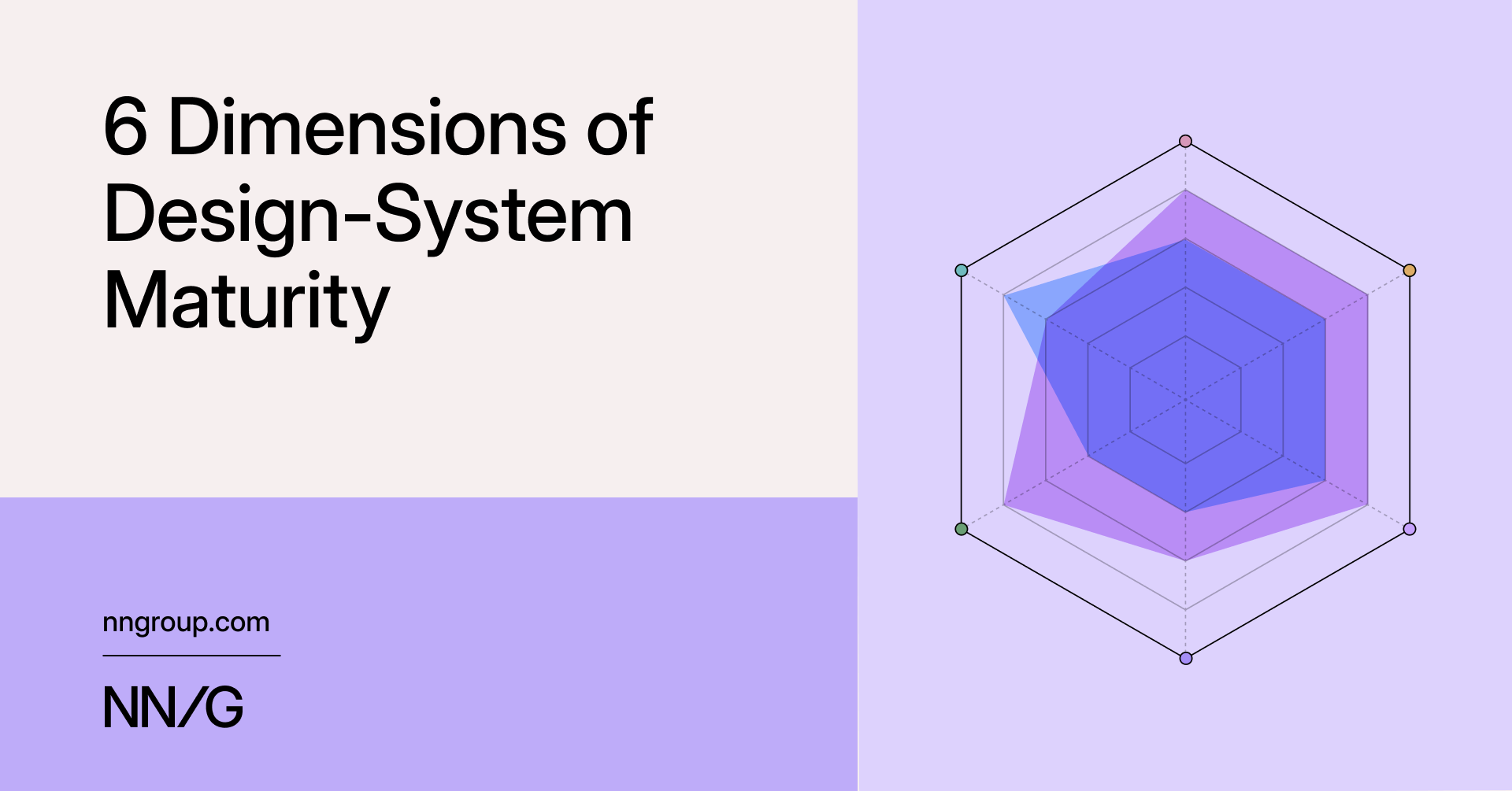
Because design-system work simultaneously spans UI design, software engineering, strategic management, operational workflows, and corporate politics, it cannot be measured on a single axis. True maturity is evaluated across six independent dimensions, which combine to form a multi-dimensional radar profile of system health.
                  [Organizational Alignment]
                           /
                          /
            [Adoption] --              -- [Team Effectiveness]
                 |                          |
                 |      RADAR PROFILE       |
                 |                          |
            [Support]  --              -- [Infrastructure Robustness]
                                    /
                                   /
                           [Governance]
1. Organizational Alignment
Of all the factors that dictate whether a design system survives long-term, organizational support is the most foundational. A system can endure incomplete documentation or informal governance for a sustained period, but it cannot survive an executive leadership team that decides the investment is no longer justifiable.
- Key Focus Areas: Executive sponsorship, budget stability, integration with company-wide strategic goals, and resilience through leadership turnover and corporate restructuring.
2. Team Effectiveness
A design system can only scale as far as the multidisciplinary team behind it. Even the most brilliantly architected component library will wither if its maintainers lack the appropriate mix of skill sets, adequate resourcing, or clear internal decision-making structures.
- Key Focus Areas: Staffing ratios, cross-functional skill diversity (design, engineering, content, tokens), psychological safety, and operational capacity under pressure.
3. Infrastructure Robustness
This is the most visible dimension of any design system—the tangible artifacts that product teams interact with on a daily basis. It evaluates the engineering quality, design fidelity, and architectural soundness of what is built, shipped, and maintained.
- Key Focus Areas: Component architectural integrity, token systems, accessibility compliance (WCAG standards), cross-platform compatibility, and automated testing suites.
4. Governance
Without a well-defined operating model, a shared design system quickly devolves from everyone’s priority into no one’s responsibility. Governance defines the rules of engagement: Who decides when a new component is added? Who reviews breaking changes? How do product teams request custom additions when the system falls short?
- Key Focus Areas: Contribution models, versioning policies, deprecation workflows, decision-making rights (RACI frameworks), and cross-team working groups.
5. Support
An impeccably architected component sitting in a repository is practically invisible if product designers and engineers do not know it exists, cannot find it, or do not understand how to implement it. This dimension evaluates the active, ongoing effort directed at making the system discoverable, approachable, and actionable.
- Key Focus Areas: Internal documentation clarity, office hours, dedicated communication channels (Slack/Teams support loops), onboarding programs, and educational resources.
6. Adoption
While usage metrics remain the most common shorthand for design-system success, raw utilization data fails to reveal whether teams genuinely trust the system, apply it correctly, or quietly build workarounds behind closed doors.
- Key Focus Areas: Breadth of usage across product squads, depth of integration into daily workflows, mitigation of local overrides, and qualitative trust in the system’s reliability.
Official Perspectives: Framework Assessment Methodology
To operationalize this multidimensional approach, organizations must move away from top-down auditing and embrace a collaborative, cross-functional assessment methodology.
Conducting the Maturity Assessment
Step 1: Assemble a Diverse Evaluator Panel
Select between 4 to 8 evaluators representing various vantage points within the product ecosystem. The panel should ideally include:
- Dedicated design-system maintainers (designers and engineers).
- End-users of the system (product designers and software engineers).
- Product managers relying on predictable delivery timelines.
- Engineering or design leadership providing strategic oversight.
Step 2: Score Independently Across the 6 Dimensions
Each evaluator independently scores the design system on all six dimensions using a standardized 1-to-5 scale:
| Score | Level | Definition |
|---|---|---|
| 1 | Absent | No intentional structure or ownership in place. Efforts are entirely ad hoc, relying on individual heroics. |
| 2 | Emerging | Early awareness or initial effort exists, but practices remain inconsistent, informal, and difficult to sustain. |
| 3 | Functional | A defined approach supports routine operational needs, but the system remains fragile under scaling pressure. |
| 4 | Strong | Practices are consistent, clearly owned, and reliably applied across teams with predictable outcomes. |
| 5 | Exceptional | The approach is deeply mature, continuously optimized via data-driven metrics, and resilient through enterprise changes. |
Step 3: Triangulate, Discuss, and Align
Bring evaluators together to compare notes. Focus initial discussions on areas of broad consensus, then dive deeply into points of divergence.
- Example: If a frontline software engineer rates Support as a
2while a design-system manager rates it as a4, this stark gap exposes a critical communication breakdown. It signals that while maintainers are producing resources, product squads are unaware of how to access or utilize them effectively.
Step 4: Plot and Analyze the Radar Profile
Translate the consensus scores onto a hexagonal radar chart, connecting the data points to form the team’s system profile. When analyzing the resulting shape, look for four key patterns:
- Shape Area: Represents general maturity, but must be contextualized by organizational scale. A smaller footprint is not inherently negative if the organization is young.
- Symmetry: Indicates balanced capability growth. A smaller, highly symmetrical shape is vastly more stable than a sprawling, highly uneven one.
- Valleys (Bottlenecks): A severe drop on a single dimension undermines overall performance. Always prioritize shoring up the weakest dimension first to relieve systemic pressure.
- Spikes (Outliers): High spikes often indicate uneven investment. For instance, a massive spike in Infrastructure Robustness paired with low Governance scores reveals a team heavily over-indexing on building UI assets while lacking the operational machinery to maintain them.
Step 5: Establish a Regular Cadence
A maturity profile is a snapshot in time, not a permanent diagnosis. Reassess the system on a quarterly basis, or immediately following significant inflection points—such as company reorganizations, major version releases, or budget reallocations.
Future Outlook: Alignment Over Assessment
Ultimately, the greatest value of conducting a multidimensional maturity assessment lies less in the numerical scores generated and more in the collaborative dialogue it forces among cross-functional teams.
When product designers, software engineers, and executive sponsors sit down to debate the health of their design system, they are engaging in a powerful exercise of shared ownership. By involving stakeholders in defining the system’s strengths and operational gaps, organizations leverage the psychological principles of co-creation (often mirrored in the IKEA effect): individuals who help build and evaluate a system are fundamentally more invested in its long-term success, far more likely to champion its adoption, and infinitely better equipped to protect it through organizational turbulence.
Looking forward, the organizations that win will be those that abandon the rigid pursuit of an idealized, linear maturity ladder. By embracing a flexible, multidimensional view of health, design-system leaders can build resilient infrastructures that do not merely grow larger with time—they remain coherent, adaptable, and genuinely indispensable as the enterprises they serve continue to evolve.