
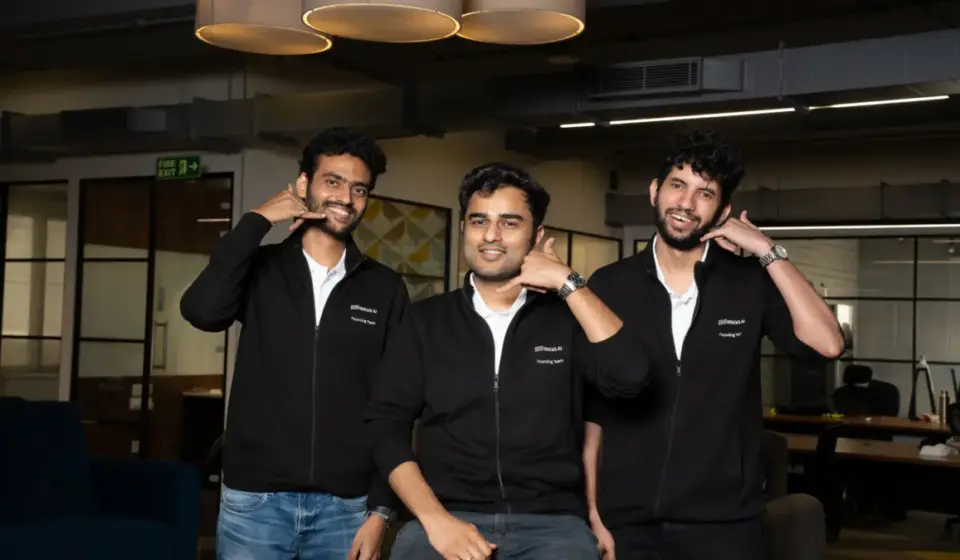
The Voice AI Gold Rush: How Ringg’s $15.5M Series A Highlights India’s Shift Toward Conversational Automation

Executive Overview
The landscape of customer engagement is undergoing a seismic, voice-driven transformation. According to a recent landmark study by Truecaller, more than 76% of consumers in India actively prefer verbal communication over digital text when interacting with businesses. This profound consumer preference highlights a massive, largely untapped market for automated support and outreach systems powered by generative voice artificial intelligence.
Capitalizing on this surging demand is Ringg, an emerging voice AI startup that has rapidly evolved from a niche text-to-speech experiment into a robust enterprise automation platform. Demonstrating immense investor confidence in this trajectory, Ringg has successfully secured an additional $10 million in an extension of its Series A funding round, led by prominent venture capital firm Peak XV Partners. This latest injection follows an initial $5.5 million raised earlier this year, bringing the startup’s total Series A capital raised to a formidable $15.5 million.
Currently processing an astonishing 20 million call attempts every month, Ringg is positioning itself at the intersection of enterprise efficiency and human-centric conversational design. As businesses across India, the Middle East, and the United States grapple with skyrocketing customer support costs and escalating demands for 2f-7 availability, the startup’s orchestration layer is proving to be a vital operational backbone. By shifting its strategic focus from high-volume, low-margin outbound calling toward complex, high-value enterprise workflows—such as clinical appointment management, abandoned-cart recovery, and stringent KYC onboarding—Ringg is redefining what automated voice agents can achieve in emerging markets and beyond.
Detailed Chronology: From DesiVocal to Enterprise Orchestrator
The story of Ringg is one of continuous technical iteration and strategic maturation. The enterprise did not begin as an omnichannel automation powerhouse; rather, its origins trace back to a text-to-speech (TTS) venture operating under the moniker DesiVocal.
The Early Days: Training Models and Facing Realities
In its initial iteration as DesiVocal, the founding team set out to build proprietary speech models tailored to the linguistic and cultural nuances of the Indian market. However, the economic realities of training and maintaining state-of-the-art foundational speech models quickly became apparent. The computational overhead and financial runway required to continuously train proprietary models proved excessively expensive for an early-stage startup.
Recognizing that competing purely on raw model development was a capital-intensive trap, the founders made a decisive pivot. Moving further up the software stack, they decided to leverage existing foundational models while building a sophisticated orchestration and application layer specifically designed to construct voice AI agents for large enterprises.
Securing Early Validation
This strategic pivot found immediate validation in the market. Indian fintech pioneer Cred stepped up as Ringg’s inaugural customer, testing the startup’s nascent capabilities in automated customer interactions. Buoyed by this early success, Ringg expanded its footprint across the elite tier of India’s technology ecosystem, onboarding household-name startups and enterprises including Flipkart, Practo, Groww, and PolicyBazaar.
Initially, the platform’s utility was defined by transactional, repetitive tasks. Co-founder Siddharth Tripathi noted that the company’s earliest deployments focused on high-volume, low-complexity use cases such as outbound lead qualification, basic reminders, and loan collection attempts. Yet, the leadership team quickly recognized a critical flaw in this business model.
"At the start, we were doing high-volume, low-complexity use cases like outbound calling, lead qualification, loan collection, and more," Tripathi explained in an interview with TechCrunch. "We quickly realized these are not sticky use cases, and so it’s always going to be a price game."
Moving Up the Value Chain
Determined to escape the race-to-the-bottom pricing pressures of basic outbound calling, Ringg pivoted its architectural and product roadmap toward complex, deeply integrated enterprise workflows. Instead of merely placing calls to remind customers of overdue bills, the startup began architecting conversational agents capable of executing multi-step business logic.
Today, Ringg’s voice agents manage sophisticated processes across diverse sectors. For instance, the platform operates across 1,200 clinics for the prominent healthcare aggregator Practo, autonomously helping patients navigate appointment bookings, rescheduling, and post-visit follow-up care instructions. In the e-commerce and fintech sectors, the startup has expanded into abandoned-cart recovery, merchant onboarding, and intricate know-your-customer (KYC) compliance checks.
Furthermore, while voice calls continue to anchor the vast majority of its business—accounting for over 70% of transactions—Ringg has strategically branched into multimodal communications. The company now seamlessly integrates chat, WhatsApp, and browser-based support requests for major global entities like Shell, cementing its transition from a voice-only tool to a comprehensive outcome-driven engagement platform.
Supporting Context & Metrics: The Mechanics of Modern Voice AI
To understand the economic and technical rationale behind Peak XV Partners’ investment in Ringg, one must examine the metrics driving India’s digital economy and the unique structural composition of the voice AI technology stack.
Market Demographics and the Power of Voice
India’s digital transformation has brought hundreds of millions of new users online over the past decade. For a significant portion of this population, text-based interfaces, complex mobile app menus, and written customer service portals present friction. Voice bridges this digital divide. Truecaller’s State of Business Calling report reveals that more than 76% of Indian consumers favor a direct phone conversation when resolving issues with businesses. This preference is deeply cultural and practical, rooted in accessibility, clarity, and the nuance of natural spoken language.
Operational Scale and Technology Architecture
Ringg’s current operational metrics underscore its rapid scaling:
- Monthly Volume: Over 20 million call attempts processed autonomously.
- Workforce Expansion: A lean, highly agile team of 40 employees, with more than 15 new hires onboarded in just the past three months.
- Geographic Reach: Primarily centered in India, with emerging footprints in the Middle East and the United States.
Technically, Ringg operates primarily as an orchestration layer rather than a pure foundational model maker. While the startup originally built its own speech recognition and generation models—and harbors long-term ambitions to own the full stack from infrastructure to deployment—running foundational models independently remains cost-prohibitive at scale.
Instead, Ringg’s architecture dynamically routes tasks to various third-party and proprietary models depending on the specific contextual demands of the use case. This modular approach ensures optimal latency, cost-efficiency, and linguistic accuracy, allowing the platform to maintain high fidelity across multiple regional languages and dialects.
Navigating the Enterprise Ecosystem
Rather than engaging in expensive, direct-to-consumer sales plays in Western markets like the United States, Ringg is executing a calculated channel strategy. The company is actively partnering with Global Capability Centers (GCCs)—the massive offshore operational and back-office hubs that multinational corporations maintain in India. By integrating its voice AI automation capacity alongside human support agents within these GCCs, Ringg can scale internationally by riding the coattails of established enterprise back-office infrastructure.
Official Statements & Industry Perspectives
The convergence of capital, technology, and market demand has turned the voice AI sector into one of the most fiercely contested battlegrounds in enterprise software. Leadership figures from both Ringg and its primary financial backers have offered critical insights into this dynamic.
Siddharth Tripathi, co-founder of Ringg, emphasized that the startup’s ultimate strategic objective transcends simple telephony or isolated voice scripts.
"We are trying to position ourselves as a platform for agents that bring outcomes or get things done rather than voice agents for enterprises," Tripathi noted.
This philosophy is echoed by Rishen Kapoor, principal at Peak XV Partners, who highlighted how Ringg’s technical origins differentiate it from competitors who merely wrap basic APIs around off-the-shelf language models. Because the founders spent years in a research lab building proprietary models, that foundational technical depth directly translates into the execution of complex workflows.
"Because of the technical capabilities, they can actually do these hard-won enterprise workflows end to end," Kapoor told TechCrunch. "They can complete these higher-value tasks like merchant onboarding, like L1 and L2 support, with quality and with consistency."
Future Outlook: The Competitive Landscape and the Road Ahead
As Ringg deploys its newly acquired $10 million Series A extension, it enters an increasingly crowded and well-capitalized ecosystem. The global and regional voice AI market is currently experiencing a massive influx of venture capital and technical innovation.
The Crowded Arena
The global model-making layer features heavily funded heavyweights such as Deepgram, ElevenLabs, and Cartesia, each pushing the boundaries of speech synthesis, latency reduction, and emotional inflection. Locally within India, foundational AI champions like Sarvam—which recently achieved unicorn status following a $234 million funding round led by HCLTech—alongside specialized startups like Smallest.ai, are building ultra-fast voice models optimized for Indian linguistic diversity.
Meanwhile, at the orchestration and application layers, a fierce race is underway. Startups like Bolna and Blue Machines are competing directly with Ringg in the orchestration space, while sector-specific players like Gnani and Arrowhead concentrate heavily on capturing the lucrative financial services and banking verticals.
Defensibility in the Application Layer
Industry analysts point out that the ultimate defensibility in this ecosystem does not reside solely with the underlying model makers. As foundational models become increasingly commoditized and accessible via APIs, long-term value and pricing power shift toward the companies that own the customer relationship and guarantee measurable business outcomes.
By targeting complex, mission-critical enterprise workflows—such as healthcare diagnostics coordination, comprehensive KYC verification, and intelligent merchant support—Ringg is actively building high switching costs into its platform.
The Path Forward for Ringg
To sustain its rapid growth, Ringg is aggressively scaling its talent pool. The startup is currently hiring for forward-deployed engineer roles—a specialized hybrid position combining deep technical engineering capabilities with product management acumen. Additionally, the company is actively recruiting specialized researchers dedicated entirely to optimizing model inference costs, ensuring that as transaction volumes scale past tens of millions of calls per month, operational margins continue to expand.
With $15.5 million in total Series A funding securely in the bank, a proven enterprise client roster, and a clear strategic vision anchored on driving tangible business outcomes, Ringg is well-equipped to navigate the complexities of the voice AI revolution. As consumer preference for conversational interaction solidifies across India and global markets, platforms that successfully bridge the gap between human nuance and machine efficiency will ultimately dictate the future of customer engagement.