The rapid evolution of generative artificial intelligence has fundamentally transformed digital marketing and design workflows. Today, organizations can produce polished, context-specific website imagery in seconds at a fraction of the cost traditionally required for commercial photography or licensed stock assets. Yet, this technological leap has been shadowed by a persistent corporate anxiety: Will consumers view AI-generated imagery as cheap, deceitful, or fundamentally inauthentic compared to real-world photography?
To answer this pressing empirical question, researchers recently conducted a controlled study to evaluate whether AI-generated images—when encountered by users without explicit provenance labeling—affect public perceptions of a company’s trustworthiness, professionalism, and authenticity.
The findings challenge conventional industry wisdom. Contrary to the prevailing fear that AI visuals invite an immediate reputational penalty, the study revealed that when users do not know an image is AI-generated, it performs just as well as—and in some metrics slightly better than—traditional stock photography.
However, this good news for design teams comes with critical nuances. The study highlights that audience reactions are deeply tethered to traditional visual design criteria, such as realistic human collaboration, cultural and gender representation, and psychological cues of inclusion. Furthermore, the research sounds a cautionary note: while unlabeled AI images hold their ground, the moment a user suspects an image is artificial, or if regulatory frameworks require explicit transparency labeling (such as the European Union’s expanding AI Act mandates), public trust can erode rapidly. Ultimately, the study concludes that design teams must treat AI-generated assets with the same rigorous scrutiny applied to traditional stock photography, balancing visual quality with ethical sourcing and inclusive design.
Detailed Chronology
Understanding how this investigation unfolded provides vital context for digital strategists and UX practitioners looking to integrate generative visual assets into their operational pipelines.
Phase 1: Experimental Design and Setup
The research methodology was meticulously engineered to isolate the variable of image origin while controlling for external confounding factors. Researchers recruited a representative sample of 77 participants drawn from the general U.S. adult population. These participants were tasked with evaluating six distinct versions of a homepage for a fictional consulting firm named "Momentum."
To maintain experimental integrity, the underlying webpage architecture—spanning the navigation bar, headline text, calls-to-action, statistical banners, service cards, client logos, and footers—remained entirely identical across all versions. The sole variant was the homepage "hero image" positioned prominently at the top of the fold.
Among the six evaluated pages, three utilized AI-generated imagery produced via ChatGPT Images 2.0, while the remaining three utilized high-quality real stock photography sourced from platforms like Unsplash+ and iStock. Critically, participants were never informed that the study involved artificial intelligence.
Phase 2: Evaluation and Data Gathering Protocol
Participants were exposed to each of the six webpage variations for a standardized duration of 10 seconds—mimicking typical user skimming behavior on the modern web. Following each viewing, respondents were asked to rate the fictional firm across three core brand dimensions:
Trustworthiness
Professionalism
Authenticity
To capture qualitative insights that quantitative scales might miss, participants were also prompted with an open-ended inquiry: "What other factors influenced your impression of this company?"
Phase 3: Quantitative and Qualitative Analysis
Upon completion of the trial views, the research team deployed a robust mixed-effects analysis. This statistical approach successfully accounted for individual variance across participants as well as intrinsic differences across specific image assets. Additionally, pairwise t-tests comparing ratings for individual images were executed, supported by a Bonferroni correction to strictly manage family-wise error rates during multiple comparisons. Meanwhile, the rich open-ended commentary was processed via systematic thematic analysis, unearthing the underlying psychological mechanics driving user trust.
Supporting Context & Metrics
The quantitative results of the study upend several foundational assumptions long held by digital marketing departments.
Breaking Down the Metrics
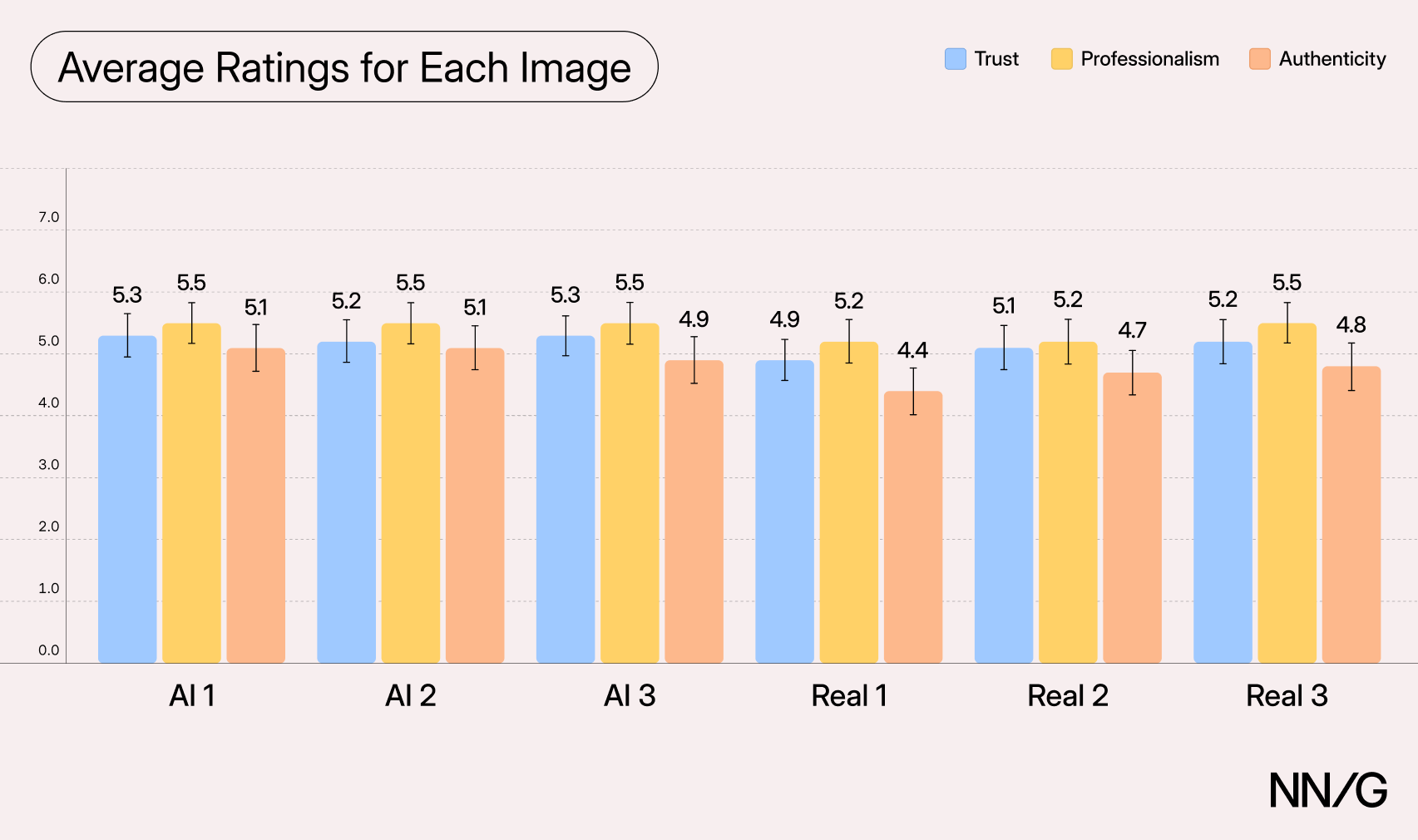
When comparing the aggregated scores across the two conditions, webpages featuring AI-generated images did not suffer any devaluation. In fact, ratings were marginally higher for pages featuring AI imagery across all three evaluated dimensions:
Trustworthiness and Professionalism: AI-generated images scored slightly higher by an estimated margin of approximately 0.2 points on a standard 7-point Likert scale.
Authenticity: AI-generated imagery achieved the widest performance gap, scoring higher by approximately 0.4 points on the 7-point scale, a difference that reached statistical significance.
Despite these minor advantages, researchers urge caution against overgeneralization. Because the overall performance differences were small and the study evaluated a limited set of six specific workplace images, the data does not support the absolute claim that AI images are categorically better than stock photography. Instead, the definitive takeaway is that AI-generated images do not operate at a baseline disadvantage.
The Power of Depicted Collaboration
The qualitative feedback harvested through open-ended responses revealed that user trust is rarely dictated by the technical provenance of a pixel, but rather by the narrative context the pixel conveys. Webpages utilizing both AI and real imagery consistently received glowing marks when the visual depicted active human collaboration, teamwork, and shared problem-solving.
For instance, reviewing AI Image 1, one participant remarked:
"I like that they are all working together and that makes me feel like this company values teamwork, and that to me is indicative of a company that is big and reputable."
Similarly, reacting to a real photograph (Real Image 2), another respondent noted:
"I think the biggest factor that influenced me was the image of the people meeting together and seeming to be in unison. As though they came to a resolution or made a plan, it made me feel at ease about the company, as though they could be trusted."
Conversely, poorly composed stock photography faced immediate backlash. Real Image 1—a traditional stock photo—elicited multiple negative critiques concerning corporate hierarchy, rigid body language, and a perceived lack of genuine diversity:
"The group does not seem to be diverse enough." "The individual leaning in doesn’t give me a collaborative feel." "The image felt like there was a leader and it made me less trusting of this page."
Official Statements & Industry Implications
The study’s insights open a wider window into modern inclusive design, AI transparency dilemmas, and the operational responsibilities facing enterprise web teams.
The Imperative of Inclusive Representation
A recurring theme throughout the thematic analysis was the heavy emphasis participants placed on cultural and gender representation. Users actively evaluated whether an organization’s visual assets reflected modern societal diversity. Several AI-generated images successfully prompted positive remarks regarding inclusion and well-balanced team dynamics.
Experts emphasize that this introduces a critical caveat for design systems: AI does not automatically produce inclusive imagery. Generative models must be prompted and curated with extreme care. Organizations cannot rely on algorithms to inherently safeguard inclusive design principles. Teams must audit AI outputs to evaluate who occupies leadership roles, how individuals are positioned physically within the frame, and whether the composition inadvertently reinforces historical stereotypes regarding race, gender, age, ability, or profession.
The Transparency Dilemma: When Suspicions Arise
While the study proved that unlabeled AI images perform admirably, the moment a user suspected artificial generation, sentiment shifted dramatically. A subset of participants correctly or incorrectly identified certain images as AI-generated in the open-ended feedback. Whenever these suspicions were voiced, the associated ratings for the company dropped sharply.
For example, scrutinizing Real Image 3 (a genuine photograph), a suspicious participant wrote:
"The image seems again like its fake/AI generated. The main blonde woman in the photo looks like she could be a real worker but her having the ‘spotlight’ in the image makes it all seem a bit fake."
This psychological phenomenon establishes a crucial boundary for corporate communications: Users react negatively when they suspect artificial intervention, regardless of how naturally polished the visual asset appears.
Future Outlook
As digital organizations look toward the horizon, the intersection of generative visual assets and regulatory compliance presents an increasingly complex landscape.
Navigating the Regulatory Landscape
The findings of this study must be evaluated against the backdrop of shifting global legislation. Regulatory bodies are moving swiftly to mandate artificial intelligence transparency. A prime example is the European Union’s AI Act, which includes rigorous requirements for identifying and conspicuously labeling AI-generated content.
This legislative trajectory intersects directly with cutting-edge academic research. Notably, organizational behavior research—such as landmark studies by scholars Oliver Schilke and Martin Reimann published in Organizational Behavior and Human Decision Processes—demonstrates the "transparency dilemma": consumers consistently exhibit diminished trust in individuals and corporate entities once the active use of artificial intelligence is explicitly disclosed.
Strategic Takeaways for Design Teams
For enterprise UX teams, marketing agencies, and corporate communications departments, these converging realities dictate a multi-step strategic framework before deploying generative imagery:
Evaluate on Classical Merits First: Treat AI-generated visual outputs with the same foundational design criteria applied to traditional photography. Assess composition, lighting, color harmony, and psychological resonance.
Audit for Inclusive Design: Do not assume generative tools inherently respect diversity. Deliberately check outputs for balanced representation, equitable power dynamics, and the absence of harmful stereotypes.
Scrutinize Sourcing and Ethics: Because image-generation models are routinely trained on vast datasets encompassing copyrighted photographs of real people, organizations must investigate the provenance of training data, commercial use indemnities, and tool licensing policies. An image may look pristine in an interface, but if its creation introduces copyright or consent liabilities, it remains unsuitable for enterprise deployment.
Prepare for Disclosure Realities: As legal mandates increasingly compel organizations to label AI-generated media, strategies must account for the psychological "trust penalty" documented when consumers knowingly engage with artificial content.
Conclusion
Ultimately, the empirical evidence demonstrates that the source of an image matters far less than whether the image effectively serves its intended communicative context—at least when users remain unaware of its artificial origin. Just as traditional stock photography has long required careful curation to avoid cliché and inauthenticity, AI-generated imagery must be embraced not as a reckless shortcut, but as a sophisticated design asset that demands rigorous editorial oversight, ethical mindfulness, and strategic foresight.