How Backstory Revolutionized Go-To-Market Account Tiering: Turning Months of Manual Analysis into a 20-Minute AI Workflow

Executive Overview
For decades, go-to-market (GTM) leaders have viewed account tiering analysis as a necessary evil. Traditionally a grueling, cross-functional ordeal, segmenting a customer base meant pulling data from BI, finance, product, and sales operations. It required weeks—often months—of painstaking data wrangling, spreadsheet consolidation, and subjective debate.
When the board at B2B tech company Backstory demanded a comprehensive tiering framework for their 141 strategic accounts with an aggressively short turnaround, Haya Kamola, Head of Customer Success, knew the old playbook would fail. In a previous professional life, a project of this scale would have mobilized five distinct teams for an entire quarter.
Instead, leveraging modern AI tooling, custom data connectors, and a structured, multi-step prompt methodology, Kamola accomplished the entire overhaul in just three to four days—with the final data processing run taking a mere 20 minutes.
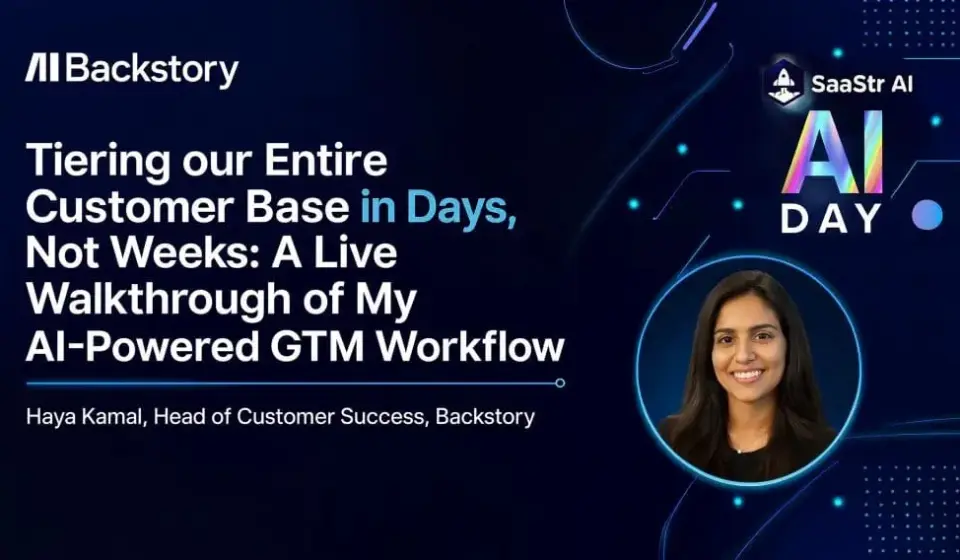
Live at SaaStr AI Day, Kamola detailed how her team bypassed traditional operational bottlenecks. By establishing qualitative definitions before mining quantitative data, automating hard-to-capture signals (such as internal AI maturity and tech-stack mix), and utilizing an iterative 4-stage AI workflow via Claude Cowork, Backstory successfully mapped out their entire customer base. The resulting framework did not just organize accounts into neat hierarchies; it fundamentally reshaped internal GTM operations, customer success allocations, and executive strategy.
This report investigates the methodology, technical architecture, strategic hurdles, and operational outcomes behind Backstory’s paradigm-shifting account tiering model.
Detailed Chronology: From Board Directive to Automated Execution
The project kicked off with a classic high-pressure executive mandate: evaluate 141 accounts, define the structural characteristics of top-tier customers, measure the entire current base against those metrics, and deliver an actionable tiering framework. To execute this with unprecedented speed, Kamola engineered a sequential, highly disciplined workflow that prioritized human strategic alignment alongside machine-learning execution.
Phase 1: Defining the "Golden Customer" Before Touching the Data
Kamola’s first critical strategic decision was refusing to let existing CRM fields dictate the parameters of success. In many organizations, customer scoring defaults to what is easy to measure—such as contract tenure or contract value (ACV).
Instead, Kamola convened account teams and senior leadership to perform a qualitative autopsy on their best customers. They asked a fundamental question: What makes a specific customer feel fundamentally different from everyone else, independent of how long they have been with us or how much they pay?
The consensus pointed to specific behavioral traits:
- Treating Backstory as a foundational core of their technical stack rather than a peripheral tool.
- Architecting internal systems around the platform.
- Engaging in long-term strategic planning (looking out five years) with Backstory at the center.
- Actively investing in product roadmaps, offering proactive feedback, and pushing the platform into novel, unmapped use cases.
Only after codifying this profile did Kamola allow the team to look at quantitative data, ensuring that the technology served a human-defined strategic vision rather than distorting it.
Phase 2: Generating Missing Signals via Automated Prompts
Once the ideal customer profile (ICP) was locked down, Kamola’s team identified a glaring operational gap: most of the data points that truly mattered simply did not exist in a structured, queryable format.
These signals fell into two categories:
- Internal Customer Metrics: Go-to-market process maturity, underlying tech-stack composition, enterprise AI maturity, and partner-motion integration.
- Relationship Dynamics: Deployment velocity (how fast they expanded from a small pilot into enterprise-wide usage), executive visibility (whether C-suite leaders were using Backstory insights for macro decisions), and remaining account white space.
Rather than forcing account executives (AEs) and customer success managers (CSMs) to manually audit 141 accounts—a grueling process prone to human error and cognitive fatigue—Backstory built automated signal generators.
For AI maturity, for instance, they moved away from manual tiering spreadsheets and instead deployed a systematic prompt that cross-referenced CRM history, public announcements (such as AI-forward product launches and venture investments), and chronological interaction records extracted from emails, calendar invites, and Slack logs. The resulting output categorized each account into a five-level AI maturity framework complete with qualitative reasoning. A parallel process was run to clean up outdated pre-sales scorecards and map current tech stacks from unstructured conversational data.
Phase 3: Bypassing Cross-Functional Silos with Four Connectors
In traditional enterprises, collecting TAM, health scores, revenue numbers, renewal dates, delivery risks, and feature requests requires scheduling dozens of meetings across product, data science, finance, and support.
Kamola eliminated this overhead entirely by implementing four targeted data connectors. Crucially, this included leveraging internal Slack dialogues. While most enterprises ignore internal team chat logs, Kamola recognized that an account team’s internal Slack threads represent the earliest, most candid, and unfiltered read on a customer’s true sentiment and friction points—insights that rarely make it into formal CRM notes.
The sole manual prerequisite in the entire workflow was exporting a clean CSV from Salesforce containing baseline account attributes: account name, executive engagement level, predicted account health, the AI maturity score, upcoming renewal dates, and renewal ACV.
Phase 4: Sequencing the Workflow in Claude Cowork
To ensure the AI synthesized the data logically rather than hallucinating connections, Kamola utilized Claude Cowork, executing the analysis as a strict, multi-step sequence rather than a single, monolithic prompt.
The execution order mattered deeply:
- Ingestion & Normalization: Standardizing the CSV to ensure account identifiers matched flawlessly across disparate sources.
- Conversation History Analysis: Treating interaction logs as the primary source of truth regarding recent engagement, emerging risks, and unexploited opportunities.
- Utilization Tracking: Assessing active platform consumption metrics.
- Growth Potential Modeling: Combining Salesforce revenue metrics with public market research to assess the total addressable market (TAM) within the account. Because Backstory prices its software per seat based on go-to-market headcount, the size of a client’s GTM organization served as the ultimate TAM indicator; the delta between that and current active seats defined the white space.
- Jira & Feature Gap Integration: Evaluating product requests and engineering tickets.
- Reconciliation & Final Scoring: Synthesizing all variables into a unified model.
A complete run took roughly 20 minutes of processing time.
Supporting Context, Metrics & Lessons Learned
Iteration and Overcoming Counter-Intuitive Data
Kamola was candid about the fact that her live demo was the product of three or four rigorous rounds of iteration. Initially starting with roughly eight distinct signals, the team realized that too many variables created signal contradiction, muddying the executive narrative. They ultimately narrowed the focus to four core scoring buckets: Growth Potential, AI Maturity/Velocity, Engagement Quality, and Account Health.
The most profound realization during these iterative cycles centered on feature requests. In the first version of the scoring model, the AI treated a high volume of feature requests as a negative indicator, docking points for health and engagement under the assumption that a demanding customer is an unhappy customer.
When cross-referenced against actual retention and expansion data, the exact opposite proved true. Backstory’s highest-adopting customers correlated strongly with high feature-request volume. Deep platform adoption paired with a continuous stream of ambitious, AI-forward feature demands was actually the definitive hallmark of a hyper-engaged champion.
Kamola noted that in a traditional hand-built scoring model, an error of this magnitude would have survived indefinitely because human teams rarely possess the bandwidth to audit scoring assumptions across an entire customer base simultaneously.
The Power of Tier D
The output of the AI framework divided the 141 accounts into four distinct operational tiers (A through D). While most organizations celebrate their Tier A accounts and quietly ignore the rest, Kamola emphasized that the true strategic value of the project emerged from confronting the bottom tier.
The data forced leadership to look past anecdotal optimism and objectively decide whether Tier D accounts possessed genuine growth trajectories or if they represented operational drag. Backstory plans to rerun the tiering analysis on a strict quarterly cadence to track account migration between tiers and dynamically adjust operational definitions.
Official Impact & Operational Shifts
The implementation of the AI-driven tiering framework immediately transformed day-to-day go-to-market operations at Backstory:
- Targeted Resource Allocation: Customer success and account management teams re-allocated their time, matching high-touch interventions to accounts with verified white space and strategic alignment rather than spreading resources evenly across the board.
- Proactive Risk Mitigation: Early identification of engagement drops within mid-tier accounts allowed teams to intervene months before an impending renewal cycle.
- Product-Led Alignment: Engineering and product teams began prioritizing feature requests vetted by the data model, directly tying product development back to high-value account behaviors.
While the current framework strictly addresses existing customers—relying as it does on deep utilization metrics, historical conversation data, and historical product engagement—Backstory is actively exploring the development of a pre-sales tiering variant utilizing forward-looking inputs.
Future Outlook
Backstory’s success with automated account tiering signals a broader, inevitable shift in modern go-to-market strategy. As artificial intelligence tooling evolves from simple chat interfaces to agentic, multi-step workflow engines like Claude Cowork, the days of sacrificing strategic quarters to manual data collection are coming to an end.
By establishing clear qualitative guardrails, automating unstructured conversational data via connectors, and maintaining a healthy skepticism that requires rigorous iterative validation, GTM leaders can transform operational planning from a painful, episodic chore into a fluid, quarterly optimization loop. For Backstory, what once took five teams ninety days now takes one leader twenty minutes—proving that the future of enterprise operations belongs to those who successfully combine human strategic vision with autonomous execution.