The landscape of mobile software engineering is undergoing a tectonic shift, driven by rapid advancements in Large Language Models (LLMs) and autonomous coding agents. When Android Bench was first unveiled to the development community in March, it filled a critical void: a specialized, real-world evaluation benchmark tailored explicitly to the complex demands of Android development. Designed to cut through generalized claims of AI superiority, Android Bench set out to measure how models handle practical, day-to-day hurdles like Jetpack Compose migrations, wearable networking configurations, and intricate platform API updates.
Now, following continuous iterative improvements that introduced open-weight evaluations and cost-efficiency dimensions, the platform is taking its most significant evolutionary leap yet. The July Release of Android Bench marks a foundational upgrade to its evaluation architecture by migrating to the industry-standard Harbor framework. This transition brings a modernized benchmarking agent and a standardized infrastructure, offering unparalleled transparency and replicability for developers and AI researchers alike.
Alongside this structural overhaul, the July update expands the leaderboard with eight powerful new models, including the latest heavyweights from Anthropic, Google, Zhipu, Moonshot, and Alibaba. Furthermore, in a nod to its growing ecosystem, Android Bench is officially opening its doors to community-driven task contributions, allowing developers worldwide to shape the very datasets used to test the industry’s top AI assistants.
This comprehensive report explores the motivations behind the Harbor framework integration, analyzes the performance metrics of the newly minted leaderboard, highlights the shifting dynamics between proprietary and open-weight models, and outlines the roadmap for community collaboration.
Detailed Chronology: The Evolution of Android Bench
To understand the significance of the July release, one must examine the trajectory of Android Bench since its inception.
Phase 1: The Genesis (March Launch)
When Google and the Android developer ecosystem introduced Android Bench in March, the goal was deceptively simple yet technically demanding: establish transparency around LLM capabilities specifically within Android ecosystems. Prior to this, general-purpose benchmarks such as SWE-bench provided broad measures of software engineering prowess, but they often failed to capture the nuances of mobile development—such as asynchronous UI rendering states, Gradle dependency management, XML-to-Compose layout translations, and strict memory management constraints on resource-limited mobile hardware.
Using a customized adaptation of the general-purpose mini-swe-agent v1, the initial release established a crucial baseline. It allowed developers to sift through marketing hype and evaluate which models could actually generate compiling, functional Android code without hallucinating deprecated APIs.
Phase 2: Iterative Refinement and Open-Weight Expansion
Recognizing that capability alone does not dictate real-world utility, the Android Bench team quickly expanded the evaluation criteria. In the months following the launch, the leaderboard integrated metrics assessing cost and efficiency dimensions, acknowledging that an AI assistant that costs prohibitively much to run or takes too long to generate a solution is impractical for daily enterprise workflows.
Simultaneously, the team expanded its scope to evaluate open-weight models, democratizing access to performance insights for developers and organizations that prioritize data privacy, local execution, or cost-control over proprietary API dependency.
Phase 3: The July Release and the Harbor Framework Standard
As AI architectures advanced at a breakneck pace, the evaluation framework itself required modernization. General-purpose agents like early iterations of mini-swe-agent faced limitations in handling complex, multi-file mobile repositories with strict build environments.
In the July release, the project abandoned older custom harness iterations in favor of the Harbor framework. Harbor provides a robust, standardized set of definitions and integrations that streamline how benchmarks are executed. By adopting Harbor, Android Bench ensures that its testing harness is not only more rigorous and reliable, but also entirely portable. Researchers and enterprise engineering teams can now run the exact same benchmark configurations locally or within their own CI/CD pipelines, verifying results with absolute confidence.
Supporting Context & Metrics: Analyzing the July Leaderboard
The integration of the Harbor framework necessitated a complete re-evaluation of all models in the repository to establish an updated, highly accurate baseline. While this systemic recalculation introduced minor shifts in historical scoring—accessible via the official archive—it has provided a crystal-clear snapshot of the current AI hierarchy in mobile development.
The New Contenders
The July update infuses the leaderboard with eight sophisticated models:
Claude Fable 5 (Anthropic)
Claude Sonnet 5 (Anthropic)
Claude Opus 4.8 (Anthropic)
GLM 5.2 (Zhipu AI)
Kimi K2.7 Code (Moonshot AI)
MiniMax M3 (MiniMax)
Qwen 3.7 Plus (Alibaba Cloud)
Qwen 3.7 Max (Alibaba Cloud)
Proprietary Model Dominance and Surprises
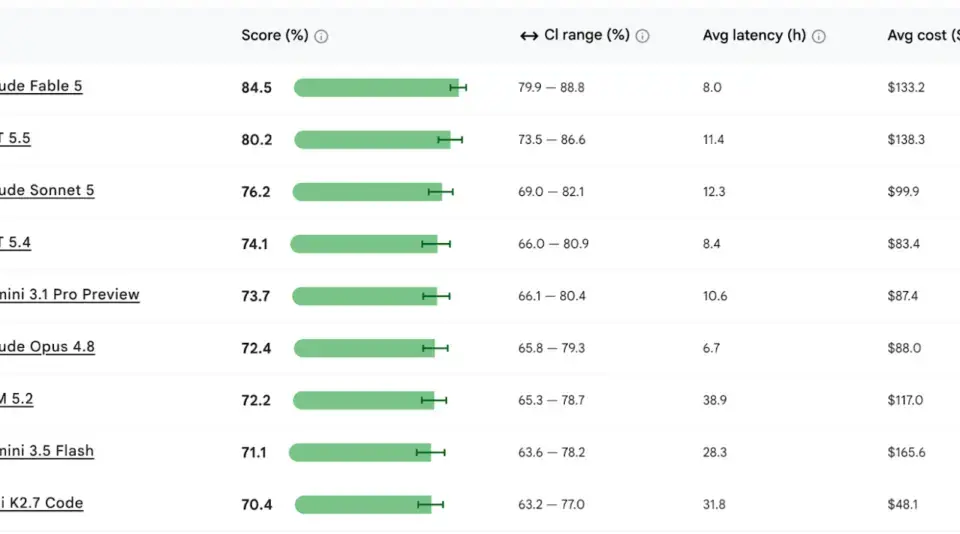
At the very pinnacle of the updated leaderboard sits Anthropic’s Claude Fable 5, capturing the #1 spot with an impressive score of 84.5. Claude Fable 5 demonstrates an exceptional grasp of contextual architecture, particularly when navigating deep dependency trees and asynchronous Kotlin coroutine implementations.
Hot on its heels is GPT 5.5, holding strong in second place with a score of 80.2, proving that OpenAI remains a fierce competitor in multi-file code refactoring and algorithmic problem-solving within the Android Studio environment.
Securing the third position is Claude Sonnet 5, posting a robust score of 76.2. Sonnet 5 continues Anthropic’s legacy of balancing high execution speed with structural code elegance, making it an appealing option for developers seeking rapid code completions without sacrificing type safety or architectural integrity.
The Rise of Open-Weight Models
While proprietary models continue to set the ceiling for performance, the open-weight category has closed the gap remarkably. When isolating open-weight models on the leaderboard, GLM 5.2 emerges as the clear frontrunner with a score of 72.2. Close behind is Kimi K2.7 Code, securing a commendable score of 70.4.
These scores signify a watershed moment for open-weight architectures. Achieving scores above 70 on a rigorous, domain-specific benchmark like Android Bench indicates that open models are no longer just viable alternatives for hobbyists—they are fully capable enterprise-grade tools that can handle sophisticated UI migrations (such as shifting legacy View hierarchies to Jetpack Compose) and modern wearable networking protocols.
Evaluating Beyond Raw Scores: Efficiency and Cost
A high score on Android Bench is only half the equation. The leaderboard’s continued emphasis on efficiency and cost metrics allows engineering leads to perform cost-benefit analyses. For instance, while a proprietary flagship model may edge out an open-weight competitor by a few percentage points in capability, the token-generation cost and latency profile of models like GLM 5.2 or Qwen variants may offer superior ROI for high-volume, automated CI/CD code generation pipelines.
Official Statements and Architectural Insights
The shift to the Harbor framework is more than a technical upgrade; it represents a philosophical alignment with the broader open-source AI benchmarking community.
In detailing the rationale behind the transition, the Android Bench engineering team emphasized the necessity of standardization:
"When we designed Android Bench, we anchored our methodology on leading industry standards available at the time. To continue providing you with state-of-the-art evaluations that accurately measure the latest model capabilities on Android development, we are standardizing our benchmark to the Harbor framework. Harbor defines standards and integrations that make it easy for anyone to run the benchmark, evaluate their preferred set-up, or share results — providing you with additional transparency and visibility."
This commitment to transparency addresses a longstanding industry critique: opaque benchmarks that cannot be independently audited or replicated by third parties. By leveraging Harbor, the Android Bench infrastructure ensures that every test case—whether evaluating wearable Bluetooth Low Energy (BLE) synchronization or Jetpack Navigation component updates—is executed within a controlled, immutable environment.
Furthermore, the team highlighted the pedagogical and practical value of these evaluations for everyday developers:
"We want to ensure Android Bench is helpful for you, so we will continuously update it as our evaluations and the industry mature. You can check out model performance and efficiency metrics on the updated leaderboard to see how these new and previous models navigate Android-specific challenges."
Opening Android Bench to Community Contributions
Perhaps the most transformative aspect of the July release is the decentralization of benchmark curation. From its inception, Android Bench maintained an open-source ethos, hosting its original methodology and test harness publicly on GitHub. However, listening closely to developer feedback regarding dataset limitations, the project is taking community involvement to the next level.
Starting today, Android developer community members can actively contribute to Android Bench. Developers can submit custom tasks, real-world bug fixes, architectural refactoring challenges, and performance optimization scenarios encountered in their own production codebases.
How the Contribution Pipeline Works:
Task Creation: Developers author specific Android development challenges complete with reproduction scripts, test suites, and expected outputs mirroring real-world engineering friction points.
Review and Assessment: The core maintainer team rigorously reviews submitted tasks, assessing their difficulty, uniqueness, and relevance to the global Android ecosystem before integrating them into future benchmark iterations.
By crowdsourcing tasks from engineers working across diverse domains—from fintech apps handling rigorous encryption to high-performance gaming companion utilities—Android Bench ensures its evaluation suite does not suffer from academic stagnation or overfitting to synthetic test cases.
Future Outlook: The Road Ahead for AI-Driven Mobile Development
As agentic development workflows transition from experimental novelties to core engineering pillars, maintaining a cutting-edge evaluation framework is paramount. The velocity of AI advancement means that today’s state-of-the-art model will inevitably be surpassed within months.
By anchoring Android Bench to the Harbor framework, the project has future-proofed its evaluation pipeline. The ability to seamlessly swap benchmarking agents, standardize execution environments, and rapidly ingest newly released proprietary and open-weight models ensures that developers will always have an authoritative compass to guide their AI tool adoption.
Key Takeaways for Android Engineers:
Audit Your Tools: Review the updated Android Bench leaderboard to assess whether your current AI assistant (whether Claude Fable 5, GPT 5.5, or an open-weight champion like GLM 5.2) aligns with your project’s performance and cost requirements.
Leverage the Ecosystem: Utilize the Harbor framework integrations to run local benchmarks tailored to your team’s specific architectural patterns.
Get Involved: Take advantage of the new community contribution channels. Submit your toughest architectural bottlenecks to the GitHub repository to help train and test the next generation of coding agents.
The future of mobile development is collaborative, autonomous, and increasingly intelligent. With its comprehensive July release, Android Bench has solidified its status as the definitive standard for measuring AI capability in the mobile sphere—empowering developers to build better, faster, and more reliable applications than ever before.
To explore the updated leaderboard, review the detailed methodology, or access the archive of historical scores, visit the official Android Bench portal.