

Scaling the Backbone of Modern Retail: Navigating the Complexities of E-Commerce Fulfillment, 3PL Integration, and Omnichannel Growth

Executive Overview
As digital commerce matures past its explosive pandemic-era expansion, online retailers face a sophisticated new bottleneck: fulfillment operations. While scaling from 200 daily orders to 2,000 represents a monumental milestone for any growing business, it invariably exposes structural fractures in inventory management, warehousing, and reverse logistics. Methods that comfortably sustain a boutique storefront frequently collapse under the weight of high-volume seasonal spikes and multi-channel synchronization demands.
Recent industry data underscores the immediate revenue stakes. Research from Baymard Institute reveals that fulfillment-related friction is a primary catalyst for cart abandonment: 40% of shoppers abandon carts due to unexpected extra costs like shipping fees, 20% cite unacceptably slow delivery windows, and 13% reject restrictive returns policies. Simultaneously, modern consumer expectations continue to tighten. Capital One Shopping research indicates that while 90% of online shoppers will wait up to three days for free shipping, over 95% prioritize zero-shipping costs over accelerated delivery speeds.
For growing merchants operating on platforms like WooCommerce, identifying the warning signs of a maxed-out fulfillment system—ranging from manual daily inventory tracking to chronic overselling—is no longer merely an operational housekeeping chore. It is an urgent existential imperative. This report provides an exhaustive, investigative breakdown of how modern e-commerce brands must evaluate internal process enhancements, third-party logistics (3PL) outsourcing, hybrid fulfillment models, and advanced technological tooling to future-proof their supply chains.
Detailed Chronology: The Evolution of Fulfillment Bottlenecks
Phase 1: The Small-Batch Illusion (0 to 200 Orders)
In the nascent stages of an e-commerce enterprise, fulfillment is inherently forgiving. Founders and small teams can manually manage inventory on shelves, print single labels from desktop printers, and pack boxes on a back-room table. Errors are easily caught, customer inquiries are handled personally, and capital is preserved by avoiding third-party overhead. However, this phase breeds a false sense of security. Because processes are informal, they rely heavily on tribal knowledge rather than standardized systems.
Phase 2: The Tipping Point (200 to 2,000 Orders)
As order volume approaches the critical threshold of 2,000 units per day, tribal knowledge shatters. This is the chronological tipping point where internal processes outgrow human bandwidth. The warning signs manifest predictably:
- Metrics Micro-Management: Management spends hours every day cross-referencing spreadsheets and physically counting stock because automated syncing fails.
- The Multi-Channel Multiplier: Expanding to secondary sales channels (such as marketplaces or social commerce) accelerates structural flaws. Without real-time, bi-directional inventory syncing across all channels, brands face catastrophic overselling events and stockouts during promotional peaks.
- Returns Paralysis: With industry-wide return rates hovering near 19.3% according to National Retail Federation and Happy Returns data, reverse logistics transform from a minor customer service task into an overwhelming warehouse bottleneck.
Phase 3: Strategic Re-Architecture (The Crossroads)
When operational capacity—not just operational process—becomes the primary constraint, merchants face a definitive fork in the road. They must choose between overhauling internal systems, migrating workloads to a 3PL provider, or executing a tailored hybrid model.

Supporting Context & Metrics: The Financial and Operational Landscape
Understanding the true total cost of ownership (TCO) requires analyzing hard data from recent e-commerce benchmarks. Fulfillment is not merely a line-item expense; it is a complex web of variable costs that shifts dynamically as a business evolves.
The Consumer Psychology of Shipping and Speed
Merchants often misallocate capital in an attempt to offer lightning-fast delivery, misinterpreting consumer demands. Capital One Shopping’s March 2026 research highlights a vital consumer preference: 90% of online shoppers will wait up to three days for free shipping, and over 95% prefer free shipping over accelerated, paid delivery.
Consequently, warehouse proximity is less about breaking speed records and more about preserving profit margins by keeping shipping zones optimized for free-delivery models. If a merchant’s primary customer base is concentrated on the West Coast, anchoring inventory exclusively in an East Coast 3PL warehouse guarantees inflated shipping costs and extended transit times.
The Rising Tide of Reverse Logistics
The financial impact of returns cannot be overstated. According to the 2025 Retail Returns Landscape report published by the National Retail Federation and Happy Returns, online returns reached an average of 19.3%, dwarfing the overall retail average of 15.8%.
When nearly one in five orders circles back to the warehouse, an inefficient returns pipeline acts as a financial drain. Hidden costs accumulate rapidly through:
- Extended holding times for uninspected inventory.
- Labor-intensive manual grading and restocking.
- Uninformed customer support teams unable to answer real-time refund status queries.
Hidden TCO Pitfalls in 3PL Contracts
When businesses transition to third-party logistics, they frequently underestimate ancillary fees. Beyond base storage and pick-and-pack charges, total cost of ownership is driven up by:
- Value-Added Services (VAS): Custom product inserts, subscription box assembly, fragile item bubble-wrapping, and branded packaging materials.
- Seasonal Surge Fees: Peak-season storage premiums and overflow inventory surcharges levied during Q4.
- Integration and Setup Fees: Costs associated with connecting Enterprise Resource Planning (ERP), Warehouse Management Systems (WMS), and e-commerce platforms like WooCommerce.
Official Industry Approaches & Strategic Models
When businesses recognize the structural limits of their fulfillment operations, they generally deploy one of three distinct strategic pathways.

1. Internal Process Optimization (The In-House Upgrade)
For companies whose volume is sustainable but whose internal workflows are chaotic, outsourcing is unnecessary and potentially counterproductive. By introducing disciplined warehouse management techniques, internal teams can match the efficiency of a 3PL while retaining total control over the brand experience.
- Standardized Bin Locations: Assigning every SKU to a specific, barcoded warehouse location eliminates wandering pickers.
- Barcode Scanning: Replacing manual reading with digital scanners drastically reduces picking errors.
- Digital Pick Lists and Real-Time Syncing: Ensuring warehouse floor tablets update automatically the moment an order is placed on WooCommerce.
2. Full Outsourcing to Third-Party Logistics (3PL)
Outsourcing becomes imperative when physical space, labor availability, or geographic distance prevents internal scaling. Ideal candidates struggle with massive seasonal spikes or maintain customer bases far from their current operational hubs.
Before signing with a 3PL, merchants must audit their own operational profile. Documenting daily order averages, peak volumes, SKU variants, fragile or high-value items, return percentages, and connected software ecosystems enables brands to separate warehouse operators from true logistics partners.
Expert Tip: Modern business leaders can leverage artificial intelligence to formulate precise vetting questions. Running a prompt such as:
"Here’s my operation: [X] average daily orders, peaking at [Y]. [Z] SKUs, including [variants/bundles/fragile/high-value/expiring]. Selling through [channels]. Top shipping regions: [regions]. Returns run about [%]. Systems that need fulfillment data: [ERP/WMS/analytics/support]. Write me the questions I should ask a 3PL before signing, and tell me which parts of this profile will cost me the most."
…can instantly generate rigorous, customized RFQ questionnaires.
3. The Hybrid Fulfillment Model
The vast majority of fast-growing e-commerce brands ultimately adopt a hybrid approach, blending in-house agility with external scale. Under this model, a merchant might retain management of fragile, high-value, or specialty custom items in-house, while offloading standard, high-velocity SKUs to a nationwide 3PL network.
The hybrid model shines when one specific segment of a business outgrows current capabilities before the rest. For instance, a brand may transition its direct-to-consumer national shipping to a 3PL while keeping local delivery, wholesale distribution, and special custom orders tethered to its own warehouse staff.
Future Outlook: Technological Integration and the Modern E-Commerce Stack
As distributed and regional fulfillment networks become the industry standard—driven by surging carrier costs and consumer delivery expectations, as highlighted in Digital Commerce 360’s 2026 trends analysis—software infrastructure is just as critical as physical warehouse square footage.
Real-time data synchronization between the e-commerce storefront (such as WooCommerce) and the fulfillment apparatus is non-negotiable. Orders must flow seamlessly downstream, while tracking numbers, inventory adjustments, and return statuses must update upstream instantly.
Essential Tech Stack Components for Scaled Fulfillment
To bridge the gap between complex operations and transparent customer communication, merchants rely on specialized, deeply integrated extensions:
- For High-Volume Label Printing: Tools like ShipStation empower merchants processing hundreds of orders daily to generate USPS, UPS, DHL, and FedEx labels directly from their dashboard. By consolidating multiple sales channels and carriers into a single interface, it eliminates administrative lag for cross-platform sellers.
- For In-House Warehouse Management: Scanventory replaces outdated manual logging with QR code scanning and bin location tracking, serving as an indispensable asset for operations managing over 100 SKUs.
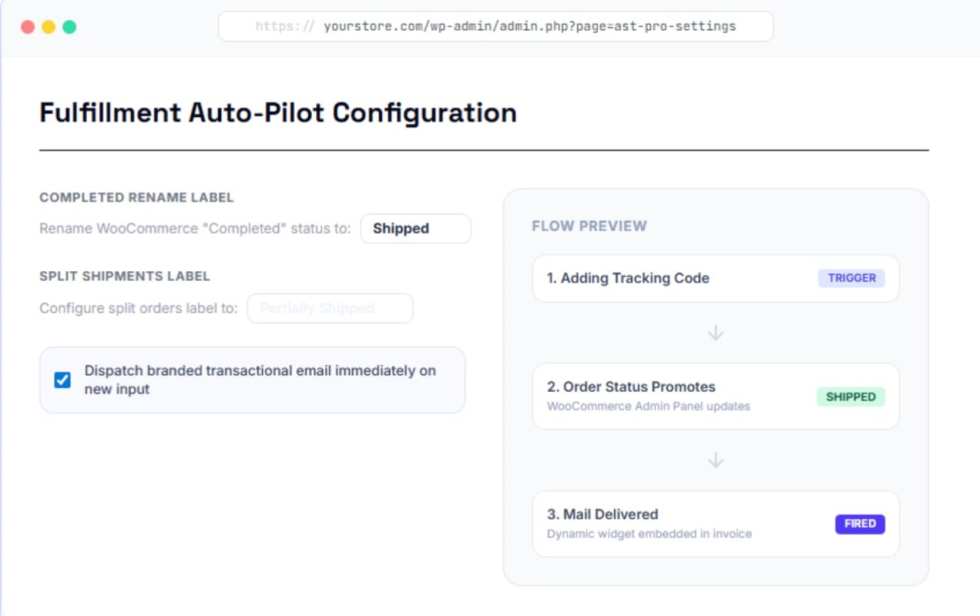
- For Outsourced Tracking Visibility: When utilizing 3PLs, Advanced Shipment Tracking Pro ensures that WooCommerce remains continuously updated with real-time tracking data, slashing customer support ticket volumes and granting buyers instant visibility into shipment milestones.
Conclusion: The Path Forward
Overcoming fulfillment bottlenecks requires a rigorous, data-driven audit of where capital is bleeding and where processes are breaking down. Whether the solution lies in internal barcode adoption, a fully integrated 3PL partnership, or a nuanced hybrid model, software alone cannot solve a structural logistics crisis. Sustainable e-commerce growth demands that clean, real-time data flows uninterrupted from the warehouse floor directly to the decision-makers shaping the brand’s future.